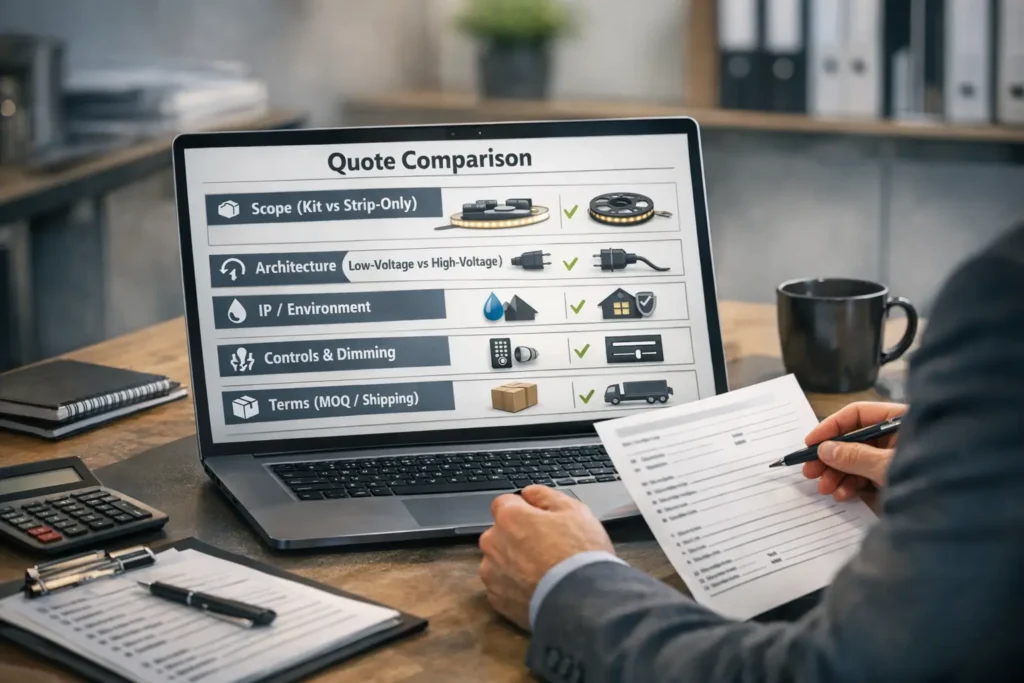
For LED strip importers, the lowest unit price is only one part of the buying choice. However, a cheap quote can cost more later if the strip voltage is wrong, the IP rating does not fit the use area, or the pack is not right for resale.
Also, many problems start before the first order. For example, a buyer may ask for a “bright waterproof strip” but not give the wattage, length, color, use area, or pack needs. As a result, each supplier may quote a different product.
Therefore, this guide is for importers, wholesalers, distributors, project buyers, and buying teams that source LED strip lights from suppliers. It is not a buyer list. Instead, it helps you compare suppliers, build a clear RFQ, and decide whether a standard wholesale strip or a custom review is the better next step.
Quick Answer: First, LED strip importers should check product fit, specs, docs, sample needs, pack needs, clear replies, and order terms. Then, before asking for a quote, share the use case, voltage, wattage, CCT or color, CRI need, IP rating, length, quantity, control method, pack needs, target market, and any docs you need to review.
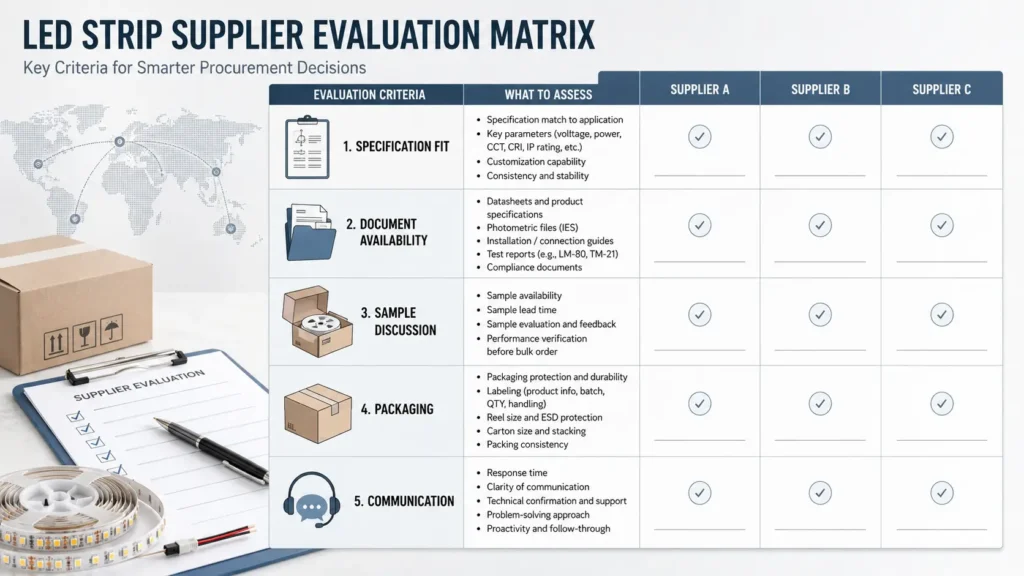
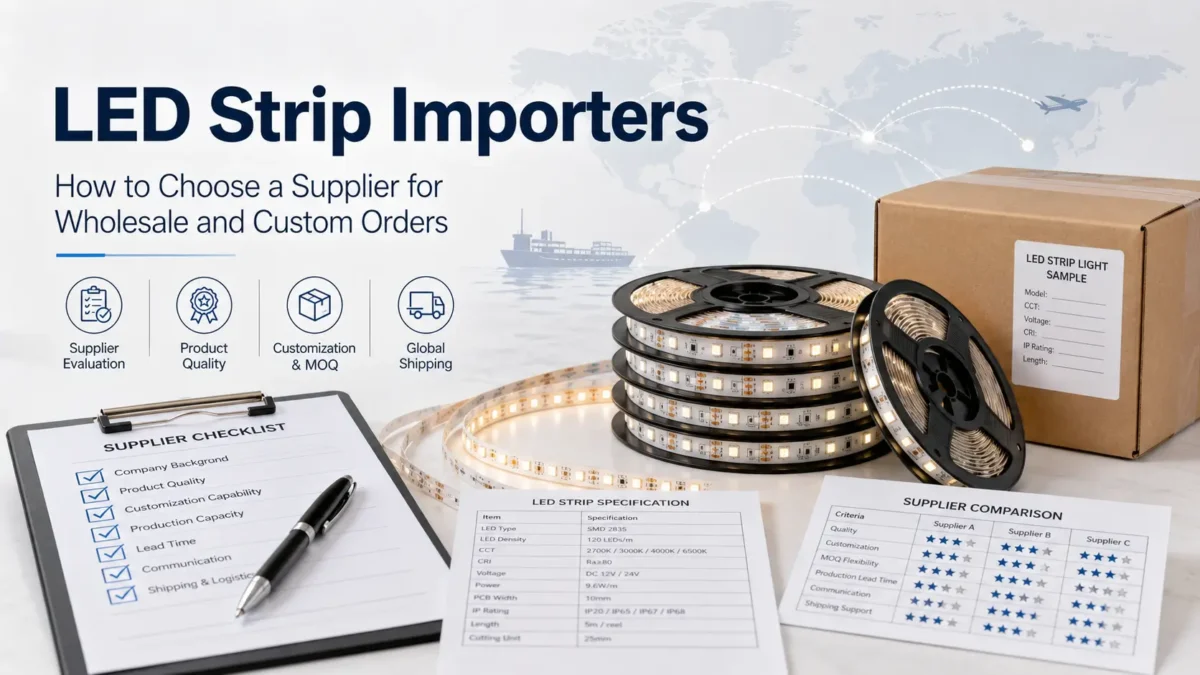
First, price matters. However, it should not be the only reason to choose a supplier. A useful supplier check looks at product fit, clear spec answers, document readiness, sample discussion, pack needs, and how well the quote matches your real order.
In addition, use the same check list for every supplier. As a result, you can compare the same order needs instead of comparing mixed product offers.
| Check Area | What to Check | Why It Matters | What to Ask |
|---|---|---|---|
| Product fit | Strip type, voltage, wattage, CCT/color, CRI, IP rating, length, and control method | Because similar-looking strips may work in different ways. | “Which strip fits this use and site?” |
| Use review | Indoor or outdoor use, moisture, dust, mount surface, run length, and dimming needs | Because the real site affects the right product path. | “What use details do you need before quoting?” |
| Docs | Spec sheet, test report, certificate, or market docs for the exact product | Also, importers may need docs before buying or reselling. | “What docs are ready for this product and market?” |
| Samples | Sample plan before a bulk or custom order | For example, samples can help check look, color, adhesive, connector, waterproofing, and pack style. | “Should we review samples before a larger order?” |
| Packing | Neutral pack, private label, SKU, carton label, barcode, and resale pack | In addition, packing affects storage, sale, and market display. | “What pack details should we send before quote?” |
| Clear replies | Fast, clear answers about specs, quote scope, and order assumptions | Therefore, clear replies reduce wrong quotes and missed details. | “Can you confirm the specs used in the quote?” |
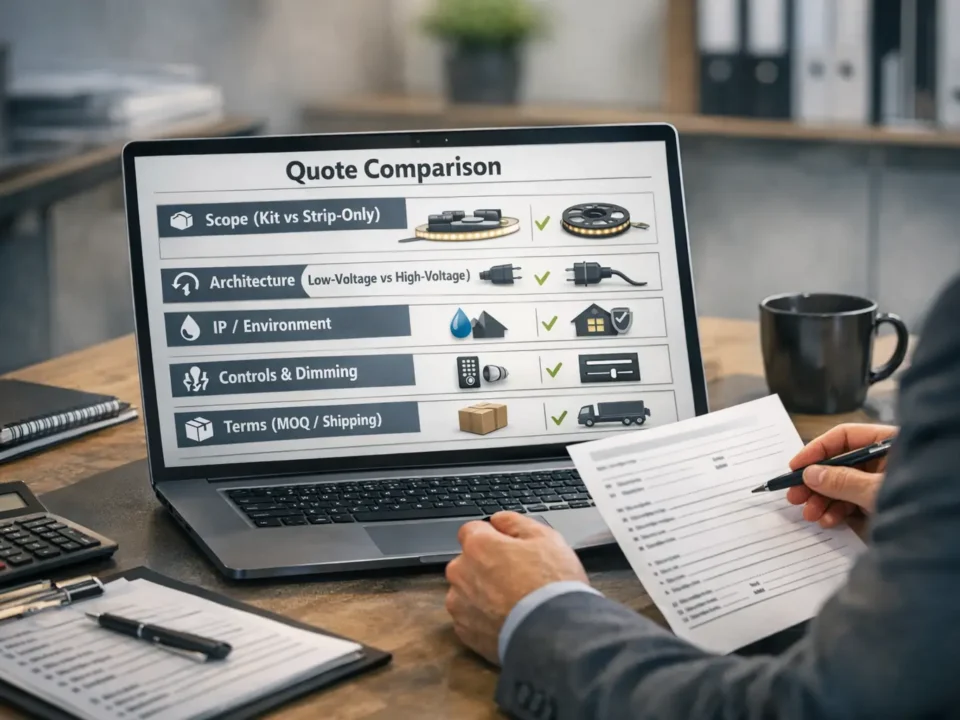
Therefore, compare each supplier with the same RFQ. If one supplier quotes a basic indoor strip and another quotes a higher IP-rated strip with special packing, the prices do not mean the same thing.
Also, review the supplier’s product range before you send the RFQ. For ELSTARLED, buyers can start with the LED strip product category and then send project details for review. For more sourcing background, you can also read the LED strip sourcing guide.
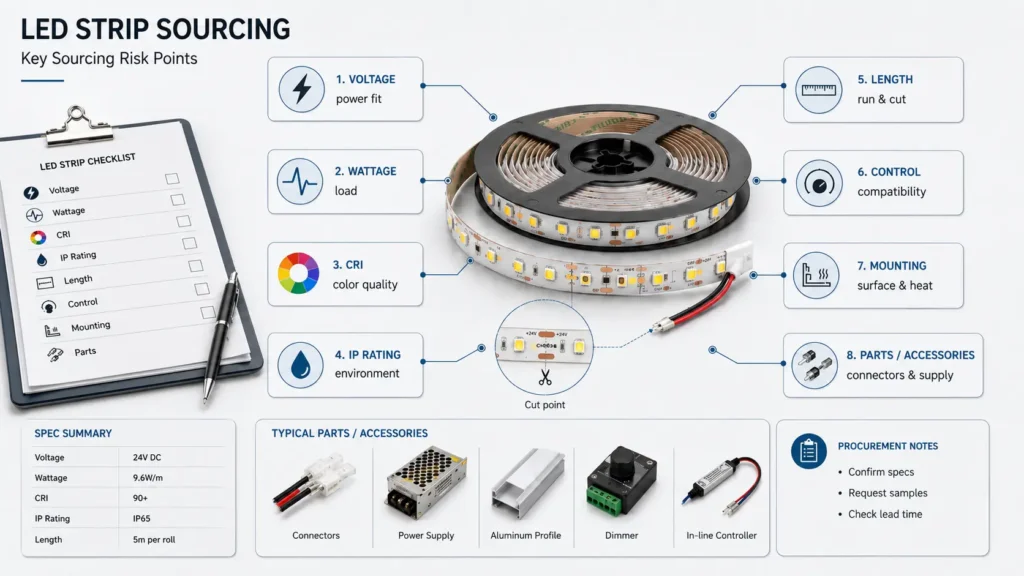
First, LED strips can look alike in photos. However, small spec changes can change the result. So, confirm the key items before you compare quotes, ask for samples, or place a bulk order.
For example, a dry cabinet strip has different needs from a strip used near water or dust. Likewise, a retail display may need a more careful color and light quality review than a simple accent light.
| Spec | What to Confirm | Why It Matters for Import Orders |
|---|---|---|
| Voltage | Required voltage or power plan | Because the strip must match the driver and install plan. |
| Wattage | Power per meter or per unit | Also, wattage affects driver choice and heat planning. |
| CCT / color | Warm white, neutral white, cool white, RGB, RGBW, or other color | As a result, the light effect and resale position are clearer. |
| CRI | Color rendering need for the job | For example, CRI matters for retail, display, task, and color-sensitive use. See general DOE color guidance. |
| IP rating | Protection level for dry, damp, dusty, or outdoor use | Therefore, IP rating should match the exposure level. |
| Length and cut points | Roll length, cut interval, and connection plan | Because length affects install layout and stock planning. |
| Dimming / control | Driver, controller, RGB control, or smart control needs | Also, control needs affect strips, drivers, and parts. |
| Mounting and parts | Surface, adhesive, aluminum profile, connectors, and power supplies | In addition, missing parts can delay install or resale. |
Also, describe the real use area instead of only asking for “waterproof LED strip” or “bright LED strip.” In short, clear use details help the supplier point you to a better product path.
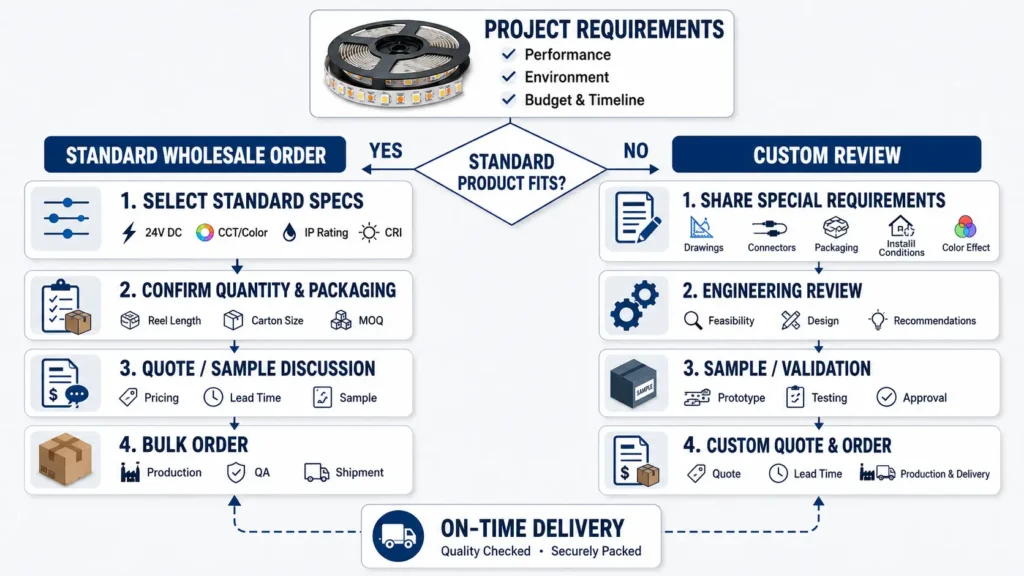
Not every order needs a custom strip. In many cases, a standard wholesale product may fit the use. However, custom review may help when the length, connector, label, pack, color effect, or install limits are not standard.
| Sourcing Path | When It May Fit | What to Prepare |
|---|---|---|
| Standard wholesale order | When common strip types, standard color options, standard voltage, and regular roll length fit the need. | Therefore, prepare strip type, voltage, CCT/color, IP rating, quantity, pack needs, and target market. |
| Custom LED strip review | When you need special length, connector, label, pack, color effect, or site setup. | Also, prepare drawings, photos, use details, target specs, samples if ready, and label or pack needs. See ELSTARLED’s customization page for the review path. |
| Project-based sourcing | When the strip is for a lighting project, OEM product, display, cabinet, sign, or building detail. | For example, prepare use details, mount method, run length, control system, schedule needs, and docs. |
| Distributor or resale sourcing | When you need repeat-sale products for your own channels. | In addition, prepare SKU plan, pack style, label needs, expected quantity range, and target market. |
Therefore, choose the path based on what is different about your order. If your needs are common, start with standard product options. If your order has special size, pack, label, or use needs, ask what details are needed for review.
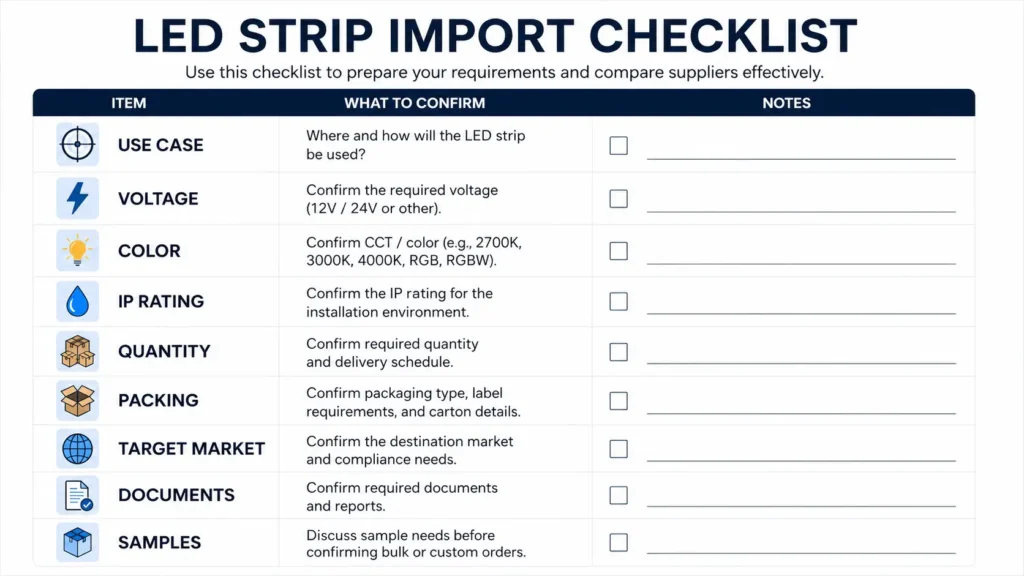
First, a clear RFQ helps the buyer and supplier speak about the same product. As a result, quotes are easier to compare and less likely to miss key details.
Before you ask for a quote, prepare these details:
| RFQ Item | Details to Provide |
|---|---|
| Use case | For example, cabinet, sign, retail display, furniture, outdoor decor, OEM product, or other use. |
| Use area | Also, state indoor, damp, dusty, outdoor, enclosed, high-touch, or heat-sensitive use. |
| LED strip type | Single-color, tunable white, RGB, RGBW, COB, high-density, waterproof, or another type if known. |
| Voltage and wattage | Required voltage, power plan, wattage per meter, or reference product if ready. |
| CCT/color and CRI | Therefore, state warm white, neutral white, cool white, RGB, RGBW, target CCT, and CRI need. |
| IP rating | State the needed protection level based on exposure. |
| Length and quantity | Also, include roll length, total meters, cut length, order quantity, or yearly demand if useful. |
| Control and parts | For example, list dimming, controller, sensor, driver, power supply, connector, profile, and mounting needs. |
| Packing | State neutral pack, private label, distributor pack, carton label, barcode, or SKU needs. |
| Target market and docs | In addition, state the country or region and the docs you need to review. |
| Samples | Finally, note whether you want samples before a bulk or custom order. |
However, a clear RFQ does not promise a set price, lead time, or approval result. Instead, it helps both sides work from the same facts.
For importers, docs can matter as much as samples. Still, document needs depend on the exact product, use, sales channel, and target market. So, ask what is ready for the exact LED strip you plan to buy.
Useful questions include:
In addition, ask where each document applies and where it does not. This section is not legal or compliance advice. Instead, it is a prompt to ask the supplier and your own market team what is needed. For general lighting testing context, you can review UL’s lighting industry page. If you want to review ELSTARLED’s page-stated process checks, see the production page.
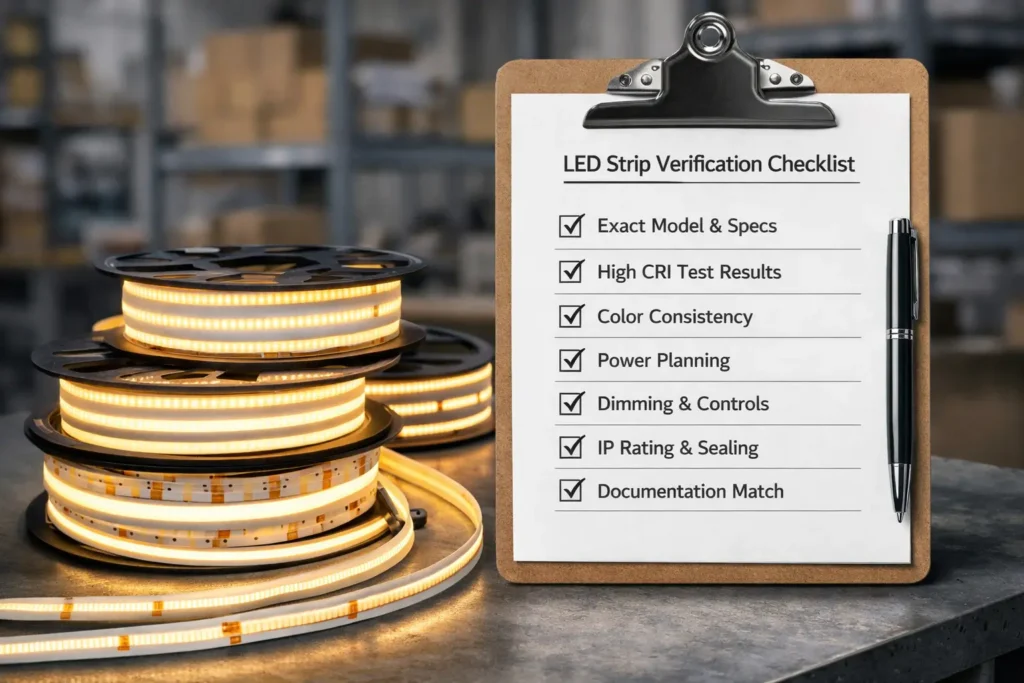
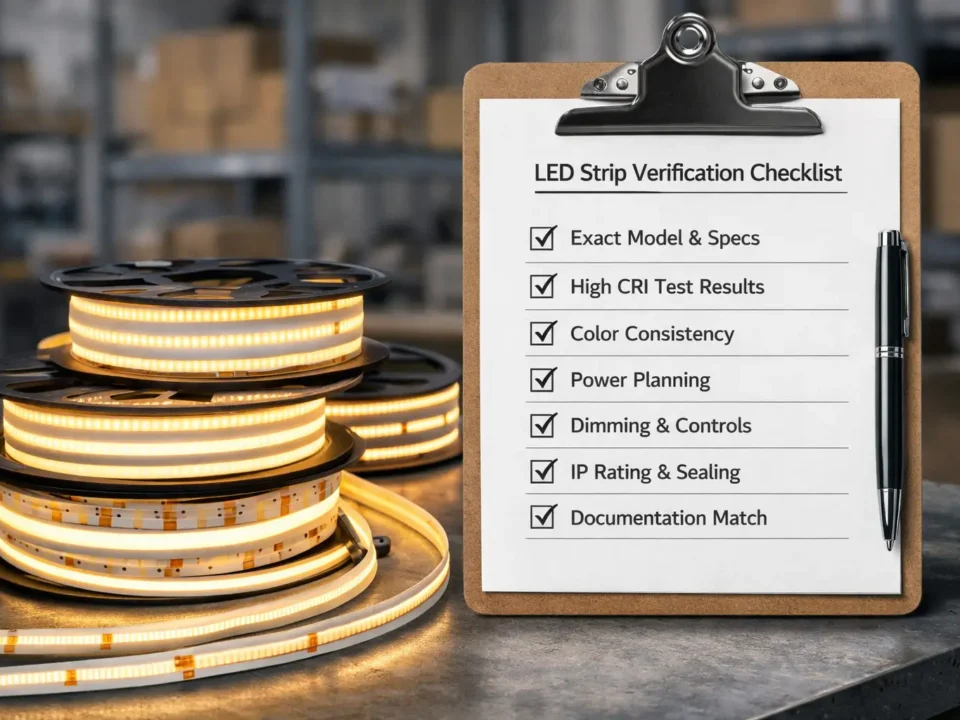
Many order problems start with missing details. Therefore, check the points below before you place a bulk or custom order.
Contact ELSTARLED when you are ready to compare LED strip options, prepare a wholesale RFQ, or ask whether a standard or custom LED strip option may fit your project.
To make the review easier, send:
As a result, the team can review the inquiry without relying on vague product names. Also, a complete RFQ makes it easier to discuss standard or custom LED strip options.
CTA: Send your LED strip specs, use details, quantity, pack needs, and target market to ELSTARLED for review. The more complete your RFQ is, the easier it is to discuss product options for wholesale or custom LED strip sourcing.
First, check product fit, spec clarity, docs, sample needs, pack needs, clear replies, and order terms. Also, compare price only after each supplier quotes the same needs.
First, include the use case, use area, strip type, voltage, wattage, CCT/color, CRI need, IP rating, length, quantity, control method, parts, pack needs, target market, docs, and sample needs.
Key specs include voltage, wattage, CCT or color, CRI, IP rating, run length, cut points, control method, mount conditions, and parts. However, the most important specs depend on the use area.
Yes. For example, samples can help check look, color, adhesive, waterproofing, connector type, pack style, and fit. However, buyers should still confirm final order specs in writing.
Ask what spec sheets, test reports, certificates or market docs, pack labels, and install notes are ready for the exact product and target market. Also, ask where each document applies and where it does not apply.
First, compare suppliers by spec support, use review, document readiness, sample discussion, pack options, clear replies, and RFQ quality. Then, compare quotes only when each supplier is quoting the same needs.
Choose custom review when standard strips do not match your length, connector, pack, label, color effect, mount condition, or project design. Otherwise, standard wholesale options may be enough for common resale orders.

 English
  Spanish
  French
  Arabic