
Choosing the best LED lighting company is not only about a famous brand or the lowest price. Instead, the right supplier should fit your project, product type, documents, quantity, and buying process.
For example, a company that fits a home smart-light project may not fit a warehouse, retail chain, signage job, or OEM lighting build. A large brand may offer a wide product range. However, a focused supplier may give better support for custom sizes, LED strips, profiles, packaging, or project review.
Therefore, compare LED lighting companies by project fit first. Then, review product range, quality checks, support, documents, and RFQ readiness before you shortlist suppliers.
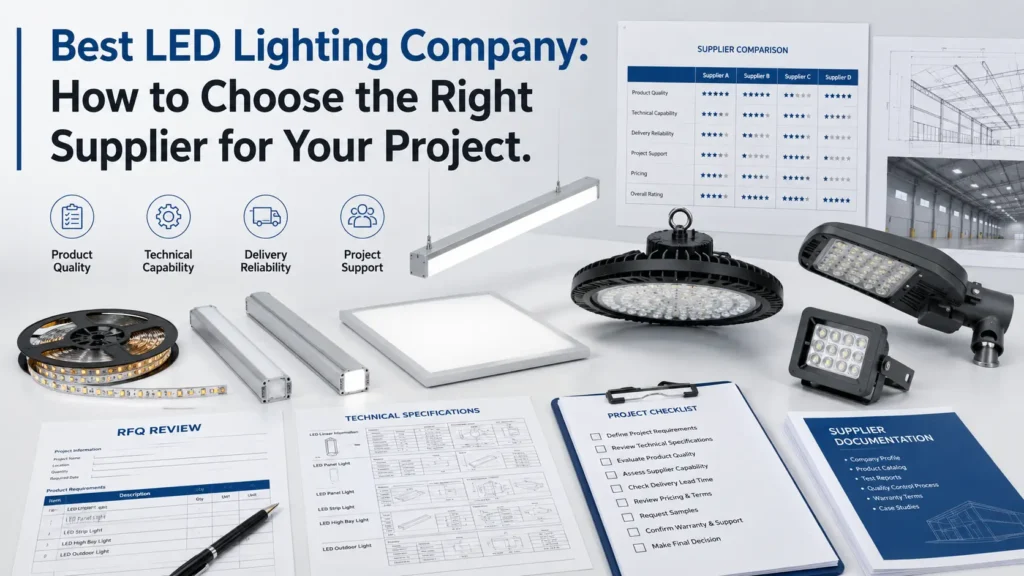
Source: i5design
The best LED lighting company depends on your project. For B2B buyers, the right supplier should match the application, product type, technical needs, documents, quantity, destination, and response process.
As a result, do not choose only by brand popularity. Instead, compare suppliers by application fit, product range, quality checks, support, and quote readiness.
A useful supplier comparison should go beyond a list of brand names. First, write down the project needs. Next, check whether each company can support those needs with the right products, clear data, and fast communication.
Start with the basics. A supplier should understand the project, confirm the product type, and explain what can be supplied. Also, the supplier should be clear about limits, documents, samples, and lead time.
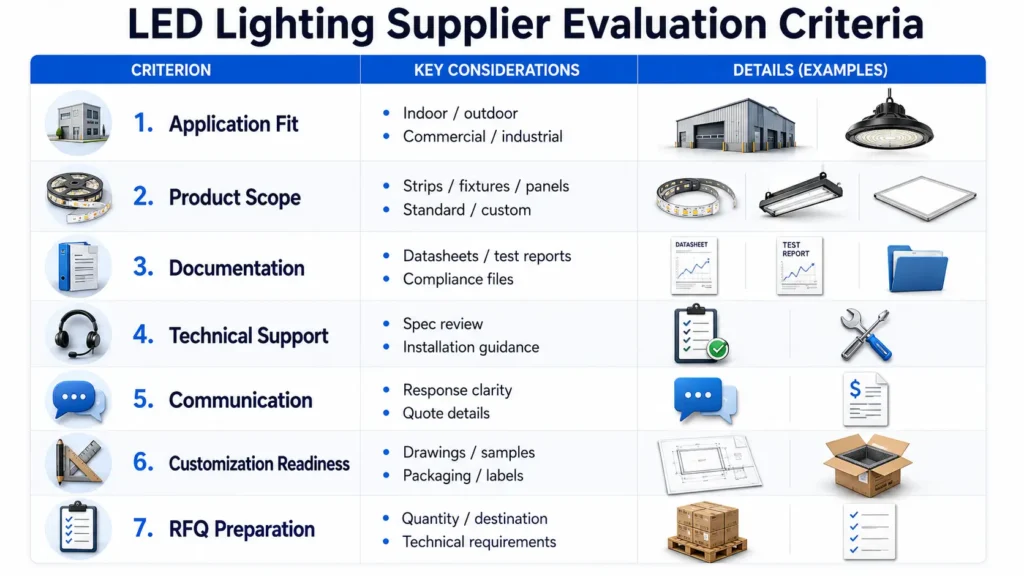
| Criteria | What to Check | Why It Matters | Evidence to Request |
|---|---|---|---|
| Application fit | Indoor, outdoor, commercial, industrial, retail, signage, or custom use | A product that works in one place may not fit another site | Product category, use examples, specification sheet |
| Product scope | LED strips, fixtures, panels, high bays, flood lights, or custom assemblies | A broad supplier and a focused supplier solve different problems | Catalog, product list, model range |
| Technical details | Voltage, wattage, lumens, CCT, CRI, beam angle, dimming, IP rating, and mounting | A mismatch can cause poor light, install issues, or control problems | Datasheet, test report, sample check |
| Documents | Safety, test, listing, or market documents when needed | Some projects need documents before approval or purchase | Documents for the exact model and market |
| Communication | Clear replies, drawing review, scope notes, and quote details | Poor replies increase buying risk | Written scope and assumptions |
| Customization fit | Size, housing, LED layout, optics, wiring, label, or packaging | Custom projects need more checks before ordering | Drawings, sample plan, approval steps |
| RFQ readiness | Quantity, destination, packaging, documents, and timeline | A clear RFQ helps the supplier quote better | Inquiry form or project brief |
A supplier does not need to be the largest company to be the best fit. However, it should explain what fits, what needs review, and what documents are available. In addition, it should ask clear questions if your inquiry is missing key details.
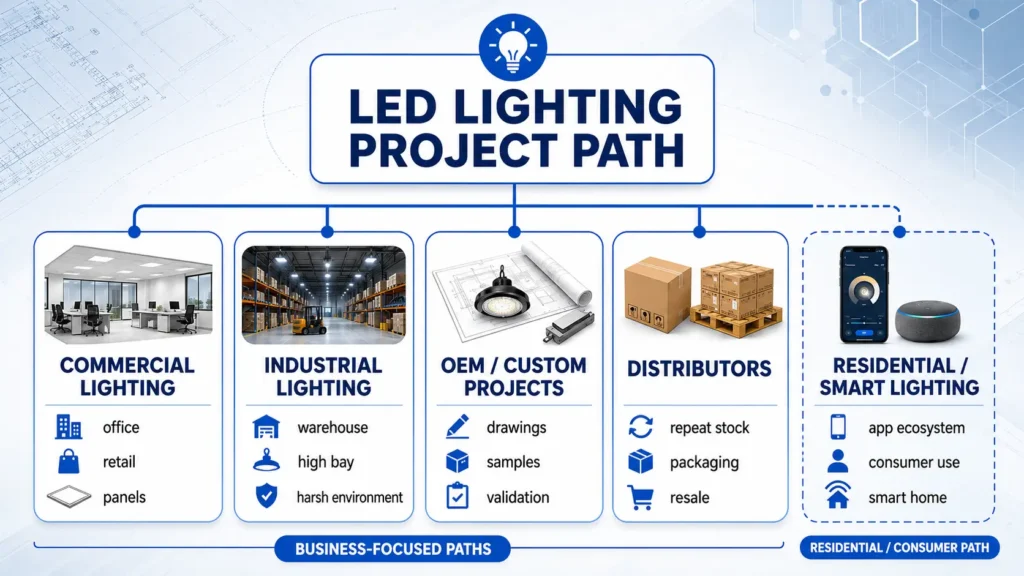
“Best” changes by project type. For instance, a retail chain, factory, warehouse, distributor, and OEM buyer may all need different supplier support.
Before comparing brands, define the job. Then, match the supplier type to that job. This simple step helps you avoid buying from a supplier that looks strong but does not fit the project.
| Project Type | Supplier Type to Consider | Key Checks | Risk if Ignored |
|---|---|---|---|
| Commercial building or retail project | Commercial lighting supplier or maker | Product range, controls, mounting, documents, and stable supply | Products may not fit approval or install needs |
| Industrial or warehouse project | Supplier familiar with tough site conditions | Brightness, mounting height, heat, controls, and site conditions | Lighting may not perform well on site |
| Architectural or design-led project | Brand or maker with finish and option support | Look, color match, optics, dimming, and custom lengths | The result may not match the design intent |
| LED strip or linear lighting project | LED strip and profile supplier | Voltage, density, color quality, heat, profiles, and accessories | Heat, voltage drop, or install problems |
| OEM or custom project | Custom-capable manufacturer | Drawings, samples, checks, packaging, and repeatability | Production may not match the design |
| Distributor sourcing | Supplier with steady product and clear terms | Range, packaging, documents, and repeat-order support | Harder resale or uneven supply |
| Residential smart lighting | Consumer brand or smart-light system supplier | App support, smart system, and warranty channel | A B2B supplier may not be the best fit |
A universal ranking is less useful than a project-fit review. The best LED lighting company for one buyer may be the wrong
Technical needs should guide supplier selection early. Otherwise, quotes become hard to compare.
Start with the application environment and lighting goal. Then, review electrical, mechanical, control, and document needs. This gives each supplier a clear basis for review.
A product specification alone does not guarantee a good result. The site condition, install method, and control system can change what the buyer should request.
For example, a higher brightness target may require better heat design, mounting, power supply selection, and glare control. Also, a decorative linear project may depend more on color match, diffuser choice, profile fit, and install detail than on wattage alone.
When buyers ask for “high-quality LED lights,” they often mean several things at once. They may want good materials, stable output, clear specs, safe install, steady batches, and documents for project approval.
Before choosing a supplier, ask which documents apply to the product and target market. The answer may change by product type, use case, and country. For commercial product listings, buyers can review the DesignLights Consortium Qualified Products Lists. For safety context, UL Solutions provides lighting standards information, including common standards such as UL 1598 and UL 8750, on its lighting standards and certification page.
| Document or Evidence Type | When It May Be Relevant | What It May Support | What Still Needs Confirmation |
|---|---|---|---|
| Product datasheet | Almost every B2B lighting inquiry | Basic specs and model comparison | Whether the product fits the real project |
| Test report | Technical or performance-sensitive projects | Reported electrical, optical, or environmental results | Scope, sample model, test method, and date |
| Safety or compliance document | Regulated or approval-sensitive markets | Product safety or market access review | Exact standard, model scope, and issuer |
| Installation guide | Projects with mounting or wiring complexity | Install planning and risk reduction | Site conditions and installer needs |
| Control compatibility note | Dimming or control-system projects | System planning | Exact dimmer or controller fit |
| Sample or prototype review | Custom or OEM projects | Fit, look, and function before a larger order | Approval rules and revision scope |
| Packaging or labeling details | Distributor or repeat-purchase projects | Resale, logistics, and stock planning | Final packaging needs |
Evidence boundary: Do not rely only on broad claims such as “best,” “certified,” or “premium quality.” Instead, ask which documents apply to the exact product, model, and market. If a document matters for approval, request it before final supplier selection.
Different supplier types can work well in different situations. Therefore, choose the supplier type based on your project, not only brand size.
| Supplier Type | Strengths | Limits | When to Consider |
|---|---|---|---|
| Global brand | Strong name, wide distribution, known product lines | May offer less flexibility for small custom requests | Large commercial projects or brand-sensitive specs |
| Specialized LED supplier | Focused product knowledge and category depth | May cover a narrower product range | LED strips, profiles, linear lighting, signage, or niche uses |
| OEM/custom manufacturer | Can review drawings, samples, labels, packaging, or private-label needs | Needs clearer specs and sample checks | Custom products, repeat orders, or project-specific designs |
| Distributor/reseller | Local stock, several brands, and easier small purchases | May have less control over production or custom work | Urgent local purchase, small volume, or repair stock |
There is no single best supplier type. A large brand may be easier for standard specs. Meanwhile, a focused LED supplier may be better when the application needs careful matching. Also, a custom maker may be better when the buyer has drawings, unique sizes, or repeat production needs.
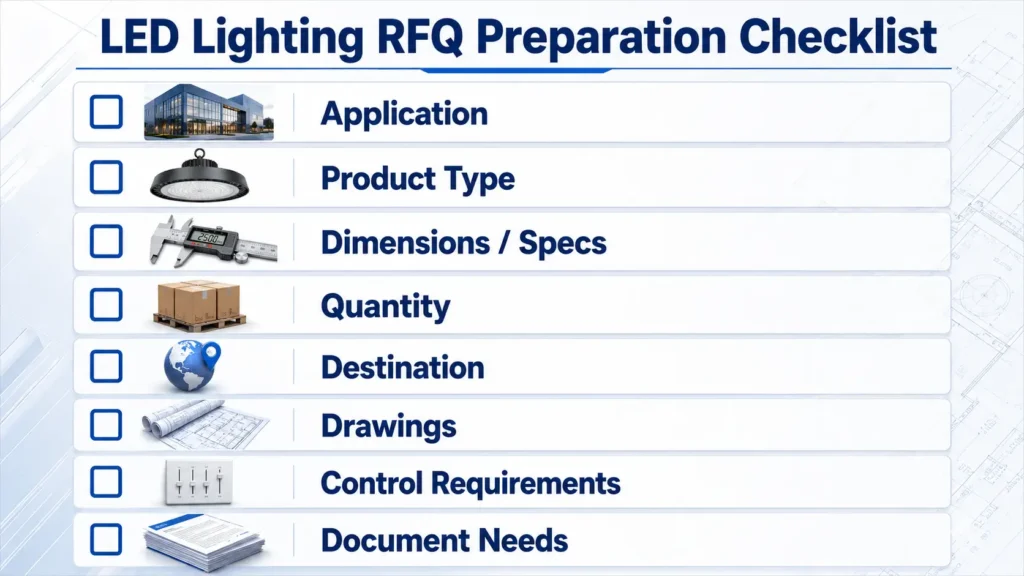
A clear RFQ helps the supplier understand the request and reduces back-and-forth. Before contacting a LED lighting company, prepare as much detail as possible.
For custom or OEM lighting, also prepare drawings, sample references, material needs, cable and connector details, packaging needs, and approval rules. If the design is not final, explain what is fixed and what can still change.
As a result, the supplier can usually give a more useful response when the inquiry includes project conditions, not only a product name.
Many supplier problems start before the order is placed. However, buyers can avoid most of them with better checks.
The best LED lighting company is the one that fits your project needs. For B2B buyers, compare application fit, product type, documents, technical support, communication, and RFQ readiness instead of choosing only by brand popularity.
For commercial projects, look for a supplier that can support the product type, site conditions, control needs, documents, and buying process. The best choice depends on whether the project is retail, office, warehouse, architectural, outdoor, or custom.
The best LED brand depends on the use case. Consumer smart-light brands, commercial lighting brands, specialized LED strip suppliers, and custom makers serve different needs. Start with the application, then compare suppliers by product fit and support.
Useful signs include clear specs, good heat design, stable color requirements, suitable drivers, install guidance, and relevant documents. Avoid relying only on broad quality claims without checking product details.
Check whether the supplier can explain product fit, provide clear specs, answer technical questions, support document requests, review project conditions, and quote clearly. For custom projects, ask how drawings, samples, and approval steps will be handled.
Prepare the application, product type, size, voltage, brightness target, CCT or color needs, quantity, destination, drawings or photos, control needs, packaging requirements, and required documents. A clearer RFQ helps the supplier review the request more accurately.
Before choosing a LED lighting company, define what “best” means for your project. The right supplier should fit your application, technical needs, document needs, buying process, and response expectations.
For supplier review, prepare your application details, product type, specs, quantity, destination, drawings or photos, control needs, and document needs. This gives the supplier a clearer basis to review your request and respond with more useful information.


 English
  Spanish
  French
  Arabic