LED strip lights for mirror projects should be chosen by use, light effect, and site conditions, not by product name alone. A vanity mirror, bathroom mirror, hotel restroom mirror, salon mirror, and OEM mirror can each need a different strip type, light level, setup method, and set of documents.
For B2B buyers, the aim is not only to find a popular mirror light strip. Instead, the better aim is to define the mirror use, light position, light quality, power, controls, site conditions, and RFQ details before you ask for samples or place an order.
First, choose LED strip lights for a mirror by defining the mirror use, light position, and effect you want. Then compare strip type, CCT, CRI, brightness, voltage, watts, dimming or control method, mounting surface, waterproofing need, and access for service. Finally, before you ask for a quote, prepare mirror size, strip placement, site conditions, quantity, sample needs, and document requests.
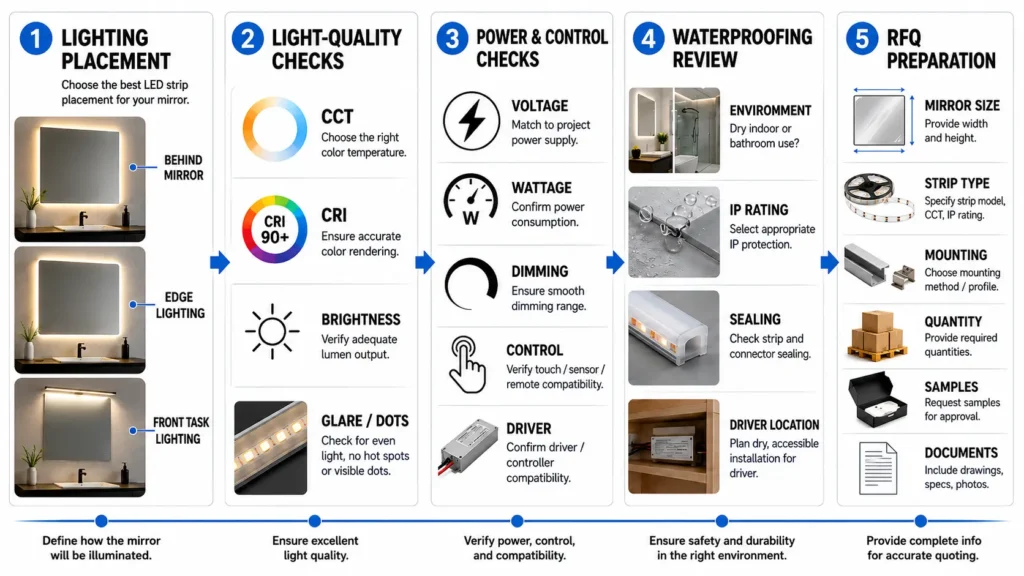
A mirror lighting project should begin with the use case, not the strip model. For example, a strip that works for soft backlight may not work well for makeup, bathroom use, or OEM mirror production.
First, decide what the light must do:
Next, define whether the strip is mainly for looks, task visibility, brand mood, or a product that will be sold or installed again and again.
Different mirror projects have different risks. Therefore, use the table below to set a clear buying path before you ask suppliers for product options.
| Mirror use | Main buyer priority | Useful checks before buying | Risk to avoid |
|---|---|---|---|
| Vanity or makeup mirror | Even light and good color look | CCT, CRI, glare, strip position, diffuser, dimming | Using a decorative strip for task light |
| Bathroom mirror | Moisture and safe setup review | IP rating, driver place, sealing, qualified install, service access | Assuming every strip is fit for bathroom use |
| Hotel or public restroom mirror | Same look in many rooms | Light match, driver access, mounting, spare parts, cleaning exposure, docs | Choosing a strip that is hard to service later |
| Salon or boutique mirror | Good look plus useful light | CCT, CRI, glare, dimming, controls, finish, sample review | Using RGB-only light when true white light is needed |
| OEM mirror production | Repeatable product build | Strip width, cut length, connectors, driver fit, packing, sample test | Going to bulk order before sample approval |
| Distributor stock | Clear use and sales limits | Common uses, docs, accessories, packing, support material | Promising universal fit or bathroom use |
Vanity and makeup mirrors need more care with light quality than simple mirror backlight. In addition, buyers should define the target light look, color-rendering need, glare level, dimming need, and whether the strip will be seen directly or hidden behind a diffuser.
DOE/FEMP guidance defines correlated color temperature as a color look measured in Kelvin and CRI as a color rendering measure. Therefore, for mirror lighting, check these specs in the datasheet or project brief instead of judging from photos alone.
Bathroom mirror projects need extra care. A strip that works on a dry vanity wall may not be right for a wet area or a place with moisture.
Before sourcing, confirm the exposure level, product IP evidence if protection is claimed, driver location, cable route, sealing method, mounting surface, service access, and local review needs.
Commercial and OEM projects usually need more than a visual sample. They may also need the same light look from batch to batch, stable accessory choices, clear setup notes, supplier docs, and sample approval before a larger order.
For that reason, avoid buying only by price, photos, or a simple “mirror LED strip” label. A clear RFQ should state mirror size, site use, light position, CCT/CRI target, voltage or control preference, and document needs.
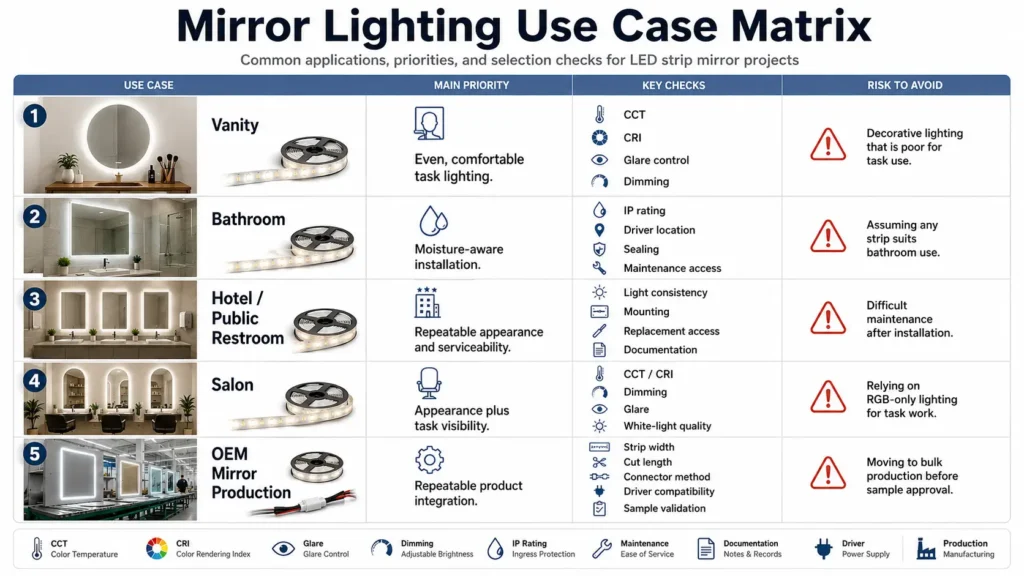
Use the matrix below to turn a broad mirror lighting idea into a clear sourcing request.
First, match the strip choice to the light position and effect. Then use the RFQ note to tell suppliers what they must review.
| Use case | Light position | Wanted effect | Strip type to review | Specs to check | Main risk | RFQ note |
|---|---|---|---|---|---|---|
| Vanity mirror | Edge, behind mirror, or with diffuser | Task light plus soft look | COB, dense SMD, diffused strip, or vanity kit | CCT, CRI, brightness, dimming, width, driver fit | Poor color look or visible dots | Send size, position, and task-light need |
| Bathroom mirror | Behind or around mirror, away from splash where possible | Backlight or useful accent | IP-rated or coated option if the site needs it | IP proof, driver place, voltage, sealing, setup method | Moisture risk and unsafe assumptions | Ask for IP proof and setup docs if claimed |
| Hotel or public restroom | Behind mirror or built into fixture | Same look across rooms | Repeatable strip and accessory set | CCT match, driver access, mounting, service plan | Hard service after install | Send room type, quantity, and service access details |
| Salon or boutique mirror | Edge, front light, or accent | Strong look and good user view | Quality white strip, optional RGB or RGBWW | CCT, CRI, dimming, controls, diffuser, glare | Decor light replacing task white light | Separate task light from mood light |
| OEM mirror production | Built into frame or back panel | Repeatable product design | COB, SMD, side-emitting, coated, or custom set | Cut length, PCB width, connector, driver, packing | Bulk order before sample review | Include drawings, samples, target specs, and docs |
| Distributor assortment | Stock for many mirror jobs | Clear product use | Common white-light and backlight options | Use cases, accessories, pack contents, limits | Overclaiming universal use | Ask supplier for sales limits and available docs |
There is no single “best” LED strip light for every mirror. Instead, choose the strip type by light effect, viewing angle, setup depth, diffuser use, site conditions, and sample result.
For instance, a strip that works well for hidden backlight may not suit direct task light. Also, a strip that looks smooth in a channel may show dots if it sits too close to a shiny mirror edge. In the same way, a retail DIY kit may not provide the docs or batch match needed for a hotel or OEM job.
| Option | Where it may fit | What to check | Limit |
|---|---|---|---|
| COB LED strip | Projects that need a smoother line or fewer visible dots | Distance, diffuser, width, voltage, controls, sample result | COB is not always better; test it in the real mirror layout |
| High-density SMD strip | Backlight, diffused channels, or cost-sensitive jobs | LED density, diffuser depth, brightness, watts, heat, cut points | Dots may show without enough spacing or diffusion |
| Side-emitting strip | Edge layouts where light direction matters | Light direction, placement, bend direction, channel or mount | It does not replace a normal top-emitting strip in every job |
| Coated or IP-rated strip | Sites with moisture, cleaning spray, or exposure concerns | IP proof, coating type, connector seal, driver place | Coating alone does not prove bathroom fit |
| Ready-made vanity kit | Small upgrade or simple non-custom job | Pack contents, power method, controls, adhesive, service limits | May not suit OEM, commercial, or long-term stock needs |
| Aluminum profile or diffuser | Jobs that need a cleaner finish, better mounting, heat help, or protection | Profile depth, diffuser type, strip fit, mounting surface, access | Adds cost, space, and assembly steps |
COB strips may be worth a sample when the buyer wants a smoother line or fewer visible dots. However, the final look still depends on the mirror design, strip position, diffuser or wall distance, brightness, and sample approval.
Avoid wording such as “COB is always the best for mirrors.” A safer question is: Does the sample create the required look in the real mirror structure?
High-density SMD strips may work well when the strip is hidden, diffused, or mounted with enough space from the visible surface. Also, they can be useful for backlight, commercial jobs, and distributor ranges when the design controls dots and glare.
Before ordering, check strip density, watts, heat, voltage, and mounting method. Product photos are not enough to predict the final mirror effect.
Side-emitting strips can help when the mirror design needs light to project from the edge instead of straight outward. Meanwhile, coated or IP-rated strips may help where the site needs extra protection, but product proof is needed before making bathroom or wet-area claims.
Ready-made vanity kits may work for small or simple jobs. However, B2B buyers should still check voltage, controls, service access, packing, and docs.
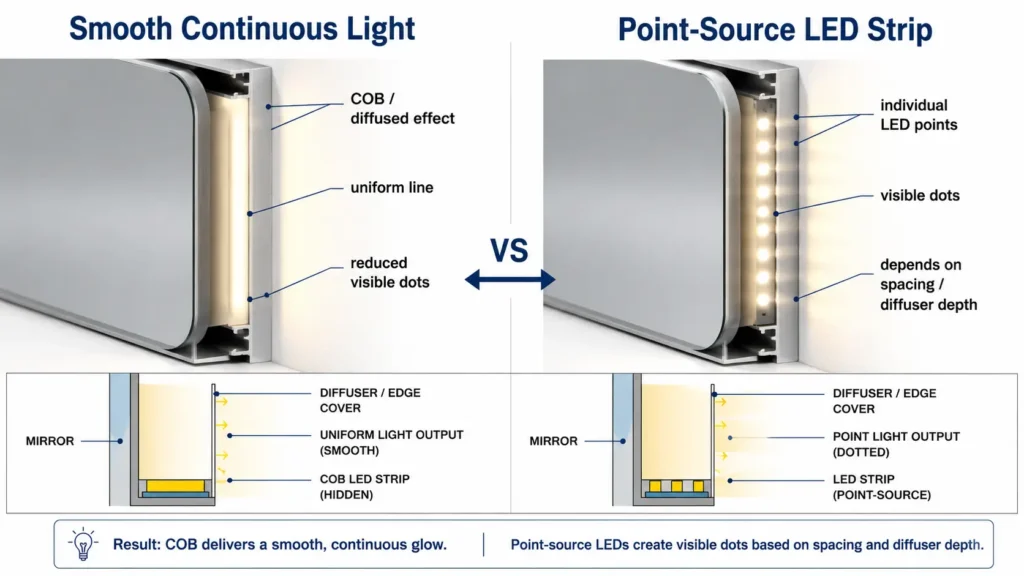
Mirror lighting quality depends on several specs working together. Therefore, buyers should not judge a strip by brightness alone.
CCT affects whether the light looks warmer or cooler. CRI describes how well colors appear under a light source. For vanity, makeup, salon, retail, and hotel mirrors, these specs can affect the user experience, so define them before sampling.
Also, do not rely only on product images to judge CCT or color quality. Ask for datasheets, sample testing, or project-specific confirmation.
Lumens describe light output, while watts describe power input. Because these are different points, a mirror project should compare both. The U.S. Department of Energy’s Lighting Facts guidance treats brightness, color, life, and watts as separate checks. Higher power does not always give the best view, and high brightness can cause glare, heat, or uneven reflection if the layout is poor.
The strip voltage, total run length, watts, driver capacity, and wiring layout should be reviewed together. This article is not a wiring guide. Instead, it reminds buyers that power supply size and driver choice cannot be guessed from a product title.
If the mirror needs dimming, touch control, motion control, smart control, or RGB/RGBWW control, check fit before ordering. In addition, state whether the project needs simple on/off control, dimming, CCT change, RGB control, or connection to a larger control system.
ENERGY STAR explains that LEDs use heat sinks to absorb and release heat. Therefore, check the mounting surface, airflow, profile or channel use, strip watts, service access, and whether the mirror structure traps heat.
A common mistake is to treat “LED strip lights for bathroom mirror” as a simple product label. In practice, bathroom use depends on exposure level, product rating, driver location, setup method, sealing, service access, and local rules.
The IP code describes protection against solid objects and water entry under IEC 60529. ANSI’s IP code explanation notes that the first number relates to solid object protection and the second number relates to water entry. However, an IP number should be used as a review point, not as proof that any unverified strip is safe for a bathroom.
First, ask whether the strip will face moisture, splash, cleaning spray, or only normal humidity. Then check whether the strip, driver, connector, and enclosure need different levels of protection.
Use this checklist before you specify a bathroom or wet-area mirror project.
| Check item | What to confirm | Why it matters |
|---|---|---|
| Exposure level | Is the strip exposed to moisture, splash, cleaning spray, or only humidity? | The protection need can change with exposure. |
| Required IP rating | What rating is needed for the strip, driver, connector, or enclosure? | The rating must match the exact product and site. |
| Driver or power supply location | Is the driver in a suitable and accessible place? | The strip and power parts may have different needs. |
| Connector and sealing points | Are cut ends, connectors, and cable entries protected as needed? | Weak seal points can defeat the protection. |
| Mounting surface | Is the surface clean, dry, stable, and fit for adhesive or profile mounting? | Poor mounting can cause failure or uneven light. |
| Install responsibility | Who will install and approve the electrical work? | Rules and installer needs can vary by place. |
| Service access | Can the strip, driver, or controller be serviced later? | Hidden parts can be costly to replace. |
In addition, follow product instructions and involve qualified electrical review where required. UL Solutions guidance on LED retrofit kits highlights markings, setup instructions, and local authority review. Mirror strip jobs are not the same as retrofit kits, but the same caution is useful when the mirror is part of a fixed building project or a product sold to others.
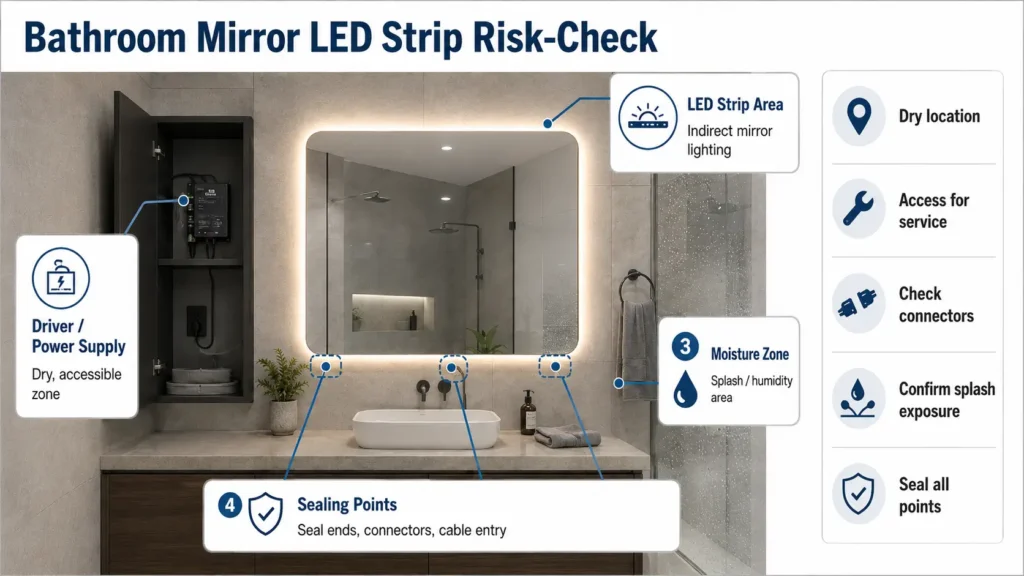
This article is not a wiring guide. For B2B sourcing, the safer path is to define the site conditions that affect product choice before setup begins.
First, collect mirror and site details. Then send them with the RFQ so the supplier can check strip type, accessories, and driver needs.
| Condition | Buyer question | RFQ impact |
|---|---|---|
| Mirror size and shape | Is the mirror rectangular, round, irregular, framed, frameless, or built into furniture? | Send sizes or drawings. |
| Light position | Is the strip behind the mirror, around the edge, inside a frame, or facing forward? | Include a sketch or photo. |
| Distance from wall or diffuser | How far is the strip from the visible surface? | This affects dots and smoothness. |
| Mounting surface | Is the surface glass, metal, wood, plastic, painted wall, or aluminum profile? | This affects adhesive, profile, or mount choice. |
| Power supply location | Where will the driver or adapter be installed? | This affects voltage, cable length, access, and service. |
| Control method | Will the project use a wall switch, touch sensor, dimmer, remote, app, or building control? | This needs a control fit check. |
| Heat condition | Will the strip be enclosed, recessed, or mounted in a low-airflow area? | This may affect watts and profile choice. |
| Connector and cut points | Where will the strip be cut or connected? | This affects connector type, soldering, sealing, and layout. |
| Service access | Can the strip or driver be replaced after setup? | This is key for hotels, public restrooms, and OEM products. |
Before ordering samples, provide enough layout details for technical review. Even a simple sketch can prevent wrong strip width, wrong light direction, poor connector choice, or a driver that cannot be reached later.
A strong RFQ helps the supplier or technical team understand the job instead of guessing from the keyword “mirror LED strip.”
Start with the core project details. Then add site, packing, sample, and document needs so the supplier can respond with fewer follow-up questions.
| RFQ item | What to provide |
|---|---|
| Mirror size and shape | Size, drawing, or photo |
| Use | Vanity, bathroom, hotel, salon, OEM product, distributor stock, or other use |
| Light position | Behind mirror, edge, frame, front-facing, side-emitting, or decorative |
| Wanted effect | Soft halo, task light, mood light, smooth line, or hidden backlight |
| CCT target | Required light look or project preference |
| CRI need | Color-rendering need for makeup, salon, retail, or hotel use |
| Brightness target | Visual target, reference sample, or project need |
| Voltage and controls | Voltage, driver type, dimming, touch control, RGB/RGBWW, or other control method |
| Site conditions | Dry indoor, bathroom, wet-area concern, cleaning exposure, hotel or public use |
| Strip type preference | COB, dense SMD, side-emitting, coated/IP-rated, or open to advice |
| Mounting method | Adhesive, profile, clip, frame build-in, or factory assembly |
| Quantity | Sample quantity and estimated bulk quantity |
| Packing need | Standard, project, OEM, or distributor packing |
| Document request | Datasheet, setup notes, IP proof if claimed, driver specs, warranty terms if available |
| Sample test | What the sample must prove before bulk order |
Ask what documents are available rather than assuming every document exists. Useful requests may include:
For commercial or OEM projects, sample testing is especially important. Therefore, review the sample in the real mirror structure or a close mockup, not only on a desk or in a photo.
Start with the mirror use, light position, and effect you want. Then check strip type, CCT, CRI, brightness, voltage, watts, control method, mounting surface, heat, waterproofing need, driver location, and service access. For B2B sourcing, also prepare quantity, sample needs, and document requests.
COB strips, dense SMD strips, side-emitting strips, diffused strips, coated or IP-rated strips, and vanity kits can all be reviewed. However, the right option depends on the effect, setup space, dot tolerance, diffuser use, site conditions, and sample result.
LED strip lights can be used for bathroom mirrors only when the exact product rating, driver location, sealing method, setup instructions, and local needs fit the site. Do not assume every strip is suitable for bathroom or wet-area use. Instead, ask for product IP proof and setup guidance.
For vanity or makeup mirror projects, define the target CCT and check CRI in the product datasheet or project spec. CCT affects light look, while CRI relates to color rendering. Therefore, exact needs should come from the project brief, buyer standard, or product proof.
COB can help when the goal is a smoother line or fewer visible dots, but it is not automatically better for every mirror. In contrast, SMD strips may work well with enough density, space, diffusion, and proper placement. Compare the real sample result, setup space, power, heat, controls, and cost.
RGB or RGBWW strips can work for mood light or brand style. However, task-quality white light should be reviewed separately. For makeup, grooming, salon, or retail mirrors, define the white-light need first, then decide whether color effects are also needed.
Send mirror size and shape, use, light position, wanted effect, CCT/CRI target, voltage and control choice, site conditions, quantity, mounting method, packing needs, sample needs, and document requests. Also, for bathroom or wet-area projects, ask what IP proof and setup documents are available.
For quote or technical review, prepare the mirror size, light position, target effect, CCT/CRI target, voltage and control choice, site conditions, quantity, sample needs, and document requests.
In short, the most useful inquiry is not just “send price.” A better inquiry explains where the strip will be used, what result is expected, how it will be powered and controlled, and what documents are needed before sampling or ordering.

 English
  Spanish
  French
  Arabic