Buying LED strip lights in Dubai should not start with price alone. First, check where the strip will be used and what the site needs. A low-cost strip may still be a poor fit if the voltage, color, IP rating, control method, or power supply does not match the job.
For buyers, contractors, and project teams, the safer step is to define the use case first. Then, compare the strip type, light output, color, IP rating, driver, controller, parts, quantity, and documents before asking for a quote.
Before buying LED strip lights in Dubai, check the use case, site conditions, voltage, watts per meter, lumen output, CCT or RGB color needs, CRI, IP rating, strip length, driver, controller, dimming method, quantity, destination, and required documents. As a result, the supplier can check fit before quoting.
LED strip lights are used for cabinet lights, retail displays, signs, hotel interiors, home decor, line lighting, and outdoor accents. However, each use case needs a different set of checks.
For example, an indoor decor strip does not need the same checks as an exposed outdoor strip. Also, a retail display may need better color rendering than basic accent lighting. In addition, a long run may need more power planning than a short under-cabinet strip.
Use the table below as a first-pass guide. Then, review the available LED strip light categories and confirm the final spec against the site conditions.
| Project Need | What to Check | Why It Matters | Supplier Question |
|---|---|---|---|
| Indoor decor lighting | CCT, brightness, dimming, backing, driver | Helps match the look and mounting method | Which strip and driver fit this indoor use? |
| Cabinet or shelf lighting | Strip width, brightness, CCT, heat, profile | Small spaces need the right size and light spread | What strip width and profile should I use? |
| Retail or display lighting | CCT, CRI, brightness, even light | Product color can change under poor light | What CRI and CCT options are available? |
| Signage or accent lines | Color, RGB, controller, length, power | Control and run length affect the system | Which controller and power supply are needed? |
| Outdoor or exposed areas | IP rating, exposure, cable route, parts | Dust or water exposure must be checked | What IP rating and site checks are needed? |
| Bulk or project supply | Quantity, packing, samples, documents | Project buying needs stable specs and records | What datasheets, samples, and documents are available? |
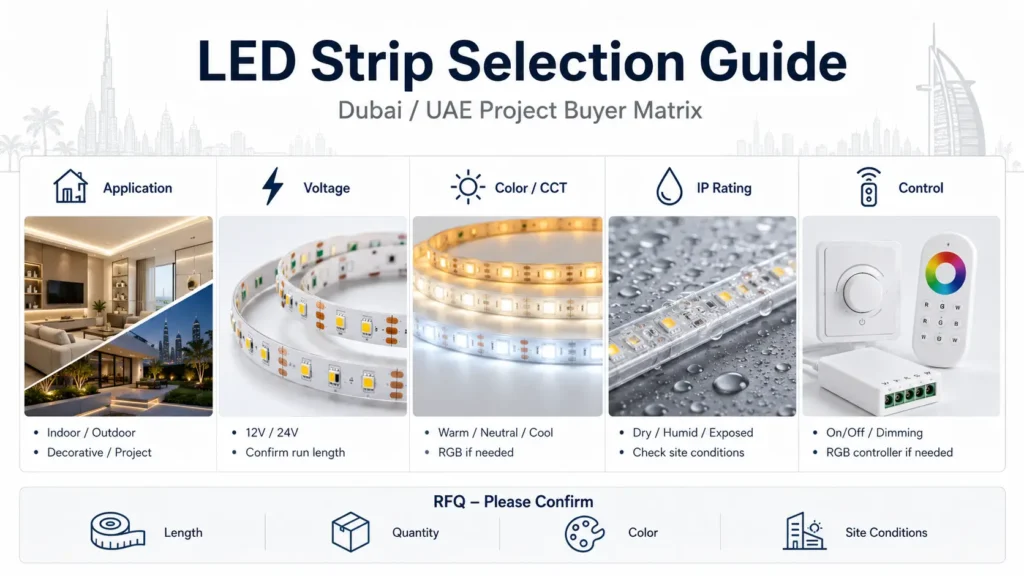
This matrix does not replace a product datasheet or installer review. It helps buyers ask better questions before choosing a product or supplier.
Indoor and outdoor LED strip lights should be selected differently. The key issue is exposure. A dry indoor ceiling cove, a humid area, a covered outdoor feature, and an exposed exterior installation may require different protection and installation checks. For the protection-code concept, see the IEC explanation of IP ratings.
| Location Type | Main Risk to Check | Selection Direction | What to Confirm Before Buying |
|---|---|---|---|
| Dry indoor area | Visual effect, brightness, driver placement | Focus on CCT, brightness, dimming, and installation profile | Strip type, driver, controller, mounting surface |
| Cabinet or furniture area | Heat, strip width, diffuser needs | Check narrow strip options and profile compatibility | Width, output, profile, adhesive or mounting method |
| Retail or display area | Color accuracy and visual consistency | Check CCT and CRI/color-rendering needs | Datasheet, sample, CCT, CRI, brightness |
| Humid indoor area | Moisture exposure | Check whether a protected strip is needed | IP rating, installation method, ventilation |
| Covered outdoor area | Dust, splash, heat, cable routing | Check protection level and accessory suitability | IP rating, cable, connector, power supply location |
| Exposed outdoor area | Water, dust, weather exposure | Require careful product and installation review | Product datasheet, IP rating, installation conditions |
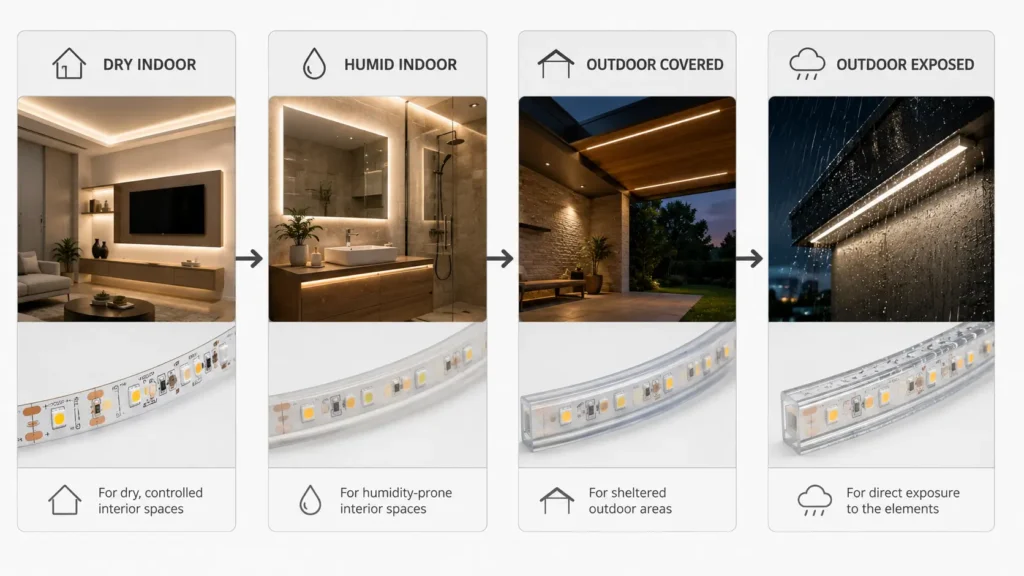
However, do not choose an outdoor strip only because a listing shows a high IP number. The right choice still depends on exposure, mounting, parts, and the product datasheet.
LED strip light price in Dubai can vary for many reasons. Length matters, but it is not the only cost driver. Also, buyers should compare strip type, light output, voltage, LED density, color quality, IP rating, control method, driver, parts, packing, and quantity. For general LED buying checks, see the DOE LED lighting guide.
| Factor | Why It Affects Selection | Why It Can Affect Price |
|---|---|---|
| Strip type | SMD, COB, RGB, RGBW, and addressable strips create different looks | Different LED parts and strip builds have different costs |
| Voltage | 12V, 24V, and high-voltage strips need different planning | Power supply, control, and setup needs can change |
| Watts per meter | Helps estimate power demand | Higher power may need larger drivers or more heat planning |
| Lumen output | Helps compare brightness | Higher output strips may cost more than basic decor strips |
| CCT or color | Warm white, cool white, RGB, or tunable options affect the look | More color options may need extra control parts |
| CRI | Can matter for retail, display, hotel, and task lighting | Higher color-rendering needs may limit choices |
| IP rating | Matters for dusty, wet, or exposed places | Protected strips and parts can add cost |
| Controls and parts | Dimming, RGB, profiles, clips, and connectors affect setup | Extra parts add to the full project cost |
Wattage and brightness are not the same. Wattage helps estimate power use. By contrast, lumen output helps compare brightness. Therefore, buyers should check both values instead of using wattage alone. For more context, see the DOE page on lumens and lighting facts.
CCT affects the color look of white light. For example, warm white, neutral white, and cool white can feel very different in a hotel, shop, sign, or home. Also, CRI or color-rendering data can matter when products, finishes, or displays need to look natural. For background on these terms, see DOE LED basics.
LED density also affects how smooth the light line looks. If the strip will be seen through a diffuser, ask whether the strip, profile, and diffuser can reduce dots or uneven light.
Voltage choice affects system planning. Many low-voltage LED strips use 12V or 24V drivers. Also, some product listings include high-voltage strips. Because setup and safety needs vary by product and project, buyers should ask the supplier and a qualified installer before choosing them.
There is no single voltage that fits every job. Instead, confirm run length, power supply location, voltage drop risk, dimming or control method, installer needs, and the product datasheet.
System parts matter too. Therefore, check the required LED power supply, connector type, controller, and mounting parts before you approve a quote.
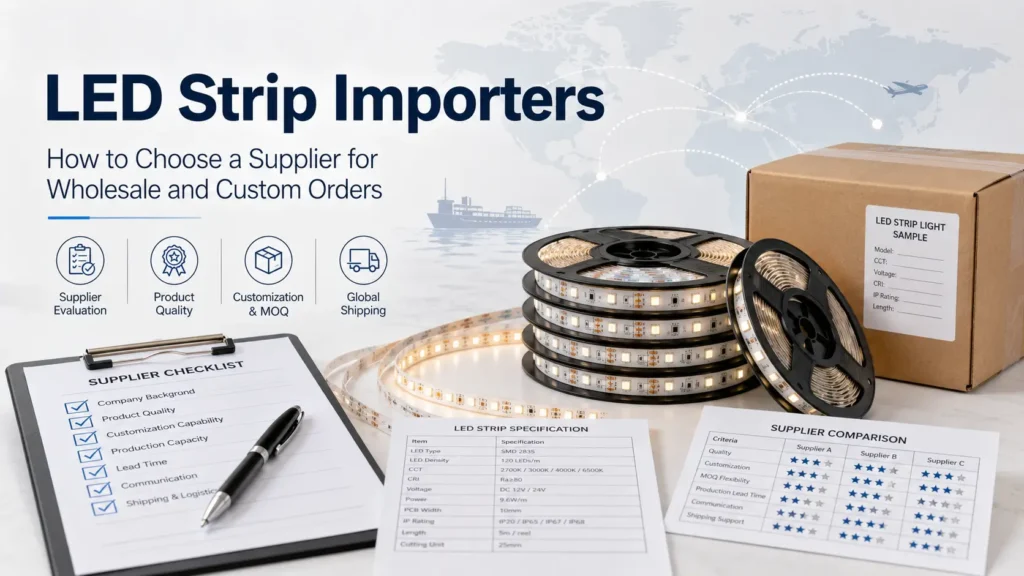
Search results for LED strip lights often include marketplaces, local shops, supplier lists, and product pages. As a result, buyers have many options. However, that can make side-by-side checks harder.
Instead of asking only “Which brand is best?”, ask how clearly each supplier can answer project questions.
| Supplier Question | Why It Matters | Safe Buying Action |
|---|---|---|
| Can you provide a datasheet for the exact strip? | Confirms voltage, watts, CCT, CRI, IP rating, and size | Review the datasheet before approval |
| Can you provide a sample? | Helps check brightness, color, and fit | Test before a larger buy when risk is high |
| What driver and controller are recommended? | Strip, driver, and controller must work together | Confirm system fit |
| What IP rating is available for this strip? | Protection level matters in exposed places | Match the rating to the site |
| What parts are needed? | Profiles, diffusers, connectors, clips, and power supplies affect the final result | Include parts in the quote |
| What documents are available? | Some jobs need records or proof from the supplier | Ask for documents before buying if needed |
| Can the supplier support the needed quantity and packing? | Bulk or resale orders may need stable labels and packing | Confirm before quote approval |
| What should be checked before setup? | Helps avoid mismatch between the strip, site, and installer | Ask the installer and supplier to review the site conditions |
This approach avoids unsupported “best” claims. In practice, a useful supplier talk should make product fit clearer, not just repeat sales copy.
A clear RFQ helps the supplier check fit before quoting. Also, it reduces back-and-forth and makes offers easier to compare. For projects that need custom length, color, packing, or parts, review the custom LED strip light path before sending the inquiry.
Before you ask for LED strip light pricing, send the details below.
| RFQ Detail | What to Send |
|---|---|
| Application | Cabinet, sign, retail display, cove light, outdoor accent, line light, or other use |
| Installation environment | Dry indoor, humid indoor, covered outdoor, exposed outdoor, dusty area, or other site |
| Required length | Total meters and length per run |
| Quantity | Number of rolls, meters, or project sets |
| Voltage preference | 12V, 24V, high-voltage, or “please recommend” |
| Light color | Warm white, neutral white, cool white, RGB, RGBW, tunable white, or other |
| CCT / CRI needs | Target CCT and CRI if the job has visual needs |
| Brightness or output | Target brightness or a product reference if you have one |
| IP rating need | Indoor, splash risk, outdoor, or job-specific need |
| Control method | On/off, dimming, remote control, RGB control, smart control, DMX, or other |
| Accessories | Power supply, controller, connector, profile, diffuser, clips, cable |
| Destination | Dubai, UAE, or another delivery destination |
| Documents needed | Datasheet, test report, certificate, install guide, warranty terms, or other project files |
| Sample need | Whether a sample is needed before a bulk or project order |
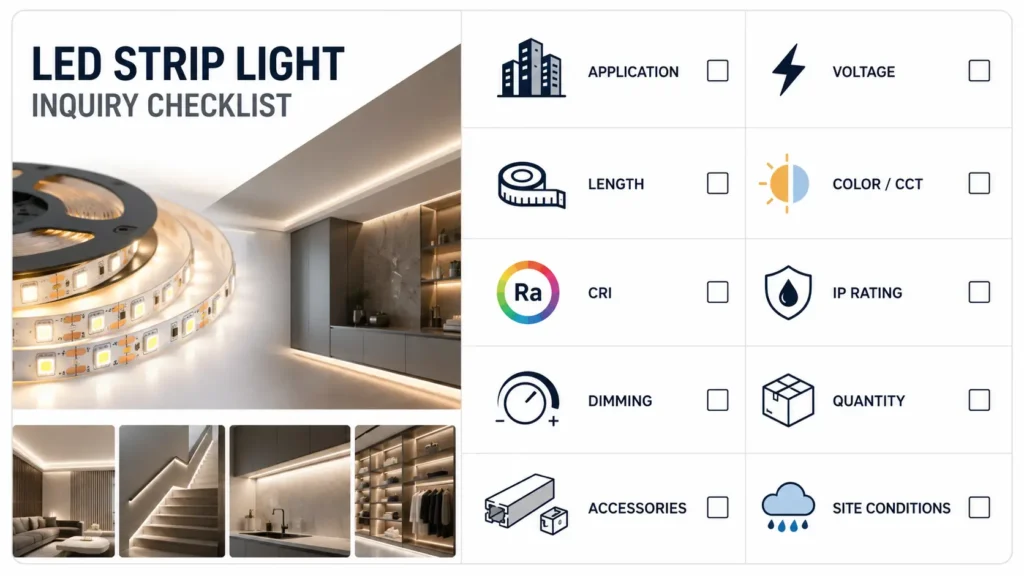
Finally, do not assume lead time, MOQ, warranty, or certification from a product title. Ask for those details directly and request proof when they matter to the job.
First, check the use case and site conditions. Then, check voltage, watts per meter, lumen output, CCT or color, CRI, IP rating, strip width, driver, controller, dimming method, parts, quantity, and documents needed.
Buyers often compare marketplaces, local lighting shops, supplier lists, and direct supplier or maker options. For project or bulk buying, prepare your specs and RFQ details first so suppliers can check fit more clearly.
Price can vary by strip type, LED density, brightness, color quality, IP rating, voltage, control method, power supply, parts, packing, quantity, and document needs. Therefore, exact pricing should come from a supplier quote for the specific job.
Indoor jobs usually focus on brightness, color, dimming, look, and mounting profile. Outdoor or exposed jobs need closer checks for IP rating, cable route, connectors, power supply place, and site conditions. In all cases, check the product datasheet before buying.
The right voltage depends on run length, driver place, control method, and site conditions. If high-voltage strips are being considered, ask the supplier and a qualified installer to confirm the product-specific requirements before buying.
Send the use case, site conditions, total length, quantity, voltage, color or CCT, CRI needs, IP rating, control method, parts, destination, sample needs, and required documents. As a result, suppliers can quote the right product and system parts.
Ask what documents are available for the exact product and order. However, do not assume a certificate, warranty term, or test report applies unless the supplier provides the relevant document for that product or order.
Before contacting a supplier, prepare your use case, strip length, quantity, voltage choice, CCT or color, IP rating need, control method, site conditions, destination, and document needs.
Then, send those details first if you are not sure which LED strip type fits the job. A supplier can give better guidance when the project conditions are clear.
 English
  Spanish
  French
  Arabic