You can leave some LED strip lights on overnight, but only when the setup is right. Therefore, the safer answer depends on the strip quality, power supply, wiring, connectors, mounting surface, heat control, airflow, and where the strip is installed.
However, a well-planned setup is different from a strip with an unknown adapter, loose connector, damaged insulation, or poor airflow. So, use the checks below before leaving LED strips running through the night.
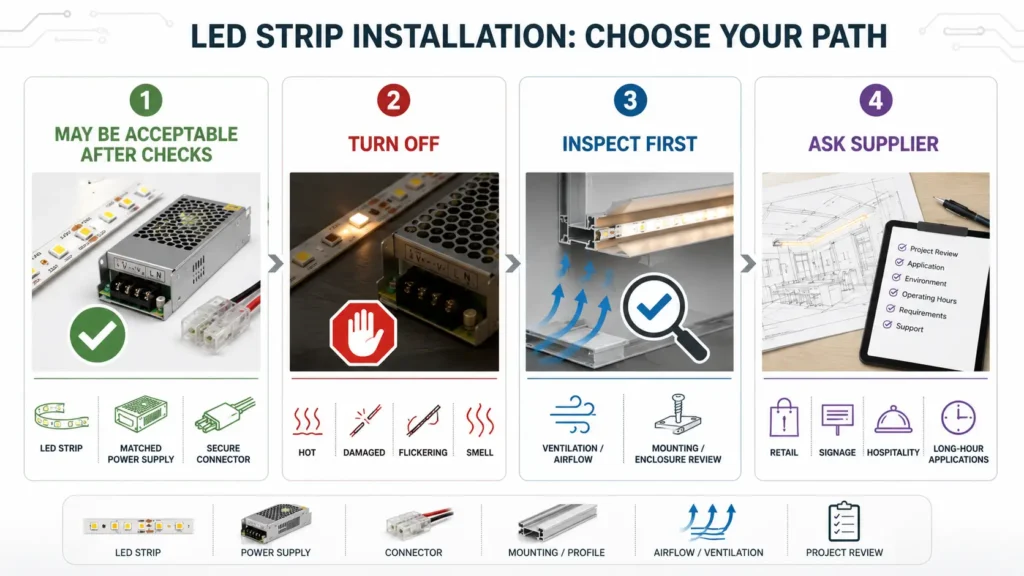
LED strip lights may be safe for overnight use when the strip, power supply, wiring, mounting, airflow, and area match the product instructions. However, do not treat every strip as automatically safe. Turn the lights off and inspect the setup if the strip, connector, cord, or power supply feels unusually hot, flickers, smells, shows damage, or is installed where heat cannot escape.
| Situation | Overnight decision | Why | Action |
|---|---|---|---|
| The strip uses the correct voltage, a matched power supply, secure connectors, and open airflow | May be acceptable after checks | Core setup factors are known and appear normal | Keep the area clear and monitor the first long run |
| The power supply, connector, or strip feels unusually hot | Turn off | Abnormal heat can point to overload, poor contact, or the wrong setup | Disconnect power and inspect before reuse |
| The strip flickers, smells, dims unevenly, or has visible damage | Turn off | These are warning signs, not normal use conditions | Do not continue using damaged parts until they are checked or replaced |
| The strip is inside a tight enclosed space with poor airflow | Inspect first | Heat can build up when it cannot escape | Improve airflow or use a suitable mounting profile |
| The setup is for retail, signage, hospitality, cabinet, or other long-hour project use | Ask supplier | Project use needs a checked power and setup plan | Send specs before ordering or installing |
Overnight use is not only about the LED strip itself. Instead, the full system matters.
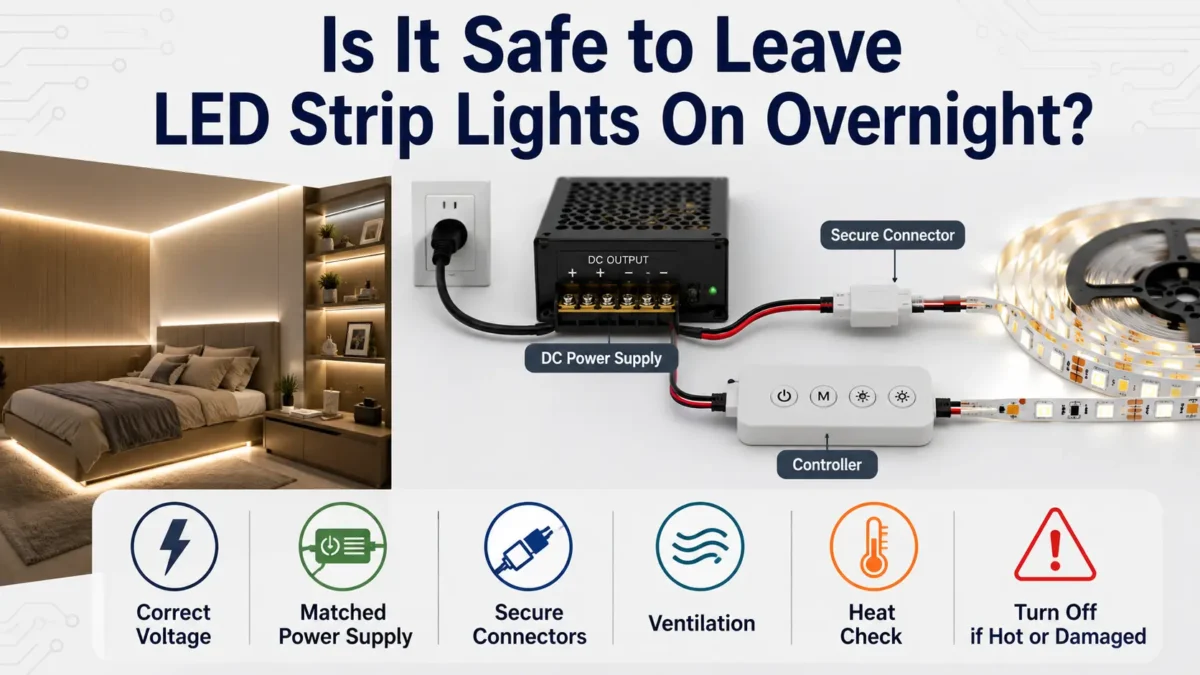
A safer setup usually includes:
For product selection, compare the available LED strip lights and confirm the strip type, voltage, power, control method, and use area before long-hour use.
Do not leave a damaged or unknown-quality strip running overnight.
Before long use, check the strip for:
Also, if the strip was cut, extended, or reconnected, inspect those points first. Many problems start at cut points, solder joints, connectors, or power-entry points.
The power supply is one of the most important parts of the system. Therefore, a strip designed for one voltage should not be connected to a different voltage. Also, the power supply should be right for the total length and wattage of the strip.
Before leaving LED strips on overnight, confirm:
| Check | What to confirm | Why it matters |
|---|---|---|
| Strip voltage | The strip and power supply use the same voltage | A mismatch can damage the strip or create unsafe use |
| Wattage per meter | The load is calculated based on strip length | Longer runs draw more power |
| Total length | The power plan matches the full installed length | Extra length increases load |
| Power supply rating | The power supply is suitable for the connected load | Undersized or unsuitable power supplies can run hot |
| Connector and controller rating | Connectors and controllers match the load | Weak points can heat up or fail |
| Manufacturer guidance | The setup follows product instructions | Product instructions define intended use conditions |
For sourcing, review matching LED power supply options and confirm voltage, wattage/current, run length, controller load, and setup area before long-hour use.
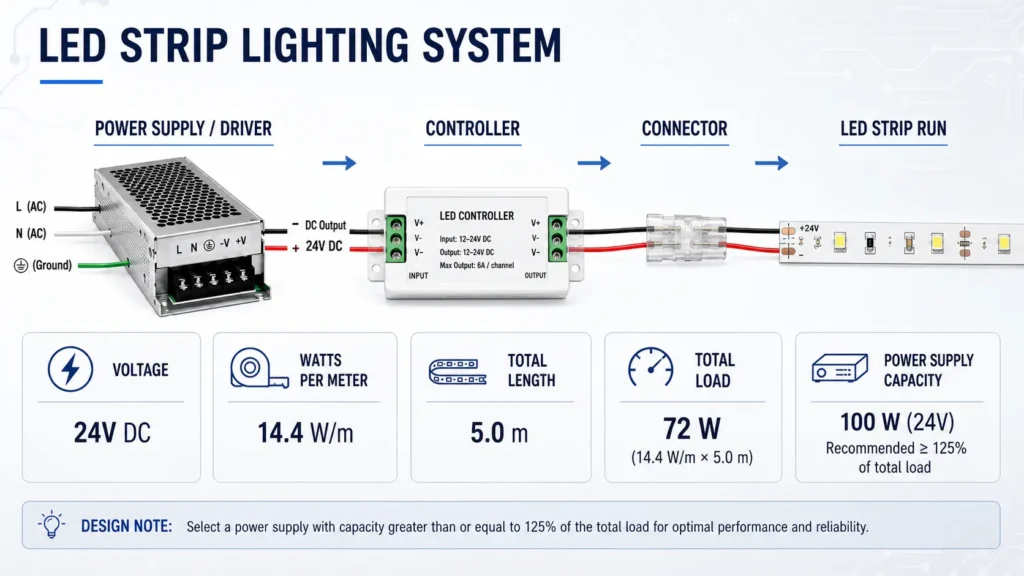
LED strips often use connectors, controllers, dimmers, or smart control devices. However, these parts should not be ignored.
Check that:
Also, do not try to repair damaged electrical parts without the right skill and tools. For project setups, ask a qualified installer or the product supplier to review the setup. For general setup checks, see ElstarLED’s LED strip installation guide.
LEDs are efficient compared with older lighting types, but they still produce heat. Also, ENERGY STAR explains that LED heat is absorbed into a heat sink to help prevent performance issues. For LED strip projects, that means heat still needs a path away from the strip and power supply.
Heat buildup is more likely when LED strips are:
As a result, a suitable LED aluminum profile, mounting channel, or heat-spreading surface can help manage heat in many setups. It can also protect the strip and create a cleaner finish.
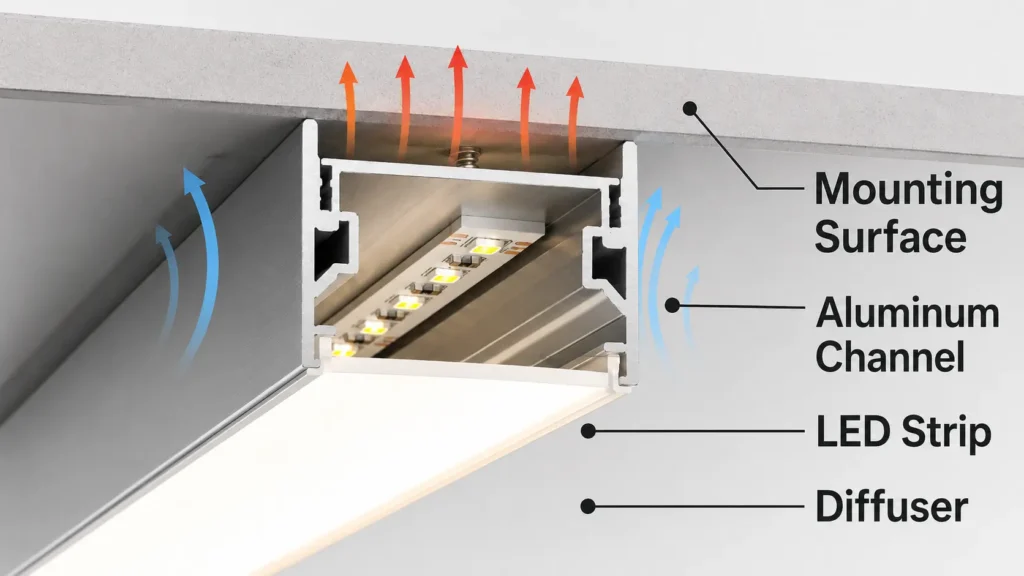
Turn LED strips off and inspect the setup if you notice any warning signs.
Turn them off if:
In addition, do not cover power supplies, cords, or controllers in a way that traps heat. Keep them easy enough to reach for inspection and replacement. For general electrical-safety context, ESFI cautions that covered cords can trap heat and may create a fire hazard.
A well-matched, undamaged setup that follows product instructions and is switched off should carry much less operating load than one that is on. Still, “plugged in but off” does not automatically mean every part of the system is risk-free.
For example, some adapters, controllers, or smart devices may remain connected to power. Damaged wiring, poor connectors, unsuitable power supplies, or heat-trapping setup conditions can still create risk.
A cautious approach is simple:
Leaving LED strip lights on all night can have several effects, depending on the product and setup.
| Possible effect | What it means | What to do |
|---|---|---|
| Heat buildup | Heat may collect around the strip, power supply, or enclosed mounting area | Check airflow, mounting, and power load |
| Power use | Efficient lights still consume electricity when running | Use a timer, dimmer, or control system if overnight light is not needed |
| Slow light output decline | LEDs can lose brightness slowly over long use | Check the product datasheet for rated life |
| Comfort issues | Bright or poorly placed light may disturb sleep comfort | Dim the strip, change placement, or turn it off |
| Part stress | Power supplies, connectors, and controllers may be affected by long use hours | Use parts rated for the application and inspect them regularly |
Also, avoid using a fixed lifespan number unless the exact product datasheet is available. Different strip types, heat levels, brightness levels, power supplies, and setup conditions can affect long-term performance.
Use this checklist before the first overnight run.
For retail displays, signage, hospitality lighting, cabinet lighting, architectural accents, and other long-hour projects, treat overnight use as a spec check rather than a simple yes/no answer.
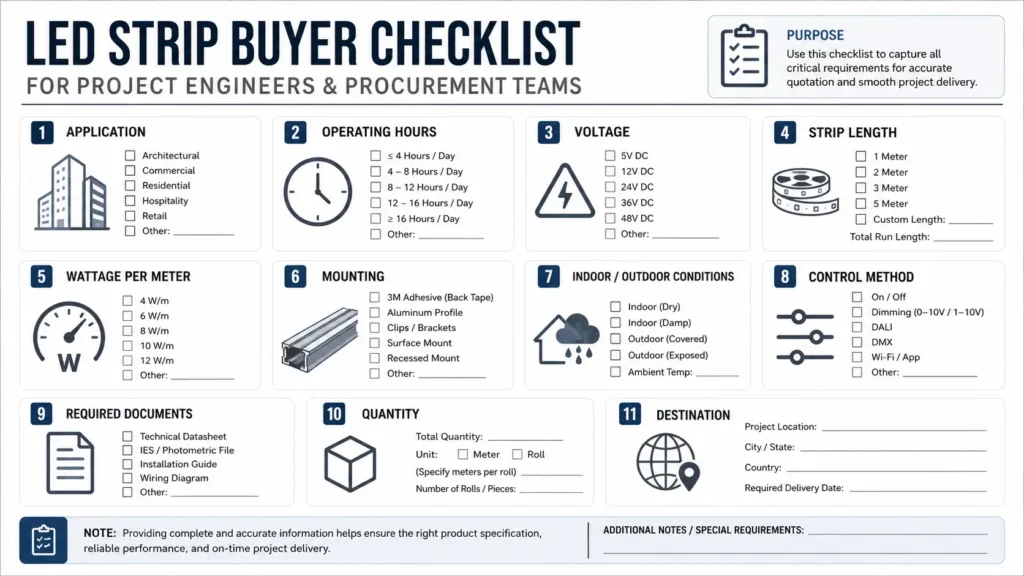
Before ordering LED strips for long-hour use, prepare these details:
| RFQ item | What to send | Why it helps |
|---|---|---|
| Application | Cabinet, retail display, signage, hospitality, bedroom, architectural accent, or other use | Helps match strip type and brightness |
| Operating hours | Expected daily use and whether overnight use is needed | Helps review heat and power conditions |
| Indoor or outdoor area | Dry indoor, humid area, outdoor, covered outdoor, or wet area | Helps identify protection needs |
| Strip length | Total length and run layout | Helps calculate load and voltage-drop concerns |
| Voltage | Required or preferred strip voltage | Helps match strip and power supply |
| Wattage per meter | If already selected, include the product wattage | Helps size the power supply |
| Mounting surface | Wood, metal, drywall, display case, aluminum profile, or enclosed channel | Helps review heat path |
| Control method | Switch, dimmer, remote, sensor, smart controller, or DMX/system control | Helps check fit |
| Documents needed | Certificates, test reports, datasheets, or market-specific documents | Lets the supplier confirm what is available for the exact product |
| Quantity and destination | Order quantity and delivery market | Helps prepare a practical quotation path |
Also, do not assume every strip, power supply, or controller is suitable for repeated overnight use. Ask for the right product and document set for the actual project.
LED strip lights may be suitable for overnight use when the strip, power supply, wiring, connectors, mounting, ventilation, and environment match the product instructions. Do not treat every setup as automatically safe. Turn the lights off and inspect the setup if any part feels unusually hot, flickers, smells, or shows damage.
There is no universal safe hour limit for every LED strip. The answer depends on the strip type, power supply, heat dissipation, installation quality, and product instructions. For long-hour use, test the setup first and confirm the power plan with the supplier.
A switched-off strip normally has much less operating load than a running strip, but plugged-in adapters, controllers, damaged wiring, or poor installation can still create risk. If the setup is old, damaged, unknown, or poorly ventilated, unplug it and inspect it before using it again.
Yes. LED strips can overheat under unsuitable conditions. Common risk factors include poor ventilation, wrong power supply, overloaded connectors, long runs without a proper power plan, enclosed spaces, or damaged parts. Heat management is especially important for long-hour operation.
Check the voltage, power supply rating, strip length, wiring, connectors, controller compatibility, mounting surface, ventilation, moisture exposure, and visible product condition. If the strip feels hot, flickers, smells, or has damaged insulation, turn it off.
They continue using power, generating heat, and adding operating hours to the system. In a suitable setup, this may be acceptable. In a poor setup, heat, connector problems, or power-supply stress may become more likely. Bright light may also disturb sleep comfort.
Turn them off if you are unsure about the setup, if the strip is installed near heat-sensitive materials, if the power supply is unknown, or if there are warning signs such as heat, smell, flicker, or damage. You can also use a timer or dimmer when overnight lighting is not needed.
Send the application, operating hours, strip length, voltage, wattage per meter, indoor/outdoor conditions, mounting method, control method, required documents, quantity, and destination market. This helps the supplier review strip, power supply, connector, and profile options.
For overnight or long-hour LED strip projects, share the application, operating hours, voltage, wattage per meter, strip length, mounting surface, indoor/outdoor conditions, control method, quantity, destination market, and any required documents.
Share these details with ElstarLED for project review and discussion of possible LED strip, power supply, connector, and aluminum profile options.
Do not rely on a general “yes” or “no” answer for every installation. A safer choice starts with the right product, correct power setup, suitable mounting, and clear project requirements.

 English
  Spanish
  French
  Arabic