Choosing between IP20 and IP44 may look simple at first. However, the right choice changes when the light goes into a real project. A dry shelf, a kitchen cabinet, a bathroom mirror area, a sheltered sign, and an open outdoor run do not face the same water or dust risk. So, the IP rating should be checked with the place of use, water contact, driver position, cable joints, housing, and local rules.
In this guide, you will see the key difference between IP20 and IP44 for LED lighting. Also, you will see what to share before an RFQ, so the supplier can review the right setup without guessing.
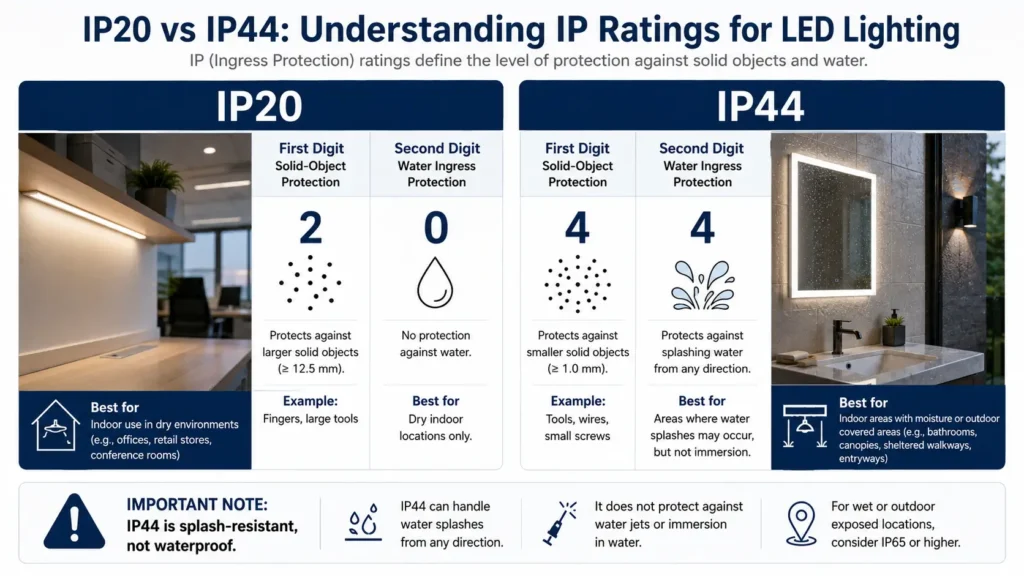
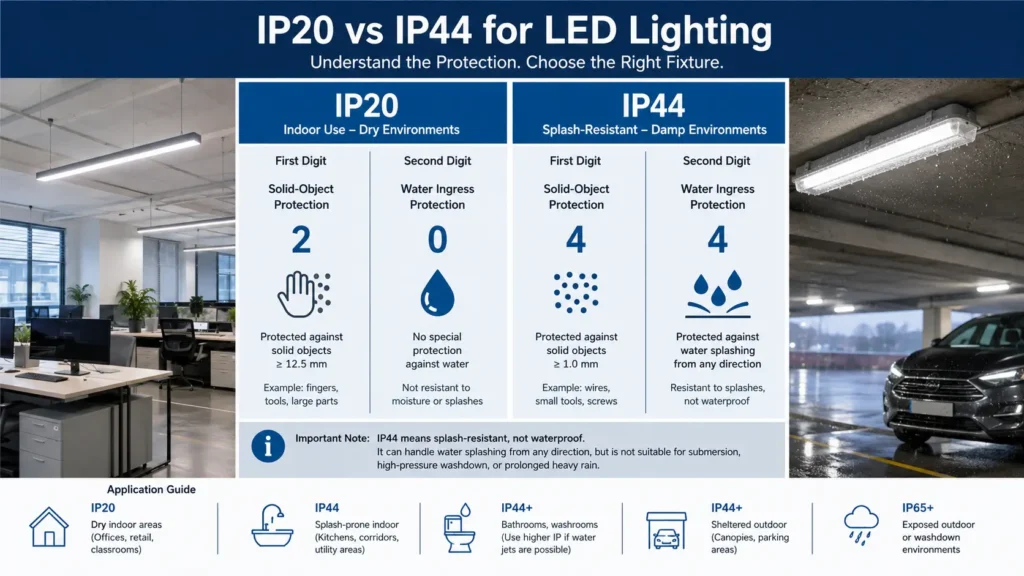
IP20 and IP44 are ingress protection ratings. In simple terms, the first digit refers to solid objects, while the second digit refers to water. IP20 has no rated water protection, so it is normally reviewed for dry indoor areas. IP44 adds splash protection; however, it is not waterproof and should not be treated as fit for every outdoor or bathroom area.
An IP rating normally has two digits. First, the solid-object digit shows how well the enclosure blocks objects or dust. Next, the water digit shows how well it blocks fluid or water. IEC 60529 is used for this kind of enclosure test, and Intertek’s IP testing reference explains that the code uses one digit for solid objects and one digit for water or fluid.
| Rating | First Digit | Second Digit | Plain Meaning | Key Limit |
|---|---|---|---|---|
| IP20 | 2 | 0 | Blocks finger-sized solid objects, but has no rated water protection. | Do not present it as water-protected. |
| IP44 | 4 | 4 | Blocks small solid objects and resists splashing water. | Do not present it as waterproof, jet-rated, or immersion-rated. |
| Selection Point | IP20 | IP44 | What Buyers Should Notice |
|---|---|---|---|
| Solid-object rating | Blocks larger solid objects, such as finger-sized access. | Blocks smaller solid objects, often described as greater than 1 mm. | IP44 has a higher solid-object digit. |
| Water rating | No rated water protection. | Splashing-water protection. | IP44 gives more water ingress protection than IP20, but it is not waterproof. |
| Common review context | Dry indoor areas where water or moisture is not expected. | Splash-prone or sheltered areas where limited water contact may occur. | Even so, the final choice depends on the real site and setup. |
| Main risk | Using it where moisture, splashing, cleaning, or steam may occur. | Treating it as fit for direct rain, water jets, washdown, or immersion. | Therefore, the second digit must match the real water risk. |
| Supplier question | Is this a dry indoor use case with no water contact? | Is splash protection enough, or should a higher rating be reviewed? | Before RFQ, share the water and dust risk. |
IP44 gives more ingress protection than IP20. However, more protection does not always mean the best choice. For example, a dry indoor display may not need the same enclosure as a splash-prone sign or an outdoor-facing light. As a result, the better choice depends on exposure, site layout, product design, needed papers, and project risk.
Use the table below as a review aid, not as a final code or safety rule. Also, treat each project as its own case.
| Environment / Condition | IP20 Review | IP44 Review | When to Review a Higher Rating |
|---|---|---|---|
| Dry indoor cabinet, display, shelf, or ceiling area | May be reviewed if no water or moisture is expected. | May be more protection than the project needs. | If dust, cleaning spray, steam, or stray splashing is possible. |
| Kitchen-adjacent or splash-prone indoor area | Use caution because IP20 has no rated water protection. | May be reviewed where splash risk is limited. | If water spray, frequent cleaning, steam, or direct wetting is expected. |
| Bathroom or washroom area | Use high caution; do not assume IP20 is acceptable. | May be discussed for splash-prone areas, but the exact fit depends on location and local rules. | If the product is near direct spray, shower areas, or wet zones. |
| Sheltered outdoor location | Usually not the first choice if moisture is possible. | May need review, but should not be assumed outdoor-safe. | If there is wind-driven rain, exposed joints, UV, heat change, or standing water. |
| Exposed outdoor, washdown, or direct water contact | Not a water-protection choice. | Usually not enough for water jets, heavy rain, washdown, or immersion review. | Review a higher IP rating and the full product setup. |
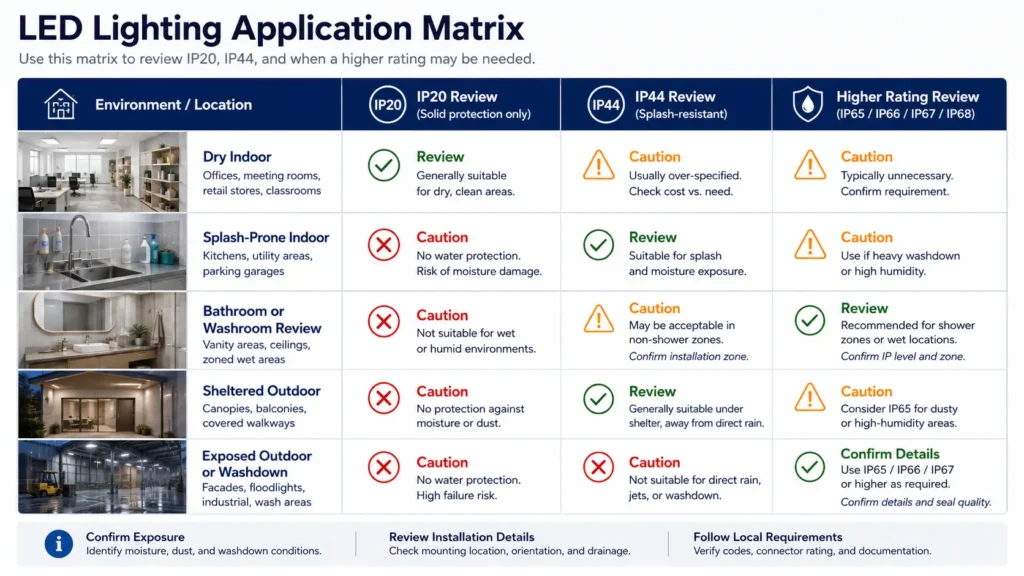
IP44 should not be used as another word for waterproof. Instead, describe it as splash-resistant under the rating definition. Therefore, review a higher rating or a different product design when the project includes:
In short, the IP rating applies to the tested enclosure. However, the installed lighting system may have more than one weak point. A strip, fixture, driver, connector, cable entry, mounting profile, adhesive, and setup method can all affect the final review.
Related internal resources: for LED strip projects, compare waterproof vs non-waterproof LED strips. For outdoor COB strip planning, review the outdoor COB LED strip IP and installation guide.
For B2B lighting projects, the IP number is only one part of the choice. For instance, a fixture may have one rating, while the driver, connector, cable joint, or mounting space faces a different level of dust or water. If the weakest point is exposed, a higher-rated fixture alone may not solve the risk.
Before choosing IP20 or IP44, confirm these points:
Also, this system check is useful for OEM, sign, retail display, bathroom, kitchen, hotel, and outdoor-facing lighting projects.
A supplier cannot review IP20 vs IP44 from the rating number alone. Therefore, the RFQ should explain the use case, site, and water risk. With that detail, the sales or tech team can check whether the requested rating makes sense.
| RFQ Item | What to Provide |
|---|---|
| Use case | Cabinet lighting, display lighting, sign lighting, bathroom mirror area, kitchen area, outdoor accent, or other use. |
| Install location | Dry indoor area, splash-prone area, sheltered outdoor area, exposed outdoor area, or special site. |
| Water exposure | No water, light splash, steam, cleaning spray, rain, water jets, or immersion risk. |
| Product format | LED strip, fixture, module, profile, sign lighting, or custom assembly. |
| Driver location | Inside dry space, near the light, remote cabinet, outdoor box, or other place. |
| Connector and cable exposure | Hidden, partly exposed, or exposed to moisture. |
| Quantity and size | Length, quantity, voltage, power, install size, and layout drawing if available. |
| Document needs | Datasheet, install notes, exact IP rating, test note, product drawing, or certificate files if required. |
This does not promise a specific product, lead time, certificate, or rating. Instead, it helps the supplier understand the job before giving advice or a quote.
Procurement teams should not approve IP claims based only on a short product title or sales phrase. Instead, ask whether the supplier can provide papers that match the project risk.
Finally, use “ask whether available” wording during supplier review. Do not assume every supplier or every SKU has the same document set.
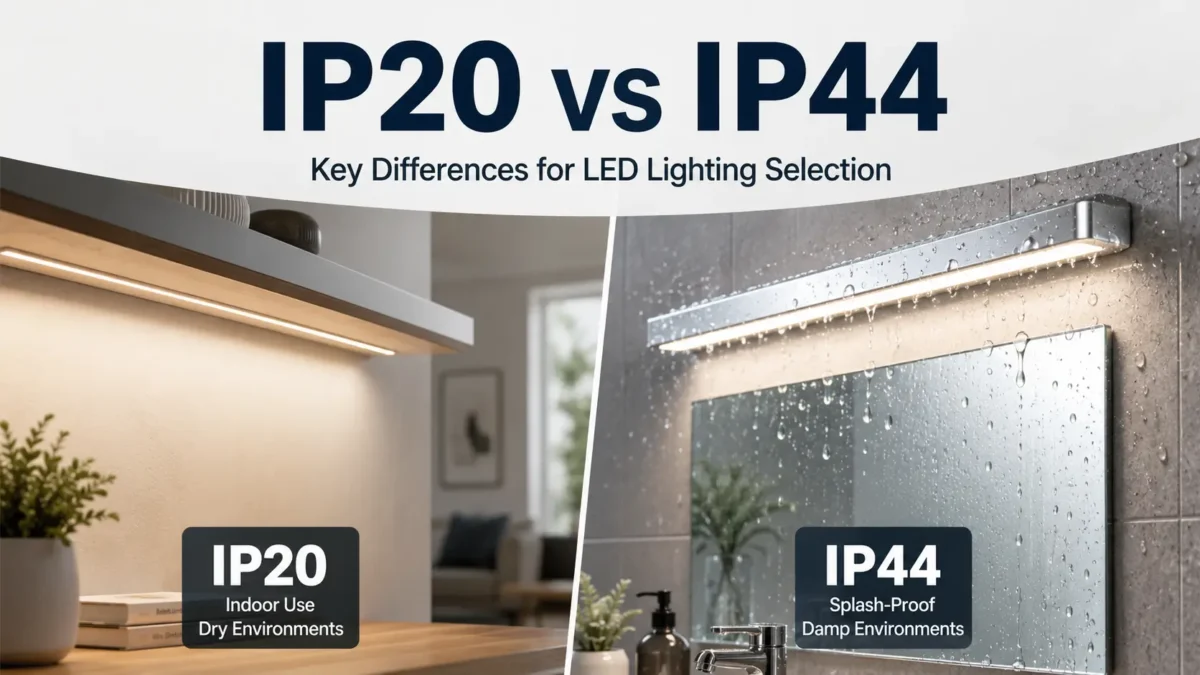
IP20 blocks larger solid objects but has no rated water protection. IP44 has a higher solid-object digit and a water digit for splashing water. In lighting selection, IP20 is usually reviewed for dry indoor areas, while IP44 is reviewed when limited splash risk may occur.
IP44 gives more ingress protection than IP20 because it has a higher solid-object digit and includes splash protection. However, it is not always the better project choice. For a dry indoor use case, IP20 may be enough if the product design and setup are suitable. For splash-prone areas, IP44 or a higher rating may need review.
No. IP20 should not be described as waterproof. Its second digit is 0, so it does not provide rated water protection. Therefore, review it only where water, splashing, steam, or cleaning spray is not expected.
No. IP44 should not be described as waterproof. It means protection against splashing water, not water jets, heavy washdown, or immersion. If the lighting will face stronger water exposure, review a higher IP rating and the full system design.
It depends on the outdoor condition. For example, a sheltered outdoor spot is different from direct rain, wind-driven water, washdown, or exposed joints. So, do not assume IP44 is fit for all outdoor projects. Share the exposure details with the supplier before selection.
Do not assume IP20 is acceptable for a bathroom. Bathroom use depends on the exact location, splash risk, fixture design, install method, and local rules. If moisture or splashing may occur, ask for a technical review before selecting IP20.
Review a higher IP rating when the product may face direct rain, water jets, washdown cleaning, heavy dust, exposed outdoor use, or immersion risk. Also, choose the exact rating based on the real exposure and the full lighting system, not only the fixture body.
Provide the use case, install location, indoor or outdoor condition, water exposure, cleaning method, driver location, connector exposure, quantity, size, target IP rating, and document needs. As a result, the supplier can review whether IP20, IP44, or a higher rating should be considered.
Before requesting a quote, prepare the site details, install position, splash or cleaning exposure, target IP rating, quantity, drawings, and document needs. Then, a technical review can check whether IP20, IP44, or a higher IP-rated lighting setup should be discussed for your project.

 English
  Spanish
  French
  Arabic