Commercial outdoor LED strip projects can go wrong when buyers choose only by brightness, price, or the word “waterproof.” For example, a strip that works under a covered sign cabinet may not fit an open façade, a landscape edge, or a wet area. So, the strip should be reviewed as part of a full system.
First, look at the site. Then, check the install method, power plan, color needs, control method, and quote details. This guide explains how to compare commercial grade outdoor LED strip lights before you contact a supplier or prepare an RFQ.
Choose commercial grade outdoor LED strip lights by matching the strip and full system to the site. First, confirm water and dust risk, IP rating needs, voltage, watts per meter, run length, driver location, color or CCT, control method, connectors, mounting, and RFQ details. Also, do not rely on “waterproof” or “commercial grade” wording alone.

“Commercial grade” should not be treated as one fixed spec. Instead, it should mean the LED strip can be checked against the real site, buyer needs, and technical limits.
For this reason, a buyer should compare these points:
| Choice Factor | Why It Matters | What to Confirm |
|---|---|---|
| Outdoor site risk | Covered, splash-prone, rain-hit, and wet areas need different planning. | Location, water direction, drain path, UV, and service access. |
| IP rating need | IP ratings are used as a guide for dust and water ingress. | Needed protection for the strip and nearby parts. |
| Voltage and power plan | Long runs and many sections affect feeds and driver size. | Voltage, watts per meter, run length, feed points, and driver size. |
| Color or CCT | Projects may require warm white, neutral white, cool white, RGB, RGBW, or other options. | First, define the color, CCT, color consistency expectations, and control method. |
| Mounting method | Adhesive alone may not be enough outside. | Channel, clips, profile, surface, and service access. |
| System sealing | The strip body is only one part of the outdoor system. | Cut ends, connectors, cable entries, controller, driver, and box. |
| RFQ details | Clear input helps avoid a vague quote. | Application, drawings, quantity, destination, docs needed, and install notes. |
Therefore, the goal is not to find a universal “best” strip. The goal is to define the job clearly enough for a useful quote. For product context, review the ELSTARLED LED strip lights category before final supplier discussion.
Outdoor LED strips can fit many business sites. However, the use case must match the product, install method, and site risk. Use this table as a starting point for seller discussion.
| Use Case | Main Choice Point | Risk to Check | RFQ Note |
|---|---|---|---|
| Signage and sign cabinets | Brightness, color, run length, power access, service access. | Heat buildup, uneven light, and hard repair access. | Send sign size, layout, color target, and site photos. |
| Building façade accents | Weather risk, profile mounting, long runs, and color match. | Open rain, cable route, and driver place. | Share wall drawings and section lengths. |
| Outdoor cove or edge lighting | Diffusion, mounting profile, glare control, voltage-drop planning. | Moisture, hard service access, and uneven light. | Send cove size and power-feed points. |
| Hotel or retail exterior lighting | Look, dimming, color match, and install strength. | Too much glare, poor hiding, and hard repair access. | Share the desired look and control needs. |
| Landscape edge or pathway-adjacent lighting | Moisture risk, impact risk, cable cover, and fixture place. | Standing water, soil contact, accidental damage. | Say whether the strip is covered, open, or near water buildup. |
| OEM or custom channel lighting | Size, cut length, connector type, wire exit, pack, and assembly. | Fit tolerance, sealing after cuts, and sample checks. | Send drawings, samples, or fit limits. |
In short, these use cases may work when the rating, install method, and site conditions match. They should not be treated as automatic fit claims.
Ingress protection ratings are used to classify resistance to dust and liquids. In the IP code, the first digit relates to access or solid foreign objects. The second digit relates to water ingress. However, IP ratings are only one part of outdoor review.
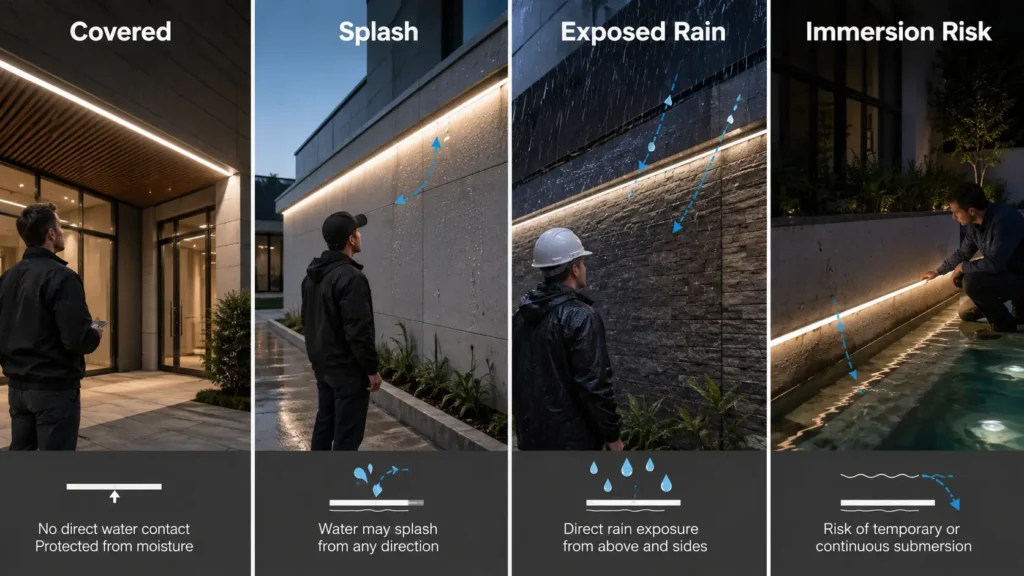
| Outdoor Condition | What to Check | What Not to Assume |
|---|---|---|
| Covered outdoor area | Dust, humidity, light splash, and cleaning. | Do not assume an indoor-rated strip is acceptable just because the area is covered. |
| Splash-prone area | Splash direction, splash frequency, cleaning method, and cable entry cover. | Do not assume the strip body rating covers connectors and cut ends. |
| Rain-hit area | Rain direction, mounting angle, drain path, UV, and driver place. | Do not assume “waterproof” means the whole system is protected. |
| Wet or washdown-adjacent area | Water pressure, cleaning cycle, chemical risk, and box needs. | Do not assume an IP rating covers every washdown or chemical condition. |
| Standing-water risk | Whether the product and system are made for that use. | Do not treat normal outdoor strips as fit for immersion without written review. |
Also, a higher IP rating is not always the right answer. It may affect flexibility, heat handling, installation method, or service access. Therefore, ask the seller to match the rating and sealing method to the real site.
US project note: If a project specification mentions NEMA enclosure types, confirm the exact need instead of treating IP and NEMA as the same. NEMA’s enclosure reference explains that IEC classifications cannot be exactly equated with NEMA enclosure type numbers and that the conversion table cannot be used in both directions.
A waterproof-rated strip does not make the whole install waterproof. Therefore, outdoor jobs need a system-level review. ELSTARLED’s outdoor COB LED strip guide can help with basic planning for sealing, driver/controller place, and power layout.
| System Part | What to Check |
|---|---|
| Strip body | Confirm the rating, coating or sleeve type, and fit for the site. |
| Cut ends | Ask how cut ends should be sealed after field cutting or factory prep. |
| Connectors | Confirm whether connectors fit outdoor use and how they should be covered. Also, use connector guidance, such as ELSTARLED’s COB LED strip connector guide, only as a starting point for project review. |
| Cable entries | Check cable route, entry points, strain relief, and seal method. |
| Controller | Confirm whether the controller is placed in a dry area or a suitable box. |
| Power supply / driver | Confirm location, box, load plan, and service access. |
| Mounting channel or profile | Check drain path, heat path, support, and service access. |
| Final install test | Inspect before closing panels, profiles, or sign cabinets. |
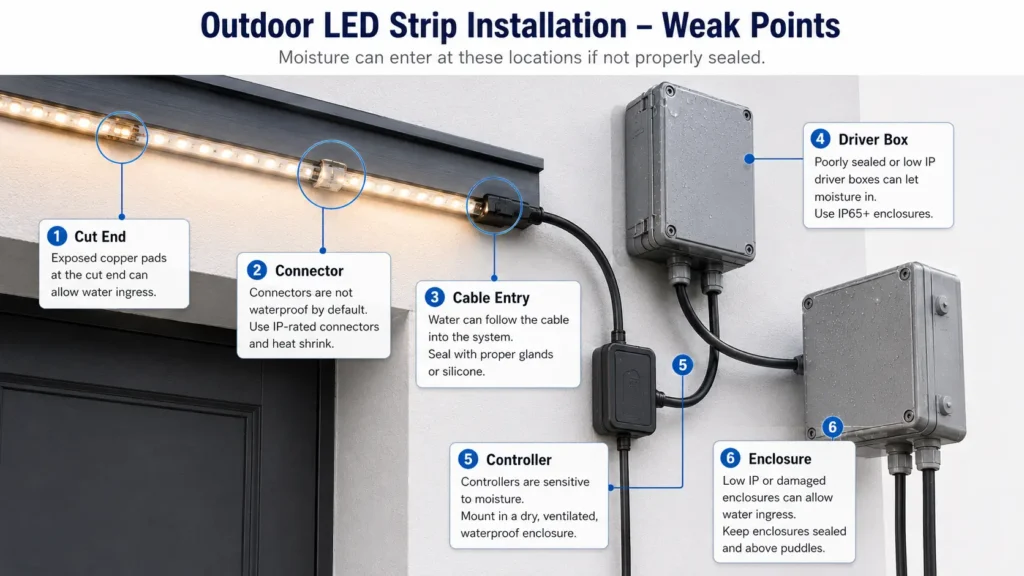
For example, long runs, field cuts, sharp corners, open cable paths, and outdoor controls add risk. If local rules apply, have a qualified installer or engineer review the final setup.
Voltage and power planning affect strip layout, feed points, and driver or LED power supplies can be placed. The right choice depends on the exact data sheet and job layout.
| Planning Item | What to Prepare | Why It Matters |
|---|---|---|
| Voltage choice | 12V, 24V, or seller advice. | Voltage affects feeds and driver/controller fit. |
| Watts per meter | Confirm from the exact data sheet. | It is needed for driver size and load math. |
| Total length | Total job length and length by section. | It helps plan power demand and layout. |
| Maximum single run | Longest strip section without a break. | It helps spot voltage drop and feed needs. |
| Feed method | One-end feed, two-end feed, or many feed points. | It affects light balance and wire work. |
| Driver location | Indoor, protected box, cabinet, or other place. | It affects cable route, box plan, and service access. |
| Dimming/control | On/off, dimming, RGB, RGBW, DMX, SPI, or other needs. | Controls must match strip type and job needs. Also, review compatible LED strip controllers and amplifiers during system planning. |
Do not choose voltage by habit alone. A small sign, a long façade run, and a custom OEM channel may need different power plans. For more context, compare the roles of the LED driver and strip light before you finalize the power plan. Confirm the exact datasheet and wiring plan before purchase.
Commercial buyers often focus on brightness first. However, other details can affect fit. When tunable white, dimming, or color control matters, review color and CRI needs during sampling; the U.S. Department of Energy provides more context on LED color-tunable products.
For custom requests, share the needed CCT, brightness, CRI, PCB board, IP rating, input voltage, outlet type, bend direction, or mechanical need, Then, confirm what is available for the exact job and order.
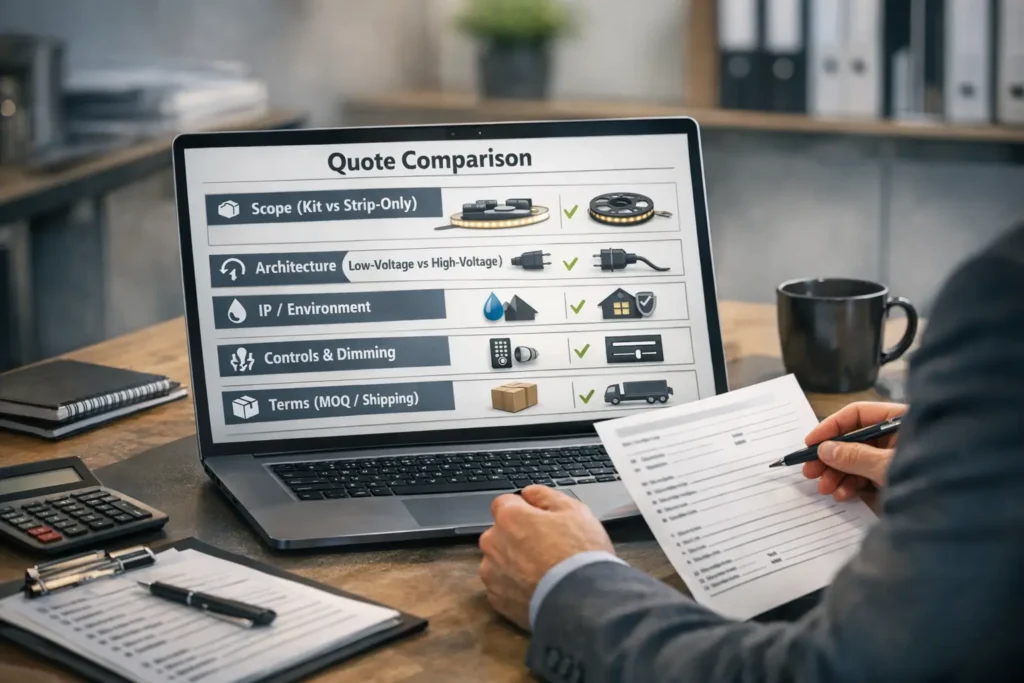
A clear RFQ helps the seller respond with useful input instead of asking for basic facts later. ELSTARLED’s LED strip manufacturer selection and RFQ guide can support deeper seller-screening questions.
| RFQ Item | Details to Send |
|---|---|
| Use case | Signage, façade, cove, landscape edge, hospitality exterior, retail exterior, OEM channel, or other. |
| Outdoor site | Covered, splash-prone, rain-hit, wet area, high humidity, or other risk. |
| Drawings or photos | Wall drawings, sign cabinet drawings, profile drawings, site photos, or sketches. |
| Total length | Total meters/feet and section-by-section lengths. |
| Strip path | Straight runs, corners, curves, side-bend needs, or custom routes. |
| Color need | CCT, RGB/RGBW, color consistency expectation, or sample target. |
| Brightness need | Accent, sign light, visibility, or job output target. |
| Voltage choice | Known voltage or request seller advice. |
| Control method | On/off, dimming, RGB/RGBW controller, DMX/SPI, or other. |
| Quantity | Sample quantity, project quantity, or forecast quantity. |
| Destination | Country/region and any packaging or shipping requirements. |
| Docs needed | Data sheet, wiring note, install guidance, test or certificate docs if available. |
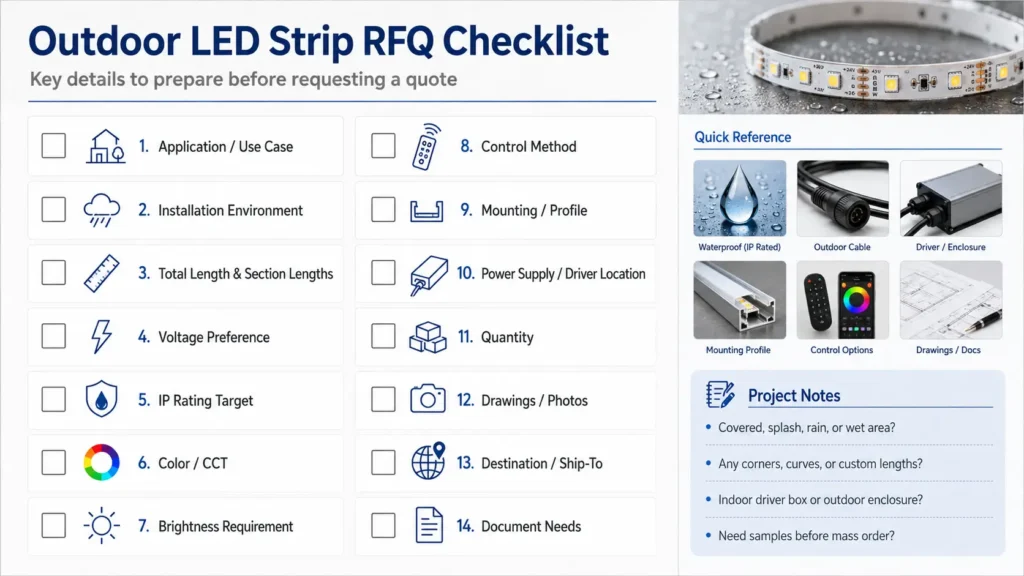
Therefore, avoid asking only, “How much is commercial outdoor LED strip?” A useful quote usually needs site risk, length, color, voltage, control, quantity, and install details.
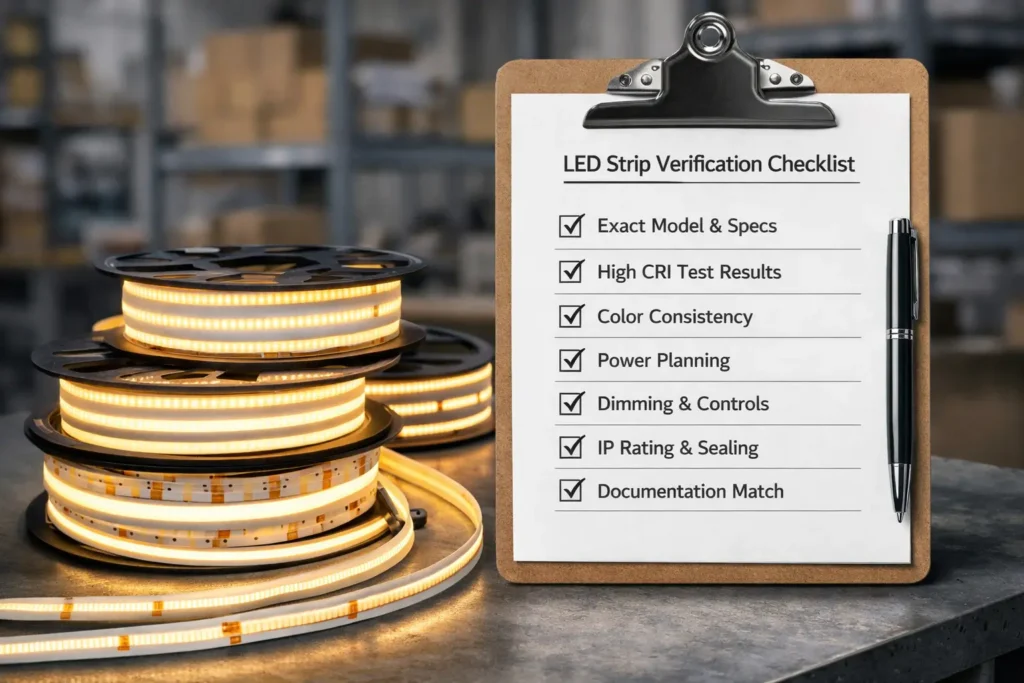
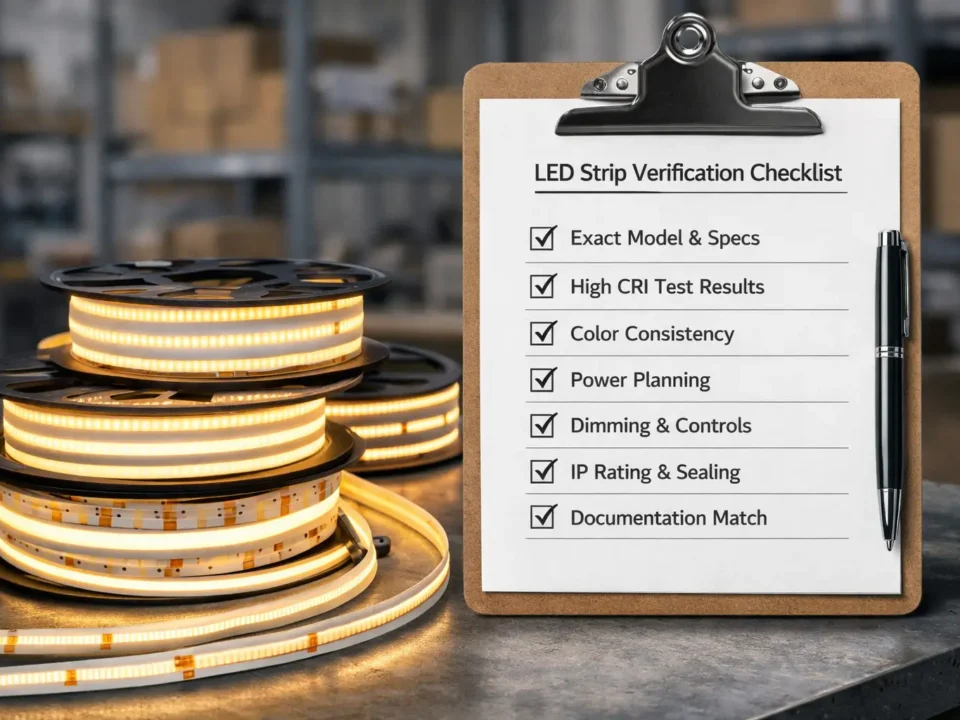
Before you confirm a business order, the buying and engineering teams should ask questions that reduce risk.
These questions do not replace engineering review. However, they help buyers avoid vague product checks.
For outdoor projects, “commercial grade” should mean the strip and the full system can fit the real site. First, check water and dust risk, IP rating needs, voltage, watts per meter, run length, color or CCT, control type, mounting, connectors, driver location, and RFQ details. Also, do not treat the phrase as proof by itself.
There is no single best IP rating for every outdoor job. Instead, match the rating to the site. For example, a covered wall, a splash zone, an open rain area, and a place with standing water each need a different review. So, ask the seller to match the IP rating and sealing method to the real site.
No. A waterproof strip body does not protect every part of the install. For example, cut ends, connectors, cable entries, controllers, drivers, power supplies, and boxes may still need review. Therefore, outdoor jobs should check the whole system before purchase.
The better voltage depends on the exact product, run length, watts per meter, control method, and power-feed plan. Therefore, confirm voltage and driver size from the exact data sheet. Also, do not choose by habit or price alone.
Before you ask for a quote, prepare the use case, site risk, total length, section lengths, color or CCT, voltage choice, control method, quantity, drawings or photos, install method, destination, and document needs. As a result, the seller can review the job with fewer follow-up questions.
Yes, they may be used in these jobs when the product rating, install method, power plan, and site conditions match. However, one strip does not fit every outdoor use. Therefore, share drawings, water-risk details, and install notes before you choose.
Ask what documents are available for the exact model and order. For example, you may ask for a data sheet, wiring notes, install guidance, IP build notes, and test or certificate documents if they exist. However, do not assume a document is available until the seller confirms it.
If you are comparing commercial grade outdoor LED strip lights, prepare the job details before you ask for a quote. Include the use case, outdoor site risk, total length, section lengths, color or CCT, voltage choice, control method, quantity, drawings or photos, install method, destination, and document needs.
Then, share those details with ELSTARLED for project review and quote discussion. Final choice should be checked against the exact data sheet, site conditions, and order documents available.
Contact ELSTARLED to discuss the project details.

 English
  Spanish
  French
  Arabic