What Are the Main Types of LED Lights?
How LED Lights Are Grouped
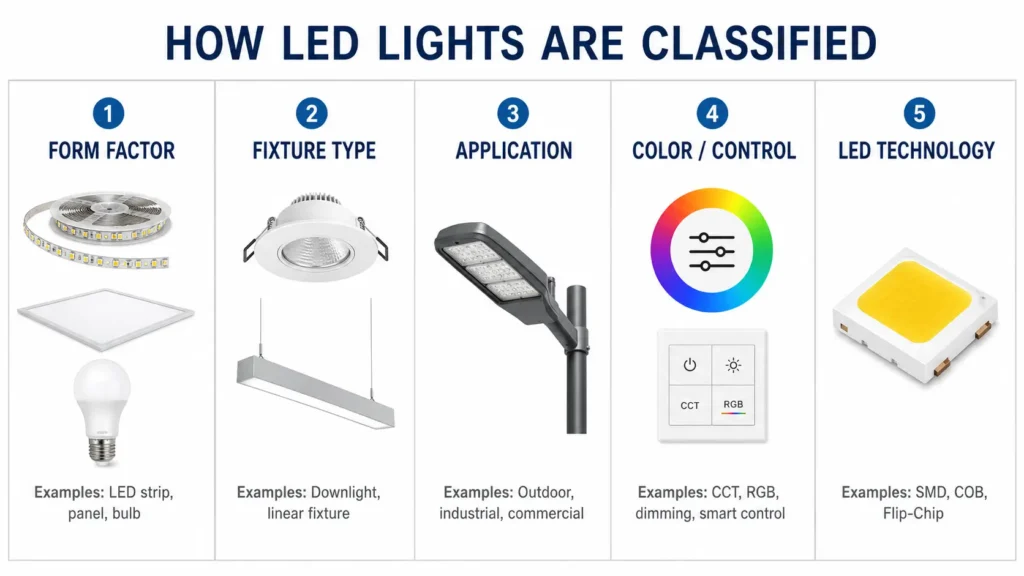
LED lights are not grouped in only one way. In fact, a product can be named by its shape, fixture style, use case, color function, or LED tech inside it.
| Group Layer | Examples | Why It Matters |
|---|---|---|
| Form factor | Strip, tube, panel, bulb, module, neon flex | Also, this defines the product shape and install method. |
| Fixture type | Downlight, spotlight, floodlight, linear fixture, under-cabinet light | In turn, this matches the product to a mounting spot or lighting task. |
| Use case | Signage, shop display, cabinet, ceiling, outdoor area, building line | As a result, it narrows the product group by project need. |
| Color / control function | One color, tunable white, RGB, RGBW, addressable control | Likewise, this matches the lighting effect and control system. |
| LED tech or package | SMD, COB, high-power LED, LED module | Also, this helps compare output style, even light, and product design; confirm against supplier specs. |
For most sourcing decisions, start with the use case and install setup. Also, use tech terms to support the choice, not to replace practical project questions.
Common Types of LED Lights at a Glance
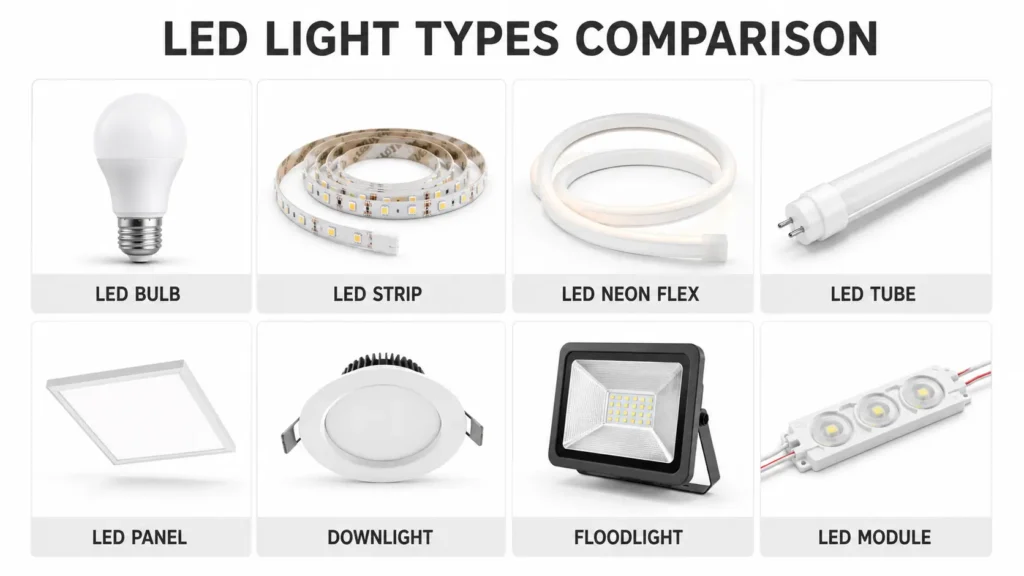
In short, the tables below give a clear view of common LED light types. Also, keep in mind that these are broad product types, not a claim that every supplier offers every type.
Bulb, Linear, and Ceiling Options
| LED Light Type | What It Is | Common Uses | Key Checks | B2B Note |
|---|---|---|---|---|
| Bulbs | Swap-in lamps | Homes, offices, hotels, small business sites | Base type, lumens, CCT, dimming fit, fixture fit | Also helpful when swapping older lamps in current fixtures. |
| Strip lights | Flexible line lighting on a strip or tape format | Cabinets, shelves, cove lighting, signage, displays, building lines | Voltage, width, length, brightness, CCT/color, IP rating, control unit, power supply | Good for linear or hidden lighting; however, install and power layout must be checked. |
| Neon flex | Bendable line lighting for a neon-like smooth line | Signage, decor lines, building accents, shop displays | Bend path, size, color, IP rating, cut/join method, mounting channel | Also chosen when a smoother line is needed. |
| Tube lights | Tube-style LED lamps or fixtures | Offices, storage sites, parking areas, service rooms | Tube size, fixture fit, wiring method, brightness, CCT | Also check retrofit vs LED-only fixture needs. |
| Panel lights | Flat panel lighting | Offices, schools, hospitals, business ceilings | Panel size, mounting method, lumens, CCT, glare control, driver fit | Also common for broad, even ceiling lighting. |
Focused, Outdoor, and Other Options
| LED Light Type | What It Is | Common Uses | Key Checks | B2B Note |
|---|---|---|---|---|
| Downlights / spotlights | Focused or recessed fixtures | Retail, hotels, offices, display areas | Beam angle, cutout size, depth, lumens, CCT, dimming | Also helpful when focused or recessed lighting is needed. |
| Floodlights | High-output fixtures for broader area lighting | Outdoor areas, building fronts, yards, parking areas, work sites | Output, beam angle, IP rating, mounting, voltage, heat control | Also, outdoor use needs a case rating and weather check. |
| Modules | Small LED units for signs, displays, or builds | Signage, channel letters, backlighting, OEM builds | Voltage, spacing, brightness, color, layout, water seal, power supply | Also part of a larger system. |
| Decorative / string lights | Small LEDs arranged for decorative lighting | Events, retail décor, outdoor décor, hotels | Indoor/outdoor rating, color, length, control mode, plug style | Also, the choice depends on site needs and install method. |
Choosing LED Lights by Use
First, start the LED choice process with the project site. Even so, the same LED type may work well in one site and poorly in another if the brightness, voltage, IP rating, mounting, or control method is wrong.
| Use | LED Forms Often Considered | Specs to Confirm | Risk to Avoid |
|---|---|---|---|
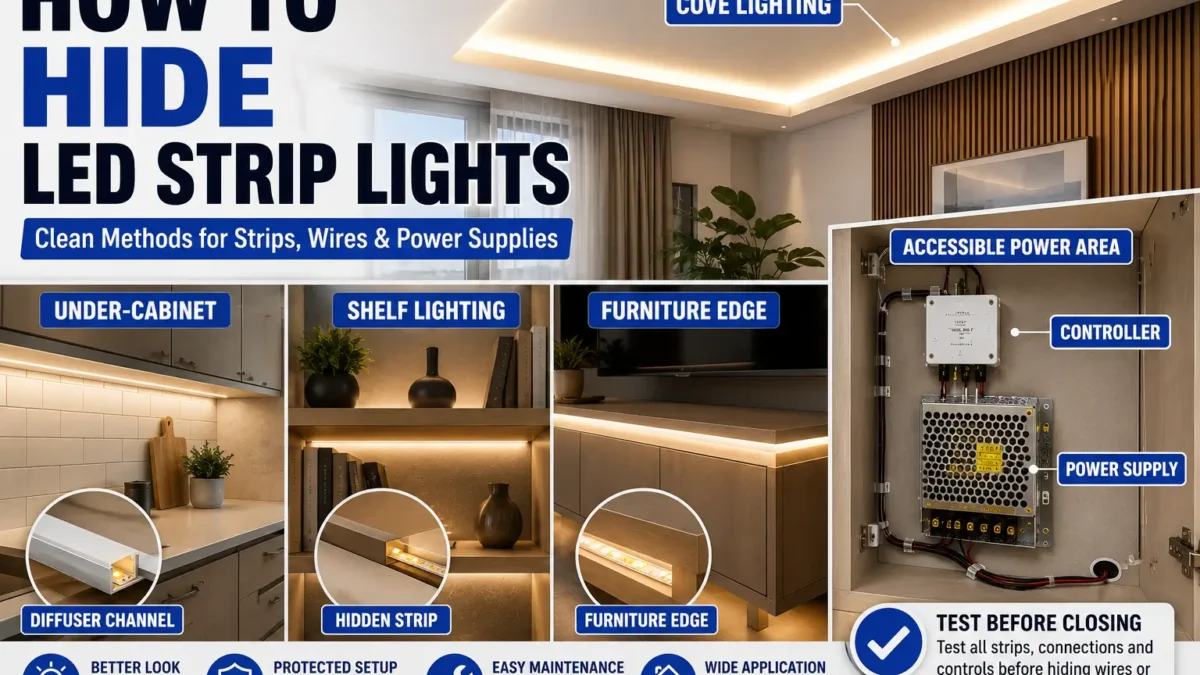
| Cabinet or shelf lighting | LED strips, under-cabinet lights, small linear fixtures | Voltage, strip width, CCT, brightness, channel/diffuser, power supply | Visible dots, poor heat handling, wrong color tone |
| Signage and logo lighting | LED modules, LED strips, LED neon flex | Color, spacing, voltage, IP rating, cut/join method, mounting | Uneven brightness, wrong bend path, poor outdoor rating |
| Building line lighting | LED strips, neon flex, linear fixtures | Length, channel, diffuser, CCT/RGB, dimming/control, install surface | Uneven color, hard upkeep, wrong mounting method |
| Office or business ceiling lighting | LED panels, downlights, tubes, linear fixtures | Size, lumens, CCT, glare control, driver/dimming fit | Wrong fixture size, harsh glare, wrong color |
| Shop display lighting | Strips, spotlights, downlights, panels | Beam angle, CCT, color quality needs, mounting position, dimming | Poor product look or uneven display lighting |
| Outdoor or exposed areas | Floodlights, outdoor linear lights, sealed strips, neon flex | IP rating, mounting, voltage, case, cable/plug seal | Using an indoor product in outdoor or exposed areas |
Also, for outdoor or exposed installs, check the product’s IP rating and supplier docs before final choice. However, the same product type may have indoor and outdoor versions, so the type name alone is not enough.
Key Specs to Check Before Choosing an LED Light
Lumens and brightness
Lumens describe light output. However, wattage alone does not tell you how bright a light will appear. As a result, define the needed brightness level or ask the supplier to suggest an output based on the use case and install distance.
CCT and color tone
CCT, or color temp, is measured in Kelvin. In general, lower Kelvin values appear warmer, while higher values appear cooler or bluer.
Voltage and power supply
Many LED products need a matched power supply or driver. Also, LED strips, modules, and low-voltage linear lighting often need careful matching between voltage, total length, wattage, control method, and power layout.
Color and control method
Some LED products are one color. By contrast, others may support tunable white, RGB, RGBW, or addressable control. As a result, control needs should be discussed early because they may affect wiring, control units, power supply choice, install layout, and fit.
IP rating and install site
If the install area is exposed to dust, moisture, rain, cleaning, or outdoor weather, first check the product’s IP rating. Also, confirm whether plugs, power supplies, and mounting parts are suitable for the site.
Size, length, and mounting
Size matters. For example, with LED strips and neon flex, confirm width, height, bend path, cutting length, connection method, and mounting parts. Also, with panels, downlights, and tubes, confirm fixture size, cutout size, mounting depth, or replacement fit.
Supplier docs
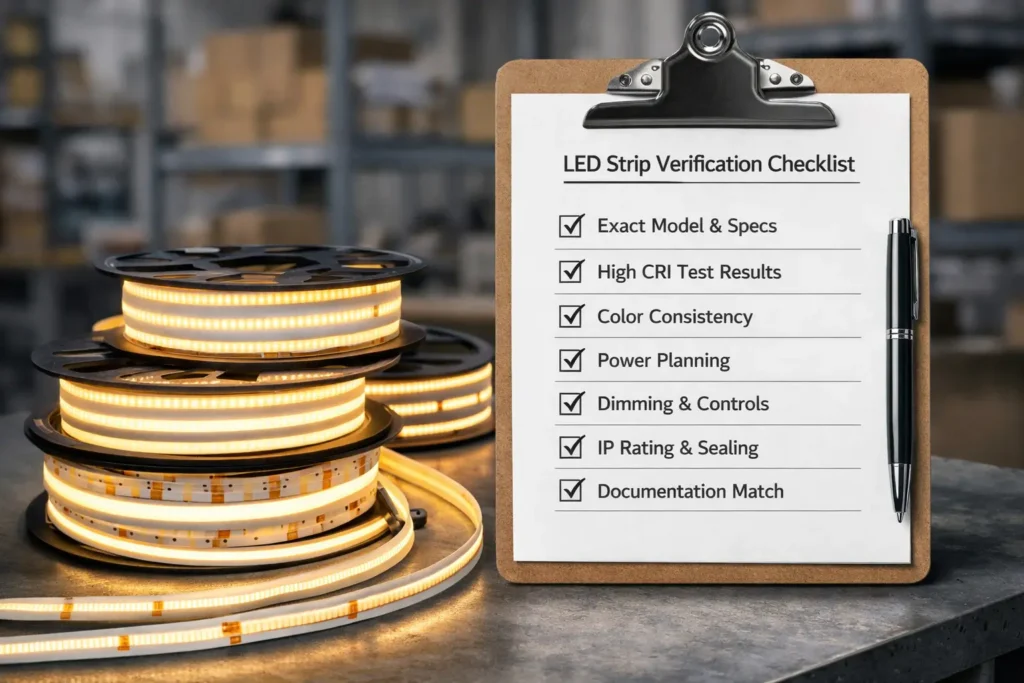
Finally, before choosing, ask for the docs needed for your project. For instance, this may include a data sheet, install guide, wiring diagram, light output data, sample sign-off, or needed test or cert docs. Also, do not assume docs are ready unless the supplier confirms it.
LED Strip Lights: Common Types and Checks
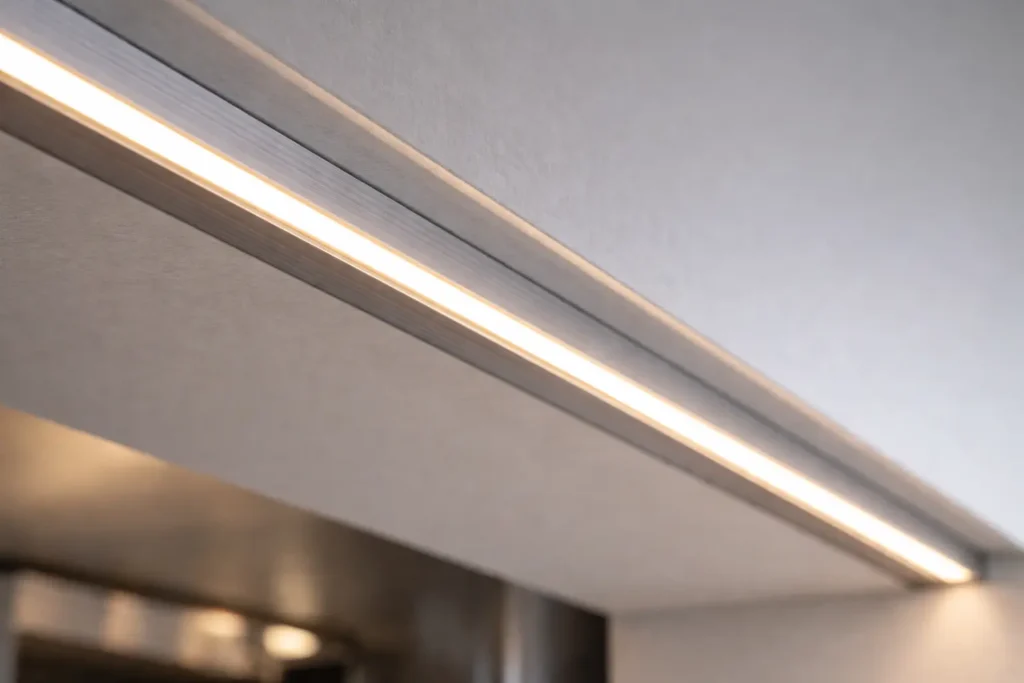
In fact, LED strip lights are a common choice when the project needs a linear, flexible, or hidden light source. For example, they are often used for cabinets, shelves, signage, cove lighting, shop displays, and building accent lines.
| LED Strip Type | Typical Use | Buyer Checks |
|---|---|---|
| One-color LED strip | Simple white or one-color linear lighting | CCT/color, brightness, voltage, width, length, power supply |
| Tunable white / CCT strip | Projects that need adjustable white tone | CCT range, control unit, wiring method, power supply fit |
| RGB strip | Decor or color-changing lighting | Controller type, voltage, brightness, install length |
| RGBW strip | Color effects plus a separate white channel | Control method, white tone, wiring, power needs |
| COB LED strip | More smooth-looking linear light in some designs | Output, width, voltage, heat control, channel/diffuser needs |
| Addressable LED strip | Moving effects where parts can be controlled one by one | Protocol/control unit, voltage, wiring, program/control needs |
| Sealed or outdoor-rated strip | Damp, exposed, or outdoor-use installs | IP rating, plug seal, mounting, power supply location |
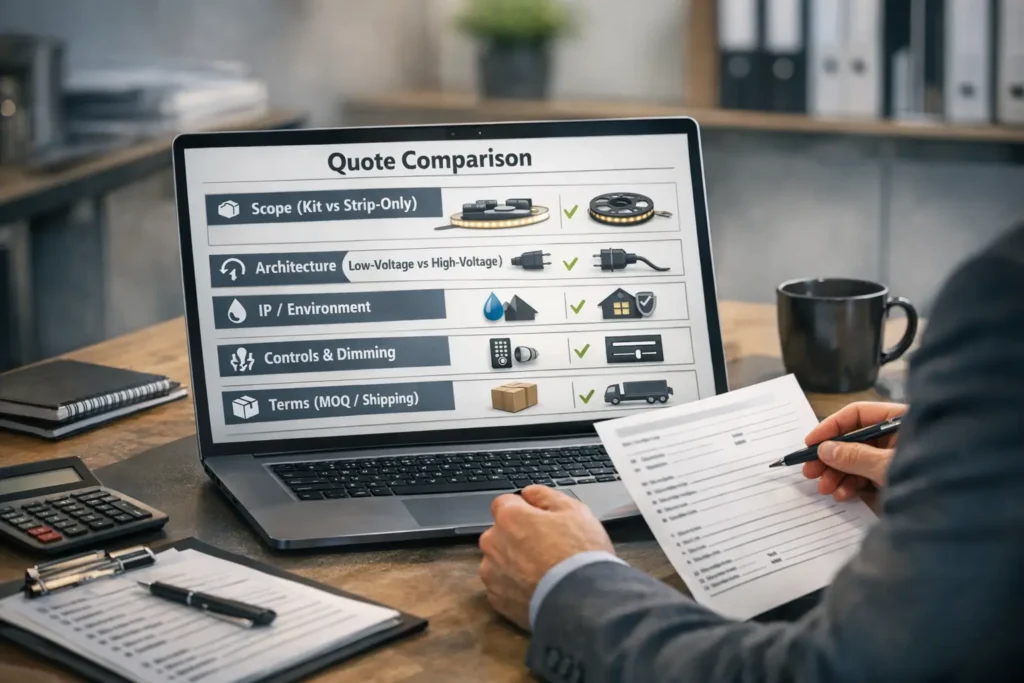
Also, for an easier supplier check, prepare the install length, desired color or CCT, voltage preference, brightness target, install surface, indoor/outdoor site, control method, and any drawings or photos. As a result, this helps the supplier review the request and suggest next-step options.
What to Prepare Before Asking for a Quote
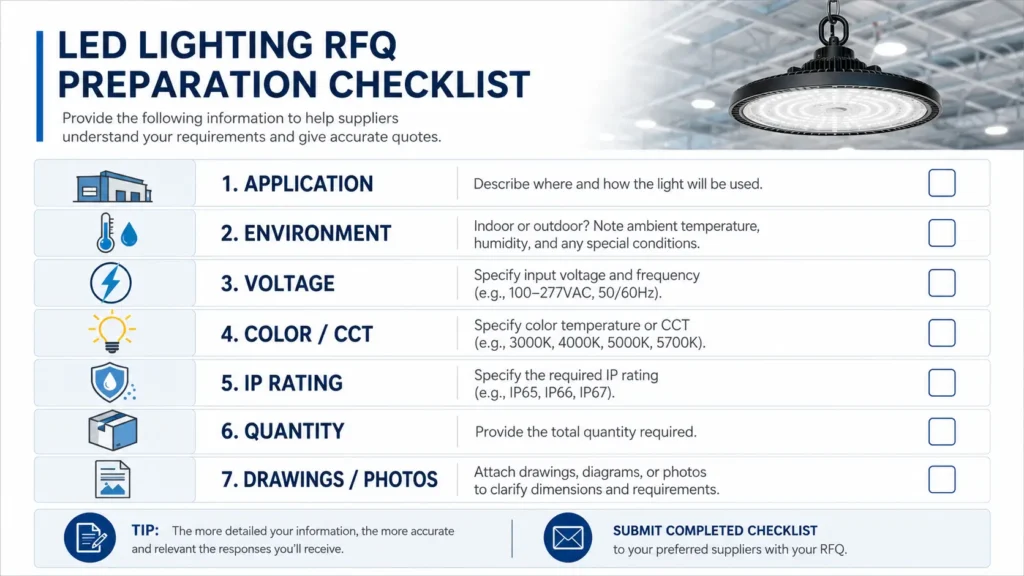
In short, a clear RFQ helps reduce back-and-forth and lowers the risk of choosing the wrong product. Also, even at an early sourcing step, buyers can prepare a basic project brief.
| RFQ Item | What to Provide | Why It Helps |
|---|---|---|
| Use | Cabinet, signage, ceiling, shop display, outdoor area, building line, etc. | Also helps narrow the product type. |
| Install site | Indoor, outdoor, damp, dusty, exposed, enclosed, high-heat area, etc. | Because of this, it helps find rating and install needs. |
| Product form | Strip, neon flex, tube, panel, floodlight, module, or unsure | In turn, it helps the supplier suggest the right type. |
| Size or length | Total length, fixture size, cutout size, channel size, or free space | As a result, it helps check real fit and power layout. |
| Brightness | Target lumens, sample, or brightness goal | For this reason, it helps avoid too little light or too much light. |
| Color / CCT | Warm white, neutral white, cool white, RGB, RGBW, or target Kelvin | Likewise, it helps match visual tone. |
| Voltage / power | Needed input voltage or site power setup | Therefore, it helps match drivers, power supplies, and wiring. |
| Control method | On/off, dimming, remote, DMX, SPI/addressable, smart control, or no control needed | In addition, it helps check fit early. |
| IP or weather needs | Indoor only, damp area, outdoor, rain, dust, cleaning | As a result, it helps review case and part needs. |
| Order count | Estimated order count or project count | Also, it helps prepare quote review. |
| Drawings or photos | Site photos, layout drawings, install sketches, section drawings | In turn, it helps avoid mix-ups. |
| Needed docs | Data sheet, install guide, wiring diagram, test report, cert doc, sample | Finally, it helps find doc needs before sign-off. |
Also, do not rely only on a product name. “LED strip,” “LED panel,” or “LED floodlight” is a starting point, not a complete spec.
Questions to Ask a Supplier Before Final Choice
- First, which product type do you suggest for this use, and why?
- Next, which voltage, power supply, driver, or control unit is needed?
- Then, how should the product be installed?
- Also, is the product intended for indoor, damp, or outdoor use?
- In addition, which IP rating or sealing details apply to the product and parts?
- For example, are there length, cutting, plug, or mounting limits we should know?
- Finally, can you provide a data sheet, wiring guide, install guide, or sample?
- Also, could you flag any fit issues with dimmers, control units, channels, or power supplies?
- Before quoting, what info do you need from us?
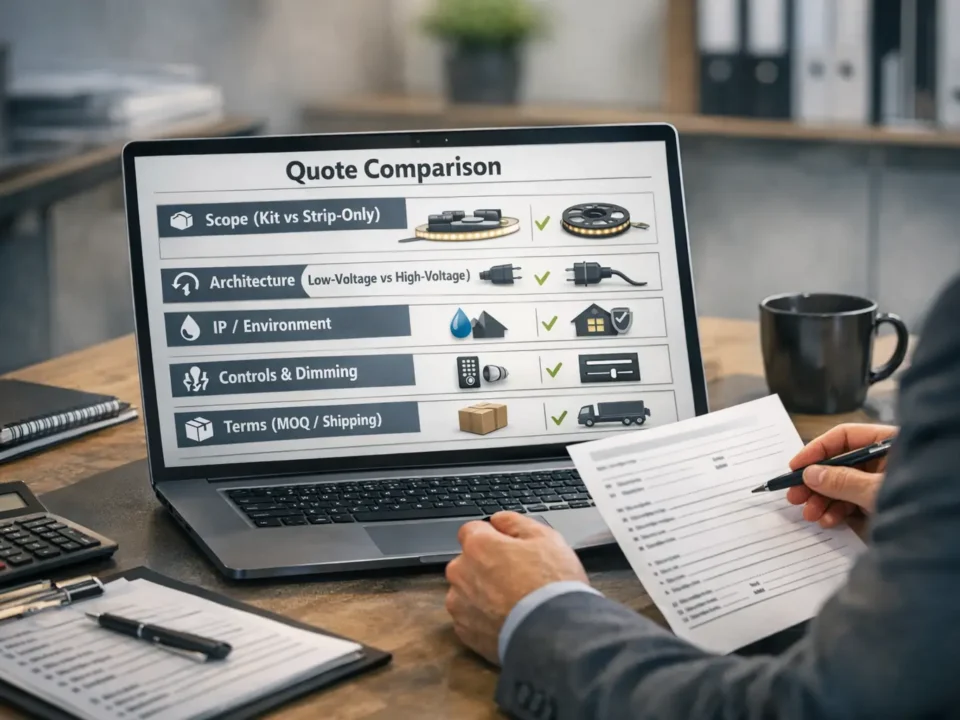
Although these questions do not replace technical review, they help buyers avoid choosing a product based only on its look or a short product title.
FAQ
What are the types of LED lights?
Common types include LED bulbs, strip lights, neon flex, tube lights, panel lights, downlights, spotlights, floodlights, LED modules, and decorative or string lights. They can also be grouped by use case, color/control function, or LED tech.
How many types of LED lights are there?
In practice, there is no one fixed number because LED lights can be grouped in several ways. For sourcing, define the use case and needed specs rather than learning a count.
Which LED light type is best?
No single type is best for every project. Instead, the right option depends on use case, install site, brightness target, color tone, voltage, control method, size, and needed docs.
What are the types of LED strip lights?
Common LED strip types include one-color strips, tunable white strips, RGB strips, RGBW strips, COB strips, addressable strips, and sealed or outdoor-rated strips.
Can LED lights be used outdoors?
First, some LED products may be rated for outdoor or open sites. However, the type name alone is not enough. Check IP rating, case design, plug seal, power supply location, and supplier docs.
What is the difference between CCT and RGB?
CCT describes white-light tone such as warm white, neutral white, or cool white. By contrast, RGB refers to red, green, and blue color mixing for color-changing effects.
Does higher wattage mean brighter LED lighting?
Not always. Instead, brightness should be checked in lumens, not only watts. Wattage shows power use, while lumens describe light output.
What info should I prepare before asking for a quote?
Prepare use case, install site, product type, size or length, brightness target, CCT or color, voltage, control method, IP/weather needs, order count, drawings/photos, and needed docs.
Need Help Choosing an LED Lighting Type?
Before asking for a quote, prepare your use case, install setup, size or length, voltage, color or CCT needs, brightness target, control method, IP or weather needs, order count, and any drawings or photos.
As a result, a clear project brief helps the supplier review the lighting type, spec path, and docs needed for the next step.

 English
  Spanish
  French
  Arabic