Confused by RGB strip types? This guide compares RGB, RGBW, RGBCCT, analog, addressable, 5050, 3528, COB, voltage choices, controllers, and IP ratings so you can choose the right strip without flicker, dim ends, or poor color results.
For related internal product pages, browse LED strip lights, COB LED strips, LED controllers and dimmers, LED power supplies, and LED aluminum profiles. For useful external references, see WLED documentation, the Adafruit NeoPixel guide, and the IEC IP ratings overview.
RGB strip types can be grouped by color channels, control method, LED package, voltage, and environment. First, choose the color family. Next, choose analog or addressable control. Then, match voltage, controller, power supply, and profile.
As a result, the best strip is not always the brightest or most complex one. Instead, the best strip is the one that matches the lighting goal, run length, controller, and install environment.
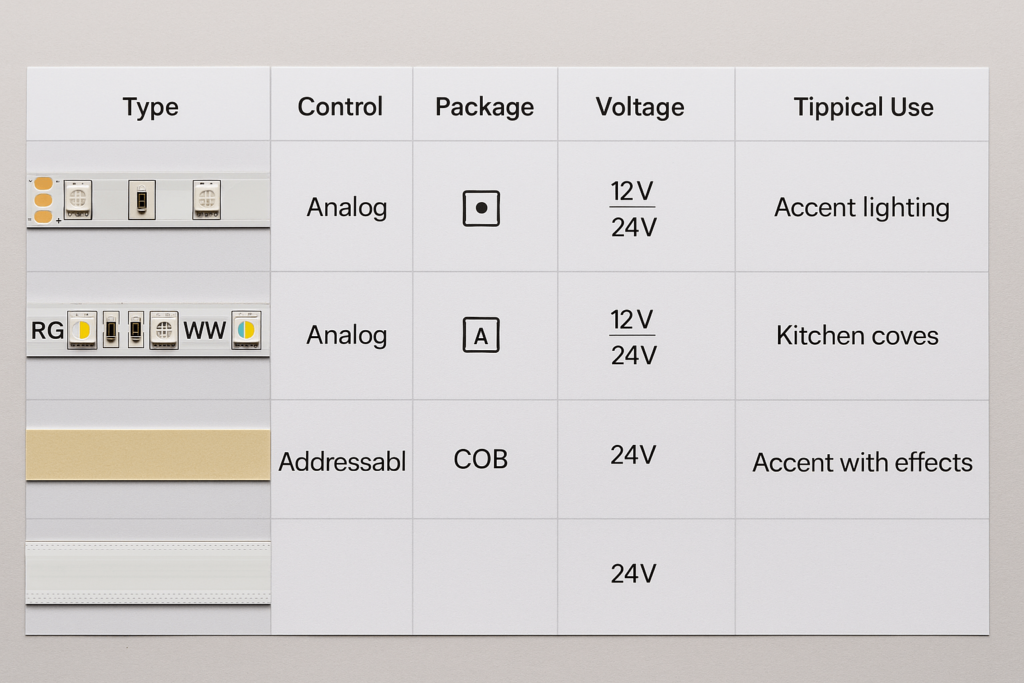
This quick matrix helps compare RGB strip types by channel setup, control method, package, voltage, and use case. Also, it can help you narrow the choice before selecting a model.
| Type | Control | Package | Voltage | Typical Use | Pros | Trade-offs |
|---|---|---|---|---|---|---|
| RGBW | Analog PWM | SMD 5050 | 24V | Kitchen coves | Better whites; simple control | Extra channel; plan run length |
| RGBCCT | Addressable or multi-channel control | COB or SMD | 5V / 12V / 24V | Accent with effects | Color plus tunable white | More wiring and controller planning |
For a product-level comparison, compare families in the LED strip lights collection. Then, confirm the controller and power supply before ordering.
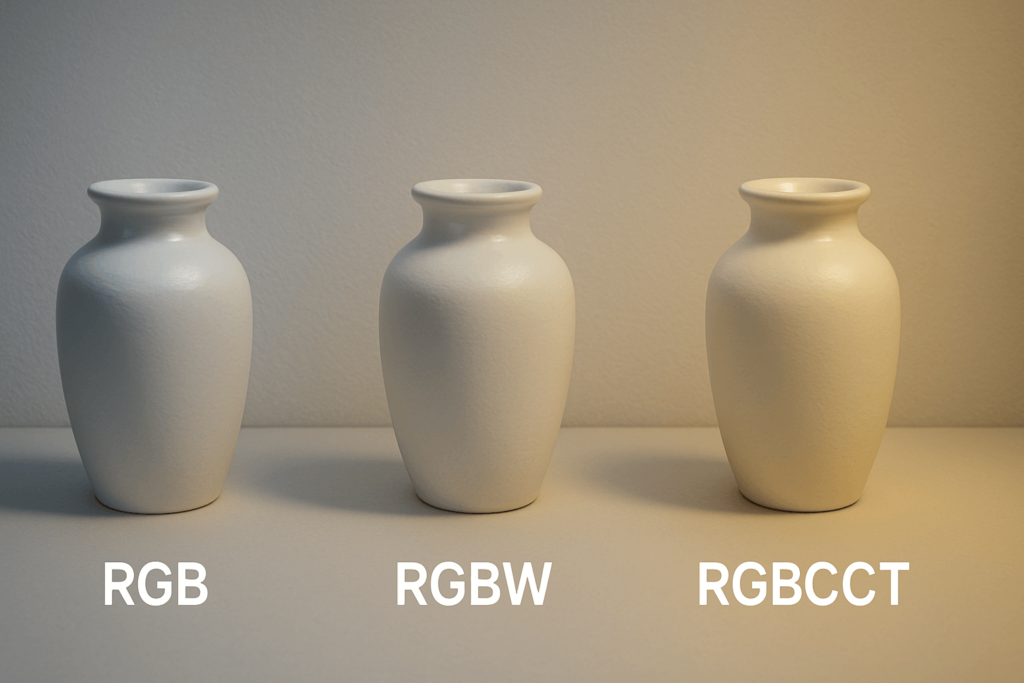
These RGB strip types differ by how they handle white light. RGB can mix colors, but white may look less clean. RGBW adds a white channel. RGBCCT adds warm and cool white channels for CCT tuning.
Choose RGB when color scenes are the main goal. However, if the project needs natural white light, RGB alone may not be ideal.
RGBW adds a dedicated white LED. As a result, neutral scenes, cove lighting, and display lighting can look cleaner.
RGBCCT adds two white channels. Therefore, it works well when you need color plus warm-to-cool white tuning in one strip.
For practical color-tuning choices, review the matching controller notes and model datasheet before final order.
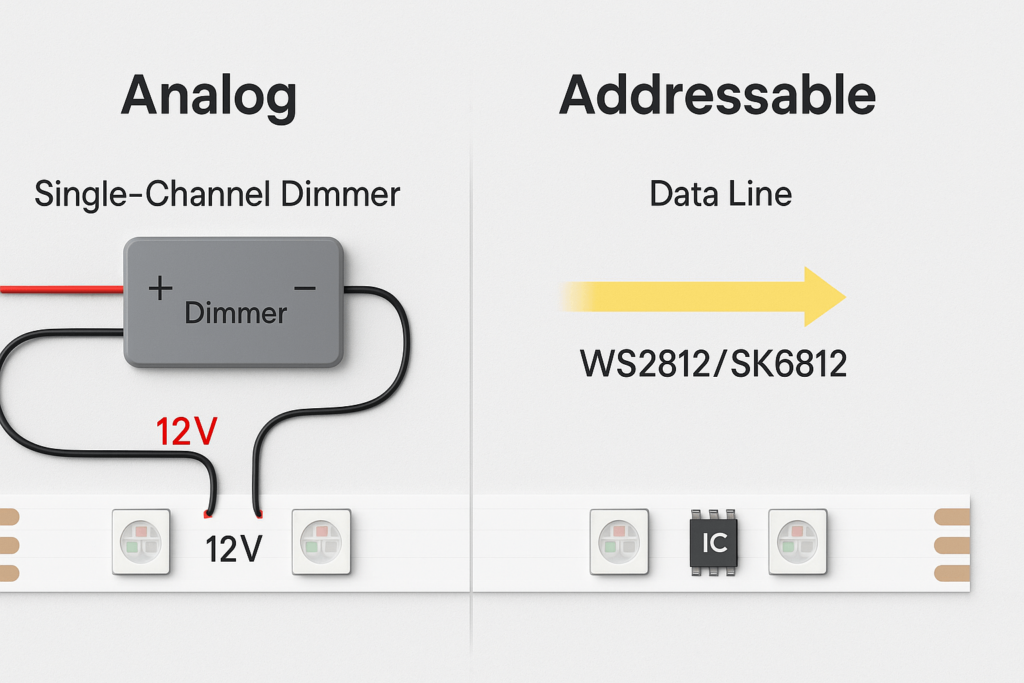
Analog strips dim the whole run together with PWM control. Addressable strips use ICs such as WS2812, WS2815, or SK6812 for per-pixel effects. Therefore, the controller type must match the strip type.
For addressable setup concepts, see the WLED knowledge base and the Adafruit NeoPixel guide.
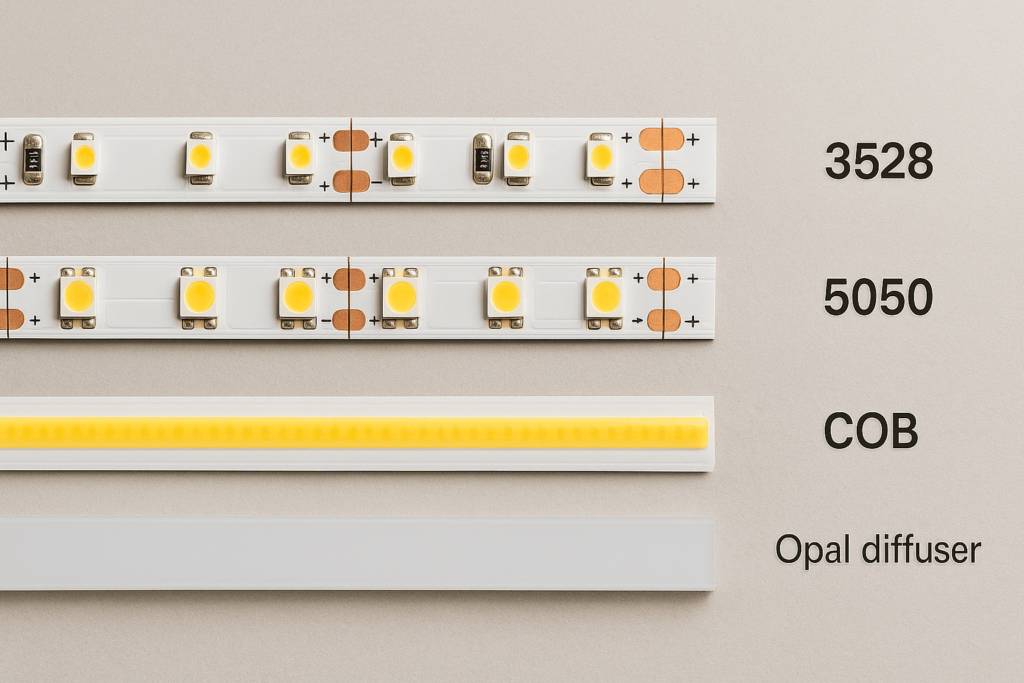
RGB strip types also differ by LED package. Package choice affects output, dot visibility, strip width, and how the light looks inside profiles.
5050 packages usually provide higher output per LED than 3528 packages. However, 3528 packages can still work for compact or softer light needs.
COB compresses many small emitters into a more continuous line. As a result, COB can look smoother, especially with an opal diffuser or aluminum profile.
Higher watts per meter can improve brightness. However, it also increases heat. Therefore, plan airflow, profiles, and power headroom.
For cleaner line-of-light projects, browse COB LED strip options and aluminum profiles.
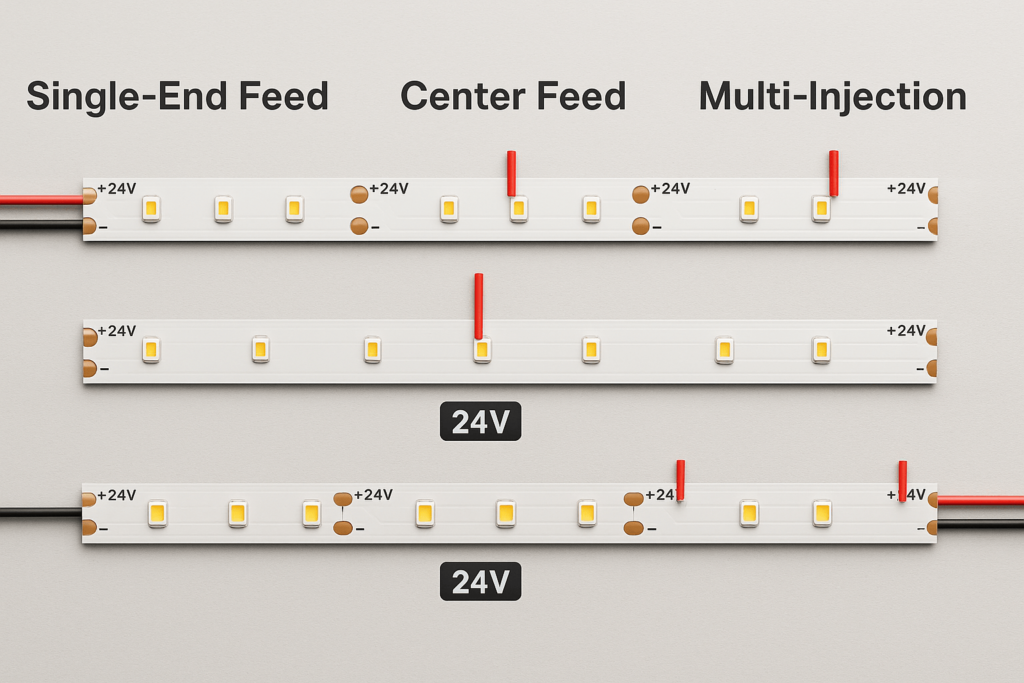
Voltage affects run length, current, injection needs, and controller choice. In general, 24V is easier for longer analog runs, while 5V addressable strips need more frequent injection.
| Voltage | Watts/m | Typical single-end run | Wire gauge | Injection points | Notes |
|---|---|---|---|---|---|
| 12V | 12 | 5–7 m | 16–18 AWG | Center-feed beyond 5 m | Analog PWM |
| 24V | 12 | 10–15 m | 16–18 AWG | Multi-injection above 10 m | Good for longer runs |
| 5V | 10 | 2–4 m | 16–18 AWG | Frequent injection | Addressable pixel strips |
For matched drivers, review LED power supplies before final layout planning.
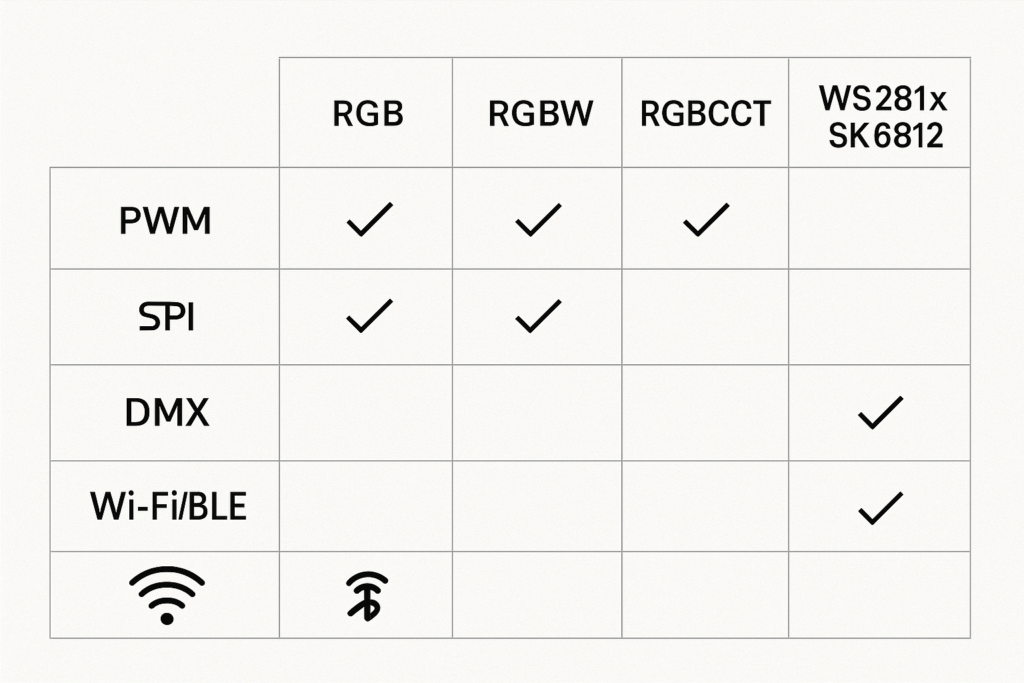
Controllers must match the strip. Analog RGB, RGBW, and RGBCCT strips usually need PWM controllers. Addressable strips need SPI or pixel controllers. Professional systems may use DMX.
Check PWM frequency and low-end dimming trim. Also, test the real strip and controller together before scaling up.
For setup ideas, review controllers and dimmers.
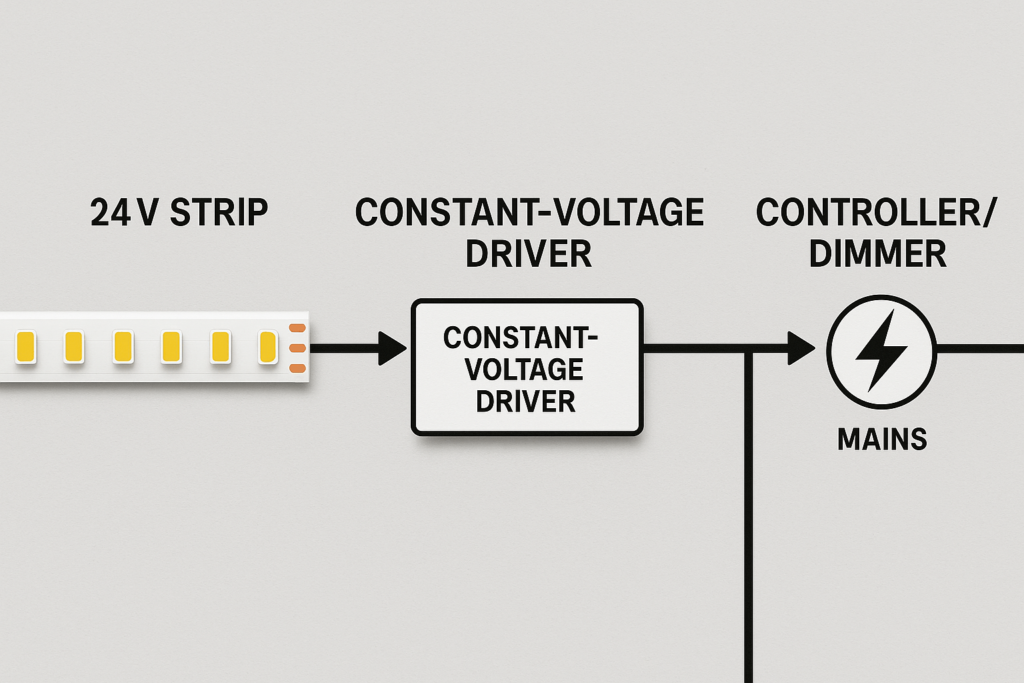
Most RGB strip types use constant-voltage drivers. Therefore, match the strip voltage and add enough wattage headroom for heat and inrush margin.
Calculate the strip load first. Then, choose a power supply with extra headroom. Many projects use about 120–150% of the calculated load, depending on site conditions.
Environment affects strip construction. Indoor dry areas may use IP20 strips. Damp or outdoor zones need higher protection and better sealing.
IP rating is not the whole install. Ends, joints, cable exits, and controller boxes also need protection. For background, see the IEC IP ratings overview.

A clean installation starts with testing. Then, it moves through routing, mounting, connecting, dim testing, and final cleanup.
If your project needs custom length, voltage, profile, driver, or controller matching, contact the supplier before ordering.

RGBW delivers cleaner whites. RGBCCT adds tunable CCT. Therefore, choose based on whether you need color only, clean white, or color plus tunable white.
Analog is simpler and controls the whole strip together. Addressable creates pixel effects, but it needs a data line and power injection planning.
5050 is higher output per LED. 3528 is compact. COB gives smoother dot-free lines, especially with an opal profile.
24V extends runs and reduces voltage drop. However, 12V works well for short spans. For 5V addressable strips, plan more injection points.
Match PWM, SPI, DMX, Wi-Fi, or BLE to your strip type. Also, test flicker behavior before scaling the project.
Choose IP65 or IP67 based on exposure and cleaning access. Also, protect ends, joints, and controllers.
Choosing RGB strip types becomes easier when you separate color family, control method, package, voltage, controller, and environment. First, choose RGB, RGBW, or RGBCCT. Next, decide analog or addressable. Then, match voltage, driver, profile, and controller.
If you want a fully matched kit list, request a quote with strip type, voltage, run length, control method, IP need, and install environment.



 English
  Spanish
  French
  Arabic