Choosing the best waterproof outdoor LED strip lights is not just about the brightest strip or the highest IP rating. For a B2B project, first ask which strip fits the site, the run length, the control plan, and the quote needs.
For example, a patio strip, a sign strip, a facade strip, and a strip near heavy water contact may all need different specs. Also, the strip body is only one part of the job. The cut end, joint, cable exit, driver, controller, mount surface, and seal method all matter.
Therefore, this guide uses a simple project-fit path. It helps buyers compare IP rating, rain or water contact, voltage, brightness, color, setup risk, and RFQ details before they ask for a quote.
The best waterproof outdoor LED strip lights are the ones that match the project’s water contact, IP rating need, voltage and run length, brightness, color, mount method, and control system. Therefore, B2B buyers should not choose only from retail rankings. Instead, check the data sheet, parts, power supply location, and quote details before ordering.
First, “waterproof” is not one fixed level. In LED strip buying, it often points to an IP rating, strip build, and site setup.
An IP rating uses two digits. The first digit shows dust or solid object protection. The second digit shows liquid or water protection. For more detail, see the IEC IP rating guide.
However, buyers should check more than the strip label. A strip may have a water-rated body, yet the final outdoor system can still fail if the strip is cut, joined, sealed, mounted, or powered in the wrong way.
As a result, a safer buying check is:
In short, waterproof LED strips can be used outdoors when the IP rating, parts, seal method, power supply location, and site setup match the job. For more background, see ELSTARLED’s guide on waterproof vs non-waterproof LED strips.
IP rating is a key filter for waterproof outdoor LED strip lights. However, it should not be the only filter. A higher rating may help in harsher places, but the right choice still depends on the full set of parts and the install method.
| Outdoor Site Condition | Common IP Talk | Buyer Check | Proof Needed Before Purchase |
|---|---|---|---|
| Covered outside area with light moisture | Lower water-rated options may be discussed | Check dew, cleaning method, and mount place | Data sheet and install notes |
| Rain or splash area | IP65 is often discussed for splash or jet contact | Check cut ends, joints, cable exits, and driver place | Data sheet, part fit, and supplier check |
| Frequent wetting or harsh outside use | IP67 may be discussed for stronger water protection | Check whether the strip, joints, and parts all fit | Data sheet and install method check |
| Possible immersion or heavy water contact | IP68 may be discussed only when the product is rated for that use | Check rating scope, seal method, and power system protection | Data sheet, rating proof, and project review |
| Unknown or mixed site | Do not choose by IP number alone | Send photos, drawings, and water contact details | Supplier spec review |
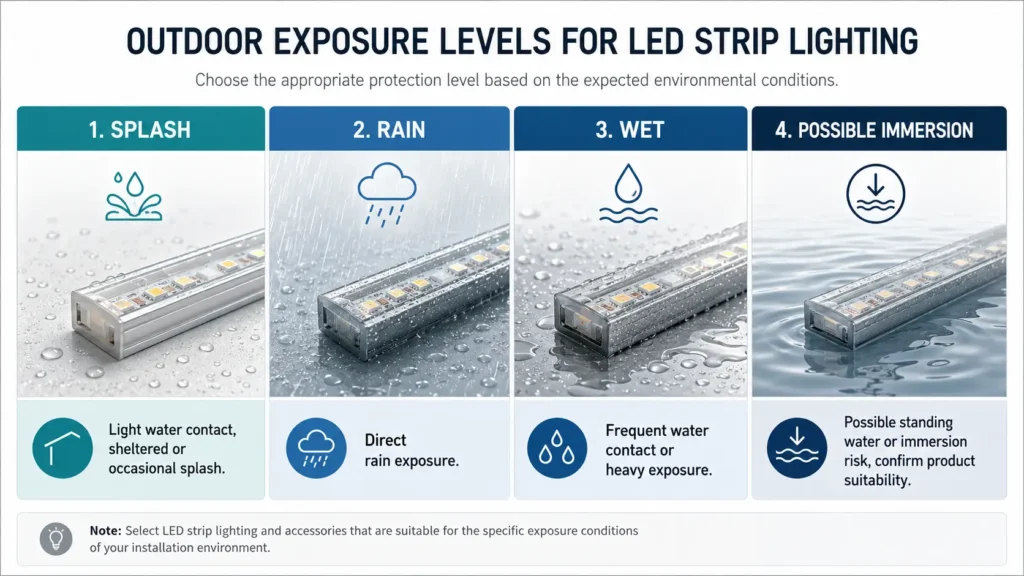
For example, IP65, IP67, and IP68 are common points in outdoor LED strip talks. However, these labels should be used with care. The selected product still needs a data sheet, and the whole system must be checked before the order is placed.
For B2B buyers, “best” means best fit for the project. Therefore, the table below avoids broad rankings and shows what to compare before selection.
| Project Condition | What to Focus On | Possible Strip Direction | What to Check |
|---|---|---|---|
| Patio, deck, or pergola lighting | Rain contact, mount surface, warm or neutral white, dimming | Water-rated strip with outdoor-ready parts | IP rating, joint seal, driver place, mount profile |
| Outdoor sign lighting | Brightness, color match, long run layout, service access | Strip chosen by brightness, color, voltage, and access | Lumen need, voltage plan, control fit, access for repair |
| Building facade accent lighting | Run length, rain contact, channel, heat path | Strip with planned power feed and protected parts | Voltage drop, driver place, mount channel, cable exits |
| Garden or path lighting | Moisture, dirt, cable route, physical guard | Water-rated strip with careful mount and power path | Drainage, impact risk, IP rating, driver housing |
| Retail or hotel exterior | Light look, CCT, CRI, dimming, repeat order match | Waterproof or moisture-ready option based on the real site | Color match, dimming method, sample check, order size |
| High water contact area | Water rating, full-system seal, and service access | Do not select by strip body alone | Data sheet, seal method, part rating, site plan |
As a result, a strip that works under a covered patio may not fit a wet sign or a long facade run. So, define the place first. Then, select the strip, parts, and power plan.
Voltage and run length matter because long runs can cause voltage drop, uneven light, or power-feed issues. Also, outdoor wiring paths can be longer and harder to service than indoor runs. For background, see this voltage drop guide.
However, this does not mean 24V is always better. It means the buyer should check the layout before ordering.
For long outdoor runs, ask the supplier or electrical designer to review voltage, wattage, driver size, power-feed point, and wire path. This guide helps with selection, but it is not a final electrical design. You can also review ELSTARLED’s LED power supply category when planning the power side.
Waterproof outdoor LED strip performance depends on the whole system, not only the strip body. Because of that, a project can still fail if the cut end, joint, cable exit, driver, or control unit is not protected in the right way.
| Item to Check | Why It Matters | Buyer Action |
|---|---|---|
| Strip body rating | Shows the base water protection level | Check the data sheet and actual IP rating |
| Cut points and strip ends | Cutting can create weak points | Ask how cut ends should be sealed |
| Connectors and joints | A water-rated strip can fail at weak joints | Check LED strip connector options and seal method |
| Cable exits | Water can enter through poor cable paths | Review cable route and strain relief |
| Driver location | Drivers may need their own protected place | Place the driver in a site-appropriate box or location |
| Controller or dimmer | Controls may not share the strip rating | Check housing and location |
| Mount surface | Outdoor surfaces can be wet, dusty, hot, or rough | Consider clips or LED aluminum profile where needed |
| Drainage and heat path | Pooled water and trapped heat can raise risk | Plan water flow, spacing, and service access |
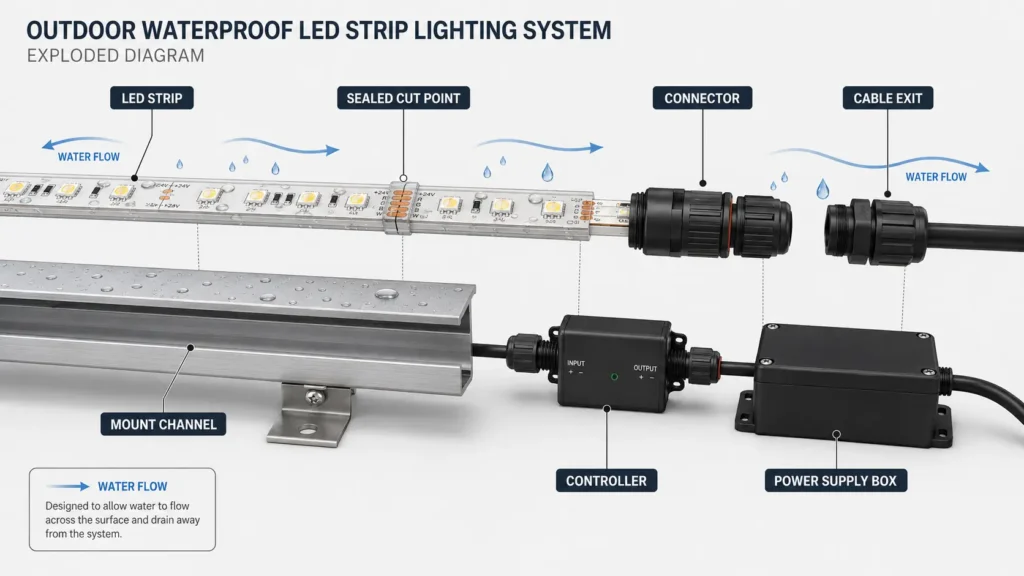
When the outside site is unclear, send photos or drawings before buying. Then, the supplier can check whether the main issue is the strip rating, the parts, the mount method, or the power layout. For basic setup steps, see ELSTARLED’s LED strip installation guide and LED strip connection guide.
Standard waterproof LED strips may fit many outdoor jobs. However, a custom or supplier review is useful when the site has tight space, long runs, special color needs, or repeat order needs.
Ask for review when you need to check:
ELSTARLED’s LED Strip Lights category page lists options such as LED chips, cuttable length, size, CCT, brightness, CRI, PCB board, IP rating, and input voltage. Also, the Custom LED Light Strip page describes custom strip kits and related parts. Still, final specs should be checked for the selected product.
Therefore, do not assume every option fits every waterproof outdoor strip. Ask for the exact model, data sheet, and part list before you confirm an order. For base product terms, you can also review ELSTARLED’s LED strip lights overview.
A clear RFQ helps the supplier suggest a better-fit waterproof outdoor LED strip. Also, it cuts back-and-forth. Instead of asking only for “best waterproof LED strip price,” send the project details.
| RFQ Item | What to Provide |
|---|---|
| Use case | Patio, sign, facade, path, garden, retail exterior, custom product, or other use |
| Site place | Indoor/outdoor, covered/uncovered, vertical/horizontal, and surface type |
| Water contact | Splash, rain, cleaning water, frequent wetting, pooled water, or other condition |
| Length | Total length, section lengths, and cut or joint needs |
| Voltage | 12V, 24V, or current system need |
| Color | Single color, CCT, RGB, RGBW, tunable white, or other |
| Brightness | Target brightness or reference photo |
| Control method | Switch, dimmer, remote, DMX, smart control, or other system |
| Parts | Connectors, aluminum channels, clips, controllers, power supplies, and cable exits |
| Quantity | Sample quantity and planned order quantity |
| Drawings/photos | Layout drawing, site photos, section size, and mount detail |
| Destination | Country or region for quote discussion |
| Docs needed | Data sheet, install notes, test docs, or other purchase docs if needed |
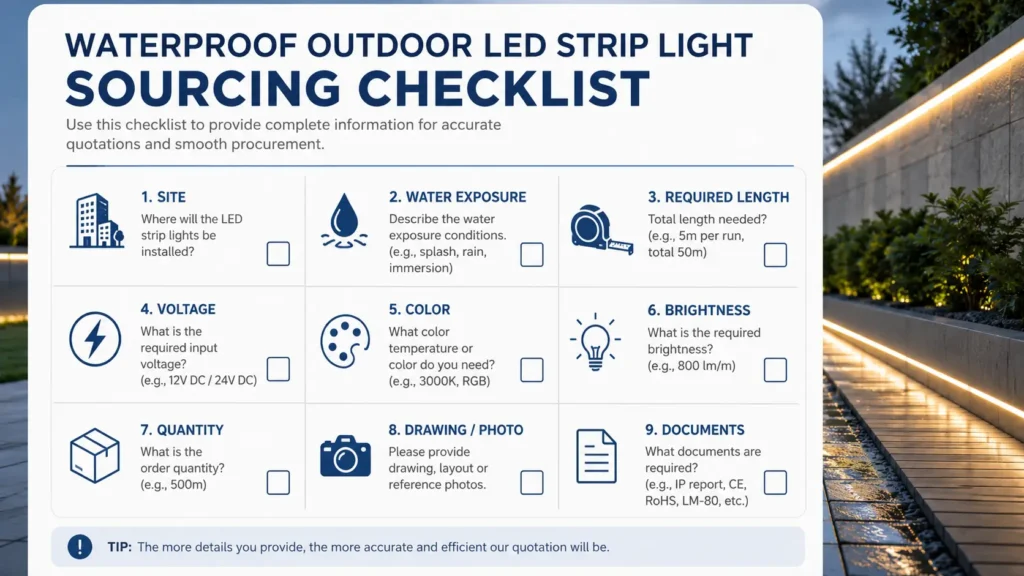
In short, a good RFQ does not need to solve every spec issue in advance. It only needs to give enough detail for a useful review and quote discussion.
The best waterproof outdoor LED strip lights are the ones that fit the job site. First, check water contact, IP rating, voltage, run length, color, brightness, control method, and mounting. Then, check the data sheet and the full set of parts before you buy.
A waterproof LED strip should have an IP rating and a build that fits the expected water contact. However, the strip is only one part of the system. Buyers should also check cut ends, joints, cable exits, controls, drivers, and power supplies.
Yes, waterproof LED strips can be used outdoors when the rating, parts, seal method, power supply location, and site setup match the place of use. However, a waterproof strip body does not make every part of the system fit for every outside site.
There is no single best IP rating for every outdoor LED strip project. For example, IP65, IP67, and IP68 are often compared, but the right choice depends on rain, water contact, mounting, and parts. Therefore, check the data sheet before ordering.
IP65 may fit some splash or rain areas. However, it should not be treated as fit for all outdoor use. If the strip may face frequent wetting, pooled water, harsh cleaning, or possible immersion, ask for a project review and check the rating scope.
The choice depends on run length, wattage, power-feed layout, control load, and the existing system. In general, longer runs need more care with voltage drop. Therefore, buyers should check voltage, wire path, driver location, and feed method before ordering.
First, check the strip rating, cut ends, joints, cable exits, driver location, control housing, mount surface, heat path, drainage, and service access. For complex outdoor jobs, ask for a spec review before you buy.
Send the use case, water contact, site location, total length, voltage, color or CCT, brightness target, control method, quantity, drawings, photos, destination, and needed docs. As a result, the supplier can review the fit and give a more useful quote.
To choose waterproof outdoor LED strip lights for a project, prepare the site details before you ask for a quote.
Send:
Finally, ELSTARLED’s public pages list LED strip and custom LED strip options, but the final product fit should be checked against your site conditions. Share your needs through the ELSTARLED contact page for spec review and quote discussion.

 English
  Spanish
  French
  Arabic