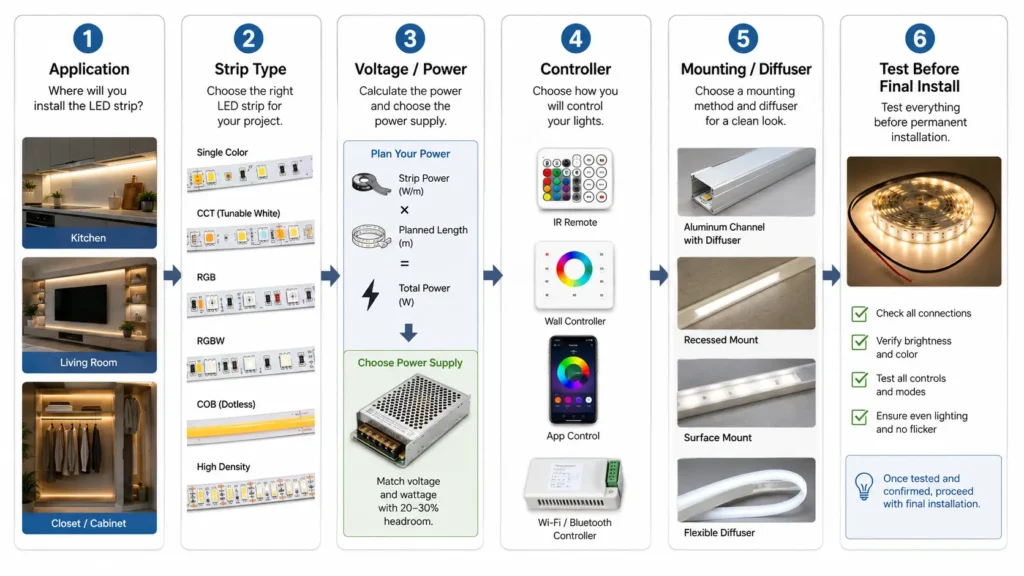
Common DIY LED Strip Planning Mistakes
- Choosing a strip before measuring the full run length.
- Ignoring voltage and total power load.
- Assuming any power adapter will work.
- Buying an RGB controller for a strip that needs a different control type.
- Cutting a strip away from the marked cut points.
- Mounting the strip for good before testing it.
- Forgetting diffuser or channel needs when the strip is visible.
- Planning a long run as if it were a short strip.
- Assuming indoor decor strips suit every site.
- Asking for supplier support without giving length, voltage, color, mount, and site details.
Instead, define the project first. Then choose the strip and parts around those conditions.
FAQ
How do I choose the right DIY LED light strip?
First, define the use, install site, total length, color output, voltage, controller, mount, and site conditions. Then compare strip type, light level, diffuser or channel needs, and power supply fit. Also, avoid choosing by color or price alone.
What power supply do I need for LED strip lights?
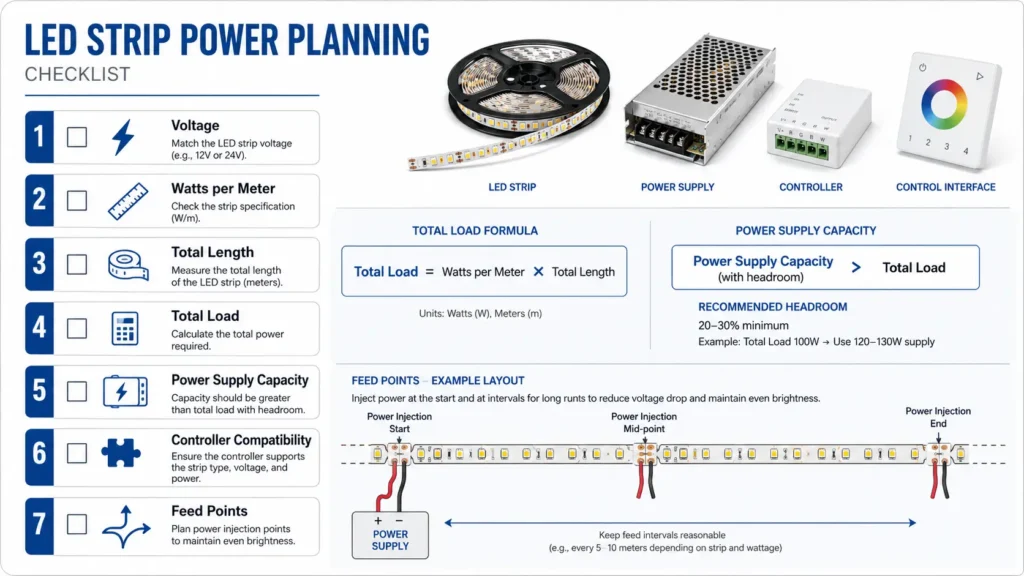
First, check the strip voltage, planned length, and wattage or load from the strip specs. Then match the power supply, controller, and strip as one system. For longer or more complex layouts, get the plan checked before install.
Can I cut and reconnect LED light strips?
Only cut the strip if the product is made to be cut. Also, cut only at the marked cut points, then use the right connector or solder method. Finally, test the section before final mounting.
Do I need a diffuser or aluminum channel for LED strips?
You may need a diffuser or aluminum channel if the strip is visible, if you want a cleaner light line, or if the project needs a neater mount. However, the result depends on strip density, diffuser depth, viewing distance, and the surface.
Should I buy a ready-made kit or separate LED strip components?
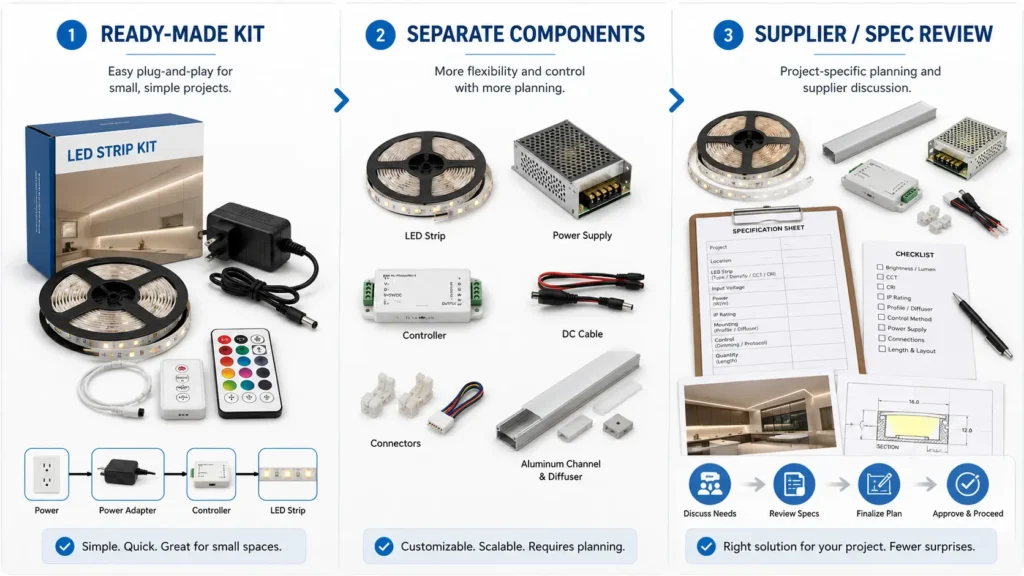
A ready-made kit may be easier for small, simple jobs. However, separate parts may be better when you need a set length, controller, color output, diffuser, mount, or supplier review. Therefore, more specific projects need more fit checks.
Why do long LED strip runs get dim or need extra planning?
Longer runs may need more care because voltage, load, strip length, controller limit, and power feed method all matter. Therefore, do not plan a long run by length alone. Instead, check the strip specs and layout before install.
What should I prepare before asking a supplier for LED strip recommendations?
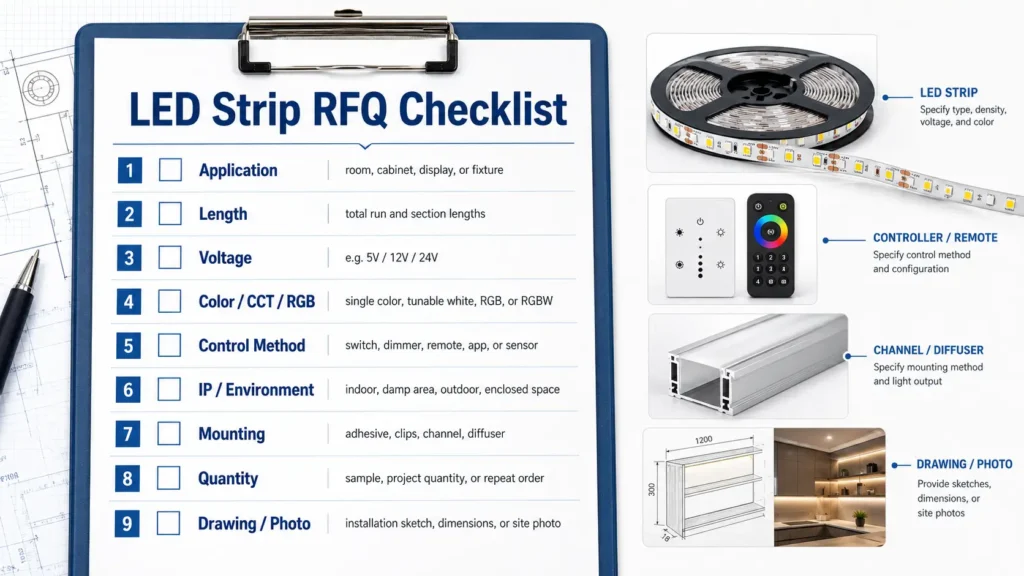
Prepare the use, total length, section lengths, voltage, color or CCT or RGB need, control method, site, mount, quantity, and drawings or photos if you have them. As a result, the supplier can review the project with fewer gaps.
Are LED strip lights safe for any DIY project?
No LED strip should be treated as safe for every job. Power load, power supply choice, heat, moisture, enclosed space, mount surface, and local rules can all affect the setup. For complex or built-in jobs, get qualified review before moving on.
Need Help Reviewing Your LED Strip Project Specs?
If your project has a longer run, cabinet or display light, custom fixture, repeat buy, or a layout with set control and mount needs, prepare your project details before ordering.
- Use
- Total length and section lengths
- Voltage
- Color or CCT need
- RGB/RGBW/control needs
- Power supply plan
- Mount method
- Diffuser or aluminum channel need
- Install site
- Quantity
- Drawing, photo, or sketch if ready
Then share those details with your supplier or technical contact. As a result, the strip, power supply, controller, and accessories can be checked against the project conditions before you order.

 English
  Spanish
  French
  Arabic