Also, finding LED strip manufacturers in India is not hard. However, the harder part is knowing which supplier fits your project, what details to compare, and what to prepare before you ask for a quote.
However, many search results show supplier lists, marketplace pages, or local supplier pages. Also, these pages can help you build an initial shortlist. However, they do not replace a supplier check. Before you choose a supplier, compare product range, specs, docs, clear replies, and RFQ readiness.
First, compare supplier trust, product range, LED strip specs, doc access, sample or RFQ process, and clear replies. Also, do not rely only on a “top supplier” list. For buying teams, prepare voltage, color, CRI, IP rating, strip length, order size, site conditions, packing needs, and needed docs before asking for a quote.
For example, a list of LED strip suppliers can help you find supplier names. However, it does not answer the full sourcing question.
Therefore, for a B2B buyer, the better question is not only “Who appears on the list?” It is:
For example, two suppliers may both sell LED strip lights. However, they may support different use cases, custom needs, doc levels, and order steps. For example, a distributor buying repeat stock, a contractor sourcing for a hotel project, and an OEM buyer making a custom product may need different supplier checks.
In short, use supplier lists as a discovery tool. Then apply a sourcing checklist before you decide who to contact.
Therefore, when you review LED strip suppliers in India, compare both product fit and business fit. However, a low price is not useful if the product does not match the use case, the docs are unclear, or the RFQ details are not complete.
| Check Area | What to Check | Why It Matters | What to Ask the Supplier |
|---|---|---|---|
| Product range | Single-color, CCT-adjustable, RGB/RGBW, COB, digital, waterproof, metal profile fit | Helps confirm whether the supplier can match the use case | Which LED strip series fits this project condition? |
| Key specs | Voltage, wattage, LED density, CCT, CRI, PCB width, IP rating, cut length | Shows whether the strip can fit the lighting design and site conditions | Can you provide a datasheet for this model? |
| Use case fit | Indoor, outdoor, signage, retail display, cabinet lighting, building lighting, project lighting | Different sites may need different strip types and parts | Is this strip right for the site conditions I described? |
| Docs | Datasheet, test report, cert copy if needed, warranty terms, setup guidance | Helps buyers and engineers check the supplier with less risk | What docs can you provide for this product? |
| RFQ process | Clear replies, quote details, sample discussion, packing details, destination needs | Makes supplier replies easier to compare | What information do you need to quote well? |
| Clear replies | Spec reply quality, clear language, follow-up speed, and ability to explain trade-offs | Reduces confusion before samples or orders | Can you confirm the model and reason? |
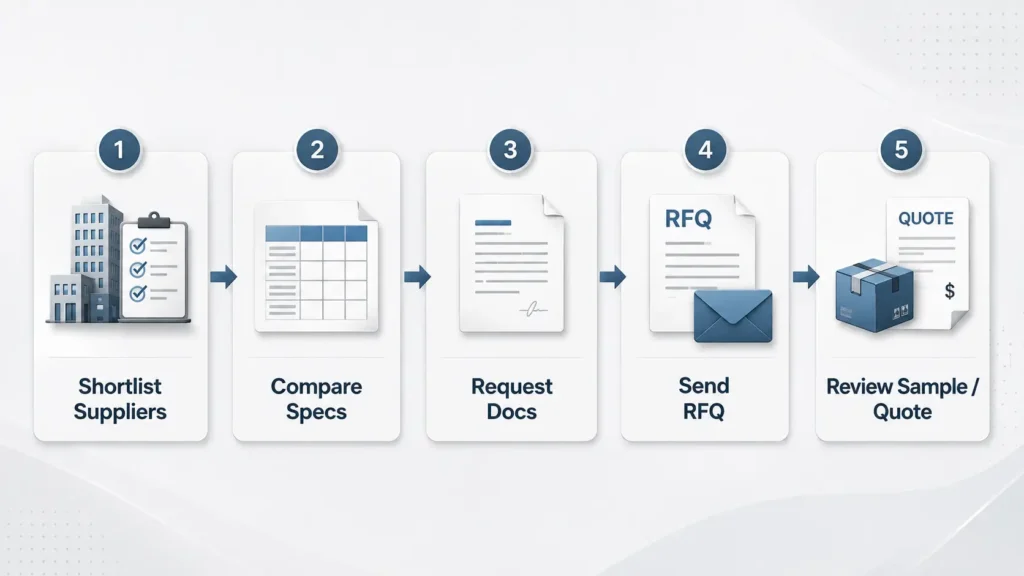
First, prepare the basic specs that affect the product choice. If the supplier has to guess the use case, the quote may not be complete or hard to compare.
| Spec | Buyer Question | Why It Matters | RFQ Detail to Send |
|---|---|---|---|
| Voltage | Do you need 12V, 24V, or another system voltage? | Voltage affects power supply selection and setup planning | Needed voltage or system design; for low-voltage planning context, see Elstar’s 12V COB LED strip planning guide |
| Color type | Do you need single color, tunable white, RGB, RGBW, or digital control? | Color type affects LED strip model, control unit, and wiring | Color/CCT/RGB/RGBW need |
| CCT | What white tone is needed? | Warm, neutral, and cool white fit different projects; for color context, see the CIE note on colour rendering of white LED light sources | Target CCT or set range |
| CRI | Is color accuracy important? | Retail, display, and building projects may need closer color review | Needed CRI level, if set |
| LED density | Do you need smoother light output or lower component density? | LED density can affect look, light spread, and cost | LED count per meter or lighting effect need |
| IP rating | Will the strip be used indoors, outdoors, or near moisture? | Water protection affects strip build and install method; install details should be checked against the supplier’s LED strip setup guidance | Indoor/outdoor condition and exposure risk |
| PCB width and cut length | Are there space or cut limits? | Narrow channels, signs, cabinets, and pages may limit size | PCB width, cut interval, and install space |
| Control unit and power supply | Does the project need dimming, color control, or smart control? | Controls and power supply must match the strip type and setup | Control unit type, dimming method, and power needs |
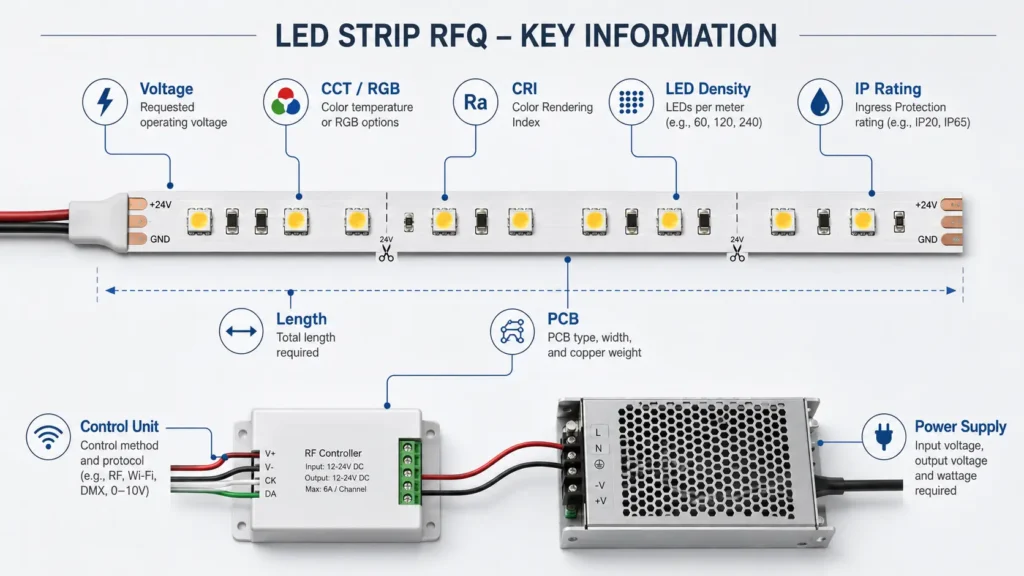
As a result, the goal is not to choose the highest spec in every case. Instead, match the strip to the use case, site conditions, budget, and upkeep needs.
Also, docs help buyers compare suppliers with more care. They reduce the chance that buying, engineering, or quality teams approve a product based only on photos and price.
For example, depending on the project, you may ask for:
Therefore, a careful buyer should ask for docs instead of assuming they exist. Cert and standards claims need exact proof, scope, and doc review. In other words, a supplier saying “certified” is not the same as providing the cert and confirming which product, standard, voltage, and market it covers.
In short, for standards and doc review, buyers can start with the Bureau of Indian Standards, the BIS standards search portal, the IEC 62031 LED module safety spec entry, and the IECEE page for IEC 60598-1:2020. Also, these links are general reference points only; they do not prove that any listed supplier or product is certified.
In some cases, buyers prefer local Indian suppliers because they want local contact, easier small-order planning, or faster access to common stock. However, other buyers compare overseas suppliers when they need broader custom support, private-label support, or direct factory discussion.
Therefore, neither route is always better. As a result, the right choice depends on the project.
| Sourcing Route | Useful When | Risk to Check | RFQ Note |
|---|---|---|---|
| Local India supplier | You need local contact, local stock, or easier planning for standard products | Stock may vary by city, distributor, or supplier type | Ask whether the supplier makes, imports, sells, or assembles |
| India-based supplier | You want local making support or an India-based production relationship | Verify actual making scope, docs, and product range | Ask what is made in-house and what is sourced |
| Overseas supplier | You need custom support, export support, or direct factory discussion | Longer logistics path, import needs, clear replies, and sample review | Confirm specs, samples, docs, packing, and destination |
| Distributor or trader | You need access to standard models or multiple brands | Custom support may be limited | Ask whether they can support datasheets, repeat supply, and model consistency |
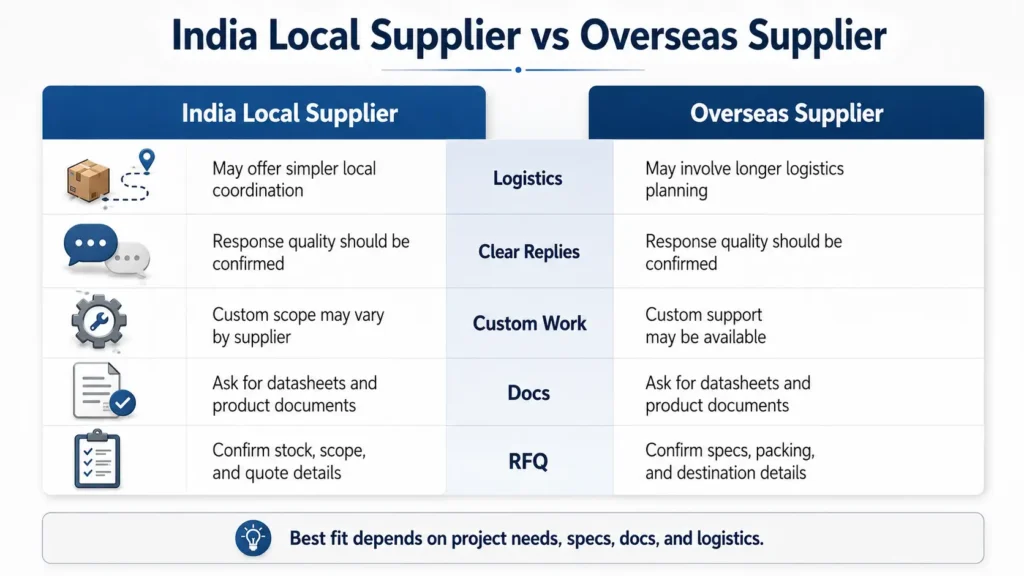
Finally, this distinction is important for Elstar positioning. Also, Elstar should not be described as an India-based supplier. Elstar’s own website positions the company as a China-based LED strip light supplier.
However, if the buyer is open to comparing overseas suppliers with India-based suppliers, Elstar can be discussed as a China-based option to review, not as part of an Indian supplier list.
Also, a good RFQ helps suppliers quote with more accuracy. Also, it helps you compare replies across many suppliers.
Before contacting a supplier, prepare these details:
As a result, when you send these details, you make the supplier’s job easier. You also reduce the risk of vague quotes that cannot be compared.
Instead, avoid asking only, “What is your best price?” A better question is, “Based on these specs and this use case, which model do you suggest, what docs can you provide, and what details do you need to quote?”
In addition, for related Elstar links during spec review, buyers can also review LED strip light types, COB vs SMD strip selection, LED power supplies, LED strip control units, and LED aluminum profiles. Treat these as product-planning links, not as proof of certification, delivery time, or project fit.
In short, for buyers who compare Indian LED strip suppliers and also consider overseas suppliers, Elstar can be reviewed as a China-based LED strip supplier.
Finally, Elstar’s website positions the company as a LED strip light supplier from China. Its About page states that Elstar Ltd was established in 2009 and publishes a product scope that includes LED strip lights and related parts such as control units, power supplies, connectors, aluminum profiles, and under-cabinet lighting.
Also, Elstar’s LED strip category page also lists multiple LED strip product types, including 2216, 2835, 3014, 3528, 5050, 5730, RGB/RGBW, digital, and COB LED strips.
Therefore, use the same review logic for Elstar as you would for any supplier:
For this reason, this keeps the comparison useful and avoids unsupported claims.
In short, many pages list LED strip suppliers and local sellers in India. However, a “top” list should be treated as a starting point, not a final decision. Therefore, buyers should compare product range, specs, docs, clear replies, and RFQ readiness before choosing who to contact.
First, check whether the supplier can support your strip type, voltage, CCT or RGB need, CRI, IP rating, site condition, order size, docs, and packing needs. Then compare how clearly each supplier answers your RFQ.
Finally, compare voltage, color type, CCT, CRI, LED density, PCB width, IP rating, control unit needs, power supply needs, site conditions, and docs. Also, compare price only after the specs are clear.
Also, send the use case, voltage, color/CCT, CRI need, IP rating, length, order size, site conditions, control unit or power supply needs, packing needs, destination, and needed docs. Also, photos, drawings, and install notes can help the supplier review the request.
Not always. For example, local Indian suppliers may help with local contact, standard product access, or local support. However, overseas suppliers may help when buyers need custom support, export support, or direct factory discussion. Therefore, the better option depends on project needs, docs, logistics, and supplier response quality.
However, ask for datasheets, install guidance, test reports if ready, cert copies if needed, warranty terms, sample details, packing details, and control unit or power-supply notes. Also, do not assume certification or compliance unless the supplier provides exact docs for review.
For example, voltage, wattage, LED density, CCT, CRI, IP rating, PCB width, heat conditions, power supply, control unit fit, and site conditions can affect project fit. Next, ask the supplier to suggest a model based on your real use case.
In addition, some suppliers may offer custom LED strip support, but the scope varies. Therefore, buyers should prepare details such as strip length, PCB width, LED type, CCT or color, CRI, IP rating, voltage, connector direction, packing needs, and target use case before asking for custom review.
Therefore, for internal planning, buyers can review Elstar links on LED strip light types, COB vs SMD LED strip selection, custom LED strip requests, LED power supplies, LED strip control units, LED aluminum profiles, and LED strip setup planning. For external standards context, use BIS, BIS standards search, IEC 62031, IEC 60598-1, and IES CRI definition as reference points only. Also, these links do not prove supplier certification, compliance, delivery time, or product fit.
Finally, if you are comparing LED strip suppliers for a project, prepare your use-case details before asking for a quote.
As a result, share your needed voltage, color or CCT, CRI, IP rating, strip length, order size, site conditions, control unit or power supply needs, packing needs, destination, and needed docs. With these details, a supplier can review your request more clearly and suggest the right product path.


 English
  Spanish
  French
  Arabic