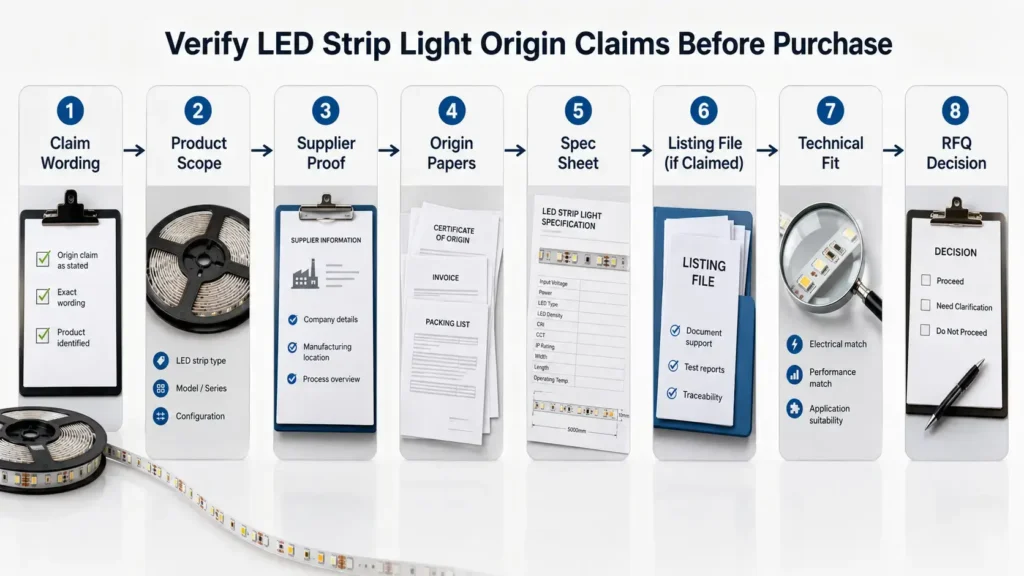
Quick Answer: Before you buy LED strip lights sold as made in the USA, check the exact claim. Also, the FTC says an unqualified Made in USA claim means the product must be “all or virtually all” made in the United States. In addition, the claim should match the exact strip, SKU, or setup you plan to buy. Therefore, ask for proof before you use the claim in an RFQ, bid, or project spec.
“Made in USA” can matter for buyers. For example, a project file may ask for origin proof, or a buying team may prefer a local supply path. However, the phrase should not be treated as a simple label.
LED strip lights can include LEDs, PCB, adhesive tape, resistors, wires, connectors, silicone covers, drivers, and control parts. As a result, one short origin claim may not tell you where each part came from or where the final work was done.
Before you shortlist a supplier, ask three basic questions. First, what exact origin wording does the seller use? Next, which product or SKU does the claim cover? Finally, what proof supports the claim?
Also, do not assume one product claim covers a full catalog. A supplier may have one U.S.-made line, one assembled line, and other imported items. Therefore, check the exact product before you quote it or add it to a project file.
For reference, Review the FTC Made in USA guidance for the main rule behind unqualified Made in USA claims.
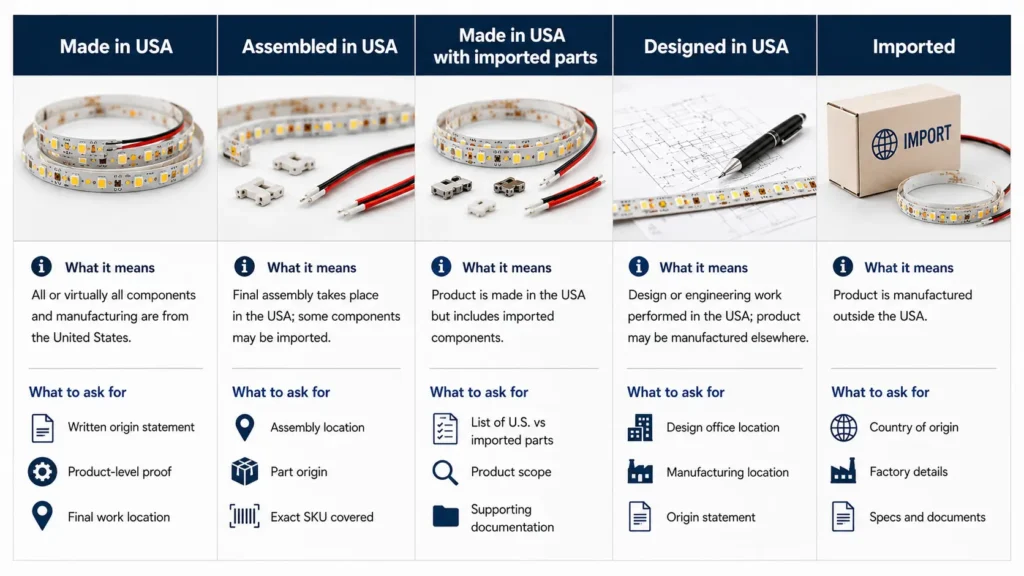
Origin wording changes the type of proof you should ask for. In addition, it helps your team avoid mixing up brand location, warehouse location, and product origin.
| Claim wording | What buyers should understand | What to ask for | Buyer caution |
|---|---|---|---|
| Made in USA | Also, this is often an unqualified origin claim. Under FTC guidance, it should meet the “all or virtually all” standard. | However, written origin statement, product-level proof, final work location, and major part origin. | Therefore, do not rely on a broad website claim without product-level proof. |
| Assembled in USA | This may mean final assembly takes place in the U.S., while some parts may come from other countries. | For example, assembly location, part origin, and the exact SKU covered. | In addition, do not treat this as the same as Made in USA. |
| As a result, made in USA with imported parts | Otherwise, this is a qualified claim that tells the buyer some parts are imported. | Still, a clear note on U.S. and imported parts, plus the product scope. | Also, check whether the wording fits your project need. |
| Designed in USA | However, this may refer to design work, not the place where the strip is made. | Therefore, design office, factory location, and origin statement. | For example, this is not enough if your project asks for domestic origin. |
| Imported | In addition, the product is sourced from outside the U.S. | As a result, country of origin, factory details, specs, and claim documents if needed. | It may still fit many projects when specs and proof match the job. |
You do not need to solve every legal issue yourself. However, you should ask for clear proof before you rely on a claim in a quote, bid, or purchase order.
| Check item | What to ask | Why it matters |
|---|---|---|
| Exact claim | Otherwise, is it “Made in USA,” “Assembled in USA,” or “Made in USA with imported parts”? | Still, different terms call for different proof. |
| Product scope | Also, does the claim cover all strips, one series, one SKU, or only a custom setup? | However, this helps you avoid using a broad claim for the wrong product. |
| Final work location | Therefore, where is final assembly or processing done? | For example, the FTC includes final assembly or processing in its standard for unqualified claims. |
| Major parts | In addition, which major parts are U.S.-made or imported? | As a result, lEDs, PCB, tape, wires, and covers may affect the claim. |
| Origin papers | Otherwise, can the supplier provide an origin statement or certificate of origin if your project needs it? | Still, many buying teams need a file they can review and store. |
| Spec sheet | Also, does the datasheet match the exact product being quoted? | However, this keeps the marketing claim tied to the product you plan to buy. |
| Listing or test file | Therefore, if a safety or test claim is made, can the supplier share the exact file or listing? | For example, claims such as UL, ETL, CE, or RoHS should be checked by product, not by brand only. |
| Warranty terms | In addition, can the supplier send the written terms for this product and use case? | As a result, warranty should be reviewed as a document, not as a slogan. |
| Change notice | Otherwise, will the supplier tell you if part sourcing or assembly location changes? | Still, this helps keep project files up to date. |
For claimed UL listings, you can also use the UL Product iQ certification database as one check point. However, do not assume a product is listed unless the exact product or file can be matched.
For import origin marking context, you can review the CBP country-of-origin marking guidance. However, use it as import-origin context, not as proof that a product is Made in USA.
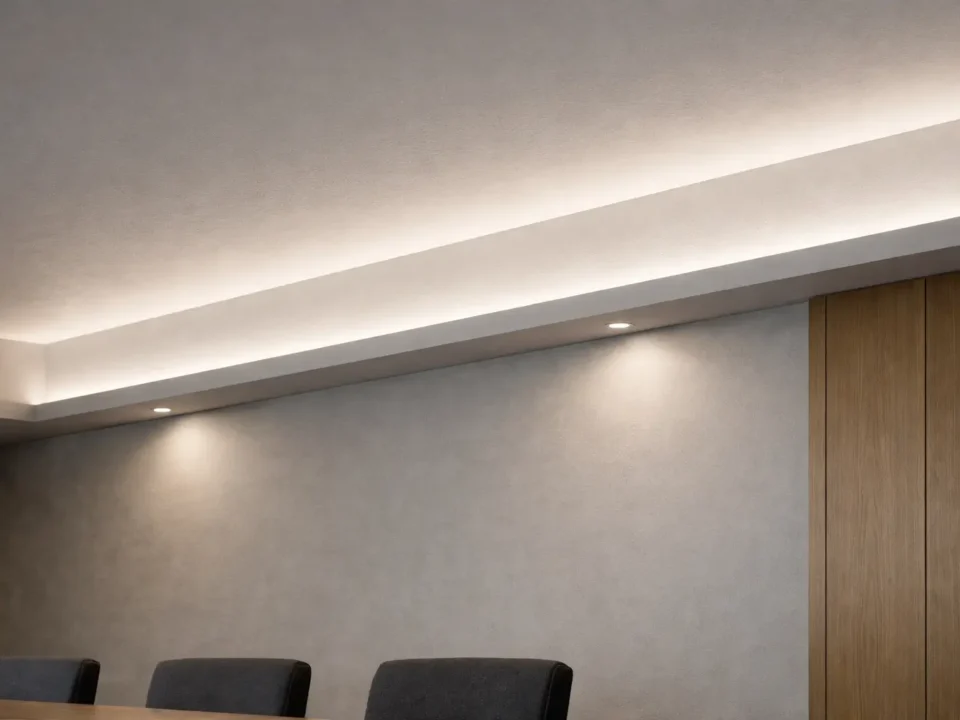
Origin is only one buying factor. Also, it does not tell you whether the LED strip will work in your space, driver system, or control setup.
Therefore, check the project specs before you compare quotes. You can also review ELSTARLED’s LED strip light options as a product exploration path. However, do not use that page as proof of U.S. origin or certification.
| Requirement | What to confirm | Risk if skipped |
|---|---|---|
| Voltage | Also, 12V, 24V, or another project need. | However, wrong voltage can lead to driver mismatch, rework, or a different power setup. |
| Power use | Therefore, watts per meter or watts per foot. | For example, the driver may be too small or larger than needed. |
| CCT | In addition, warm, neutral, cool white, or tunable white. | As a result, the light color may not fit the space or brand look. |
| CRI | Otherwise, standard CRI or high-CRI need. | Still, color may look wrong for retail, hotel, display, or photo use. |
| IP rating | Also, dry, damp, wet, or outdoor setting. | However, incorrect protection can expose the strip to conditions it was not selected for. |
| Dimming and control | Therefore, pWM, 0–10V, DMX, SPI, RGB, RGBW, or controller type. | For example, the strip may not work with the planned control system. |
| Heat and mounting | In addition, aluminum channel, surface, airflow, and enclosed spaces. | As a result, heat and mounting conditions should be reviewed before selection. |
| Cut length and wiring | Otherwise, cut points, cable exit, connectors, and bends. | Still, poor planning can lead to waste or site rework. |
| Accessories | Also, drivers, controllers, profiles, diffusers, and connectors. | However, the strip alone may not complete the system. |
USA-made LED strip lights may matter when your project file asks for origin proof or your buying team prefers a domestic source. However, this does not mean every imported or custom strip is a poor fit.
In many projects, specs, proof, support, and total fit matter together. For example, a custom job may need a special PCB width, LED density, CCT, CRI, cable exit, or packaging. In that case, the best next step is to compare the project need against each supplier’s real documents and sample path.
| Buyer situation | USA-made path may matter when… | Imported or custom path may still fit when… |
|---|---|---|
| Public or school project | Therefore, the project file asks for domestic-origin proof. | The file does not ask for domestic origin, but it still needs clear specs and documents. |
| Commercial interior | For example, the buyer wants origin documents for its own records. | In addition, the main need is the right CCT, CRI, dimming, profile, or IP rating. |
| OEM project | As a result, domestic origin is part of the product plan. | Otherwise, the OEM needs custom PCB, LED count, connector layout, or packaging. |
| Distributor stock | Still, customers ask for U.S.-origin products. | Also, customers compare spec range, price level, supply path, and support. |
| Contractor install | However, project documents name an origin need. | Therefore, the main task is to match voltage, IP rating, profile, accessories, and site schedule. |
Also, if you are comparing imported or custom options, use ELSTARLED’s China LED strip supplier selection and RFQ guide as a sourcing and RFQ planning resource. Do not use it as U.S.-origin proof.
Before you compare price, ask the supplier to remove vague wording. Then, send unclear answers to your buying, legal, or engineering review team when needed.
| Claim or topic | Ask this question | Escalate if… |
|---|---|---|
| Origin | For example, what exact origin claim applies to this SKU? | In addition, the answer is only “American brand,” “U.S. seller,” or “designed in USA.” |
| Assembly | As a result, where is final assembly or processing done? | Otherwise, the supplier cannot separate assembly from part origin. |
| Parts | Still, which major parts are imported or domestic? | Also, the product is sold as Made in USA, but part origin is unclear. |
| Listing or test claim | However, can you provide the exact file or listing for this product? | Therefore, a page says “certified,” but no document is shared. |
| Product scope | For example, does the claim apply to every strip, one series, or one order? | In addition, the supplier uses broad catalog wording. |
| Warranty | As a result, can you send the written terms for this product and use case? | Otherwise, the warranty is only a sales phrase. |
| Lead time | Still, what is the quoted lead time for this spec and quantity? | Also, the supplier gives a generic lead time before reviewing details. |
| Substitution | However, will you tell us before part or origin changes? | The project needs stable documents. |
However, a missing answer does not always mean the supplier is wrong. Sometimes sales must check with engineering, quality, or document control. Still, for a commercial order, you should not ignore unclear origin or listing claims.
A clear RFQ helps the supplier answer with fewer guesses. As a result, you get a cleaner quote and a better document trail.
Finally, remember that this checklist is not a promise that every supplier can provide every document or timeline. Instead, it helps your team ask clear questions before a quote.
Some projects need more than a standard strip. For example, you may need a special LED count, PCB width, cut length, CCT, CRI, color, IP rating, connector, cable exit, package, or mounting part.
In that case, share drawings, install photos, target size, power needs, and document needs early. Then, the sales and engineering teams can review what is practical before you lock the quote.
You can use ELSTARLED’s custom LED strip light requirements page as a project discussion path. However, do not treat it as proof of U.S. origin, listing status, or a fixed production schedule.
Some LED strip light products may be sold as made in the USA. However, buyers should check the exact product and wording before relying on the claim. Ask whether the strip is Made in USA, Assembled in USA, Designed in USA, or made with U.S. and imported parts.
For an unqualified Made in USA claim, FTC guidance uses the “all or virtually all” standard. Also, the guidance looks at final assembly or processing, significant processing, and whether all or virtually all parts are made and sourced in the United States.
No. “Assembled in USA” may show where assembly happens. However, it does not automatically mean the product meets the standard for an unqualified Made in USA claim. Ask what parts are imported, what work happens in the U.S., and which SKU the claim covers.
Ask for product-level proof. For example, request a written origin statement, factory or assembly details, part-origin notes, certificate of origin if needed, spec sheet, and listing files if a listing is claimed. For high-risk jobs, send the files to your buying, legal, or compliance team.
Also, check voltage, watts per meter, CCT, CRI, IP rating, LED density, cut length, dimming method, driver fit, heat and mounting, cable exit, connectors, and control system. Origin may matter for sourcing, but specs decide whether the strip fits the job.
A better question is: best for which project? For example, a retail display, outdoor sign, hotel cove, OEM product, and wet-location install may need different specs. Compare suppliers by proof, spec fit, support, sample path, and RFQ response instead of a generic “best” claim.
Ask for the spec sheet, install guide, wiring or control notes, origin statement if needed, certificate of origin if required, listing file if a listing is claimed, warranty terms, and any test report needed for the job. Also, confirm each file matches the exact SKU or setup.
No. Country of origin is only one sourcing factor. USA-made products may matter when domestic-origin proof is needed. However, imported or custom products may fit projects that focus on specs, custom work, quantity, or cost structure.
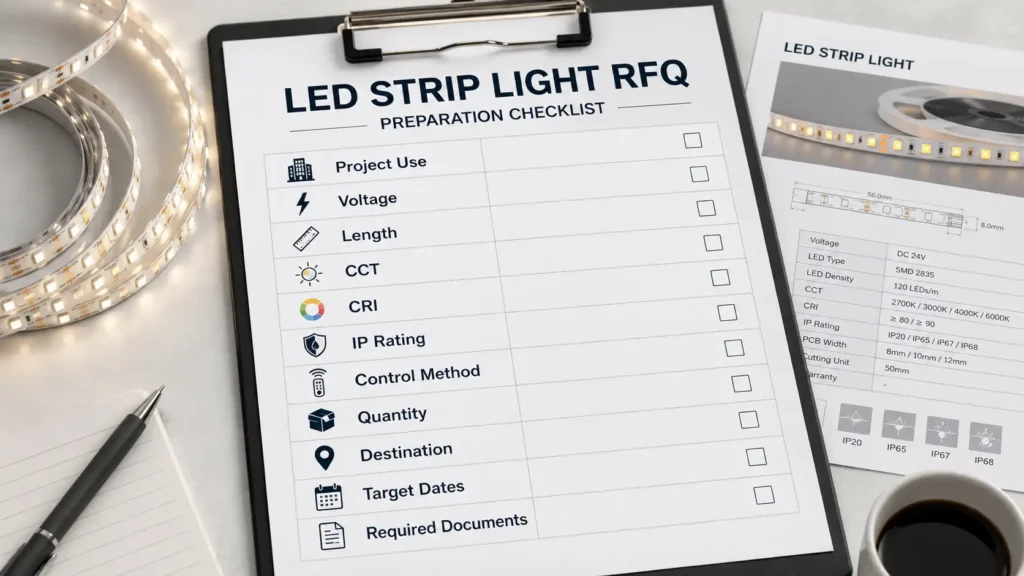
Finally, before you choose LED strip lights, prepare your project use, origin wording needs, technical specs, quantity, destination, and document needs.
Then, contact ELSTARLED with your project details and ask which documents are available for the exact product or setup being quoted.
Include your LED strip type, voltage, CCT, CRI, brightness, IP rating, driver, control method, accessories, custom needs, order quantity, and target dates. Also, state whether you need origin papers, listing files, warranty terms, or other review documents.

 English
  Spanish
  French
  Arabic