“LED strip lights offer flexible, customizable illumination ideal for decorative and detailed lighting applications. LED bulbs provide traditional lighting solutions, easy installation, and versatile usage. Clearly understanding these differences helps you select the best lighting solution for your needs.”
Introduction to LED Strips and LED Bulbs
Having personally installed various types of LED lighting, I clearly understand the differences between LED strips and LED bulbs. Let me clearly introduce each type, helping you choose the ideal lighting solution for your specific project.
What are LED Strips?
LED strips consist of flexible circuit boards populated with multiple small LEDs. They’re known for their versatility, customizable brightness, and suitability for detailed or decorative lighting. From my experience, LED strips provide uniform illumination and flexibility, making them perfect for accent lighting, detailed decoration, and task-oriented applications.
What are LED Bulbs?
LED bulbs are standard-shaped bulbs that easily replace traditional incandescent or CFL bulbs. They offer straightforward installation, broad compatibility, and reliable performance. Clearly, their design makes them ideal for general home lighting, fixtures, and spaces requiring simple illumination without customization.
People often ask me, “Are LED strips better than bulbs?” Clearly, the answer depends on your lighting needs—LED strips offer customizable, detailed lighting, while LED bulbs provide traditional convenience and ease of installation.
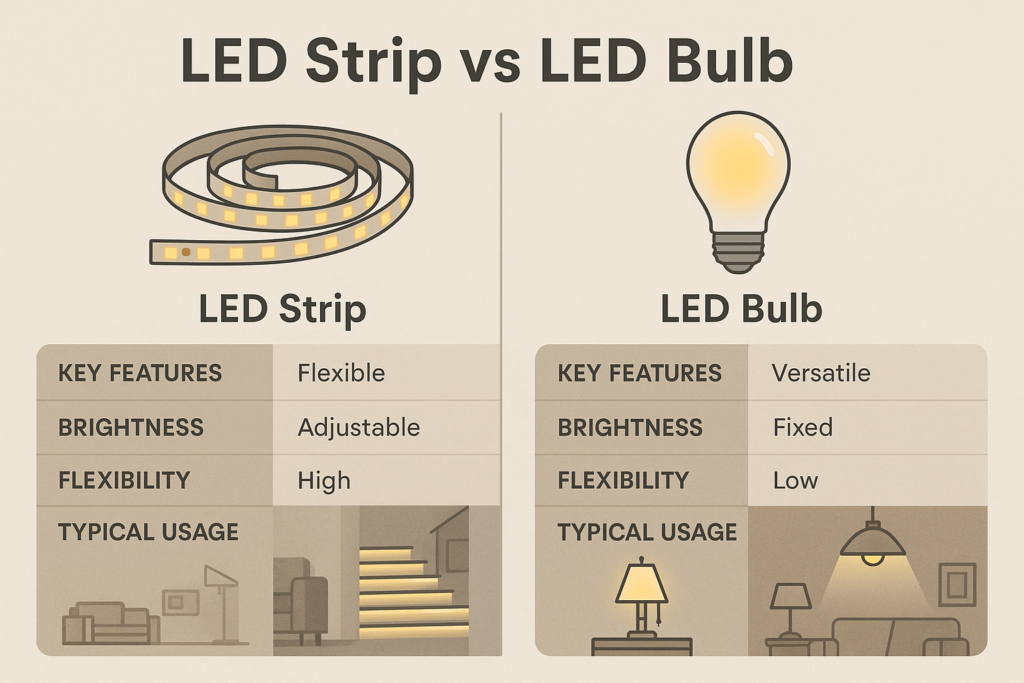
Technical Differences Clearly Explained
Drawing from my personal experience with various lighting projects, I’ll clearly outline the primary technical differences between LED strip lights and LED bulbs to help you choose confidently.
Brightness & Lighting Quality
- LED Strip Lights:
Offer customizable brightness levels and uniform illumination, making them ideal for detailed, accent, or task-focused lighting.
- LED Bulbs:
Provide reliable brightness suitable for general ambient or functional lighting, often featuring omnidirectional illumination.
Energy Efficiency & Power Consumption
- LED Strip Lights:
Highly efficient in brightness output per watt, suitable for energy-conscious installations needing tailored lighting solutions.
- LED Bulbs:
Also efficient, especially compared to traditional bulbs, but typically less customizable in brightness and color options compared to LED strips.
Installation Complexity & Flexibility
- LED Strip Lights:
Require careful installation planning, including secure mounting, power supplies, and controllers. Offer high flexibility for intricate or detailed lighting designs.
- LED Bulbs:
Simple installation, directly replace traditional bulbs in existing fixtures, clearly suitable for DIY and straightforward lighting solutions.
People commonly ask me, “Do LED strips use more electricity than bulbs?” From my experience, while LED strips can vary widely in power consumption depending on brightness and length, they generally offer similar or better energy efficiency compared to LED bulbs when planned correctly.
Comparison Table:
| Feature |
LED Strip Lights |
LED Bulbs |
| Brightness & Quality |
High, customizable |
Moderate, standard |
| Energy Efficiency |
Excellent |
Very Good |
| Installation Complexity |
Moderate complexity |
Simple, easy installation |
| Flexibility |
High, customizable |
Limited flexibility |
| Applications |
Accent, decorative, task-oriented |
General residential, functional lighting |
Advantages and Disadvantages of LED Strip Lights
Based on my personal experience installing LED strip lights in diverse projects, here’s a clear breakdown of their practical advantages and potential drawbacks.
Advantages of LED Strip Lights
- Highly Customizable:
LED strips offer adjustable brightness, color temperatures, and RGB color options, making them perfect for tailored lighting solutions clearly suited to decorative and detailed applications.
- Flexible Installation:
Their flexibility allows you to clearly install them in complex or curved spaces, perfect for creative lighting designs and detailed accents.
- Energy Efficiency:
Provide excellent brightness relative to power usage, clearly ideal for energy-conscious projects requiring significant illumination.
- Uniform Lighting:
Deliver clear, consistent lighting, ideal for task-oriented environments, under-cabinet lighting, or detailed interior design.
Disadvantages of LED Strip Lights
- Higher Initial Cost:
Typically more expensive upfront compared to traditional LED bulbs, clearly a consideration for budget-conscious projects.
- Complex Installation:
Require detailed planning, secure mounting, power supply considerations, and potentially additional controllers, clearly making installation more involved.
- Heat Management Requirements:
Clear need for proper heat dissipation planning, especially for brighter LED strips, to ensure longevity and consistent performance.
Many clients often ask me, “Are LED strips suitable for general home lighting?” Clearly, LED strips can be ideal for residential use, particularly when customized lighting effects, detailed task lighting, or decorative accents are desired.

Advantages and Disadvantages of LED Bulbs
From my personal experience installing and using LED bulbs across various applications, I clearly recognize their practical strengths and limitations. Here’s a straightforward breakdown to help you understand if LED bulbs are suitable for your lighting needs.
Advantages of LED Bulbs
- Ease of Installation:
LED bulbs offer straightforward installation, easily fitting into standard fixtures, clearly ideal for quick replacements of traditional incandescent or CFL bulbs.
- Cost-Effective:
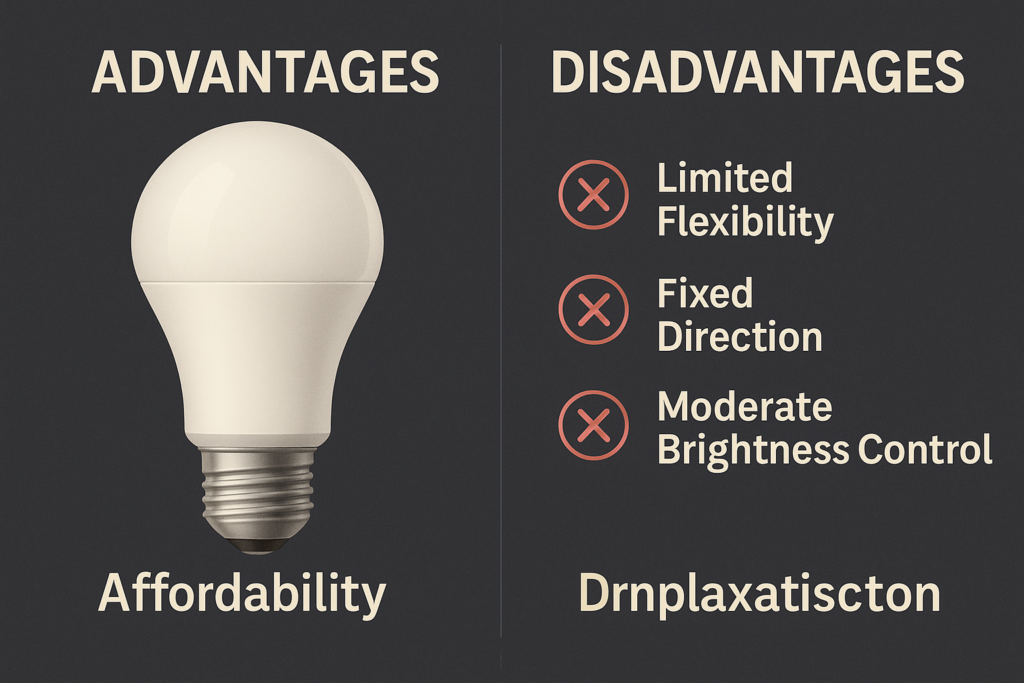
Typically have lower initial costs compared to LED strip lights, clearly beneficial for budget-conscious projects.
- Broad Compatibility:
Widely compatible with existing fixtures, lamps, and lighting setups, making them clearly practical for general residential and commercial use.
- Reliable Performance:
Offer consistent brightness and reliable performance with minimal maintenance, clearly suitable for everyday lighting needs.
Disadvantages of LED Bulbs
- Limited Flexibility:
Clearly less versatile and customizable compared to LED strip lights, limiting their suitability for detailed decorative or accent lighting projects.
- Fixed Lighting Direction:
LED bulbs typically provide omnidirectional or fixed-direction lighting, clearly limiting their effectiveness in detailed or flexible lighting applications.
- Moderate Brightness Control:
Clearly less customizable in terms of brightness and color options compared to LED strips, reducing flexibility in creating specialized lighting effects.
A common question I often hear is, “Can LED bulbs replace LED strip lights?” Clearly, while LED bulbs are excellent for general lighting, they typically can’t replicate the flexibility, customization, or detailed illumination capabilities of LED strip lights.
Best Applications & Practical Scenarios
Through my personal experience installing both LED strip lights and LED bulbs, I’ve clearly identified ideal scenarios and applications for each type. Here’s a straightforward guide to help you determine which lighting solution is best for your specific project needs.
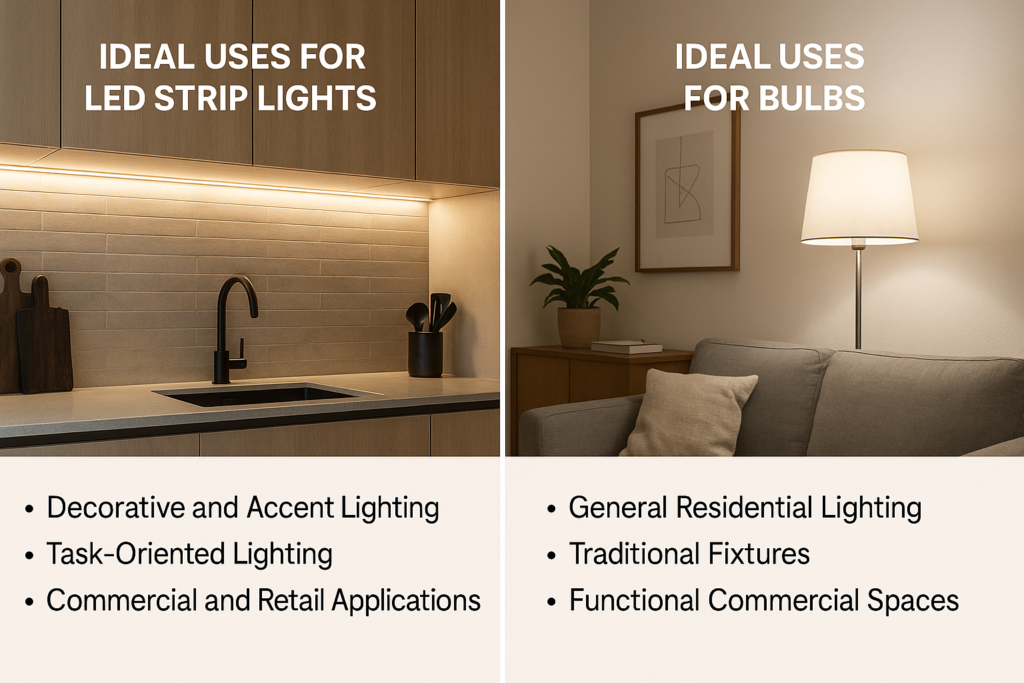
Ideal Uses for LED Strip Lights
LED strip lights clearly excel in flexible, customized, and detailed lighting scenarios, such as:
- Decorative and Accent Lighting:
Ideal for highlighting architectural features, under-cabinet lighting, furniture accents, and creative decorative effects.
- Task-Oriented Lighting:
Perfect for kitchen counters, home offices, workstations, and other areas clearly requiring detailed, bright illumination.
- Commercial and Retail Applications:
Clearly suitable for retail displays, showcases, product highlights, and dynamic decorative lighting.
Ideal Uses for LED Bulbs
LED bulbs clearly offer excellent solutions for general-purpose, straightforward lighting needs, such as:
- General Residential Lighting:
Ideal for living rooms, bedrooms, hallways, and common areas where uniform lighting is clearly desirable.
- Traditional Fixtures:
Perfect replacements for incandescent or CFL bulbs in existing lamps, ceiling fixtures, and standard residential lighting.
- Functional Commercial Spaces:
Clearly beneficial for offices, retail spaces, or commercial environments requiring reliable, consistent lighting without intricate customization.
Clients frequently ask, “Should I use LED strips or LED bulbs in my home?” Clearly, LED bulbs are ideal for general residential lighting applications, while LED strip lights clearly provide enhanced flexibility, customization, and detailed illumination suitable for decorative or specialized applications.
How to Choose Between LED Strips and LED Bulbs
From my extensive experience installing both LED strips and LED bulbs, I clearly understand the factors to consider when choosing between these two lighting options. Here’s a straightforward guide to help you decide confidently.
Key Decision Factors
- Lighting Purpose and Ambiance:
For decorative, detailed, or customized lighting clearly suited to creative applications, LED strip lights are ideal. LED bulbs are best for general, uniform, and traditional lighting.
- Brightness Requirements:
Clearly assess your lighting needs—LED strips provide customizable brightness ideal for detailed tasks, while LED bulbs offer moderate, uniform illumination suitable for general lighting.
- Installation Complexity:
Consider ease of installation clearly—LED bulbs offer simple installation and immediate compatibility with existing fixtures. LED strip lights require additional planning, secure mounting, and potential professional assistance.
- Budget Considerations:
Clearly define your budget—LED bulbs are typically more affordable upfront, whereas LED strips, though initially pricier, can offer long-term customization and detailed lighting benefits.
Common Mistakes & Practical Recommendations
- Misjudging Lighting Needs:
Avoid choosing LED bulbs for detailed or decorative effects that clearly require LED strips. Likewise, don’t unnecessarily select LED strips for straightforward general lighting.
- Overlooking Installation Complexity:
Clearly anticipate and prepare for installation needs—LED strip installations often require detailed planning for wiring, power supplies, and heat management.
- Choosing Based Solely on Cost:
Evaluate long-term effectiveness, efficiency, brightness, and practical usability clearly rather than focusing only on initial costs.
Clients often ask me, “Are LED strip lights better than LED bulbs?” Clearly, the choice depends on your specific needs—LED strips offer flexibility and customization ideal for detailed and decorative lighting, while LED bulbs clearly excel in general-purpose, easy-to-install lighting scenarios.
External Link:
LED Strip Lights vs LED Bulbs – LEDSupply

Installation, Maintenance & Expert Recommendations
Having installed LED strips and LED bulbs in various environments, I understand exactly what works and what doesn’t. Here’s clear and practical guidance, step-by-step installation instructions, maintenance tips, and troubleshooting advice to ensure your lighting performs optimally.
Step-by-Step Installation Guide
LED Strip Lights Installation:
- Planning & Preparation:
Carefully measure the installation area, ensuring surfaces are clean, dry, and smooth for reliable adhesion.
- Mounting & Securing:
Attach LED strips securely using adhesive backing or mounting channels, clearly focusing on proper heat dissipation.
- Power & Controller Connection:
Clearly connect the strips to an appropriate power supply and controller, verifying proper polarity and power requirements.
- Testing & Adjustments:
Power on carefully, clearly inspect all segments for uniform brightness and adjust placement or connections as needed.
LED Bulbs Installation:
- Fixture Compatibility:
Confirm clearly that the bulb matches the socket and fixture type (E26, E27, GU10, etc.).
- Simple Installation:
Turn off the power, securely insert the LED bulb into the fixture socket, and restore power carefully.
- Testing & Final Checks:
Turn the light on, clearly verify brightness, color temperature, and uniformity to ensure correct functionality.
Essential Maintenance Practices
- Routine Inspections:
Clearly and periodically inspect connections, brightness consistency, and overall functionality for both LED strips and bulbs.
- Regular Cleaning:
Gently clean surfaces of LED strips and bulbs occasionally with a soft, dry cloth to clearly maintain brightness and visual appeal.
- Heat Management (LED Strips):
Clearly prioritize adequate heat dissipation through mounting channels or heat sinks, especially important for high-brightness LED strips.
Troubleshooting Common Issues
- Brightness Issues:
Clearly check connections, verify power compatibility, and ensure correct polarity for LED strips or bulbs.
- LED Bulb Flickering:
Inspect fixtures for compatibility issues, clearly confirm proper bulb type, and consider adjusting dimmer switches if applicable.
- LED Strips Not Lighting:
Clearly inspect wiring, controller connections, power supply compatibility, and polarity correctness.
Clients frequently ask me, “What common issues typically occur during LED lighting installation?” Clearly, the most common issues include incorrect power connections, inadequate heat dissipation for LED strips, and compatibility problems between bulbs and fixtures.

FAQs About LED Strip Lights and LED Bulbs
Based on my extensive hands-on experience with lighting installations, I’ve clearly compiled answers to the most frequently asked questions regarding LED strip lights and LED bulbs to help guide your selection process effectively.
Are LED strips better than bulbs?
Clearly, it depends on your specific lighting requirements. LED strips offer flexible, customizable, and detailed lighting, ideal for decorative or task-oriented applications. LED bulbs provide convenient, general-purpose lighting suitable for traditional installations and everyday use.
Do LED strips use more electricity than bulbs?
Typically, LED strips have similar or slightly higher overall energy consumption compared to LED bulbs due to their customizable brightness and higher density of LEDs. However, clearly choosing appropriate brightness levels and proper power supplies can keep energy usage efficient and manageable.
Can LED strips replace traditional bulbs?
Clearly, LED strips can replace traditional bulbs in certain scenarios, especially for decorative, accent, or detailed lighting projects. However, for general, ambient, or traditional fixture lighting, LED bulbs remain clearly the most straightforward and suitable replacement option.
Conclusion & Next Steps
Clearly understanding the differences between LED strip lights and LED bulbs is essential to making the best choice for your lighting project. From my practical experience, LED strips are the ideal choice for flexible, detailed, and customizable lighting applications, while LED bulbs provide straightforward, reliable solutions for general ambient and traditional lighting scenarios.
By clearly assessing your specific requirements—brightness, flexibility, ease of installation, and budget—you can confidently select the ideal lighting solution for your needs.
Ready to explore the best LED lighting options for your project?
Explore Elstar’s LED Lighting Solutions →


 English
  Spanish
  French
  Arabic