Table of contents
If you’re searching for a “waterproof COB LED strip,” you’re usually trying to solve two problems at once: choose the right IP rating for your environment and avoid failures caused by water getting in at ends, cuts, connectors, or the power/control components. This guide treats “waterproof” as a system requirement—not a label on the strip alone.
Yes—COB LED strips can be “waterproof,” but only when the specific strip construction is designed and rated for wet exposure (typically expressed as an IP rating) and the entire installation is sealed as a system (strip + ends/cuts + connectors + power/control protection). IP65/IP67/IP68 are common labels, but your real decision should start with your exposure scenario (splashes vs rain vs pooling vs immersion) and how you’ll protect terminations.
Key Points
– “COB” describes how the LEDs are packaged for a dot-free line of light; it does not automatically make a strip waterproof.
– “Waterproof” is only meaningful when tied to a defined rating/scope and real installation boundaries.
– Most wet-area failures happen at weak points: ends, cuts, connectors, cable entries, and unprotected drivers/controllers.
– IP68 is not a universal “underwater forever” label—immersion conditions are typically specified by the manufacturer.
– Start with scenario mapping, then confirm what the supplier’s IP claim actually covers.
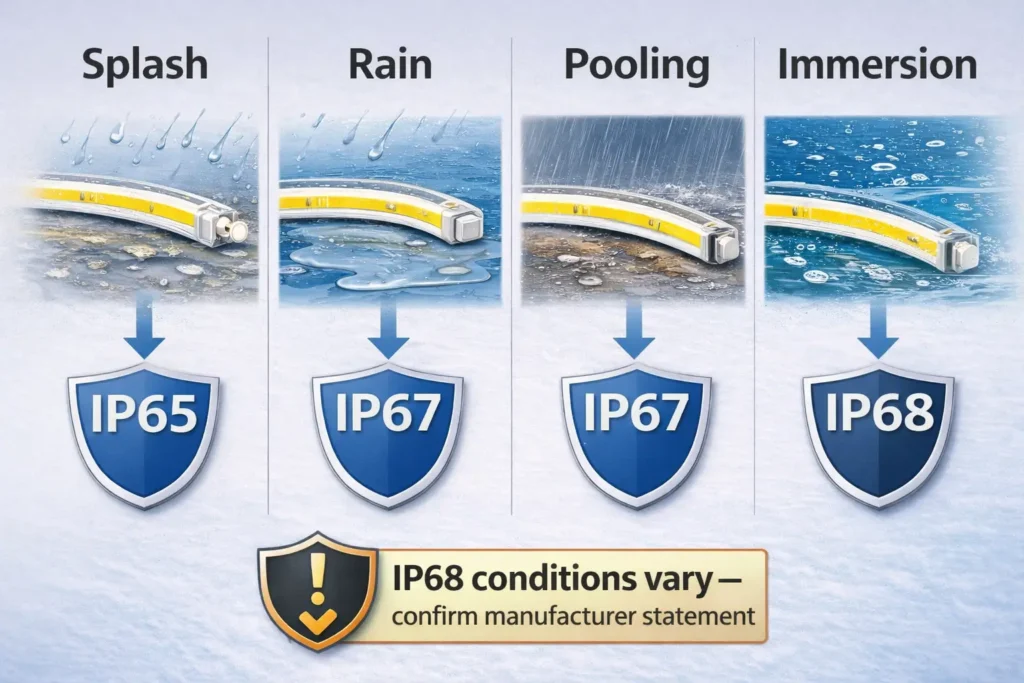
Quick scenario-to-IP starting point:
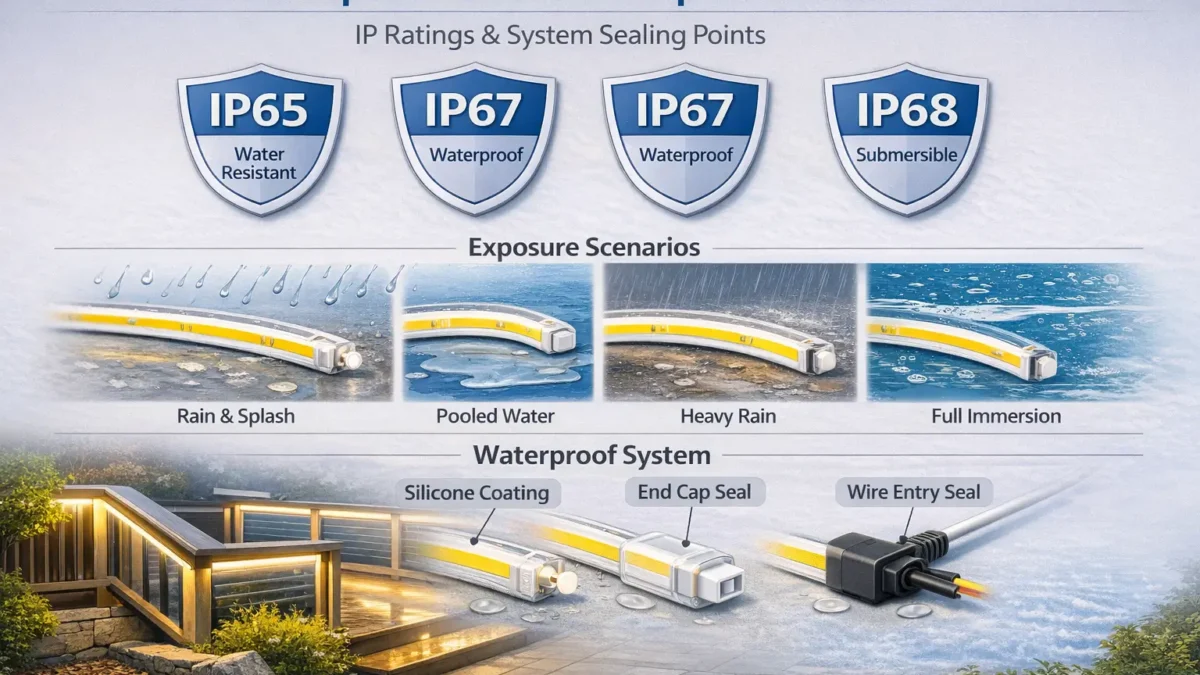
| Exposure scenario (real world) | Typical IP label used in strip sourcing | What it usually implies | Primary “gotcha” to plan for |
|---|---|---|---|
| Indoor splashes / occasional wiping | IP65 (often used as “splash resistant”) | Surface protection against splashes/jets (varies by design) | Ends/cuts/connectors still need sealing; adhesive/mounting matters |
| Outdoor rain / wind-driven wetting | IP67 (often used for “weatherproof”) | Better protection than splash-only claims; may include temporary immersion language (verify) | Water often enters at terminations and cable entries, not through the strip body |
| Pooling water / possible immersion | IP68 (often used for “submersible”) | Immersion beyond 1 m under stated conditions | Conditions (depth/time) are manufacturer-defined—must be confirmed |

Boundary Conditions
– IP ratings are based on defined test scopes for enclosures; product marketing may simplify them, so confirm what the specific strip model was tested/certified for. See IEC overview: IEC – Ingress Protection (IP) ratings.
– For immersion-style ratings, conditions are not universal; guidance commonly states that IPX8/IP68 conditions are specified by the manufacturer. See: Applus+ Keystone – IPX7 & IPX8 immersion testing (manufacturer-specified conditions for IPX8) and Polycase – IP67 vs IP68 (IP68 depth/time depends on manufacturer).
– A “waterproof strip” can still fail if terminations and power/control components are exposed.
For COB LED strips, “waterproof” should mean a specific, verified protection scope (often communicated as an IP rating) matched to your exposure scenario, plus an installation plan that keeps water out of every entry point—not just the strip surface.
Key Points
– “Waterproof” is not a single feature; it’s a combination of construction, sealing, and correct installation.
– “Water-resistant” often describes limited exposure (splashes), while “submersible” implies immersion conditions that must be stated clearly.
– The strip is only one part of the system; terminations and power/control hardware are common failure points.
– Procurement should confirm scope by model/series (and not assume universal certification coverage).
COB changes the look of the light (a more continuous line), but waterproof performance depends on how the strip is sealed and rated—not on the COB format itself.
Key Points
– COB = LED packaging style; waterproofing = construction + sealing + rating scope.
– A COB strip can be available in non-waterproof and waterproof variants.
– Your installation plan (terminations, routing, enclosure placement) often matters more than the strip IP rating.
In practice, “water-resistant” usually means limited exposure (splashes/sprays), while “waterproof/submersible” implies immersion conditions that must be stated clearly—especially for IPX8/IP68 where test conditions are typically manufacturer-specified.
Key Points
– IP codes describe protection against solids/dust (first digit) and water (second digit).
– In LED strip sourcing, “IP65/IP67/IP68” is often used as shorthand for increasing water protection—confirm what the model was tested for.
– Immersion-style protection needs special attention: depth/time and test conditions may differ by manufacturer.
Boundary Conditions (1–3 bullets)
– Do not treat “IP68” as one fixed depth/time; confirm the stated conditions. See: Applus+ Keystone – IPX7/IPX8 notes (IPX8 conditions specified by manufacturer) and Polycase – IP67 vs IP68 (manufacturer specs matter).
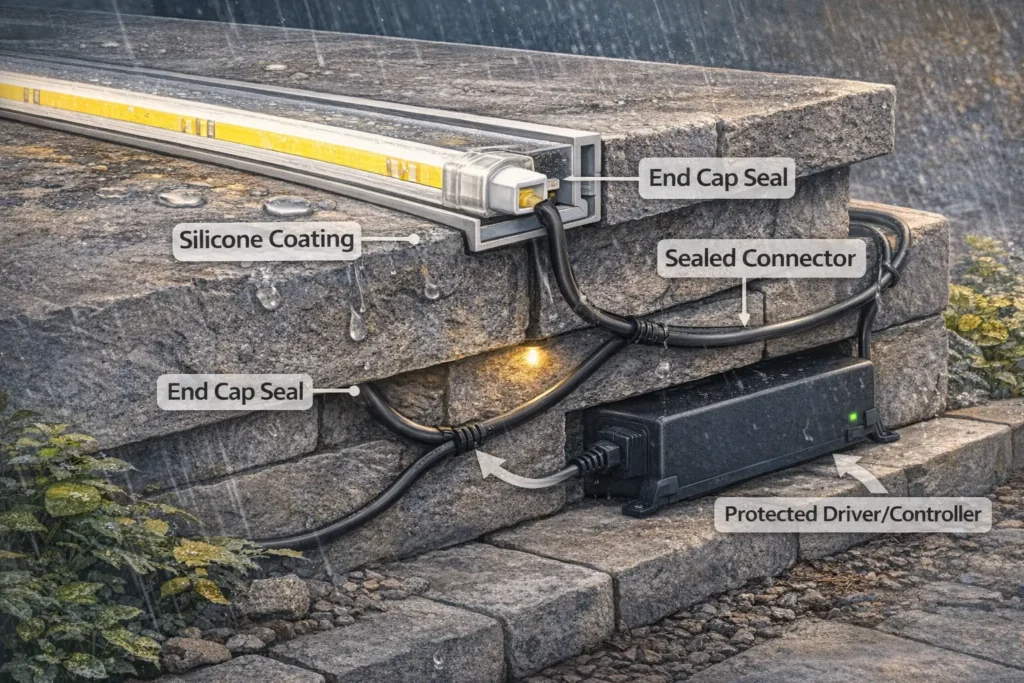
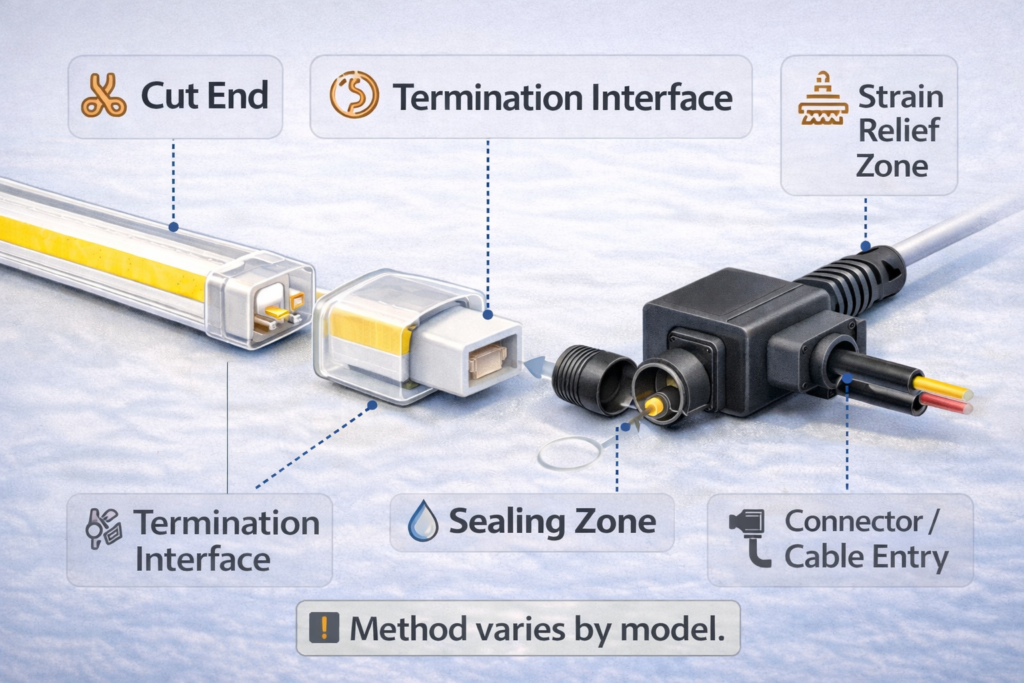
A reliable waterproof COB strip installation protects not only the strip body but also the ends/cuts, connectors/cable entries, and the driver/controller—because those are the most common entry paths for water.
Key Points
– Ends and cut points are the highest-risk locations.
– Connectors and cable entries need sealing and strain relief.
– Drivers/controllers typically need protected placement or enclosures appropriate to the environment.
– Cable routing and mounting affect whether water pools, drips into connectors, or stresses seals.
Choose IP65, IP67, or IP68 by your actual exposure scenario—splashes, rain, pooling, or immersion—and then confirm the model’s stated scope and installation constraints (especially for IP68, where immersion conditions are typically manufacturer-defined).
Key Points
– If you only expect splashes/sprays, you usually don’t need immersion-rated construction—but you still must seal terminations.
– If temporary immersion is possible (pooling or flooding risk), move beyond splash-oriented assumptions and verify scope carefully.
– If immersion is expected, require the supplier to state depth/time conditions for IP68/IPX8.
– Your “weak points” (ends/cuts/connectors/driver) often determine success more than the strip body rating.
Boundary Conditions
– IP labels are often used as shorthand in strip sourcing; confirm what the specific model’s claim covers and what must be sealed on site.
– IPX8/IP68 immersion conditions are not universal—verify manufacturer-stated conditions. See: Applus+ Keystone – IPX7/IPX8 and Polycase – IP67 vs IP68.
IP codes describe protection against solids/dust (first digit) and water (second digit); for immersion-style tests, IPX7 is commonly described as immersion up to 1 m under defined conditions, while IPX8 is immersion beyond 1 m under conditions typically specified by the manufacturer.
Key Points
– “X” means the digit isn’t specified (e.g., IPX7 focuses on water only).
– Immersion-style protection requires more careful procurement language than splash/spray scenarios.
– For IPX8/IP68, the key procurement question is: “What immersion conditions does the manufacturer state for this model?”
Boundary Conditions (1–3 bullets)
– Use model-scoped language; don’t assume the same IP label means the same condition across different suppliers. See: Applus+ Keystone – IPX8 conditions specified by manufacturer.
The simplest way to choose is to match each IP label to your wet exposure scenario and then plan for the highest-risk leak paths (ends, cuts, connectors, and power/control placement).
Key Points
– IP65 is often used for splash/spray environments (verify scope).
– IP67 is often used when temporary immersion risk exists (verify scope).
– IP68 is used for immersion scenarios, but depth/time must be confirmed (manufacturer-defined).
– Terminations and cable entries are non-negotiable design items.
| Common sourcing label | Typical wet exposure it’s used for | What to confirm with the supplier | What to plan in your installation |
|---|---|---|---|
| IP65 | Splashes/sprays, damp areas, cleaning/wiping | Scope statement for water protection; termination method | Seal ends/connectors; protect driver/controller; avoid water pooling at terminations |
| IP67 | Outdoor rain; possible temporary immersion (depends on model) | Whether temporary immersion is in scope; connector/end method | Treat ends/cuts/connectors as critical; plan protected cable routing |
| IP68 | Immersion expected | Manufacturer-stated immersion conditions (depth/time) for this model | Keep all entries sealed; plan access for inspection; confirm enclosure strategy for power/control |
Boundary Conditions
– IP68 immersion conditions vary and must be checked for the specific model. See: Polycase – IP68 requires checking manufacturer specifications for depth/time and Applus+ Keystone – IPX8 conditions specified by manufacturer.
Treat “outdoor” as too vague; decide whether your strip will face splashes, direct rain, pooling water, or true immersion—and choose an IP label accordingly, with explicit verification steps for anything beyond splashes.
Key Points
– Splash zone (no pooling): start with splash/spray intent (often IP65), then focus on sealing terminations.
– Direct rain: move toward stronger protection assumptions (often IP67), but still treat terminations as the top risk.
– Pooling/flood risk: don’t guess—verify whether the model’s scope covers temporary immersion.
– Immersion: specify IP68 and require stated conditions (depth/time) for the model.
Boundary Conditions
– A higher IP label does not automatically protect the rest of the system; your design must protect ends/cuts/connectors and power/control placement.
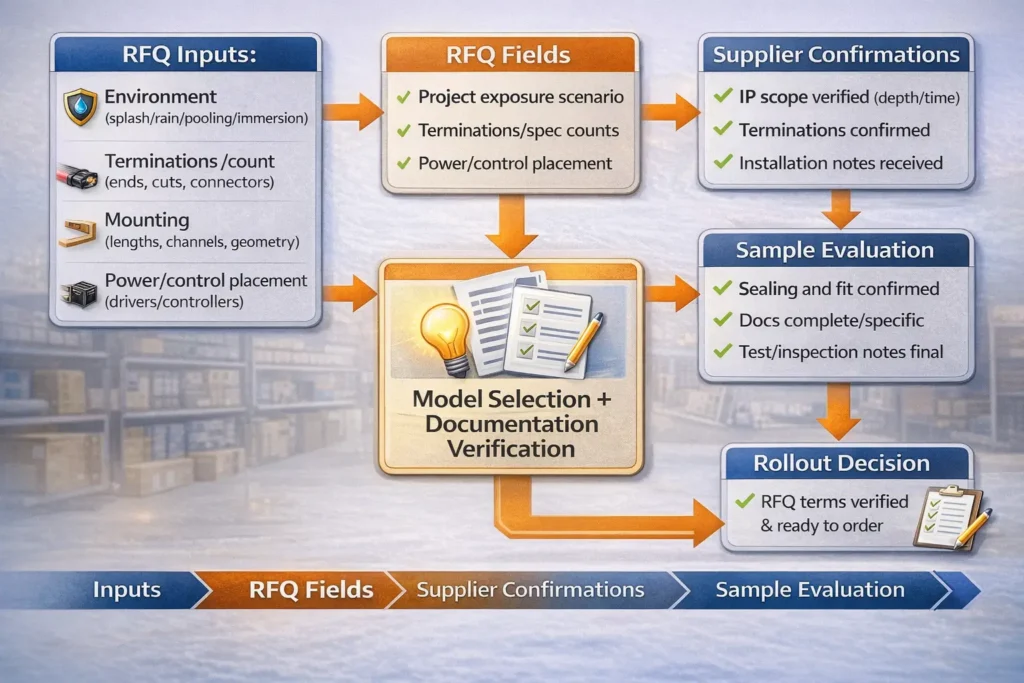
The fastest way to specify a waterproof COB LED strip is to write the spec around exposure + system design: define the wet scenario, count terminations, plan mounting and routing, and state how power/control will be protected—then request model-scoped documentation before sampling.
Project spec checklist (copy into your RFQ):

Boundary Conditions
– Don’t assume performance numbers (brightness, wattage, run length limits) without the model datasheet; confirm by documentation.
– If certifications matter for your project, confirm certification scope by model/series rather than assuming universal coverage.
A “waterproof” selection becomes reliable when you describe the site: where water comes from, where it can pool, how the strip is mounted, and whether the installation remains serviceable for inspection and resealing if needed.
Key Points
– Identify splash zones vs direct rain exposure vs pooling points.
– Note whether the strip is recessed/protected or exposed.
– Decide whether a profile/channel is needed for stability and protection.
– Plan for service access (inspection and replacement).
Boundary Conditions
– “Outdoor” alone is not a spec; exposure details determine what protection is actually needed.
For wet installations, reliability often depends on where the driver/controller is placed and how cables enter enclosures—so your spec should state placement and protection requirements even if wiring is handled by a qualified installer.
Key Points
– Locate drivers/controllers away from splash zones when possible.
– If enclosures are used, specify how cable entry points are sealed and strain-relieved.
– Maintain service access so inspection is possible after commissioning.
Boundary Conditions
– Keep electrical work within qualified installation practices and applicable project requirements.
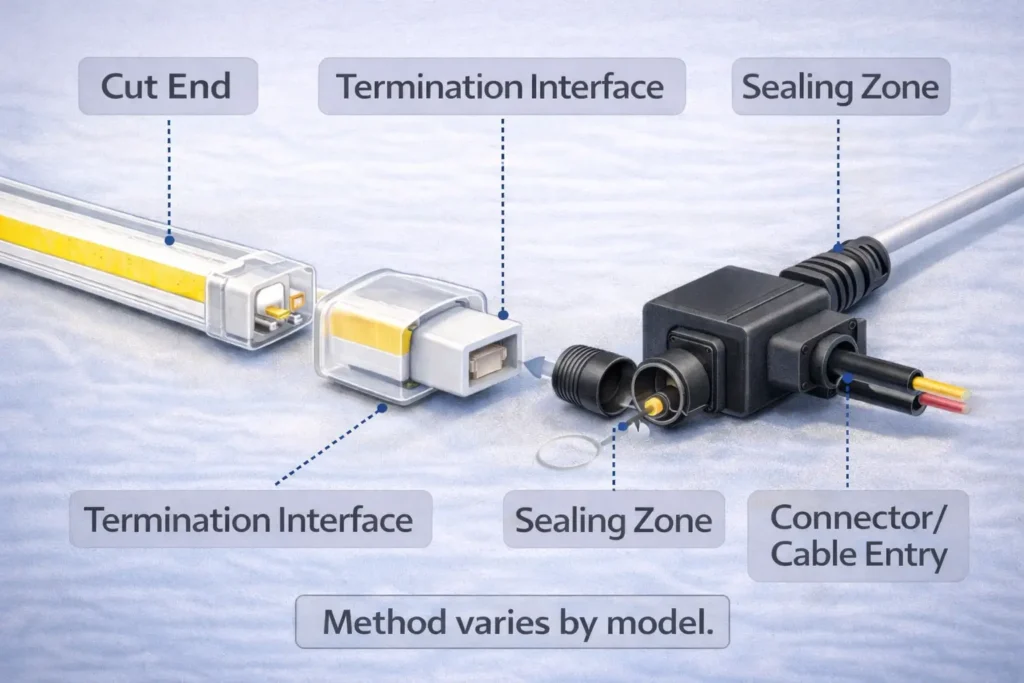
The more ends, cuts, and connectors your layout requires, the more sealing work your project must execute correctly—so count them early and decide whether you’ll reseal in the field or order custom lengths to reduce risk.
Key Points
– Ends/cuts are common ingress points; resealing rules must be confirmed by model.
– Connectors need sealing and strain relief; cable entries matter as much as the strip body.
– Custom lengths can reduce the number of field resealing events.
Boundary Conditions
– Termination and resealing methods vary by construction; always confirm what the specific model supports before committing to field cuts.
A practical sample check focuses on fit, sealing approach, connector/termination practicality, and documentation completeness—so your team can validate installability before full-scale procurement.
Key Points
– Verify the sealing method at ends/connectors is compatible with your install workflow.
– Confirm mounting fit (channel/profile if used) and access for inspection.
– Validate the documentation you’ll need to replicate the build (datasheet, termination notes, installation notes).
Boundary Conditions
– Acceptance criteria depend on your site conditions, maintenance access, and the number of terminations/cuts in the layout.
To keep waterproof COB LED strips reliable outdoors, treat the installation as a sealed system: choose the right exposure-fit model, prevent water paths at ends/cuts/connectors/cable entries, and keep power/control components protected and serviceable.
Key Points
– Start with exposure mapping and confirm model scope.
– Seal and strain-relieve every termination (ends/cuts/connectors).
– Route cables so water doesn’t drip into connectors or pool at terminations.
– Protect drivers/controllers in appropriate locations or enclosures.
– Inspect sealing points before closing channels/cavities.

Boundary Conditions
– Keep steps high-level and aligned with project safety practices; detailed wiring should follow qualified installation and model documentation.
– Final reliability depends on exposure, mounting, and long-term integrity of seals at terminations and entries.
Besides the strip body, you must waterproof the ends/cuts, connectors, and any cable entries, and protect the driver/controller—because these are the most common water paths in wet/outdoor builds.
Key Points
– Ends/cuts: sealing continuity is critical.
– Connectors: require sealing + strain relief.
– Cable entries: need protective routing or sealed entry methods.
– Driver/controller: placement and enclosure strategy matter as much as strip IP.
Boundary Conditions
– Any one unprotected entry point can defeat the entire “waterproof” intent.
A reliable wet-area installation is repeatable when you plan terminations first, execute sealing consistently, and validate protection before the final close-up.
Key Points
– Count terminations; decide factory vs field reseal.
– Seal, then strain-relieve (movement is a common cause of leaks).
– Protect power/control components and cable entries.
– Inspect before closing profiles/cavities.
Boundary Conditions
– Resealing methods and materials are not universal; follow the model’s stated approach where provided.
Most “waterproof strip failures” in wet installs are caused by incomplete sealing at ends/cuts/connectors or by placing power/control components where water can enter enclosures or cable entries.
Key Points
– Unsealed cut end or poorly resealed end cap
– Exposed connector or cable entry without sealing/strain relief
– Driver/controller placed in splash/standing-water zones
– Cable routing that drips into connectors or traps water
– Mounting gaps that allow pooling against terminations
Boundary Conditions
– Exact failure modes vary by site and build; treat these as common risk patterns, not universal diagnostics.
If your project needs a highly uniform “dot-free” look with a robust outer jacket and simpler end-to-end sealing in harsh environments, LED neon strips can sometimes be a more straightforward fit than a waterproof COB strip.
Key Points
– Choose waterproof COB strips when you want a slim profile and flexible “tape-like” installs with careful termination planning.
– Choose LED neon strips when you want a more robust casing and a consistent neon-style diffusion with potentially simpler exterior protection.
– Use your geometry, exposure, and service access to decide.
You can often cut and reconnect waterproof COB LED strips, but waterproof integrity is usually compromised at cuts unless the termination is resealed correctly using the method supported by that specific model; for high-exposure projects, custom lengths and factory terminations can reduce field sealing risk.
Key Points
– Cuts and terminations are the primary weak points for water ingress.
– “Yes, but only if…” is the correct rule: only if resealing is done per the model’s intended method and verified before final closure.
– Custom lengths can reduce the number of field reseal events (risk reduction, not a guarantee).
– Always plan strain relief so movement doesn’t stress seals.

Boundary Conditions
– Do not promise restored IP level after field cuts; phrase as “aim to maintain” and verify.
– Resealing method depends on construction and accessories; confirm model instructions before making field modifications.
Yes—often you can cut a waterproof COB strip, but only if the cut end is re-terminated and resealed correctly using a method the model supports; otherwise, the cut becomes a water-ingress point.
Key Points
– Cutting creates a new “end,” which must be sealed like the factory end.
– Connectors and cable entries must be sealed and strain-relieved.
– Verification (visual + functional) should happen before the install is closed up.
Boundary Conditions
– Model constructions differ; always confirm the approved termination method before committing to field cuts.
A waterproof reseal workflow is about maintaining sealing continuity at the end/cable entry point and preventing movement from stressing the seal—so the termination remains intact over time.
Key Points
– Identify the correct cut points and the model’s supported termination method.
– Reseal the end and cable entry points consistently.
– Add strain relief so the seal isn’t pulled or twisted.
– Inspect before final closure.
Boundary Conditions
– Avoid declaring a universal reseal material or technique; follow the model’s documented approach where provided.
Specify custom lengths when field cuts would create many reseal points in wet zones, when maintenance access is limited, or when exposure severity makes consistent sealing difficult to control on site.
Key Points
– More cuts/joins = more potential ingress points.
– Harsh exposure + low service access increases the value of factory terminations.
– Custom lengths can reduce field resealing workload and variation.
Boundary Conditions
– Custom lengths reduce risk drivers (reseal count), but they do not guarantee outcomes; installation and protection still matter.
Most outdoor failures happen because water enters through weak points (ends, cuts, connectors, cable entries, or enclosures for drivers/controllers), or because condensation/corrosion builds up over time; prevention is a system checklist, not a single product label.
Key Points
– Water rarely “penetrates the LEDs” first—it finds the easiest entry path: termination gaps and cable entries.
– Movement and poor strain relief can open seals over time.
– Condensation and corrosion can cause intermittent issues even without obvious “leaks.”
– Prevention improves when you design for inspection access and repeatable sealing.

Boundary Conditions
– Outdoor conditions vary widely; treat these as common patterns and prevention practices, not guarantees.
– A “higher IP label” does not eliminate system-level sealing responsibilities.
In wet/outdoor COB strip installs, the most common ingress points are the strip ends, cut ends, connectors, cable entries into enclosures, and any driver/controller housings placed in splash or standing-water zones.
Key Points
– Ends/cut ends: sealing continuity is critical.
– Connectors: require sealing plus strain relief.
– Cable entries: water can wick along cables into enclosures.
– Enclosures: placement and entry sealing often determine success.
Boundary Conditions
– Exact ingress points depend on layout and construction; use this as a systematic review list.
The most reliable prevention approach is to map each failure point to a specific action and inspection check before the installation is closed.
Key Points
– Prevention must be repeatable: consistent sealing method + consistent strain relief + verification.
– Inspection access reduces long-term risk when environments are harsh.
Boundary Conditions
– Verification methods and acceptance criteria should match project conditions and the supplier’s installation notes.
Early signs of water/condensation issues often appear as intermittent segments, visible moisture traces near ends/connectors, or corrosion-like discoloration; planning inspection access helps you correct issues before they spread.
Key Points
– Intermittent flicker or sections dropping out can indicate a connection/ingress issue.
– Visible corrosion near connectors/ends can indicate moisture exposure.
– If inspection is impossible after closure, risk increases—design access or reduce terminations.
Boundary Conditions
– Symptoms are not a full diagnosis; use them to trigger inspection and corrective actions appropriate to the project.
Coated and sleeve/encapsulated waterproof COB strips can both work in wet projects, but they differ in serviceability, how terminations are handled, and how easy it is to modify the strip in the field—so choose the method that matches your exposure and workflow.
Key Points
– Coated designs are often used for splash-oriented needs; sleeve/encapsulation is often used for stronger wet protection.
– Sleeve/encapsulation can reduce surface exposure but increases the importance of proper end sealing.
– Field cuts and repairs are generally easier when the termination method is well-supported and repeatable.
– Profiles/channels can help protect and stabilize installations (without replacing sealing requirements).
Boundary Conditions (1–3 bullets)
– Construction details vary by supplier and model; treat the table as “typical patterns” and confirm specifics by documentation.
– Avoid numeric thermal or performance claims unless confirmed by the model datasheet.
Method selection is best made by asking: “How harsh is the exposure, how many terminations will we have, and how serviceable does the installation need to be?”
Key Points
– Higher exposure and immersion risk push you toward more robust sealing approaches.
– More field cuts/joins push you toward approaches that are easier to re-terminate consistently.
| Waterproofing approach (typical) | Best-fit scenarios | Typical cautions | Procurement question to ask |
|---|---|---|---|
| Coated / surface-sealed style | Splashes/sprays, damp indoor areas | Terminations still vulnerable; coating may be damaged by poor handling | “What is the termination method and how are ends/cuts sealed?” |
| Sleeve / jacketed style | Outdoor rain and stronger wet exposure | End sealing becomes critical; field cuts require careful resealing | “If we cut on site, what is the approved resealing method for this model?” |
| Encapsulated / fully sealed style | Immersion-intent projects | Requires explicit manufacturer-stated immersion conditions; sealing and access planning are critical | “What immersion conditions (depth/time) are stated for this model, and what are installation limitations?” |
Boundary Conditions
– Always validate method details and field modification rules by model documentation before ordering large quantities.
Waterproofing method choice changes how you treat ends and cuts, what accessories you need for sealing, and how you approach mounting and service access.
Key Points
– More sealed constructions can be less forgiving of poor end sealing.
– If field cuts are expected, choose a method with a clear, repeatable termination workflow.
– Profiles/channels can stabilize mounting and reduce direct exposure, but they do not replace correct sealing at terminations.
Boundary Conditions
– Avoid assuming one method is “always better”; match method to workflow, exposure, and service access.
A strong RFQ for waterproof COB LED strips confirms the model’s IP scope (and immersion conditions if IP68), documents the termination and field modification rules, and makes power/control placement requirements explicit—so “waterproof” isn’t left to interpretation.
Key Points
– Confirm IP scope by model/series and ask for boundary notes (especially for IP68 conditions).
– Confirm termination method and whether field resealing is supported and how.
– Request installation notes that match your environment and mounting approach.
– If certifications matter, confirm scope by model/series instead of assuming universal coverage.
Optional RFQ field table (for clarity):
| RFQ field | What to write | Why it matters |
|---|---|---|
| Exposure scenario | splash / rain / pooling / immersion | Drives IP scope and sealing needs |
| Terminations count | number of ends/cuts/connectors | Predicts ingress risk and field workload |
| Termination method | factory vs field; reseal method | Determines whether “waterproof” is maintainable |
| IP68 conditions (if applicable) | stated depth/time for this model | Prevents incorrect “submersible” assumptions |
| Power/control placement | location + protection plan | Avoids failures at enclosures/cable entries |
Boundary Conditions (1–3 bullets)
– Certification and compliance scope can vary by model/series; confirm what applies to the specific item you are purchasing.
– For immersion-style claims, require the supplier to state the model’s conditions; do not assume a universal IP68 depth/time. See: Applus+ Keystone – IPX8 conditions specified by manufacturer and Polycase – IP68 depends on manufacturer specifications.
If you want a second set of eyes on a wet/outdoor COB strip spec (IP target, termination plan, and documentation checklist), you can share your exposure scenario and layout notes via the Elstar contact page: Contact Elstar.
Your RFQ is strongest when it specifies exposure, terminations, mounting context, and power/control placement—so the supplier can confirm the model scope and provide the correct termination method.
Key Points
– Exposure scenario (not just “outdoor”)
– Target IP label and what it must protect against
– Termination count and whether field cuts are expected
– Mounting context and service access
– Power/control location and protection constraints
Boundary Conditions
– Avoid leaving “waterproof” as a single word in the RFQ; convert it into scenario + scope + termination rules.
Request the datasheet plus clear IP scope notes and termination/installation guidance so the project doesn’t rely on assumptions about what “waterproof” includes.
Key Points
– Datasheet for the specific model/series
– IP scope statement and boundary notes
– Termination method and field modification rules (if applicable)
– Installation notes aligned to your environment and mounting plan
Boundary Conditions
– Keep requests practical and model-scoped; don’t assume all suppliers provide identical evidence depth.
Confirm IP and any certification scope by model/series and document it in procurement records, so the installed system matches project requirements and boundary conditions.
Key Points
– “By model/series” should be standard procurement language.
– IP68 requires stated immersion conditions for the specific model.
– Acceptance criteria should align to the site and installation plan.
Boundary Conditions
– Do not assume universal certification scope; scope must match the exact item being purchased.
These FAQs summarize the highest-frequency questions about waterproof COB LED strips—IP labels, system sealing, cutting/resealing, common failures, and method trade-offs—using the same boundary-first approach as the main guide.
Key Points
– Each answer is conditional on exposure and installation quality.
– IP68 immersion conditions must be stated by the manufacturer for the specific model.
– Terminations and power/control placement are common failure points.
A waterproof COB LED strip project succeeds when you choose an exposure-fit IP scope, seal the entire system (not just the strip), and write an RFQ that confirms termination rules and model-scoped boundary conditions—especially for IP68 immersion claims.
Key Points
– Decide by exposure scenario: splash vs rain vs pooling vs immersion.
– Treat “waterproof” as a system: ends/cuts/connectors/cable entries + protected driver/controller placement.
– Count terminations early; reduce field reseals when exposure is harsh or service access is limited.
– Confirm scope by model/series; for IP68/IPX8, require stated immersion conditions (depth/time).
– Use a sample evaluation checklist that checks installability and documentation, not made-up lab numbers.
Boundary Conditions
– This guide is a decision and planning framework; final suitability must be confirmed by the specific model’s documentation and the project’s site conditions.
– Avoid universal claims; “waterproof” depends on scope and execution.
For sourcing discussions, it helps to share: (1) exposure scenario, (2) layout with termination count, and (3) driver/controller placement plan. If you’d like to route that through a manufacturer’s project team, you can start here: Elstar contact and reference “waterproof COB strip—IP selection + termination plan.”