Table of Contents
A TV backlight LED strip is a flexible light strip placed behind a TV to create a soft glow on the wall. It can make dark-room viewing feel more comfortable and help the screen blend better with the room.
Also, a TV backlight LED strip is easy to install in many home setups. Instead of adding a floor lamp near the screen, you can add indirect light behind the TV.
For related product options, you can review Elstar’s LED strip lights and COB LED strips pages. For general LED lighting context, see the U.S. Department of Energy’s LED lighting overview.
The strip sits on the back of the TV and shines toward the wall. As a result, the wall reflects the light and creates a soft halo around the screen.
A TV backlight LED strip can improve comfort, mood, and room style. However, the result depends on the strip type, brightness, color, and install quality.
The main benefits are eye comfort, better room mood, perceived contrast improvement, and low power use. Therefore, a TV backlight LED strip is a simple upgrade for many TV setups.
For background on how lighting and glare can affect visual comfort, see the American Academy of Ophthalmology’s overview of screen use and eye comfort.
Choose the strip based on TV size, brightness, color, power, and control style. Also, check whether the strip can bend around the TV corners without stress.
First, measure the back of the TV. Then, choose a strip long enough to cover the sides you want to light. Larger TVs usually need longer strips for even light.
Next, choose brightness that fits the room. Too much light can distract from the screen. However, too little light may not create the desired glow.
For a calm room, warm white around 2700K to 3000K often feels soft. For a cleaner modern look, neutral white or cool white can work. Still, avoid light that feels too blue or harsh.

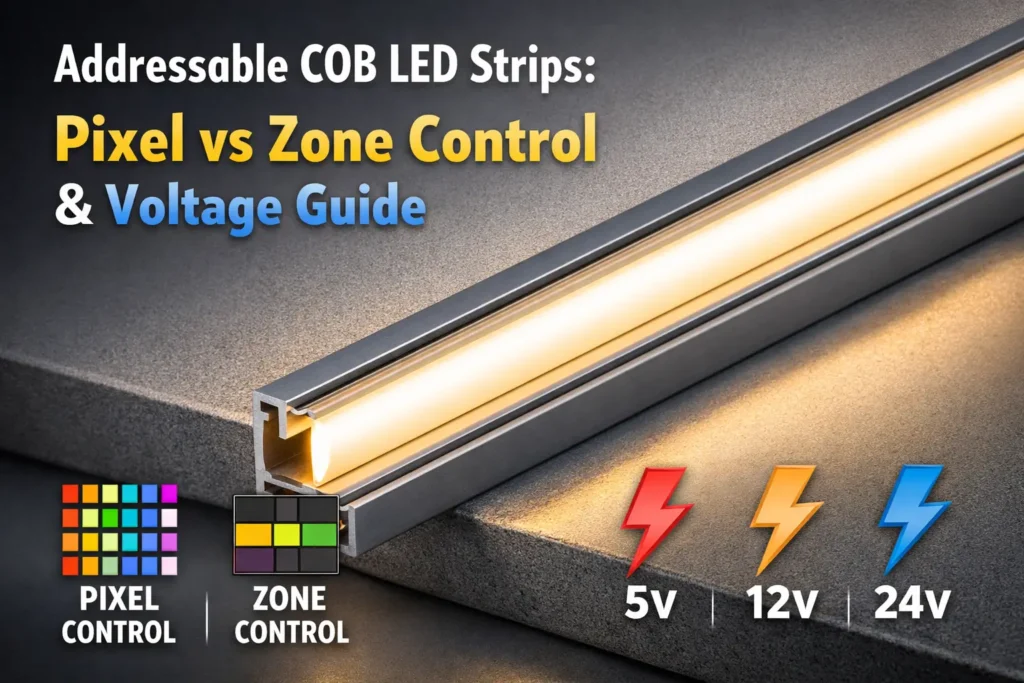
Voltage matters because it affects strip length, power supply choice, and brightness consistency. For most small TVs, 12V strips can work well. However, larger TVs may benefit from 24V strips.
| Factor | 12V LED Strips | 24V LED Strips |
|---|---|---|
| Typical run length | Better for shorter runs | Better for longer runs |
| Brightness consistency | Can drop more on long runs | Often more stable on longer runs |
| Power supply | Common and easy to find | Needs a matching 24V supply |
| Best suited scenarios | Small to medium TVs | Larger TVs or cleaner long runs |
Choose 12V if the TV is small or the strip run is short. However, choose 24V when the TV is larger or when you want more even brightness around the screen.
Do not mix voltages. A 12V strip needs a 12V power supply, while a 24V strip needs a 24V power supply.
A smart TV backlight LED strip can add color scenes, app control, voice control, and sometimes screen-sync effects. As a result, the TV area can feel more immersive.
Smart strips are useful if you like changing moods often. They are also helpful for gaming rooms. However, for simple eye comfort, a dimmable white strip may be enough.

Installing LED strips behind a TV is usually simple. Still, you should plan the path, clean the surface, and test the strip before final mounting.
For more installation basics, see Elstar’s internal LED strip installation guide.
Most problems come from poor fit, weak adhesive, too much brightness, or the wrong power supply. Therefore, check the details before final mounting.

Yes. LED strips are commonly used behind TVs to create indirect light. Also, they can make dark-room viewing more comfortable.
The main benefits are eye comfort, better room mood, perceived contrast improvement, and low power use. Therefore, they are popular for bedrooms, living rooms, and gaming setups.
Start with TV size and strip length. Then, choose brightness, color, voltage, and smart features based on your room and viewing style.
12V strips often fit shorter runs. However, 24V strips can work better for larger TVs and longer runs because brightness may stay more even.
Smart strips can change color, dim from an app, save scenes, and sometimes sync with screen content. As a result, the TV area can feel more immersive.
The best strip depends on your TV size, room brightness, budget, and control needs. For most users, a dimmable strip with even light is the safest choice.
Choosing a TV backlight LED strip is easier when you start with TV size, viewing style, brightness, and control needs. Then, match voltage, power supply, and strip length before mounting.

 English
  Spanish
  French
  Arabic