5m vs 10m LED strip choice depends on your run length, power supply size, voltage drop risk, and whether you can add power injection. A 5 m strip is easier for short cabinet or shelf runs, while a 10 m strip needs more careful wiring to keep brightness even.
Therefore, do not choose strip length by reel size alone. First, measure the route. Next, calculate power draw. Then, plan feed points, wire size, and voltage drop before final installation.
For related internal resources, review Elstar’s LED strip lights, LED power supplies, LED strip installation guide, and contact page. For helpful external references, see the U.S. Department of Energy guide to LED lighting and SparkFun’s voltage, current, and resistance guide.
Choose a 5 m LED strip for short, simple, single-feed runs. Choose a 10 m LED strip only when your layout needs the extra length and you can plan power injection, thicker wire, or parallel feeds.
The “5 m” or “10 m” label tells you the total strip length on the reel. However, it does not mean every layout should be powered from only one end.
A 5 m reel is common for under-cabinet lighting, shelves, small coves, and accent runs. Also, many 5 m runs can work from one feed if the strip power and wire route are reasonable.
A 10 m reel gives more length, but it also raises power draw and voltage drop risk. As a result, a 10 m run often needs power injection or parallel wiring.
You can cut many LED strips only at marked cut points. However, you should not extend beyond the rated run length without checking power, wire size, and voltage drop.
Power use depends on watts per meter. In this example, the strip uses 14.4 W/m. Therefore, a 10 m strip uses twice the power of a 5 m strip.
| Length | Power per m | Total power | Recommended PSU |
|---|---|---|---|
| 5 m | 14.4 W/m | 72 W | 100 W 12 V supply |
| 10 m | 14.4 W/m | 144 W | 200 W 12 V supply |
A 10 m strip at 14.4 W/m uses about 144 W. Then, you should choose a power supply with headroom, such as a 200 W 12 V supply for this example.
Do not run a power supply at its limit. Instead, leave headroom so the system stays cooler and voltage stays more stable.
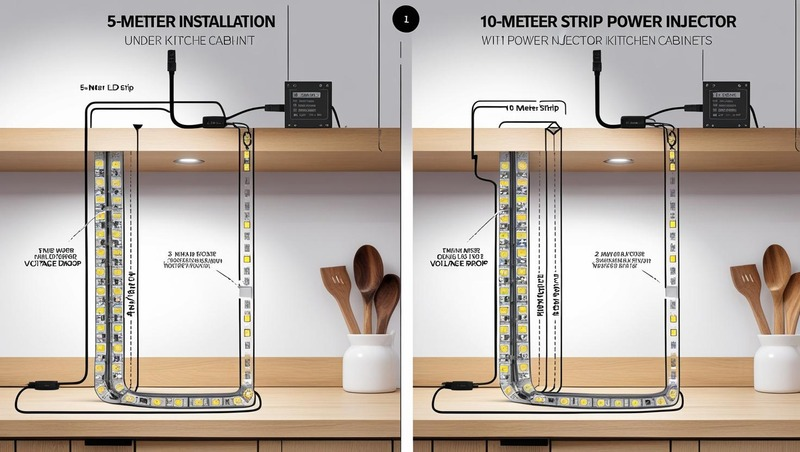
Longer LED strips are more likely to show voltage drop. As voltage drops, the far end can look dimmer than the feed end.
Voltage drop grows with current, distance, and resistance. Therefore, a 10 m run can show more dimming than a 5 m run if both are powered from one end.
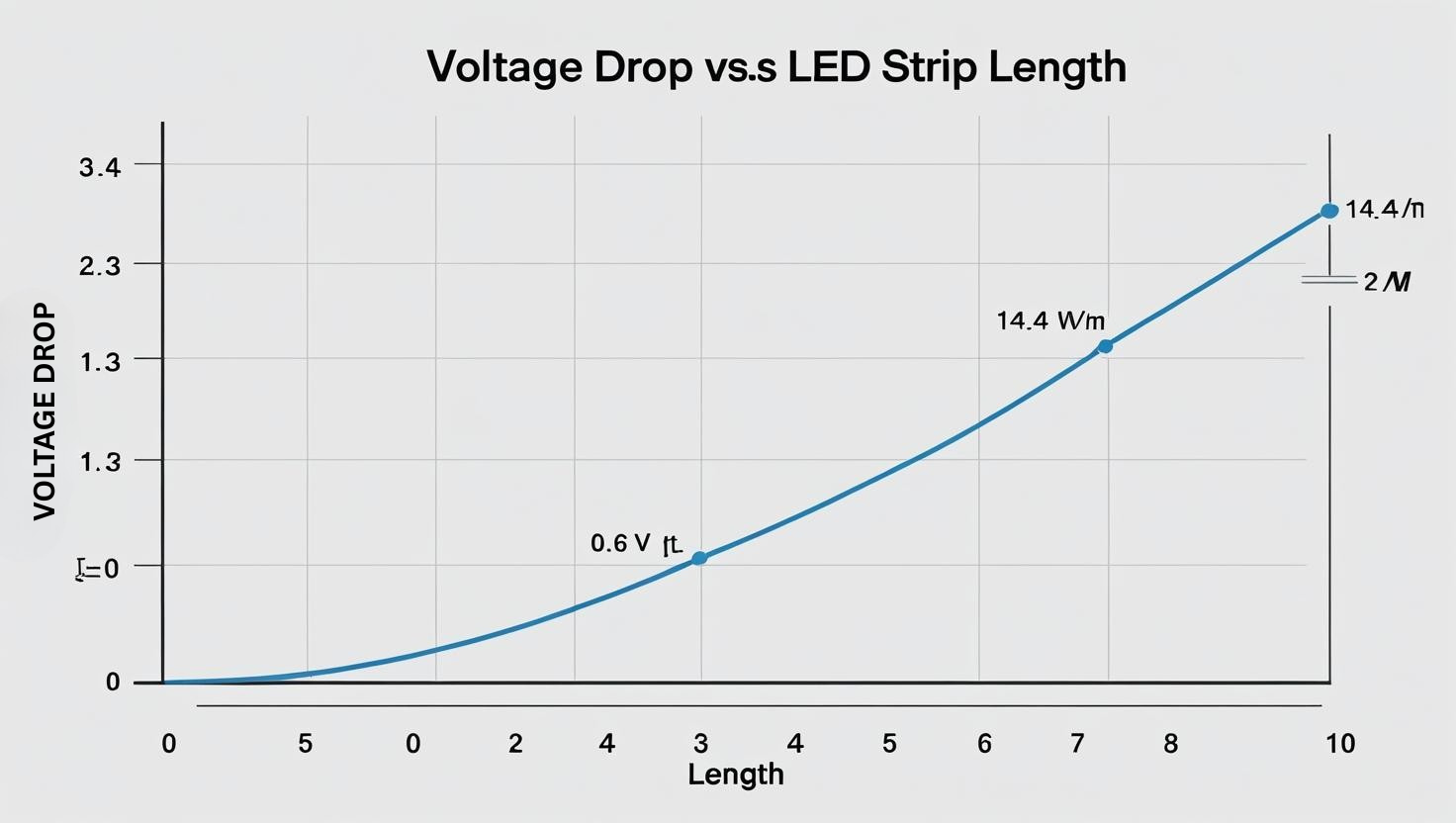
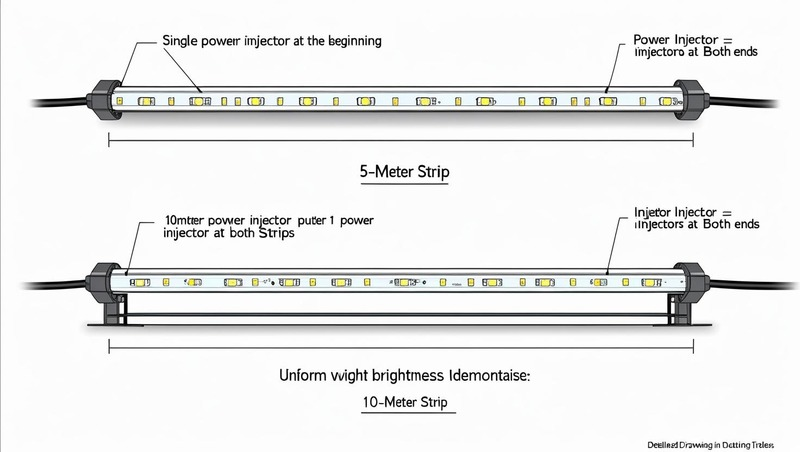
To keep long runs even, plan power feeds before sticking the strip down. Also, avoid relying on one long daisy-chain if the strip is high power.
For a 10 m LED strip, split the run into two 5 m segments where possible. Then, power both sections in parallel to improve brightness and reduce stress on the strip.
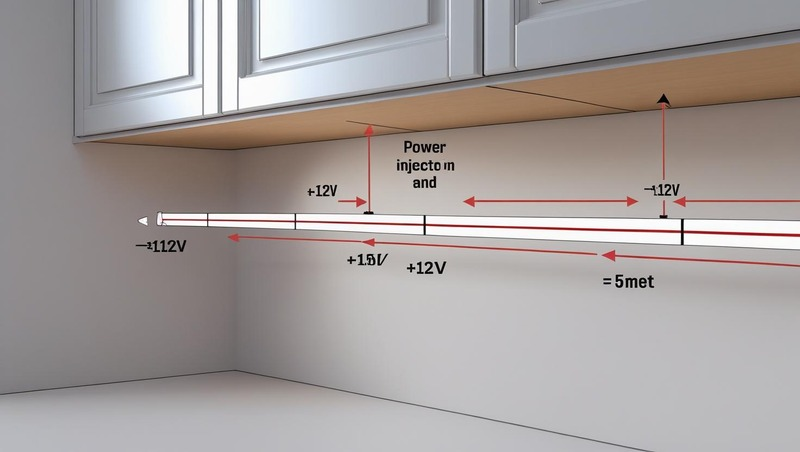
The best length depends on the space and wiring access. Therefore, choose the shortest strip plan that covers the layout cleanly.
Usually, yes. A 5 m strip often covers one standard cabinet run. However, longer kitchens may need two shorter strips or a longer strip with added power feeds.
It depends on watts per meter. For example, a 10 m strip at 14.4 W/m uses about 144 W, so it needs a larger power supply with safe headroom.
Use power injection, both-end feed, or parallel 5 m segments. Also, use suitable wire size and a power supply that matches total load.
You can, but it may cause dim ends if powered from only one end. Therefore, parallel feeds or injection are usually safer for brightness.
The 5m vs 10m LED strip decision comes down to layout length, power draw, voltage drop, and feed access. A 5 m strip is simpler for short runs. In contrast, a 10 m strip needs better wiring and power planning.
For short single-feed runs, choose 5 m. For longer spans, choose 10 m only if you can add power injection or split the layout into parallel sections.
For next steps, browse Elstar’s LED strip lights or contact Elstar for project support.
 English
  Spanish
  French
  Arabic