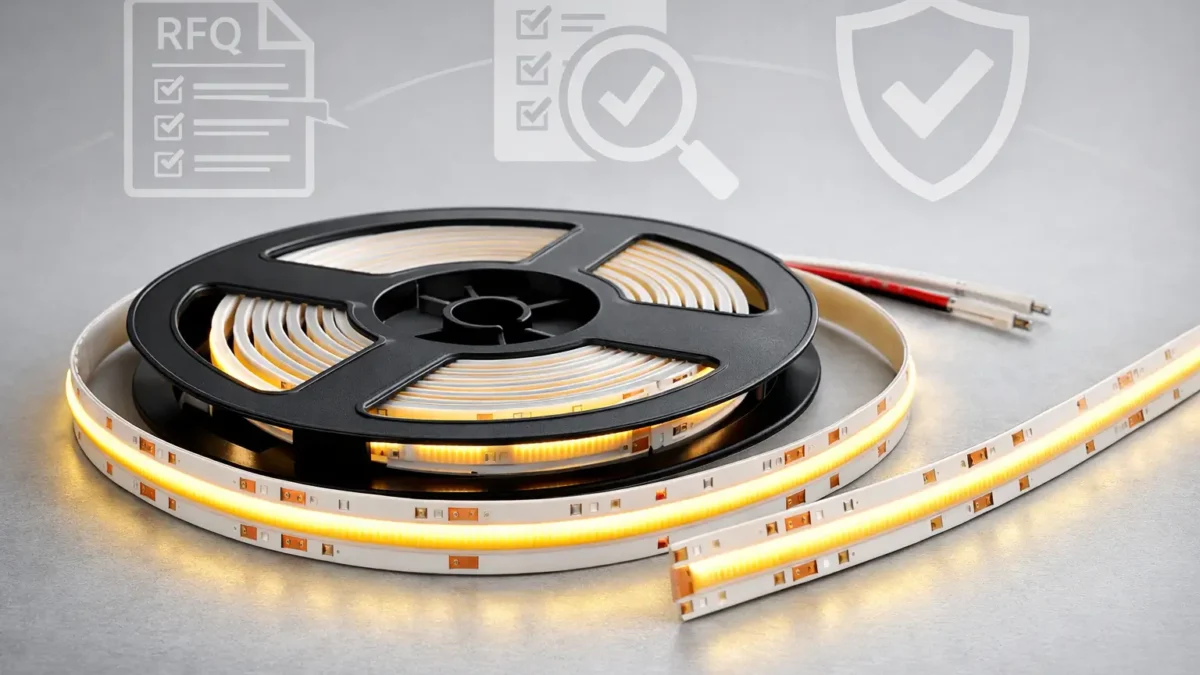
Shortlist a COB LED Strip Manufacturer (5-Step Checklist + RFQ Must-Haves)
To get useful quotes, standardize your needs before you ask for price. As a result, you can compare suppliers fairly and avoid vague “similar product” offers.
5-step checklist
| Step | What to do |
|---|---|
| 1) Define the application | State project or product-line use, site type, and visual goal. |
| 2) Build a short list | Choose suppliers whose range and custom scope fit your need. |
| 3) Send one RFQ | Use the same RFQ version for every supplier. |
| 4) Verify proof | Request model datasheets, QC notes, and certificate scope if needed. |
| 5) Sample and approve | Test samples against written acceptance checks before bulk order. |
RFQ must-haves
- First, include application and site type: dry, damp, wet, or outdoor.
- Next, list COB variant needs, such as single color, CCT, RGB, or RGBW.
- Also, state control or dimming expectations.
- Then, add layout notes, mounting method, and feed or power plan idea.
- In addition, list needed documents, such as datasheet, wiring notes, labels, and package needs.
- Finally, state any compliance needs and ask for scope by model or series.
Boundary notes
- However, do not assume universal certificates, fixed lead times, fixed MOQ, or “no voltage drop” claims.
- Also, tie every claim to the exact quoted model or series.
- Therefore, keep the RFQ, quote, datasheet, and sample approval notes together.
What Buyers Mean by “COB LED Strip Manufacturer” (US Market, B2B Context)
In B2B sourcing, a manufacturer is more than a product page. Instead, buyers need repeat supply, clear documents, stable changes, and a smooth handover process.
Who this guide is for
- First, it fits lighting brands and distributors.
- Next, it fits project, design, and engineering teams.
- Also, it fits buyers who need samples, labels, and documents before bulk order.
What “reliable” usually means
- The supplier offers product options that fit the use case.
- Also, the supplier answers RFQ questions clearly.
- Then, the supplier gives model-specific documents instead of broad claims.
- Finally, the supplier can repeat the approved sample in production.
US-market note
In the US, project needs can vary by spec and local authority. Therefore, ask what documents the project actually needs before you lock a model.
Boundary conditions: If you do not know a detail, write the constraint and ask for options. Do not guess a value just to fill the RFQ.
Options & Comparison: COB vs SMD vs LED Neon (When Each Format Makes Sense)
COB strips are often chosen for a smooth line of light. However, SMD and LED neon can be better choices in some layouts. Therefore, choose the format by use case, not by trend.
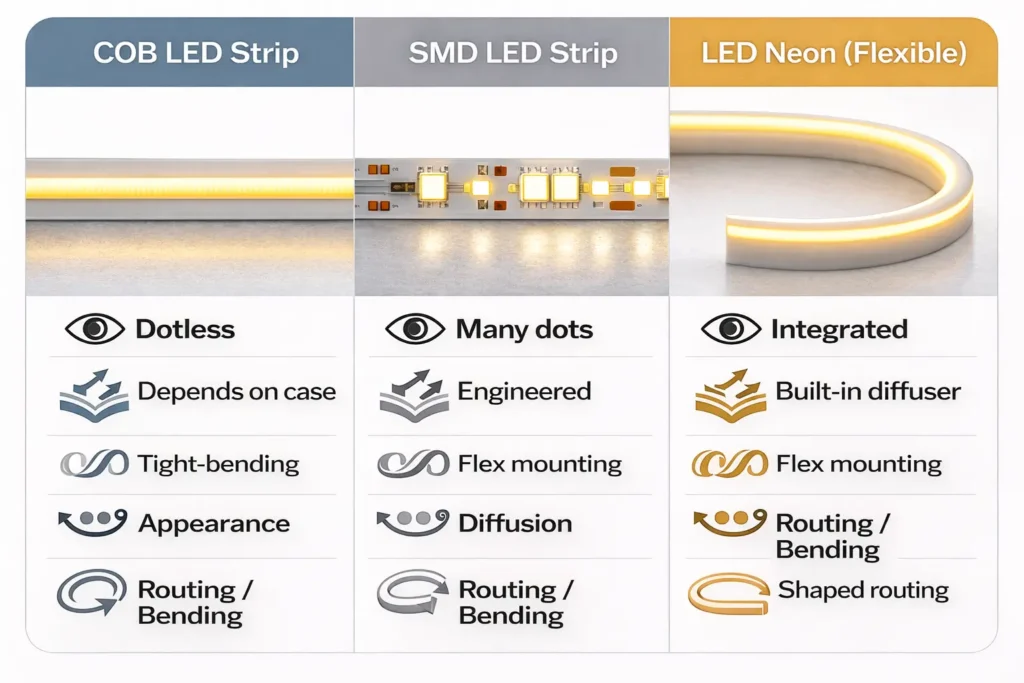
Format comparison table
| Format | Why teams choose it | Common trade-off | Buying note |
|---|---|---|---|
| Bande LED COB | Smooth line for many linear lighting jobs | Mounting and bending still matter | State visual goal, mounting plan, and control method. |
| Bande LED SMD | Wide range of options and accessories | May show dots without enough diffusion | State diffuser plan and viewing distance. |
| LED neon flex | Built-in diffuser look and shaped runs | Larger body and different install method | State route, bend needs, environment, and install method. |
Pick this when
- Pick COB when the clean line look is the main goal.
- However, pick SMD when you need wider SKU options and can manage diffusion.
- Also, pick neon when you need a built-in diffuser body or routed shape.
Boundary conditions: Final fit depends on the exact model, profile, diffuser, and site. Therefore, verify with datasheets and samples.
Decision Guide: How to Evaluate and Shortlist a COB LED Strip Manufacturer
A good shortlist uses proof, not slogans. First, check product fit. Next, check documents. Then, check sample support and change control.
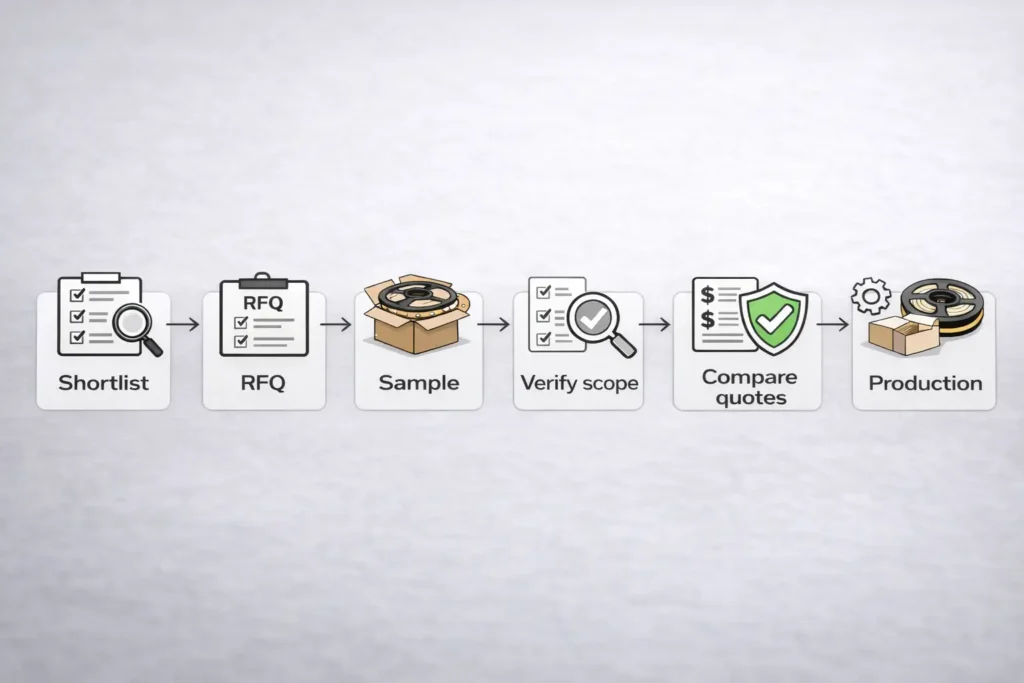
What shortlisting should do
- First, confirm the supplier can support your product line or project.
- Next, confirm they can tie claims to a model or series.
- Also, confirm they can provide samples that match the RFQ.
- Finally, confirm they can track changes after approval.
Shortlist checklist
- Product fit: can they quote the COB variant and site type you need?
- Document readiness: can they provide datasheet and wiring notes?
- Custom scope: can they explain standard options versus items that need validation?
- QC proof: can they explain what they check and what evidence they can share?
- Compliance scope: can they confirm marks or reports by model or series?
- Communication: can they track RFQ versions, samples, and changes clearly?
- Project support: can they support labels, packaging, and handover documents?
Red flags
- First, a quote has no model or series reference.
- Next, “certified” claims appear without scope evidence.
- Also, QC claims use vague phrases like “strict QC” with no checks listed.
- Then, the supplier asks no questions about environment, mounting, or control.
- Finally, sample approval has no written criteria.
Boundary conditions: A red flag does not always mean reject. However, it does mean you should add checks and tighten the scope.
Process / How-to: RFQ Checklist, OEM/ODM Scope, and Sampling Workflow
To get fair quotes, use one RFQ template across all suppliers. Also, define custom work early. Then, make sampling a real approval step, not a formality.
RFQ checklist table
| RFQ field | Why it matters | What to attach or confirm |
|---|---|---|
| Application scenario | Sets baseline needs | Project or product line; installer and sign-off role |
| Environment exposure | Drives IP and install method | Dry, damp, wet, outdoor, heat, UV, or chemicals |
| Visual goal | Avoids “looks wrong” disputes | Dotless line, diffuser plan, direct or hidden view |
| Control need | Prevents dimming issues | Controller, dimmer, or protocol notes |
| Run layout and feed idea | Helps long-run planning | Sketch or notes with segments and feed points |
| Mounting method | Affects look and life | Surface, channel, profile, bends, and route limits |
| Documents | Reduces back-and-forth | Datasheet, wiring notes, labels, packaging needs |
| Compliance needs | Avoids late issues | Project requirement and model-scope proof |
| Acceptance checks | Makes samples meaningful | Sample test and incoming check basis |
OEM/ODM scope table
| Often straightforward | Usually needs extra validation |
|---|---|
| Connector or lead position | Special route or bend needs |
| Cable exit direction | Major build or material changes |
| IP option selection | Complex wet or outdoor use |
| Labels, packaging, and documents | Any change after sample approval |
Sampling workflow
- First, freeze RFQ version 1.
- Next, request a sample that matches the RFQ scope.
- Then, test the sample in the planned profile, driver, controller, and wiring setup.
- Also, collect the model datasheet and support notes.
- After that, approve with written criteria and a sign-off owner.
- Finally, align incoming checks with the same sample criteria.
Common RFQ mismatch causes
- Environment or IP need is missing.
- Also, the control method is missing.
- Next, run layout notes are missing.
- Then, no model or series reference is required.
- Finally, sample approval criteria are unclear.
If you want a faster quote cycle, prepare your RFQ with the table above. Also, include a simple run layout, site notes, and control needs. As a result, you reduce re-quoting loops.
Boundary conditions: If a requirement changes after approval, review the scope again. In some cases, re-sampling will be needed.
Risks & Mistakes to Control Upfront: QC Evidence, Compliance Scope, Installation, Controls, and Quote Comparability
Most project problems can be reduced when you turn quality and compliance into clear buying actions. Therefore, request proof, verify scope, and record what you approved.
QC proof: request, verify, record
- First, request a model datasheet for each quoted item.
- Next, request basic wiring or install notes where needed.
- Also, ask for available test or inspection notes for the quoted series.
- Then, verify that documents match the quoted model or series.
- Finally, record RFQ version, sample approval, files received, and change rules.
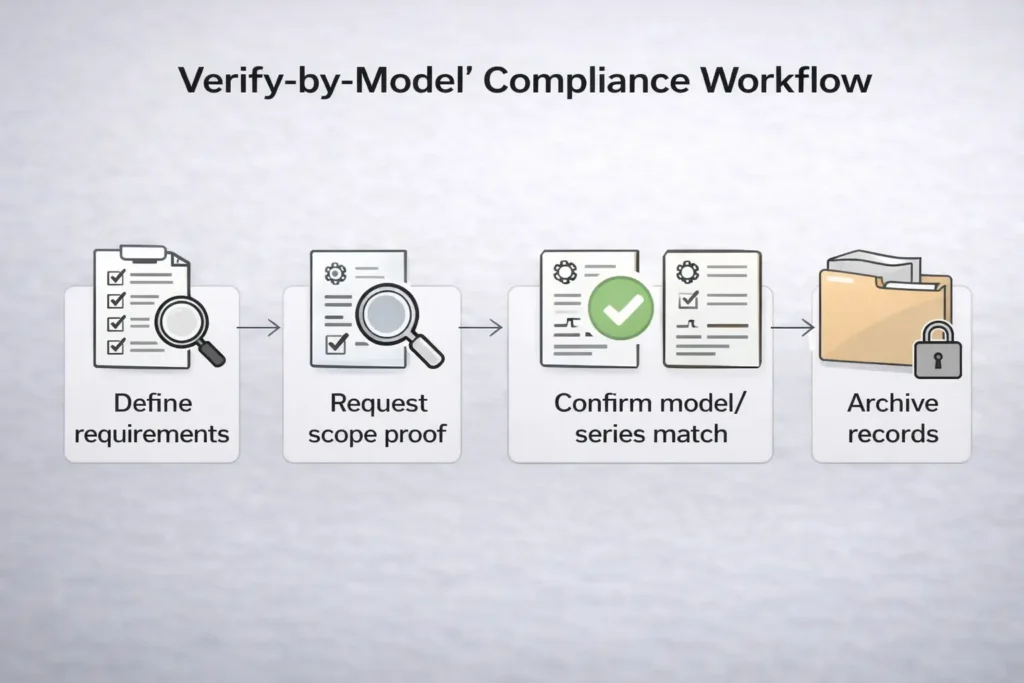
Compliance scope workflow
For US projects, treat compliance as model-specific. A broad claim is not the same as verified scope.
- First, define what the project or spec requires.
- Next, ask for documents tied to the exact quoted model or series.
- Then, check whether the scope covers the quoted item.
- Finally, archive the quote, model ID, and documents for handover.
Helpful compliance references
- OSHA NRTL Program overview: https://www.osha.gov/nationally-recognized-testing-laboratory-program
- OSHA current list of NRTLs: https://www.osha.gov/nationally-recognized-testing-laboratory-program/current-list-of-nrtls
Installation risks to capture before quote
- Run layout: start and stop points, feed access, and service access.
- Environment: water, UV, heat, chemicals, or cleaning methods.
- Mounting: profiles, bends, corners, substrate, and route limits.
- IP choice: match the real exposure and install method.
- System plan: driver location, wiring path, and control method.
For definition-level IP background, see: https://en.wikipedia.org/wiki/IP_code.
Controls and dimming checklist
- First, state the dimming or control method.
- Next, confirm the controller fits the strip type and wiring method.
- Also, confirm the driver or power supply fits the system design.
- Then, document wiring, polarity, and service access.
- Finally, include the actual controller or driver setup in sample testing.
Quote comparison table
| Scope field | How to standardize it | Hidden difference to watch |
|---|---|---|
| Model or series reference | Require ID on each line item | Similar descriptions but different products |
| RFQ version | Use the same version for all suppliers | Old revisions mixed into the quote |
| Environment and IP | State exposure and protection need | Different IP options quoted |
| Documents | List required documents | Support included in one quote but not another |
| QC proof | State requested evidence | Vague “strict QC” claims |
| Termination scope | Define connectors and leads | Accessories included or excluded |
| Labels and packaging | Define if needed | Private label scope varies |
If you compare several supplier quotes, use the table above as your internal scope sheet. Also, keep the RFQ version the same across all suppliers.
Boundary conditions: Evidence depth varies by supplier and series. Therefore, require critical items in the RFQ before quoting.
FAQ
What is a COB LED strip, and how is it different from SMD?
Answer: A COB LED strip often creates a smoother line of light. Meanwhile, SMD strips often rely more on diffuser and enclosure design to create a similar look. Therefore, choose by visual goal, routing, controls, and mounting.
How do you choose a reliable COB LED strip manufacturer?
Answer: First, check capability fit. Next, request model-level documents. Then, use a clear sample approval process. Also, avoid broad claims that are not tied to a model or series.
What should an RFQ include?
Answer: Include application, site exposure, control needs, run layout, mounting limits, documents, and acceptance checks. If a detail is unknown, state the constraint and ask for options.
What can be customized in OEM or ODM orders?
Answer: Common custom items include leads, connectors, labels, packaging, and IP options. However, larger changes may need engineering checks and new samples.
What QC proof should buyers request?
Answer: Request a datasheet for the quoted model, wiring or install notes, and available test or QC summaries. Also, define sample approval and incoming checks so QC becomes practical.
How do you confirm certification scope?
Answer: Ask for proof tied to the exact model or series. Then, confirm it matches the quoted line item. Finally, archive the RFQ, quote model IDs, and scope documents.
Summary & Next Steps (Brand Line vs Project Procurement)
Finally, the best way to choose a COB LED strip manufacturer is to compare process, proof, and sample results. First, build the shortlist. Next, send one RFQ. Then, verify documents and approve samples.
Key takeaways
- First, use the same checklist for every supplier.
- Next, standardize RFQ fields so quotes are comparable.
- Also, verify compliance by model or series.
- Then, turn QC into actions: request, verify, and record.
- Finally, compare prices only after scope is aligned.
If you source for a brand or distributor
- Lock RFQ fields, packaging needs, and label rules early.
- Also, keep a sample approval record as the repeat-order baseline.
If you source for a project
- Capture site and install limits before final model choice.
- Next, confirm driver, controller, and wiring fit during sample review.
- Finally, archive scope documents and approvals for handover.
For custom specs, long-run layouts, wet-area installs, or strict document needs, prepare your RFQ with a run-layout note and document list. As a result, suppliers can confirm scope faster and reduce surprises during samples and installation.
 English
  Spanish
  French
  Arabic