


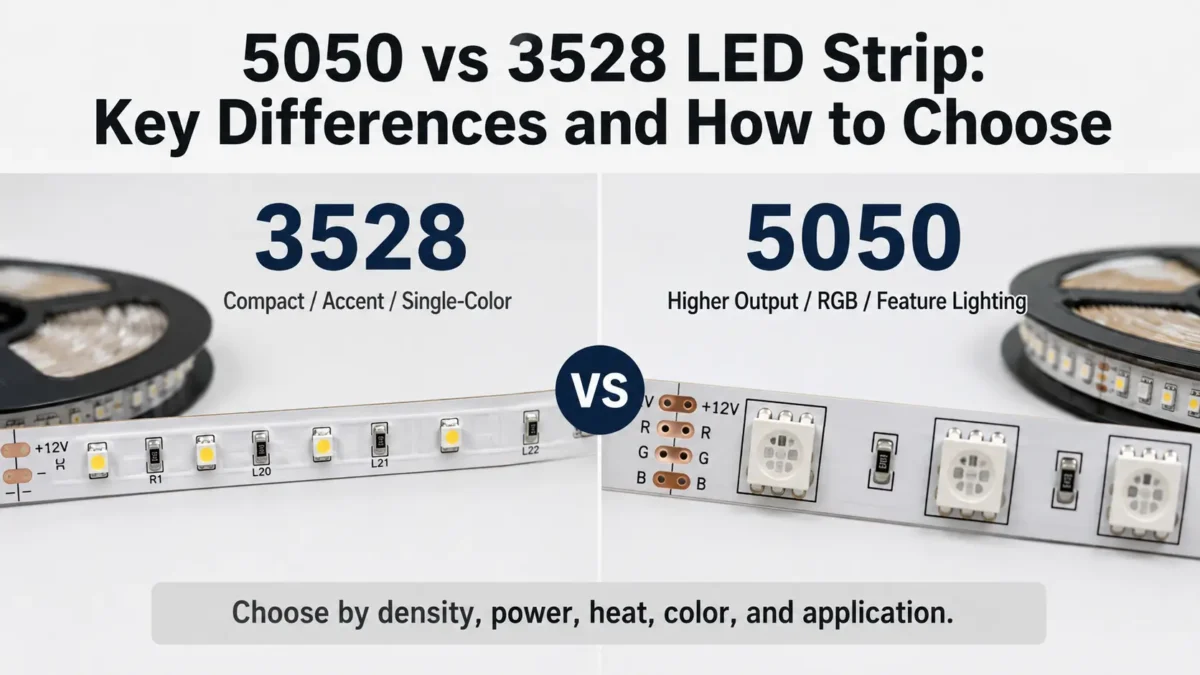
3528 and 5050 describe LED package sizes. A 3528 LED is about 3.5 × 2.8 mm, while a 5050 LED is about 5.0 × 5.0 mm. In general, 5050 strips are often chosen for higher-output or RGB-oriented designs, while 3528 strips are often used for compact, accent, or single-color lighting. The better choice depends on density, power, heat, color type, and application.
The numbers 3528 and 5050 refer to the approximate physical size of the LED package.
A 3528 LED package is about 3.5 mm × 2.8 mm. A 5050 LED package is about 5.0 mm × 5.0 mm. This means a 5050 package is physically larger and can support different internal designs, including many RGB configurations.
But package size is not the same as full strip performance. A strip with the same LED package can perform differently depending on LED density, drive current, power per meter, PCB design, heat dissipation, and controller setup.
For buyers, this means one simple rule is not enough. Instead of asking only “Is 5050 better than 3528?”, it is safer to ask: “Which strip fits my brightness, color, space, heat, and control requirements?”
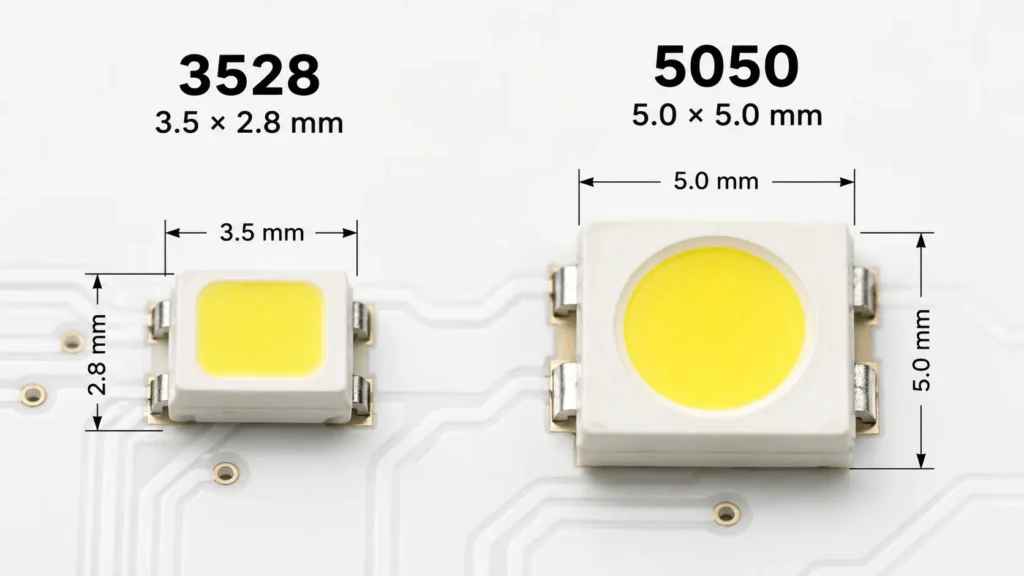
| Comparison Point | Tira de LED 3528 | Tira de LED 5050 | Buyer Note |
|---|---|---|---|
| Package size | About 3.5 × 2.8 mm | About 5.0 × 5.0 mm | 5050 is larger, but size alone does not decide final output. |
| Typical use direction | Accent lighting, compact layouts, single-color applications | Higher-output designs, RGB/color-changing applications, feature lighting | Confirm the actual strip specification before purchase. |
| RGB use | Less commonly associated with standard RGB packages; check the product spec | Commonly used for RGB designs because many 5050 packages can contain multiple chips or channels | Do not assume color capability from package size alone. |
| Brightness tendency | Often used where lower or moderate output is acceptable | Often selected when higher output potential is needed | Brightness depends on LED density, power, and strip design. |
| Heat and power | Often lower power in many strip designs | Higher-output designs may need more attention to heat and power | Check power supply, controller, PCB, and mounting conditions. |
| Space fit | Useful where compact layout matters | Needs more package space on the strip | Check width, LED spacing, and installation space. |
| Best buying approach | Use when compact, lower-output, or accent lighting fits the project | Use when stronger output, RGB, or visual impact is needed | Choose by application conditions, not by package number alone. |
A 5050 LED package is larger than a 3528 package, but that does not automatically mean every 5050 strip is better for every project.
LED strip performance depends on several strip-level factors:
| Factor | Why It Matters |
|---|---|
| LED density | More LEDs per meter can change brightness, uniformity, and power demand. |
| Power per meter | Higher power designs may need stronger power supplies and better heat handling. |
| Drive current | Different drive conditions can affect output and thermal behavior. |
| PCB design | PCB width, copper weight, and layout influence power handling and heat dissipation. |
| Heat path | Enclosures, aluminum channels, and mounting surfaces affect operating temperature. |
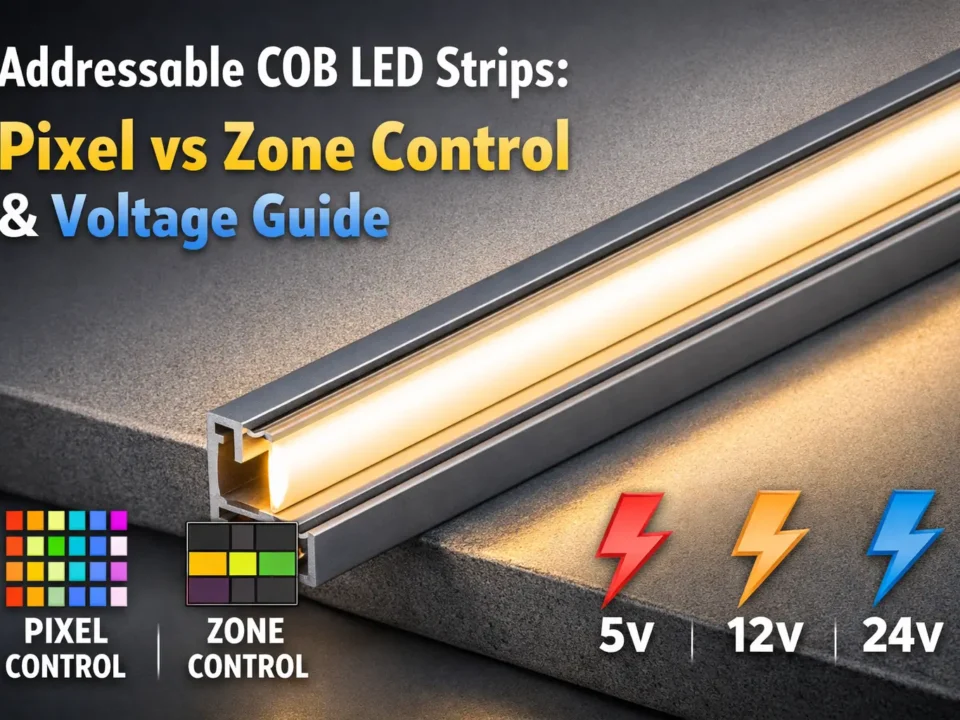
| Color/control type | Single-color, RGB, RGBW, and dimming systems require different controllers and wiring. |
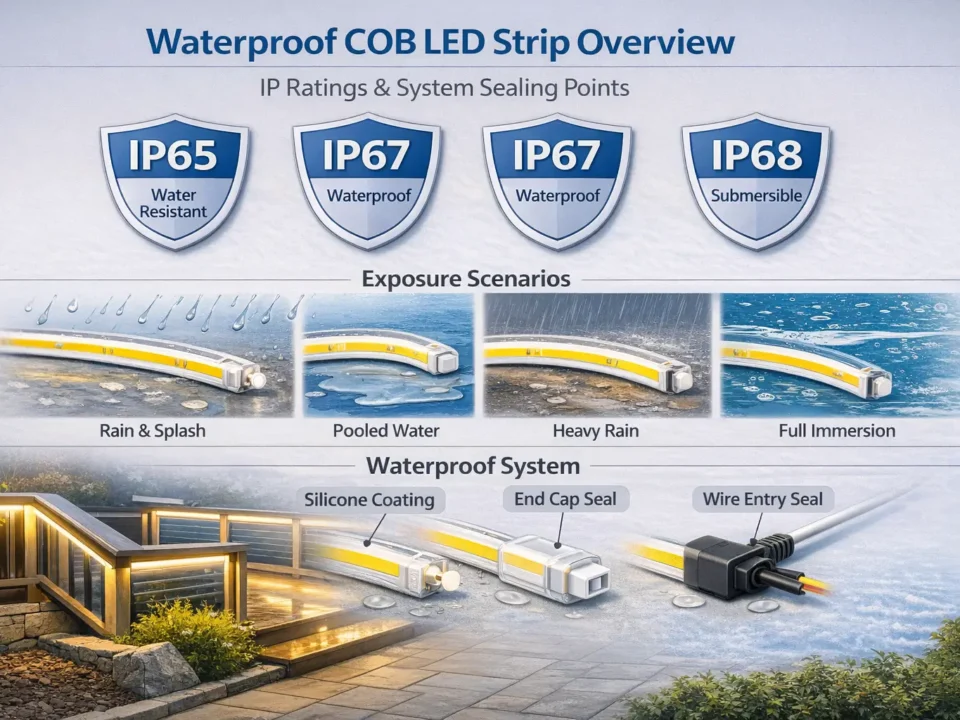
| Installation environment | Indoor, outdoor, enclosed, humid, or heat-sensitive spaces may change the right choice; for environmental protection, check the product’s IP rating against the installation site. |
This is why the safer comparison is not “5050 vs 3528, which is always brighter?” The better question is: “Which LED strip design meets the application requirements with the right power, control, and thermal setup?”
Use the table below as a practical starting point. Final selection should still be checked against the actual strip specification.
| Project Need | More Likely Fit | Why |
|---|---|---|
| Compact accent lighting | 3528 | Smaller package size can fit compact or lower-output layouts. |
| Cabinet, shelf, or decorative linear lighting | 3528 or 5050 | Choose based on required brightness, spacing, and installation space. |
| RGB color-changing lighting | 5050 | 5050 is commonly used for RGB-oriented strip designs. |
| Higher visual impact or stronger output | 5050 | Often selected where more output potential is needed, depending on strip configuration. |
| Heat-sensitive installation | Confirm specs before choosing | Higher-output strips may need better heat management. |
| Long run or bulk project | Confirm full system design | Voltage, power supply, wiring, dimming, and voltage drop matter. |
| Procurement comparison | Compare datasheets, not package size only | LED package is only one part of the buying decision. |
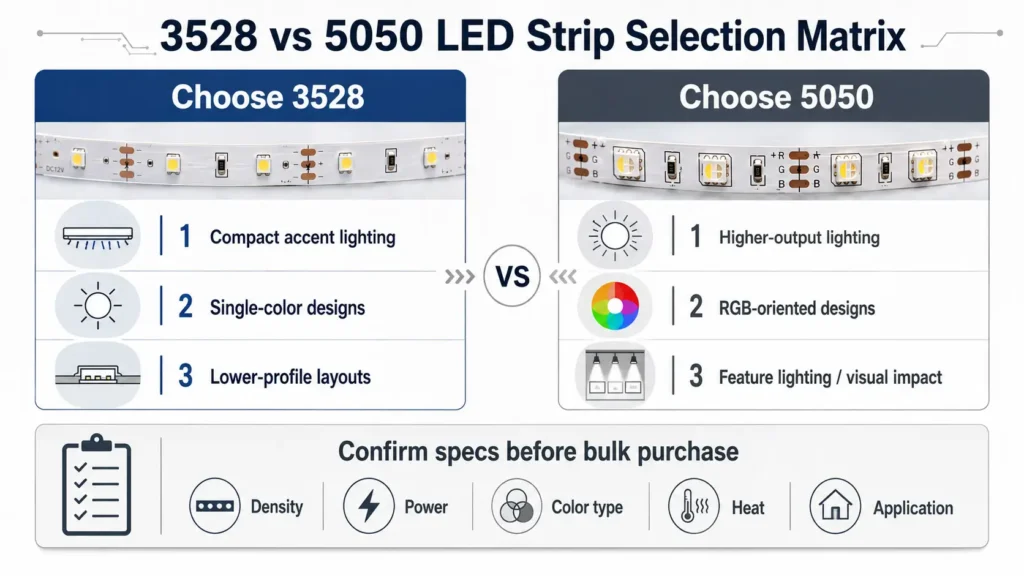
A 3528 LED strip can be a practical choice when the project needs compact spacing, softer accent lighting, or a single-color strip where high output is not the main goal. It may fit decorative lines, shelf lighting, low-profile spaces, or projects where the lighting effect needs to be subtle.
A 5050 LED strip is often selected when the project needs more visual impact, RGB color-changing effects, or a design that may require higher output. It is common in feature lighting, signage-style lighting, entertainment areas, and projects where color control matters.
Still, the application should decide the LED strip, not only the package number. For example, an RGB project may point toward 5050, but you still need to confirm voltage, controller type, strip density, power supply capacity, length, mounting method, and IP rating. A single-color accent project may point toward 3528, but brightness expectations and installation space still need to be checked.
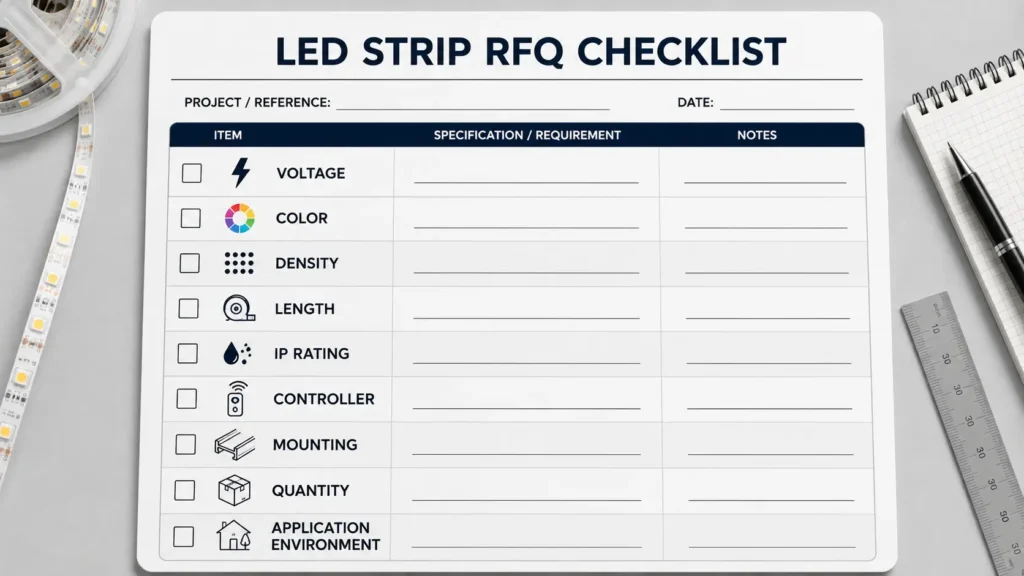
Before requesting a quote or comparing suppliers, prepare these details. This helps avoid mismatched recommendations and reduces back-and-forth during sourcing.
| RFQ Item | What to Prepare |
|---|---|
| Aplicación | Where will the strip be used? For example: cabinet, signage, shelf, display, architectural line, or decorative lighting. |
| Indoor or outdoor use | Confirm whether the strip needs moisture or dust protection. |
| Tensión | Confirm the required system voltage. |
| Color type | Single color, tunable white, RGB, RGBW, or other control needs. |
| Temperatura de color | For white strips, provide the required CCT range if known. |
| LED density | Specify LEDs per meter or the desired brightness/uniformity effect. |
| Strip length | Provide total length, cut lengths, and layout if available. |
| Dimming/control | State whether the strip needs dimming, RGB control, smart control, or a specific controller type. |
| Mounting method | Note whether it will use adhesive backing, aluminum channel, diffuser, clips, or another installation method. |
| Power supply plan | Confirm available power supply type or ask for system review. For longer runs, also review basic LED power supply sizing before finalizing the system. |
| Quantity | Provide estimated order quantity, but avoid assuming MOQ until confirmed. |
| Special conditions | Mention heat-sensitive areas, enclosed spaces, outdoor exposure, vibration, or other project constraints. |
A clear RFQ should not just say “I need 5050 LED strip” or “I need 3528 LED strip.” It should explain the lighting effect, environment, power/control requirements, and installation conditions.
The main difference is the LED package size. A 3528 LED package is about 3.5 × 2.8 mm, while a 5050 LED package is about 5.0 × 5.0 mm. In many strip designs, 5050 is associated with higher-output or RGB applications, while 3528 is often used for compact or accent lighting.
3528 refers to the approximate size of the LED package: 3.5 mm × 2.8 mm. It does not automatically define the full brightness, quality, or lifespan of the LED strip. Those depend on strip density, power, PCB design, thermal conditions, and component selection.
Neither is universally better. Choose 3528 when a compact, lower-profile, or accent lighting design fits the project. Choose 5050 when the project needs higher output potential, RGB effects, or stronger visual impact. For bulk or engineering use, compare the full strip specification before deciding.
Not always. A 5050 package often has higher output potential than a smaller 3528 package, but the final strip brightness depends on LED density, power per meter, drive current, PCB design, and heat management. Always check the actual strip datasheet or supplier specification.
5050 is more commonly associated with RGB strip designs because many 5050 packages can contain multiple chips or channels. For 3528 RGB options, do not assume based on the package name alone. Check the product specification and wiring/control design before choosing.
Confirm voltage, color type, color temperature if white, LED density, strip length, IP rating, controller or dimming requirements, mounting method, power supply plan, quantity, and installation environment. These details matter more than package size alone.
No. Package size is one factor, but strip performance also depends on LED density, drive current, watts per meter, PCB design, heat dissipation, power supply, controller, and installation conditions. A good selection process compares the full strip design.
Choosing between 3528 and 5050 LED strips is easier when the application details are clear. Before final selection, prepare your voltage, color type, density, length, IP rating, controller needs, mounting method, quantity, and installation environment.
Share your project requirements with ElstarLED so the team can review your application details and discuss suitable strip options.
 English
  Spanish
  French
  Arabic
1 Comentario
Acabo de enterarme de las nuevas luces COB. ¿Las tienen o las van a tener también?