Sourcing an OEM COB LED strip wholesale factory is easier when you treat it as a clear buying process. First, shortlist factories. Next, send a complete RFQ. Then, request proof for the exact model. Finally, test samples before bulk production.
If you are sourcing OEM or wholesale COB LED strips in the US, the safest path is simple. Start with factory fit, then check documents, samples, and project risks. As a result, you reduce wrong quotes, weak samples, and production surprises.
| Decide | Enviar | Request | Verify |
|---|---|---|---|
| COB or SMD, site, voltage, control type | Run plan, IP need, cut/length, labels | Datasheet, wiring notes, QC proof, certificate scope | Visual line, dimming, sealing, long-run behavior |
A COB LED strip uses many small LED chips placed close together. Because of this dense layout, it can create a smoother line than many SMD strips. However, “dotless” still depends on profile, diffuser, viewing distance, and brightness.
| Decision factor | Tira de LED COB | Tira de LED SMD | Buyer note |
|---|---|---|---|
| Line look | Usually smoother at close view | Dots may show without enough diffusion | Test with the real profile |
| Profile need | Often still useful | Often useful too | Choose by fixture design |
| Project fit | Coves, clean lines, close-view details | Broad use with many versions | Match the viewing distance |
| Install risk | Still needs power and mounting planning | Also needs power and mounting planning | Plan wiring early |
| Sourcing risk | Many versions, so confirm exact spec | Many versions, so confirm exact spec | RFQ detail matters |
Choose COB when the continuous light line is a key selling point. For example, use it for visible coves, under-cabinet lines, retail shelves, and premium accents. Meanwhile, choose SMD when the strip is hidden or when the project needs a wider product range.
Boundary conditions: Therefore, approve the visual result with a sample in the real fixture, not with a catalog photo only.
To shortlist a factory, focus on what you can verify. In other words, look for clear documents, model-level proof, traceable batches, and a practical sample process.
| Request | Why it matters |
|---|---|
| Model datasheet and wiring notes | Prevents wrong specs and wrong use |
| Certificate scope by model | Avoids broad compliance claims |
| QC proof summary | Shows what is checked and when |
| Sample plan and approval notes | Aligns expectations before bulk order |
| Batch labels and traceability plan | Speeds issue checks and returns |
Boundary conditions: Capability and proof vary by product. Therefore, confirm everything in writing for the exact model you plan to buy.
A quote is only as good as the RFQ. If key inputs are missing, the supplier must guess. As a result, the quote may look cheap at first but create rework later.
| RFQ field | Need level | Why it matters | Buyer note |
|---|---|---|---|
| Application and fixture | Must-have | Sets visual and mounting needs | Cove, profile, cabinet, signage |
| Site environment | Must-have | Sets IP and sealing plan | Dry, damp, wet, outdoor, cleaning method |
| Run plan | Must-have | Helps power planning | Lengths, segments, feed points |
| Voltage class | Must-have | Changes wiring and driver choice | 12V, 24V, 220–240V, or other |
| Color type | Must-have | Defines product family | Single color, CCT, RGB, RGBW |
| CCT / CRI need | Recommended | Affects visual quality | State target or priority |
| IP target | Must-have for wet use | Prevents wrong build | Add site notes, not only IP number |
| PCB or profile limit | Recommended | Prevents fit problems | Send profile inner width |
| Cut length needs | Must-have if limited | Affects install fit and waste | State cut interval needs |
| Dimming or control | Must-have if used | Prevents flicker and mismatch | State controller or dimming method |
| Quantity and batches | Must-have | Affects price and production plan | State order size and rollout plan |
| Packaging and labels | Recommended | Reduces installer errors | State label fields and cartons |
If a field is unknown, write “TBD” and ask the supplier for standard options. However, do not invent specs. Also, ask which choices are standard and which choices need new samples.
Need help turning drawings and limits into an RFQ pack? Share your run plan, site type, and control method. Then, request a spec review before sampling to reduce quote cycles and rework.
Boundary conditions: Long-run limits and brightness results depend on model, load, wiring, and feed plan. Therefore, verify with datasheet and sample testing.
Many supplier pages mention QC. However, useful QC proof must match the exact model and build you are ordering. Therefore, ask for simple, buyer-checkable proof.
In the US, some projects need products certified by a Nationally Recognized Testing Laboratory. Therefore, treat any mark as model-specific, not company-wide. See the OSHA NRTL program overview. Also, if an ETL mark is used, confirm the exact scope with Intertek’s mark information: Intertek ETL Listed Mark.
If your project needs compliance documents, long runs, outdoor use, or dimming, request scope proof and a sample test plan before placing a bulk PO.
Boundary conditions: If the product build changes, re-check the documents and certificate scope before approval.
A clear quote-to-sample workflow reduces the biggest OEM sourcing problem: approving one sample but receiving a different production build.

Boundary conditions: Timing depends on custom depth and revision count. Therefore, avoid fixed lead-time claims until the spec is clear.
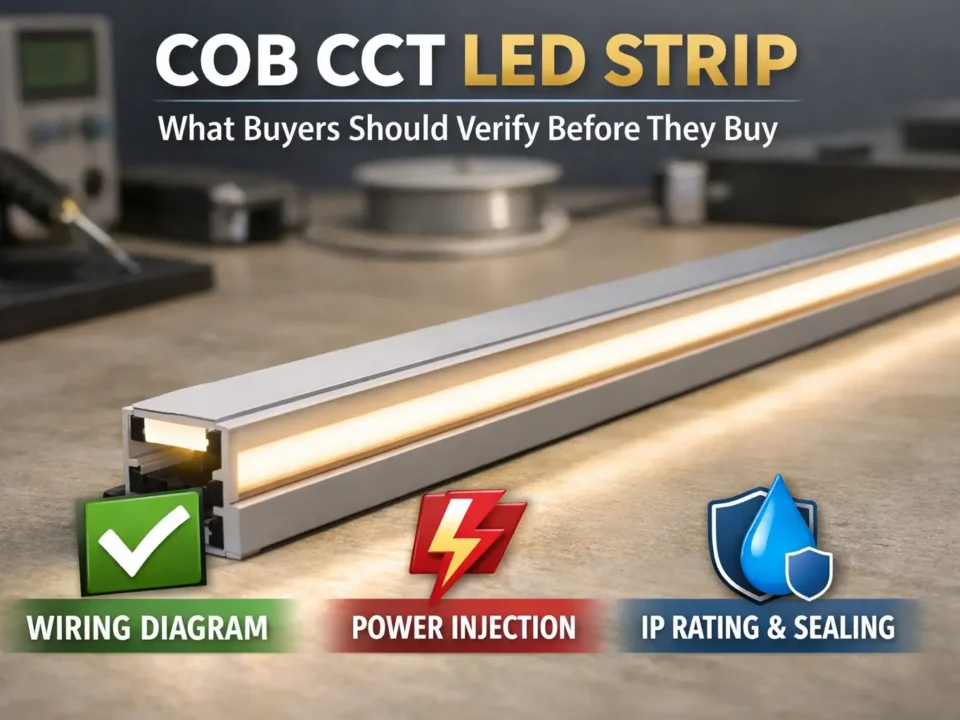
Most project failures come from three gaps. First, long runs lack a power plan. Second, wet-area jobs rely only on an IP label. Third, dimming is assumed instead of tested.
Voltage drop happens because wire and strip copper have resistance. As current travels, the far end may get less voltage. As a result, the strip can look dim, shift color, or act unstable.
For concept support, see Fluke’s simple Ohm’s Law article: Fluke: What Is Ohm’s Law?.

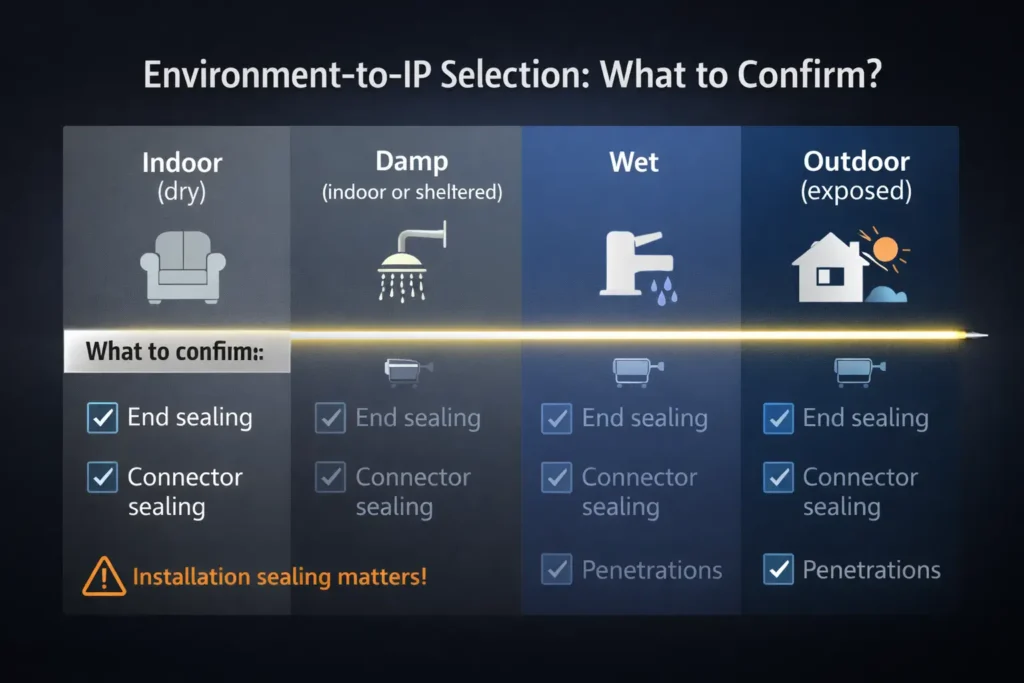
IP ratings are more precise than vague “waterproof” claims. However, IP is not a full-system guarantee. If installers cut, join, or pierce the strip, new leak points can appear. For reference, see IEC: Ingress Protection (IP) ratings.
| Environment | What to confirm | Practical note |
|---|---|---|
| Indoor dry | Mounting and dust protection | Profiles may provide enough protection |
| Indoor moisture | Condensation or splash level | Ends and cable exits matter |
| Wet cleaning | Direct spray and chemicals | Define water contact and ingress points |
| Outdoor exposure | UV, rain, and heat changes | Plan mounting, drainage, and sealing early |
Dimming is a system check. Therefore, confirm the strip, power supply, controller, dimmer, wiring length, and joint method together.
| Symptom | Likely cause | Check |
|---|---|---|
| Flicker during dimming | Control or power mismatch | Test with real driver and controller |
| Stepping dim levels | Dimming method mismatch | Confirm interface and load behavior |
| Low-level instability | System sensitivity | Test low-end dimming on sample |
Boundary conditions: These risks depend on the exact model and site. Therefore, verify with datasheet, sample, and project layout.
OEM and ODM sourcing may include standard choices and true custom work. However, custom changes can affect samples, lead time, QC, and documents.
| Request type | Often needs extra validation? | What to provide |
|---|---|---|
| New PCB width or layout | Often yes | Profile limits, drawings, pass criteria |
| Special waterproof build | Often yes | Site details and seal needs |
| Unusual cut or segment need | Sometimes | Module length, tolerance, drawing |
| Custom label or packaging | Sometimes | Label fields, brand rules, batch ID needs |
Boundary conditions: Feasibility depends on custom depth. Therefore, approve samples and document the final build before production.
Answer: A COB LED strip uses closely packed LED chips to create a smoother light line. However, the “dotless” effect still depends on viewing distance, diffuser, profile, and install quality.
Answer: First, check model datasheets, certificate scope, QC proof, traceability, and sample support. Also, treat broad claims without model-level proof as a risk sign.
Answer: Include site, run plan, voltage, control method, dimming need, cut length, packaging, and label needs. If a detail is unknown, write “TBD” and ask for standard options.
Answer: Ask for the datasheet, wiring notes, batch label plan, QC summary, and certificate scope for the exact model. Also, keep these documents with the quote and PO.
Answer: Start with a run schedule. Then, mark segment lengths, feed points, and visible areas. Finally, test the hardest run with the real power and control setup before spec lock.
Answer: First, choose by site exposure: dry, damp, wet, or outdoor. Then, define sealing for cut ends, cable exits, and connectors. For IP background, see IEC: Ingress Protection (IP) ratings.
Answer: Treat dimming as a system test. Therefore, confirm voltage, controller method, power source, wiring length, and connector setup. Then, test the real sample before mass production.
Finally, a strong OEM COB LED strip wholesale order starts with clear scope. First, shortlist factories with proof. Next, send a full RFQ. Then, test samples and lock the approved build before production.
If your project needs custom lengths, long continuous runs, outdoor exposure, special documents, or a complex dimming setup, request a spec review and sample test plan before the final bulk order.


 English
  Spanish
  French
  Arabic