LED strip staircase lighting can be both beautiful and practical: you get safer steps at night, plus a design feature that ties the whole space together.
But getting from “Pinterest idea” to a real, code-friendly installation means answering a few non-glamorous questions:
Where should the strips go?
Which strips, profiles and diffusers should you use?
How do you power and wire everything safely?
Should you add motion sensors or smart control?
This guide walks you through those decisions step by step, from placement patterns a strip/profile selection, power & wiringy automation—using a low-voltage, safety-first approach you can reuse across projects.
Before you start: what LED strip staircase lighting involves
Before you pick a strip or profile, it helps to understand what kind of staircase project you’re actually doing.
At a high level, LED strip staircase lighting can be:
Functional safety lighting – a soft glow that makes steps readable at night.
Architectural accent – highlighting floating treads, stone risers or sculptural handrails.
Showpiece feature – fully dynamic RGB/RGBW or smart sequences, often in hospitality or high-end residential.
The more you move toward “showpiece”, the more you’ll need to think about:
Placement complexity (multiple patterns at once).
Strip and profile choice (COB, deep profiles, IP ratings).
Power and wiring design (multiple runs, drivers, zones).
For many projects, a single, well-chosen placement pattern plus clean wiring and profiles beats a chaotic mix of ideas.
Project types, skill level and constraints checklist
Use this quick checklist before you start sketching layouts:
1. Project type
Simple accent add-on: a single run along wall/handrail or riser fronts.
Profile-based retrofit: adding channels under treads or on risers, working with finished stairs.
Fully integrated new build: recesses and wiring planned during stair construction.
2. Construction reality
Existing staircase with limited access to voids/stringers?
Open stringers with visible edges you can route along?
New staircase or major remodel with scope for recessed nosing profiles and conduits?
3. Skill level & support
Comfortable drilling, mounting profiles, following wiring diagrams?
Can you safely terminate low-voltage cabling and drivers?
Do you have an electrician or joiner available for mains and carpentry work?
4. Priorities
Is low-glare safety more important than dramatic effects?
How vital is serviceability (easy access to drivers and profiles)?
Is motion/smart control a must-have, or a “nice to have”?
Answers here will guide which placement patterns are realistic and how ambitious you can be with the technical design.
Install basics: how to add LED strip lights to stairs safely and cleanly
The safest and cleanest stair projects follow a simple but disciplined process. You’ll see the same steps in most successful installations, regardless of brand or controller.
Step-by-step low-voltage stair LED install overview
Here’s the high-level sequence you should follow:
Plan the placement pattern(s)
Decide where light should come from: under-tread, riser wash, side-wall, handrail, or a combination.
Choose strip type and colour
Pick low-voltage (12 V or 24 V) strips with suitable brightness, colour temperature and, if needed, RGB/RGBW.
Select profiles and diffusers
Match each placement to an aluminium channel or stair profile that hides dots, manages glare and protects the strip.
Estimate power and pick drivers
Use strip length and W/m to size constant-voltage drivers with 20–30% headroom, matching strip voltage.
Plan wiring routes and driver locations
Decide where drivers will live (cupboard, ceiling void, under-stair space) and how low-voltage cables will run along stringers, under treads or in walls.
Mount profiles and install strips
Fix channels, clean surfaces, install strips, test briefly at low brightness.
Finalize connections and test fully
Make low-voltage connections, label drivers/circuits, test at full brightness and check for glare, shadows or hot spots.
The rest of this article dives deeper into each of those decisions.
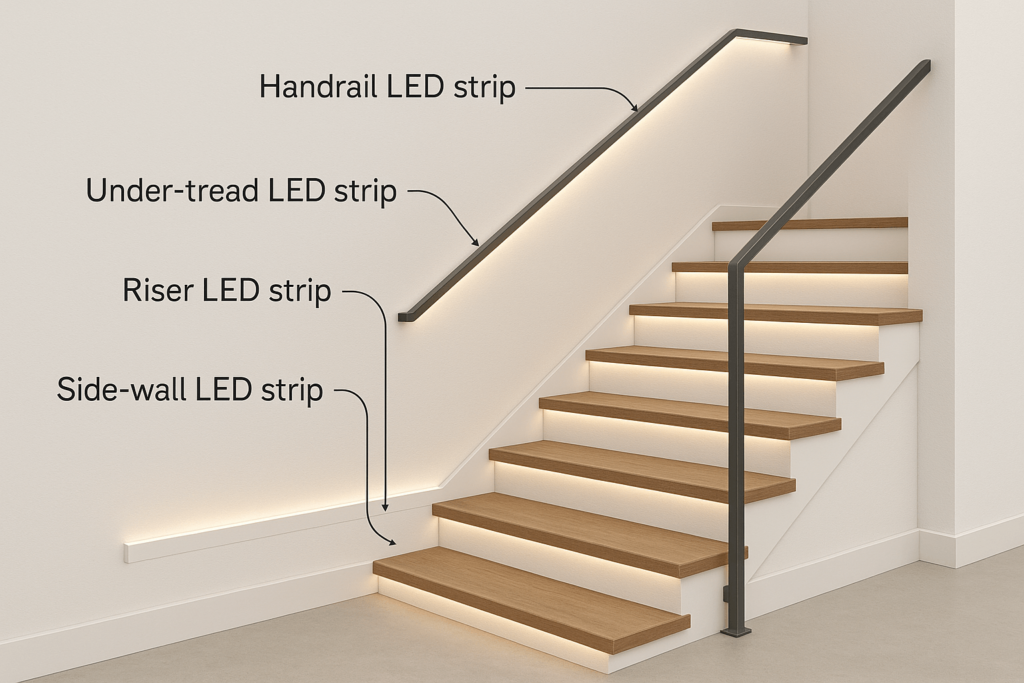
Best ways to light a staircase with LED strips (placement patterns)
There’s no single “best” way to light a staircase—only patterns that fit different spaces and goals.
The four most common placement patterns with strips are:
Under-tread / under nosing – light grazes the tread surface, steps appear to float.
Riser or side-wall wash – light grazes vertical surfaces, soft and low-glare.
Handrail / stringer – guidance light from above or alongside.
Ceiling / wall-wash – strips in coves or channels washing the staircase volume.
Pattern
Effect
Glare risk
Retrofit difficulty
Typical use-case
Under-tread / under nosing
“Floating” steps, strong drama
Medium
Medium–High
Design features, new builds, open stairs
Riser / side-wall wash
Soft vertical light on each step
Low
Low–Medium
Safety, subtle residential upgrades
Handrail / stringer lighting
Guided line of light along path
Low–Medium
Low–Medium
Guidance, minimal stair modification
Ceiling / wall-wash
Architectural volume highlighting
Low
Low
Wide stairwells, public spaces
Use this section to shortlist 1–2 patterns that actually fit your project.
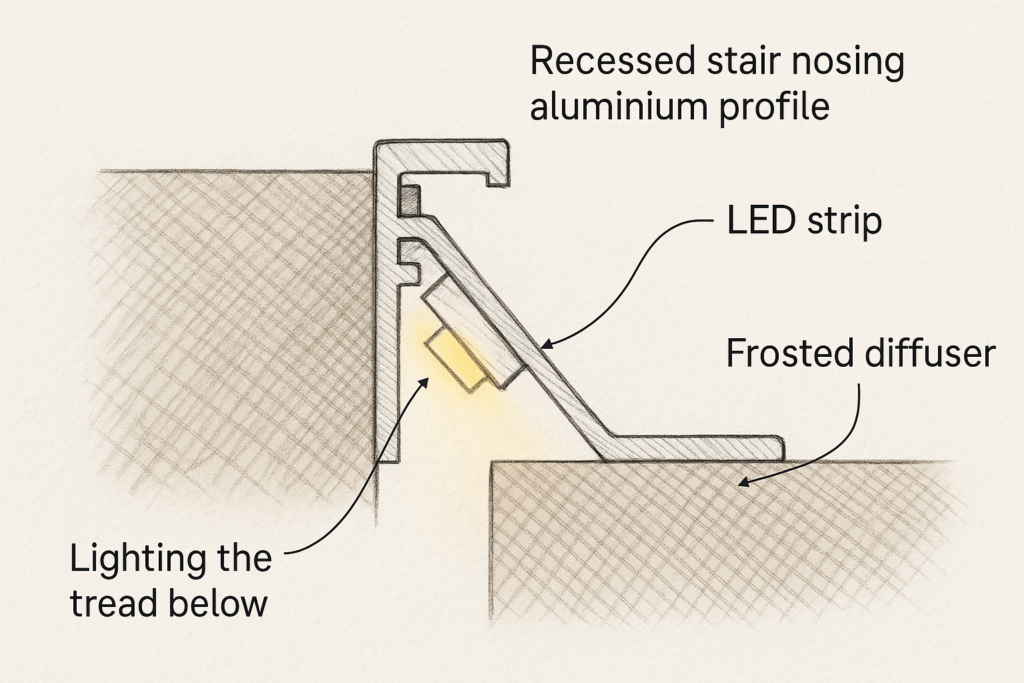
Under-tread and under-nosing LED strip patterns
What it is:
Strips sit in recessed nosing profiles or channels under the tread lip, throwing light onto the tread below.
Why people love it
Creates a striking floating effect—each step seems to hover.
The light is mostly indirect, which helps with comfort if properly diffused.
Key design notes
Best for new builds or major remodels, because it often requires routed recesses or specialist stair nosing profiles.
Needs precise carpentry so channels sit flush and nosings remain comfortable and non-slip.
Profiles must be robust enough to handle foot traffic on the nosing edge.
Use under-tread patterns when the staircase itself is a feature element you want to emphasise, and when you have control over the joinery.
Riser and side-wall LED strip washes
What it is:
Strips mounted on riser fronts or in side-wall channels that cast light across the step face.
Why it’s great
Very comfortable, low-glare when using diffused channels and warm CCT.
Often the easiest retrofit: you can surface-mount or shallow-recess profiles on risers or walls.
Key design notes
Riser lighting works especially well on solid, uniform risers (painted, timber, tile).
Side-wall channels can be mounted along the stringer or wall skirting, avoiding direct contact with treads.
For minimal glare, angle profiles so you graze surfaces, not eyes.
Use riser/side-wall washes when you need safe navigation lighting that doesn’t dominate the room.
Handrail, stringer and ceiling/wall-wash strip lighting
Handrail / stringer lighting
Strips run underneath or within handrails, or along the top/edge of stringers.
Light guides you along the stair path without touching treads or risers.
Good where stair surfaces are sensitive or cannot be disturbed.
Ceiling / wall-wash
Strips in ceiling coves or wall channels wash the stair volume, not individual steps.
Works well on wide stairwells or where walls are architectural features.
Use these patterns when you:
Can’t cut into stair structures but can add rail or wall elements.
Want a clean, minimal look where light reads as part of the architecture, not as stair “hardware”.
Choose the right LED strip type and colour temperature for stairs
Once you know where light will come from, you can pick the strip that delivers the right look, control and comfort.
Strip types for stair lighting: single-colour, CCT, RGB/RGBW, COB
Not all stair projects need colour-changing strips. Here’s how the main types compare:
Strip type
Control complexity
Typical use on stairs
Pros
Contras
Single-colour (fixed CCT)
Low
Residential night lighting, simple upgrades
Simple, reliable, easy to dim, cost-effective
One colour temperature only
CCT adjustable (tunable white)
Medium
Mixed-use spaces, day/night tuning
Flexible warm→cool tuning, great for comfort
Needs dedicated CCT controller or smart system
RGB/RGBW
Medium–High
Decorative projects, hospitality, events
Any colour, scenes and effects
More wiring/control complexity, easier to overdo
COB/dotless (any of above)
Same as base strip
Premium, low-glare looks in visible profiles
Very smooth light, minimal dotting
Sometimes lower max brightness, slightly higher cost
Practical recommendations
Para most residential stair safety lighting, a single-colour warm white strip (2700–3000 K) is ideal.
Use CCT tunable strips if the space doubles as a bright daytime circulation zone and softer night route.
Use RGB/RGBW strips only when there’s a genuine need for colour effects (bars, restaurants, feature stairs), and pair them with profiles/diffusers to avoid a “cheap club” look.
Consider COB/dotless versions wherever LEDs might be visible or where the look needs to be very clean.
Colour temperature, brightness and CRI for safe, comfortable stairs
Colour, brightness and CRI (colour rendering index) are easy to get wrong—and hard to un-see once you’ve lived with them.
Colour temperature (CCT)
Residential stairs, mainly night use:
Aim for 2700–3000 K (warm white) for a welcoming, non-clinical feel.
Mixed-use or commercial stairs: 3000–3500 K is a good neutral comfort range; 4000 K+ can feel sharp if used directly on treads.
Luminosidad
You want enough light to read each step without blasting the space.
Use dimming wherever possible so you can adjust levels for night vs day.
It’s often better to start with a moderate-output strip in a good profile than a very bright strip stuck in a poor location.
CRI
For most homes, aim for CRI ≥ 90 if the budget allows; timber, stone, carpet and metal all look better and more consistent.
In showroom or hospitality environments, high CRI helps surfaces and finishes read as intended.
If you’re unsure, err on the side of warmer, dimmable and use diffused, indirect profiles to avoid harshness.
Choose aluminium profiles and diffusers for comfortable, durable stair lighting
Aluminium profiles and diffusers are the difference between a temporary tape job and a professional installation.
They:
hide dots and hot spots,
reduce glare,
protect strips from knocks, dirt and cleaning, and
make strips replaceable without redoing the stairs.
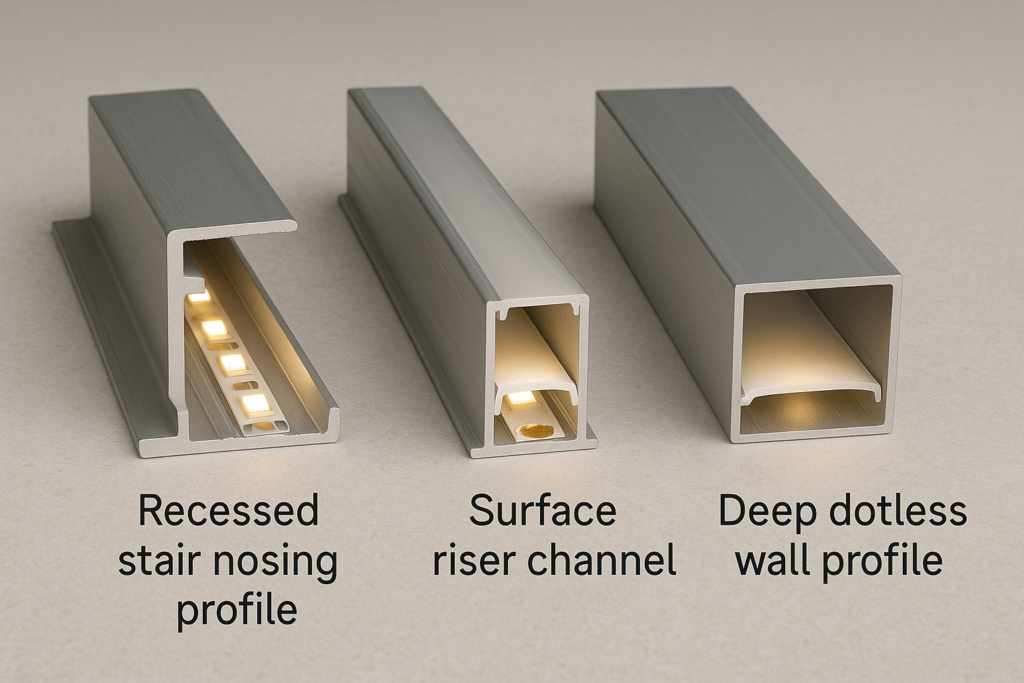
Stair nosing, riser and wall profiles: where each type works best
You’ll typically choose among these profile classes:
Profile type
Typical location
Retro-fit friendly?
Notes
Recessed stair nosing
Under tread/nosing
Medium–Low
Needs routed recess / nosing profile, great “floating” effect
Surface riser channel
On riser fronts
Alta
Easy to retrofit, good for soft vertical wash
Side-wall / stringer channel
Along wall or stringer edge
Alta
Minimal stair modification, combines with skirting
Corner / 45° channel
Wall–ceiling or wall–stringer junction
Alta
Useful for wall/ceiling washes, subtle guidance
Choosing profiles by scenario
New-build, high design emphasis:
Recessed nosing profiles under treads; maybe wall wash as a secondary effect.
Retrofit with minimal joinery:
Surface riser channels or side-wall channels along stringers or skirting.
Public or high-wear staircases:
Robust nosing profiles with integrated anti-slip surface; consider IP-rated covers for cleaning and moisture.
Diffusers, depth and dotless/COB strips for glare-free stairs
Stairs are unforgiving: harsh dots or glare show up immediately in eye-level sightlines.
To make strips look premium rather than DIY:
Use deeper profiles where you can
Deeper channels put a physical distance between LEDs and diffuser, blending output.
Choose frosted diffusers
Clear covers show every LED; frosted diffusers visually smooth things and reduce contrast.
Consider COB/dotless strips
COB (chip-on-board) strips have very closely spaced LEDs and phosphor, giving a continuous light line even in shallow profiles.
Aim light at surfaces, not eyes
Angle channels to graze treads or walls, not directly toward typical viewing positions.
A simple rule: if you can see individual LED points when standing at the bottom or top of the stairs, your profile/diffuser/strip combination probably needs re-thinking.
Design the power and wiring for your LED strip stair lighting system
Good design patterns can be ruined by poor power and wiring. This section turns generic LED power rules into stair-specific practice.
Estimate power and choose drivers for stair LED strips
You don’t need perfect precision; a conservative estimate is enough to size drivers.
1. Get the strip’s W/m (watts per metre)
Typical ranges:
Standard single-colour strip: 8–14 W/m
Brighter or RGB/RGBW strip: often 14–20 W/m
2. Multiply by total active length
Example:
10 steps, each with 1 m of strip → 10 m total
Strip: 10 W/m → 100 W total
3. Add headroom
Add 20–30% to avoid running drivers at full load:
100 W × 1.25 ≈ 125 W driver budget.
4. Match voltage
If the strip is 24 V, use 24 V constant-voltage drivers; same for 12 V.
Don’t mix strip voltages on the same driver.
5. Consider multiple drivers for long runs
For large installations (long staircases, dual runs, outdoor), split the load across two or more drivers and zones.
Example staircase
Strip length
Approx strip power
Driver plan
8-step small indoor stair
6–8 m @ 8 W/m
48–64 W
1 × 75–100 W driver
14-step medium stair
12–16 m @ 10 W/m
120–160 W
1 × 150–200 W or 2 × 75–100 W drivers
Long stair + handrail
20–24 m @ 12 W/m
240–288 W
2 × 150–200 W drivers, separate zones
If you want general background on LED efficiency, see LED lighting efficiency from energy.gov.
Wiring routes, junctions and separation of mains and low-voltage
Core principle: keep mains wiring y low-voltage strip wiring properly separated, and make everything maintainable.
Driver locations
Place drivers:
in a serviceable cupboard,
in an accessible ceiling void, or
in an under-stair space with ventilation.
Avoid burying drivers permanently inside treads, risers or solid walls.
Low-voltage cabling
Run low-voltage cables along stringers, through conduits under treads, or in service ducts.
Keep them mechanically protected (no risk of screws/nails penetrating cables).
Use junction boxes or terminations in accessible, labelled locations.
Separation from mains
Mains feeds (to drivers) should follow local code for routing and protection.
Low-voltage strip wiring must not share open junction boxes or unsegregated conduits with mains conductors unless the hardware is explicitly rated for it.
If you aren’t fully comfortable with mains, involve a licensed electrician.
This wiring strategy avoids flicker, overheating and future headaches when someone needs to troubleshoot or upgrade the system.
Motion sensors and smart controls for staircase LED strips
Automation can enhance safety and energy efficiency—if it’s designed thoughtfully.
Motion-sensor patterns: from simple on/off to step-by-step effects
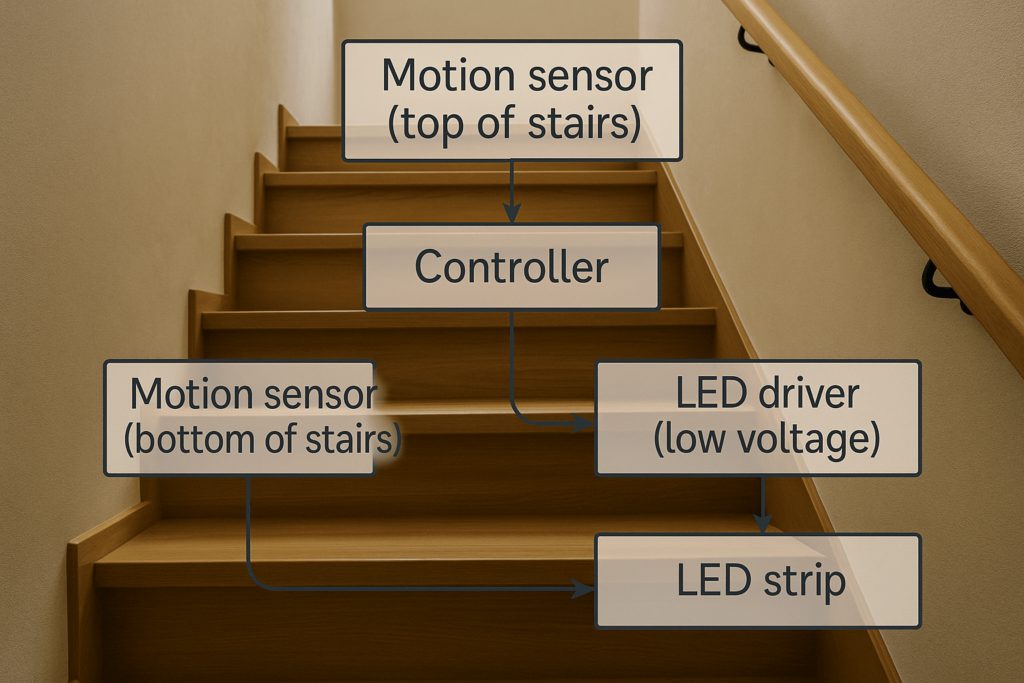
There are three common motion-sensor patterns:
Simple on/off stair lighting
One sensor at the top, one at the bottom (or a combined unit). Detect motion → turn the stair lighting on at a set brightness for a set time.
Directional activation
Sensors at top and bottom detect direction of travel. Controllers can run a “rising” effect when going up and a “falling” effect when going down.
Step-by-step (chase) effects
Each step (or group of steps) has its own output channel from a stair controller. Controller lights steps in sequence to follow the user—often seen in specialist kits.
Design considerations:
Avoid overcomplicated patterns that distract or confuse in everyday use.
Ensure sensors have clear lines of sight and are placed where they won’t be triggered constantly by people walking nearby but not using the stairs.
Remember this is still a low-voltage lighting system—controllers should ultimately be switching drivers and low-voltage circuits, not mains loads directly (unless specifically designed and installed for that).
Integrating staircase lighting with smart-home scenes
Even without specialised stair controllers, you can integrate lighting into smart-home logic:
Night-light scene
Low-level stair lighting automatically at night when motion is detected, then fades out.
Welcome scene
When front door unlocks or occupancy is detected, stair and hall lighting come on together.
All-off / away scene
Stair lights turn off with the rest of the house when you leave.
When integrating:
Keep strip and driver design standard, low voltage; smart control can sit on top via dimmable drivers, smart relays or smart switches.
Ensure smart-home hubs and apps don’t reconfigure drivers or loads beyond their specifications.
Disadvantages of LED strip stair lighting and how to fix them
LED strips are powerful tools—but they’re not perfect. Being honest about drawbacks makes the design stronger.
Disadvantage
Likely cause
Mitigation
Visible LED dots
Shallow profiles, clear covers, standard strips
Use COB/dotless strips, deeper channels and frosted diffusers
Harsh glare at eye level
Direct line of sight, poor aiming
Aim at surfaces (grazing), lower brightness, use diffusers/indirect patterns
Adhesive failure over time
Poor surface prep, wrong tape
Clean surfaces thoroughly, use proper mounting clips or screws on profiles
Colour inconsistency / cheap look
Low-quality strips, mixed batches
Specify higher-quality strips with binning and decent CRI
Not suitable for emergency/egress codes
Strips used where code demands point fixtures
Use dedicated step lights or code-approved fixtures alongside strips
Build these mitigations in from the start, rather than trying to fix problems once the staircase is finished.
Make LED strip staircase lighting look premium (no dots, no glare, no mess)
Premium installations aren’t necessarily more complex; they’re just better executed.
Key practices:
Hide the source, reveal the effect
Place channels where you don’t see the LEDs directly, only the light on surfaces.
Use dotless or well-diffused solutions
COB strips or deep profiles with frosted diffusers make a huge difference.
Keep wiring invisible, not just out of the way
Route cables behind trim, within stringers or in conduits; avoid visible loops and dangling leads.
Finish mechanically as carefully as the joinery
Use end caps, neat miter joints on profiles, consistent fixings and colour-matched accessories.
Tune brightness and colour for the space
Use dimmers and warm CCT to avoid “too bright” or “too blue” results in residential settings.
If a staircase looks like the lighting has always belonged there, you’ve hit the premium mark—even if the underlying system is simple.
When to use LED strip systems vs dedicated step lights, retrofit vs new-build
LED strip systems are versatile but not always the right answer.
Strips are ideal when:
You want continuous lines of light (under-tread, wall wash, handrail).
You need soft, ambient guidance light, not hard beams.
You value flexibility and future reconfigurability.
Dedicated step lights or fixtures are better when:
Local codes require specific illuminance patterns o point sources at set heights.
You need robust, impact-resistant fixtures in high-abuse or outdoor public settings.
You want very tight beam control (e.g., precise pools of light on each tread).
Retrofit vs new-build
En retrofits, you often lean on surface or shallow-recess profiles, side-wall channels and controlled cable routes that avoid major carpentry or structural work.
En new builds, you can design recesses, conduits, profile slots and driver cupboards into the architecture from the start, achieving cleaner results with less compromise.
It’s perfectly acceptable—and often best—to mix both: strips for ambient and feature lighting, and fixtures for code-critical emergency or egress requirements.
LED strip staircase lighting FAQ
How do you add LED lights to stairs?
Plan where you want light (under-tread, riser, side-wall or handrail), choose low-voltage LED strips and appropriate profiles, size a matching 12 V or 24 V driver with headroom, route low-voltage cabling along stringers or behind risers, mount the profiles and strips, then test and tune brightness.
What is the best way to light a staircase with LED strips?
There’s no single “best” way—under-tread lighting is dramatic, riser and side-wall washes are soft and low-glare, handrail and wall-wash patterns give guidance without touching the steps. The best option depends on your stair construction, retrofit constraints and how subtle or bold you want the effect.
Where should LED strip lights be placed on stairs?
Common placements are under the tread nosing, on riser fronts, along side-walls or stringers, under handrails, or in ceiling/wall coves that wash the stair. Choose placements that avoid direct view of the LEDs and aim light at step surfaces rather than into people’s eyes.
What are the disadvantages of LED light strips on stairs?
Strips can produce visible dots, glare and adhesive failures, and cheap products can have poor colour consistency. They’re also not always suitable as the sole code-critical lighting. Use proper profiles and diffusers, dotless strips, good surface prep and higher-quality products—and combine with dedicated fixtures where required.
How do you make LED strip lights look nice on stairs?
Hide the strips in profiles or recesses, use frosted diffusers or COB/dotless strips to avoid dots, aim light at surfaces so you see the glow rather than the LEDs, and keep wiring fully hidden and neatly terminated. Warm, dimmable light and careful finishing make the result feel intentional and premium.
How do you power LED strip lights on stairs safely?
Use low-voltage constant-voltage drivers that match the strip voltage, size them with 20–30% headroom over the estimated strip wattage, place drivers in accessible, ventilated locations, and run low-voltage cabling along protected routes. Keep mains wiring separate and involve an electrician where appropriate.
Can you use LED strip lights on outdoor stairs?
Yes—if you use strips, profiles, connectors and power supplies with appropriate IP ratings and place drivers in weatherproof enclosures, fed from GFCI/RCD-protected circuits. Avoid indoor-only tape and drivers outdoors, and design for UV, temperature changes and cleaning.
How can motion sensors or smart controls be used for stair LED strips?
Place motion sensors at the top and bottom (and possibly landings) and feed them into controllers that drive low-voltage drivers and strips. You can implement simple on/off, step-by-step chase effects, or integrate with smart-home scenes for night-light and welcome modes, as long as the underlying power and wiring remain within spec.
Summary and next steps for staircase LED strip projects
A successful LED strip staircase project doesn’t start with a product—it starts with patterns and priorities.
By now, you should be able to:
Choose one or two placement patterns (under-tread, riser, side-wall, handrail or wall-wash) that fit your space and constraints.
Select appropriate strip types, colour temperatures and CRI levels for safe, comfortable light.
Match those choices to suitable profiles and diffusers that control dots and glare and protect hardware.
Design power and wiring using low-voltage drivers with headroom and sensible cable routes along stringers or in conduits.
Decide whether motion/smart control adds real value and how to implement it safely on top of a solid low-voltage base.
Recognise and mitigate common disadvantages (glare, dots, adhesion, cheap strips) and when to pair or replace strips with dedicated step lights.
A few golden rules:
Start with where light should fall, not with what product to buy.
Keep everything low-voltage on the staircase itself; treat drivers as electrical equipment, not decorations.
Let profiles and diffusers do as much of the visual work as the strip specification.
Design wiring and drivers for maintenance and future changes, not just day one.
When in doubt, keep effects subtle and comfortable—especially in residential and circulation areas.
For more general context on strip types, run lengths and CCT options, you can refer to Elstar’s broader LED strip light range and adapt those principles to staircase projects.