Vous avez besoin d'un produit de qualité en peu de temps ? Nous avons un plan pour vous.


Choosing an Bande LED is not only about price or light level. First, you need to know if the light line will look smooth after setup. You also need to know if the strip fits the profile, driver, control system, space, and work site.
For this reason, many buyers compare COB strips with standard SMD LED strips. COB strips are often used when visible LED dots are a concern, such as in shelves, cabinets, displays, cove lights, signs, and clean line lights. However, COB is not the right choice for every job.
Therefore, this guide explains what a COB LED strip is, how it differs from an SMD strip, where it may fit, what it does not prove by itself, and what details to send before you ask for a quote.
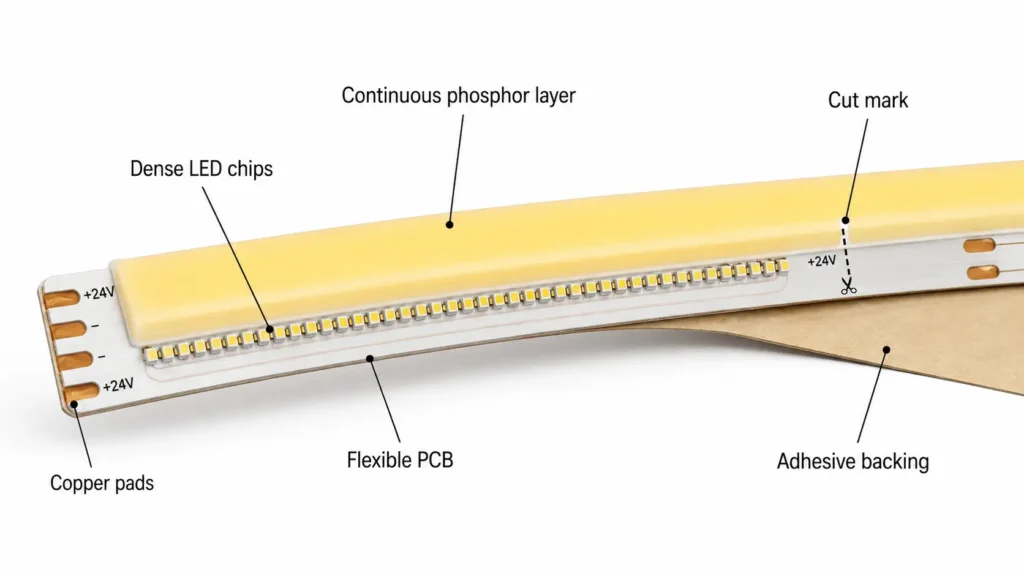
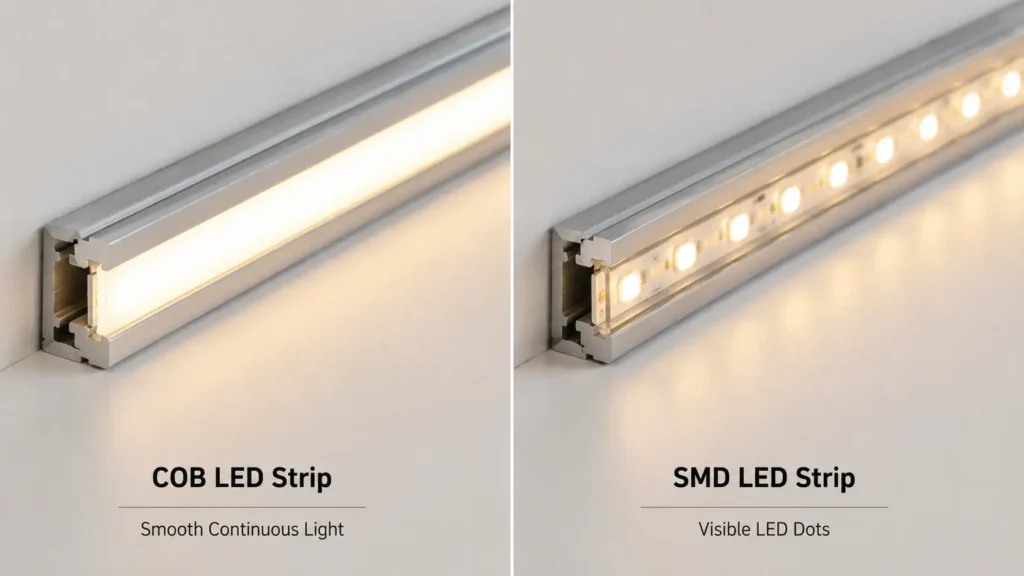
A Bande LED COB is a flexible LED strip that uses chip-on-board design. Many small LED chips sit close together on one board or base. As a result, the strip can help make a smoother light line than many standard SMD strips. Still, the final look depends on the use case, profile, diffuser, power, driver, and setup.
COB means chip-on-board. In a COB LED strip, many LED chips are placed close together on a shared flexible board. Because the chips sit close to each other, the light surface can look more even. For general context, Lumileds describes a CoB LED as many LED chips mounted on a heat-friendly base under a uniform phosphor coat.
By contrast, a common SMD LED strip has separate LED packages along the strip. Depending on LED space, view distance, diffuser, and setup angle, those LED points may show as dots. A COB strip is made to help reduce that dotted look.
However, not every COB strip looks the same in every job. The final result depends on:
For example, COB can help when the light source is close to the viewer. However, for hidden indirect light, an SMD strip may still work well if the LED space, diffuser, and distance are right.
The main difference is the LED package style and the way the light looks after setup.
| Point to Check | COB LED Strip | SMD LED Strip | Buyer Note |
|---|---|---|---|
| LED layout | Many LED chips sit close together on one board. | Separate surface-mounted LED packages. | COB can help reduce visible dots in many close-view jobs. |
| Light look | Often smoother and more like one line. | May show LED points, based on spacing and diffuser. | Use COB when the light line is seen up close. |
| Common fit | Display, cabinet, shelf, cove, sign, and clean line light. | General strip light, hidden light, and cost-sensitive jobs. | Choose based on view distance, profile, and look. |
| Specs to check | Light evenness, profile fit, heat path, driver match. | LED spacing, power, diffuser, driver match. | Both need a spec check before order. |
| Coût | May cost more, based on model and specs. | Often comes in many price and output ranges. | Do not choose COB by name only. |
| Main risk | Poor heat path, wrong driver, wrong IP level, wrong profile, or extra cost. | Visible dots, uneven light, wrong output, or wrong driver. | Both can fail if the setup is wrong. |
In short, COB is not always better than SMD. Instead, COB may be the better fit when the project needs a smoother visible light line. For example, it may help when the strip is close to the viewer or the light surface is exposed.
However, SMD may still be the right choice for hidden light, long runs, tight budgets, or jobs where LED dots are not a key issue.
So, use this simple rule:
Therefore, the best choice depends on the job, not just the LED package name.
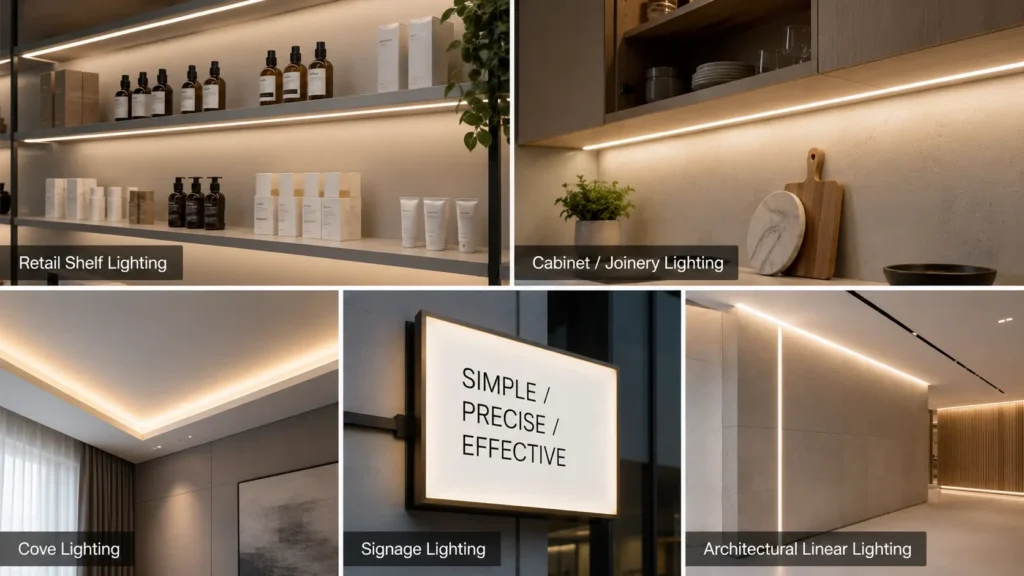
COB LED strips are often used where a smooth line matters. Usually, these jobs have close view distance, shiny surfaces, or a visible line of light.
| Cas d'utilisation | Why COB May Help | What to Check | Risk If Missed |
|---|---|---|---|
| Retail shelf light | A smoother line may help the display look clean. | View distance, light level, profile, color tone. | Uneven light or glare. |
| Cabinet and joinery light | The strip may be close to the viewer. | Profile, diffuser, heat path, cable exit. | Dots, glare, or poor fit. |
| Cove light | A more even line can improve indirect light. | Run length, voltage drop, driver place, dimming. | Uneven output on long runs. |
| Sign and display light | A smooth line may make the sign look cleaner. | Work site, IP need, mount method, service access. | Wrong protection level or hard service work. |
| Clean line light | A clean line is often part of the design. | Profile depth, diffuser, light target, control system. | The final look may miss the design goal. |
| OEM or custom fixture | COB may help fit a compact line light design. | Drawings, space, heat path, driver, test needs. | The build may not work as planned. |
Still, these are only general use cases. Each job needs its own spec check.
COB can help solve some light-line issues. However, the word “COB” alone does not prove the final result.
| Claim Buyers May Hear | Safer View | Check Needed |
|---|---|---|
| “COB is dotless.” | COB can reduce visible dots, but the result depends on view distance, diffuser, profile, and setup. | Sample test, profile check, view-distance check. |
| “COB is always brighter.” | Light output depends on power, LED design, driver, heat path, and product specs. | Data sheet and test terms. |
| “COB does not get hot.” | COB strips can make heat like other LED products. | Heat path, mount surface, profile, airflow. |
| “COB lasts longer.” | Life span depends on heat control, driver quality, work conditions, and product design. | Data sheet, test report, warranty terms if given. |
| “COB is waterproof.” | Water resistance depends on the IP level and product build, not the COB name. | Confirm IP level and work site. |
| “COB is certified.” | Any certificate must match the exact product. | Ask for the exact document. |
As a result, buyers should treat COB as a package style, not as proof of all specs.
Before you choose a COB LED strip, check the details that affect the look, setup, and use.
First, confirm the voltage system. The strip, driver, dimmer, and control system must match. Do not guess the voltage from the strip look.
Next, confirm the target color tone. For color or tunable jobs, also confirm the control mode. The wrong color tone can change the look of shelves, cabinets, signs, and rooms.
Also, check whether color rendering matters. Retail, display, and interior jobs may need a clear CRI target. Do not assume CRI from the word COB.
Then, check the full length and each section length. Long runs may need voltage-drop planning, driver placement, wire layout, or split runs.
In addition, confirm the light level and power. Higher power may need a better heat path. A sample test may help when the look is critical.
Next, check the control method. The strip, controller, dimmer, and driver must work together.
Also, review the aluminum profile, diffuser, mount surface, and angle. These parts affect both the light look and heat path.
After that, confirm whether the strip will be used in a dry indoor area, damp area, outdoor area, sign box, or wet site. The site affects the needed protection level.
Finally, check the marked cut points and the right join method. Cutting at the wrong place can damage the strip or cause field rework.
Yes, COB LED strips can make heat like other LED products. However, heat is not only a product issue. It also depends on power, mount surface, aluminum profile, airflow, room temperature, driver setup, and run time. In addition, DigiKey’s LED thermal-management guidance notes that LED array performance, reliability, and design life depend heavily on proper thermal management.
Therefore, check heat design before final choice if the job needs high power, long run time, a closed space, or low airflow.
For a safer review, confirm:
So, do not choose by light look alone if the space has a poor heat path.
COB LED strips should be cut only at marked cut points. Also, they should be handled based on the data sheet or the maker’s guide. Cut spacing, connector type, solder method, and water seal method can vary by model.
Before you order, ask:
As a result, you can reduce waste, rework, and site issues.
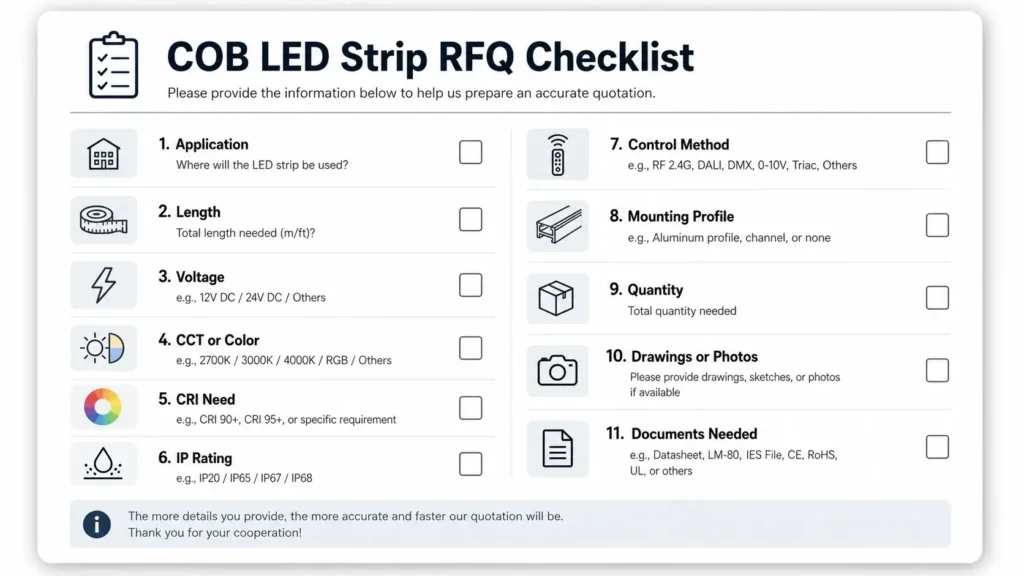
A clear RFQ helps a supplier or technical team suggest the right strip faster. Instead of asking only for “COB LED strip price,” prepare the project information below. For a broader supplier-selection process, see the LED strip manufacturer selection and RFQ guide.
| RFQ Item | What to Send | Why It Matters |
|---|---|---|
| Use case | Cabinet, shelf, cove, sign, display, clean line light, OEM fixture, etc. | Helps review the light look and setup needs. |
| Work site | Indoor, damp area, outdoor, closed space, visible strip, hidden strip. | Helps review protection and heat needs. |
| Longueur | Total length and section lengths. | Helps plan voltage drop, cuts, wires, and drivers. |
| Tension | Needed voltage or driver system if known. | Prevents mismatch with the power supply. |
| Color or CCT | White CCT, single color, tunable white, RGB, RGBW, etc. | Affects strip choice and control method. |
| CRI need | Send this if color quality matters. | Important for retail, display, and interior jobs. |
| Light target | Desired light level or reference sample. | Helps compare suitable models. |
| Control method | On/off, dimming, controller type, smart system, DMX, etc. | Helps avoid driver and control mismatch. |
| IP need | Dry indoor, splash risk, outdoor, wet site, etc. | Helps choose the right protection level. |
| Mount profile | Aluminum channel, diffuser, fixture design, free space. | Affects light look and heat path. |
| Quantity | Estimated order size or project scale. | Helps quote and supply planning. |
| Drawings or photos | Site photo, profile drawing, fixture drawing, or layout. | Helps reduce guesswork. |
| Documents needed | Data sheet, setup guide, test report, or compliance document if needed. | Helps buying review before order. |
In short, the more details you send, the easier it is to compare options and avoid the wrong strip. You can review available COB LED strip options and send project details through the contact page after the final internal-link approval step.
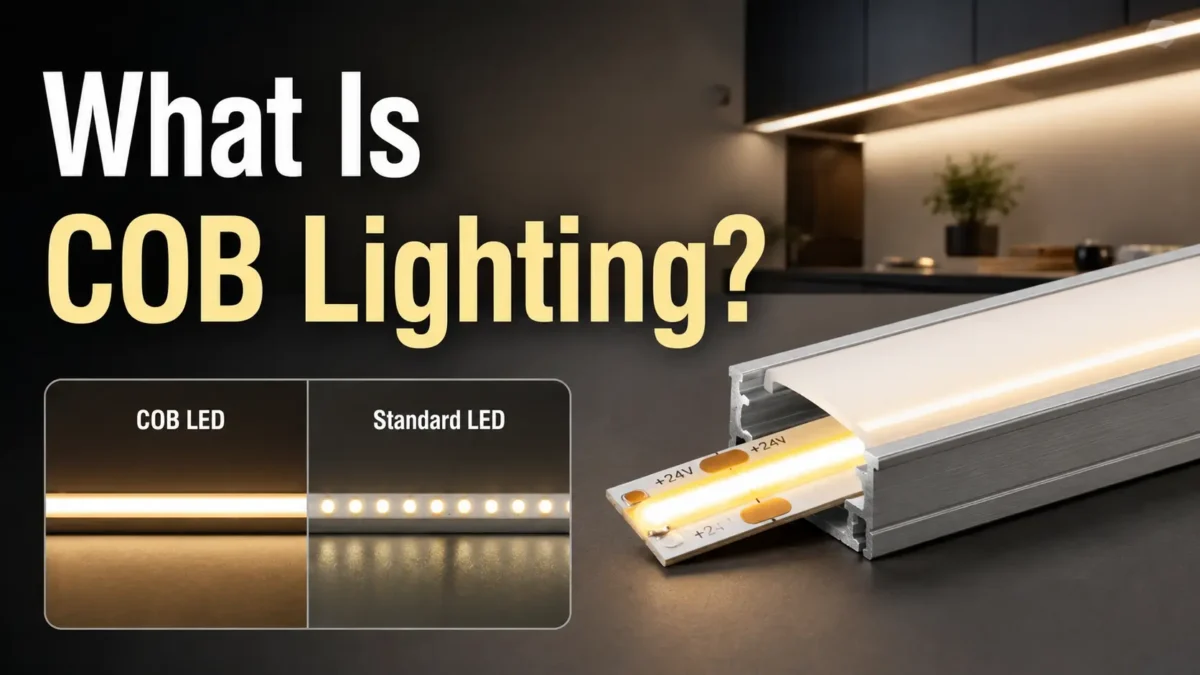
A COB LED strip is a flexible LED strip that uses chip-on-board design. Many LED chips sit close together on one board or base. As a result, it can help make a smoother light line than many standard SMD LED strips when the setup supports it.
It depends on the job. COB may fit better when the visible light line needs to look smooth and less dotted. However, SMD may still work for hidden light, tight budgets, or jobs where LED dots are not a key issue.
Yes, COB LED strips can make heat like other LED products. Heat depends on power, mount surface, profile, airflow, work site, driver setup, and run time. Therefore, high-power, closed, or long-hour jobs need heat review.
Possible limits include higher cost in some cases, heat path needs, model-specific cut points, driver or control match issues, and extra cost when the strip is hidden or when an SMD strip already works.
COB strips use many closely placed chips on one board or base. By contrast, SMD strips use separate surface-mounted LED packages. COB often helps make a smoother visible line, while SMD still works in many general or hidden-light jobs.
Many COB strips can be cut only at marked cut points, but the exact rule depends on the model. So, always follow the data sheet or maker’s guide, especially when joining, soldering, or keeping water protection.
COB strips are often used for shelves, cabinets, joinery, cove lights, signs, display lights, clean line lights, and OEM fixtures. Still, the right choice depends on view distance, profile, light target, site, and control method.
Before requesting a quotation or recommendation, prepare your use case, length, voltage, color or CCT, CRI needs, IP need, dimming or control method, mount profile, quantity, and any drawings or photos.
With those details, a technical team can review whether COB LED strip appears to fit the project conditions and what specs should be checked before order.

 English
  Spanish
  French
  Arabic