Vous avez besoin d'un produit de qualité en peu de temps ? Nous avons un plan pour vous.


LED strip lights are used in cabinets, signs, retail displays, furniture, ceilings, booths, building details, and custom gear. So, the fire-risk question often comes up before a job starts, after a team sees heat, or when a buyer needs to approve LED strips for repeat use.
In practice, the answer is not a plain “yes” or “no.” LED strip fire risk depends on the whole lighting setup: the strip, driver, wiring, connector, load, heat escape, mounting surface, airflow, run time, and site conditions.
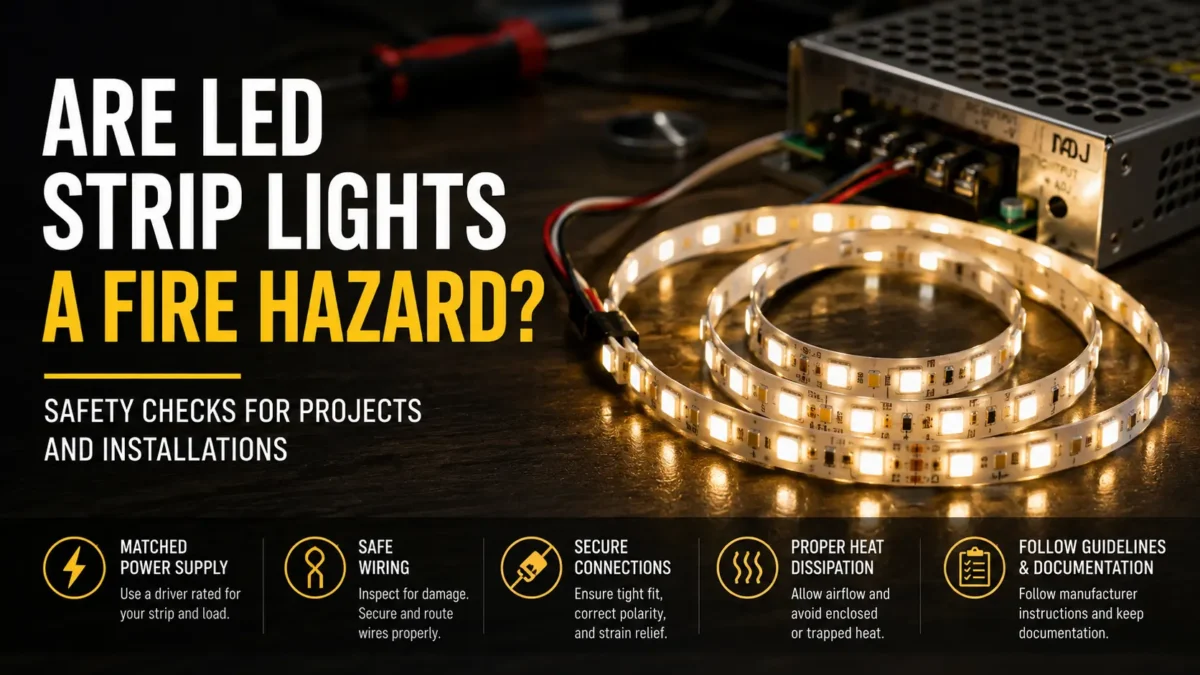
LED strip lights are not a fire hazard by default. However, they can become risky when the design, power supply, wiring, connectors, heat escape, or site setup is wrong. For project use, check strip load, matched driver, wire condition, airflow, mounting surface, run time, and supplier documents before you assume the setup is safe.
Most fire-risk problems come from the system around the strip, not from the strip label alone. For example, official product safety reports have named LED strip/light products as high fire risk where wrong fuse or wiring conditions could cause wires to overheat and ignite. GOV.UK product safety report
Therefore, buyers and installers should ask one practical question: which part of the setup can overheat, fail, or be used outside its rated limits?
| Risk source | What can go wrong | What to check before use | When to ask supplier/engineer |
|---|---|---|---|
| LED strip load | The selected strip draws more power than planned. | Confirm voltage, watts per meter, total run length, and total load. | Long runs, high-density strips, or unclear power data. |
| Power supply / driver | The driver is mismatched, overloaded, or not used as the instructions require. | Check rated output, load margin, install notes, and driver type. | If the product requires a specific driver or power-limited supply. |
| Wiring | Wire size, condition, route, or contact quality is not right. | Look for damage, loose wires, exposed conductors, and heat buildup. | Any damaged, hot, changed, or undersized wiring. |
| Connectors | Poor contact can create heat at connection points. | Check connector fit, polarity, strain relief, and firm contact. | Flicker, discoloration, on/off faults, or warm connectors. |
| Heat escape | Heat cannot leave the strip, cord, or mounting area. | Check airflow, mounting channel, enclosed spaces, and covered cords. | Enclosed furniture, signs, cabinets, display cases, or sealed channels. |
| Mounting surface | Nearby materials may trap heat or add risk. | Check surface type, adhesive grip, distance from sensitive materials, and airflow. | Wood, fabric, cardboard, foam, or enclosed décor structures. |
| Site conditions | Moisture, dust, temperature, movement, or long run time can add stress. | Check IP rating needs, site heat, cleaning exposure, and duty cycle. | Outdoor, damp, hot, vehicle, marine, or industrial jobs. |
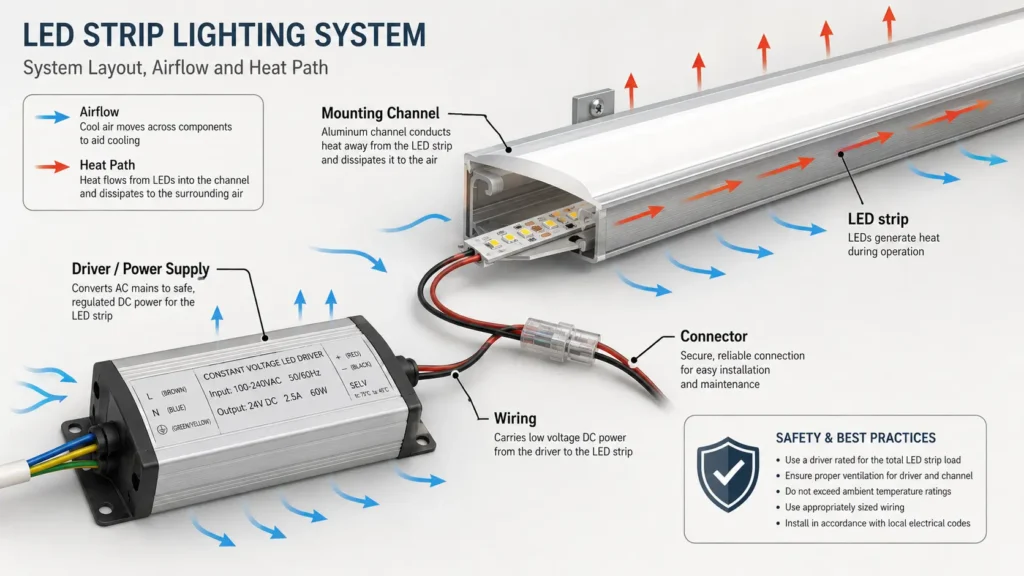
As a rule, a lower-risk LED strip setup is one where the product is used within its rated limits, the power supply is matched, wiring is secure, and heat can escape. By contrast, a higher-risk setup is one where several unknowns stack together.
| Usually lower-risk condition | Higher-risk condition | Practical action |
|---|---|---|
| Known voltage, wattage, and strip length | Unknown load or mixed strip sections | Calculate total load before choosing the driver. |
| Matched driver/power supply | Random adapter or overloaded supply | Use a driver or supply suited to the strip and job. |
| Secure wiring and connectors | Loose, damaged, hot, or changed wiring | Stop use and inspect before turning power on again. |
| Open or vented mounting | Closed channel with trapped heat | Check heat conditions and install guidance. |
| Clear product information | No datasheet, no instructions, unclear rating | Ask the supplier for product data before ordering. |
| Shorter, easy-to-reach setup | Long runs hidden in furniture or ceiling voids | Plan wiring, access, and heat escape early. |
However, this table does not mean every “lower-risk” setup is guaranteed safe. It only means the project has fewer clear unknowns. Also, electrical distribution and lighting equipment are known fire-risk groups, so lighting systems should still be installed and used within rated limits. NFPA electrical distribution and lighting equipment report
For most project teams, the key checks fall into four groups.
First, the power supply should match the strip voltage and project load. Do not choose a driver only by plug shape or price. Instead, check output voltage, rated power, load margin, indoor/outdoor use, and whether the strip or light instructions require a specific driver or power-limited type.
Where instructions name a specific driver, power supply, or power limit, follow those instructions. IAEI / UL Question Corner on low-voltage LED luminaire drivers
Next, wiring should not be damaged, loose, pinched, crushed, or routed where heat cannot escape. ESFI guidance warns against overloading extension cords, using them as permanent wiring, or running cords through walls, ceilings, floors, or places where heat cannot escape. ESFI extension cord safety tips
For LED strip projects, this matters when temporary wiring becomes permanent, when cords are hidden behind displays, or when strips are placed inside cabinets, furniture, or signs.
In addition, connectors should make firm contact. Loose or poor contact can cause on/off faults, flicker, local heat, or failure. Project teams should check connectors before final install, especially on long runs, repeat jobs, or systems that will be moved, cleaned, or serviced.
Finally, LED strips make heat during use. The issue is not only whether the strip feels warm. The real question is whether heat can leave the system safely. For example, heat can build up when strips sit inside sealed channels, under insulating materials, behind displays, or near heat-sensitive surfaces.
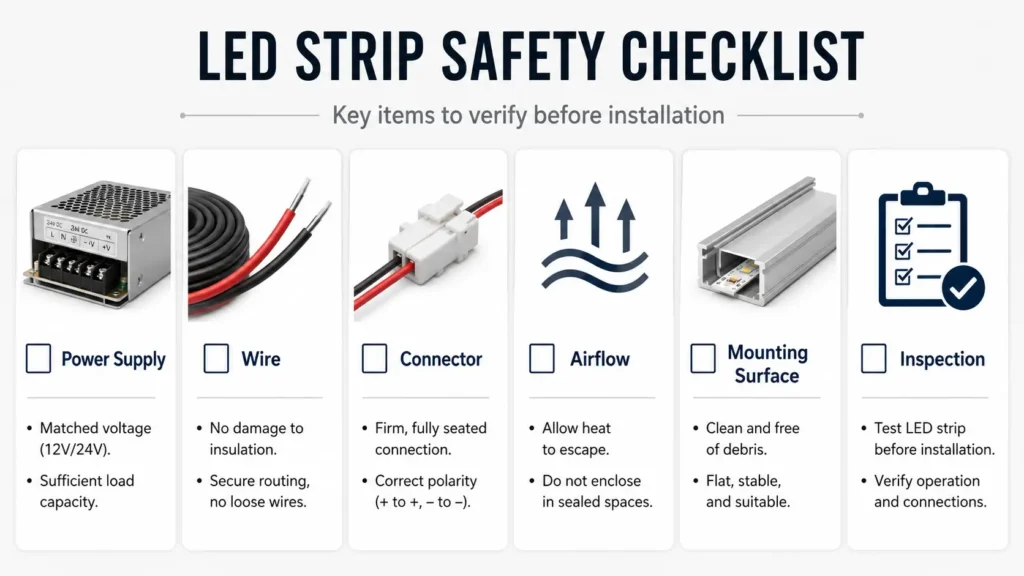
Before you power a project setup, use this checklist. It is especially useful for commercial displays, cabinets, signs, furniture, or repeat OEM use.
| Check item | What to confirm | Why it matters |
|---|---|---|
| Strip voltage | The strip voltage matches the power supply output. | Wrong voltage can damage parts or create unsafe conditions. |
| Total load | Total watts are based on strip power and length. | Overloaded systems can overheat or fail. |
| Power supply | The driver is suited to the load and site. | A mismatched supply adds electrical risk. |
| Wire condition | No exposed, loose, crushed, or damaged wiring. | Damaged wiring can raise shock or fire risk. |
| Connector quality | Connectors are secure and not warm during test use. | Poor contact can create local heat. |
| Cord routing | Cords are not covered, pinched, or used as permanent wiring. | Covered cords can trap heat; overloaded cords add risk. |
| Mounting surface | The surface is clean, stable, and fit for the setup. | Poor mounting can lead to detachment, trapped heat, or contact with sensitive materials. |
| Airflow | Heat can leave the strip, driver, and wiring area. | Closed spaces need extra review. |
| Run time | Long run time is checked against product rating and heat conditions. | Long use raises the need for heat review. |
| Site conditions | Moisture, dust, temperature, and cleaning exposure are considered. | The site affects product choice and install method. |
Do not treat overnight use as safe by default. Instead, for long run time, check the product rating, power supply, wiring, connector condition, heat buildup, airflow, and site setup.
For example, a short, open, properly powered setup is different from a long run hidden inside furniture, signage, or a sealed channel. If the strip, driver, wiring, or connectors become too warm, flicker, change color, smell odd, or show damage, stop using the system and inspect it before further use.
For commercial, rental, retail, booth, or OEM jobs, long run time should be reviewed during the spec stage, not after the install is done.
Low voltage does not remove all fire-risk factors. It may reduce some hazards when compared with higher-voltage systems. Still, the full system includes a power supply, wiring, current, connectors, site conditions, and heat.
For example, a low-voltage strip can still be part of an unsafe setup if the driver is wrong, the wiring is damaged, the connectors are poor, or the install traps heat. So, the safer question is not “Is it low voltage?” but “Is every part of this low-voltage system selected and used within its rated limits?” For a related internal guide, see ElstarLED’s low-voltage LED strip safety article.
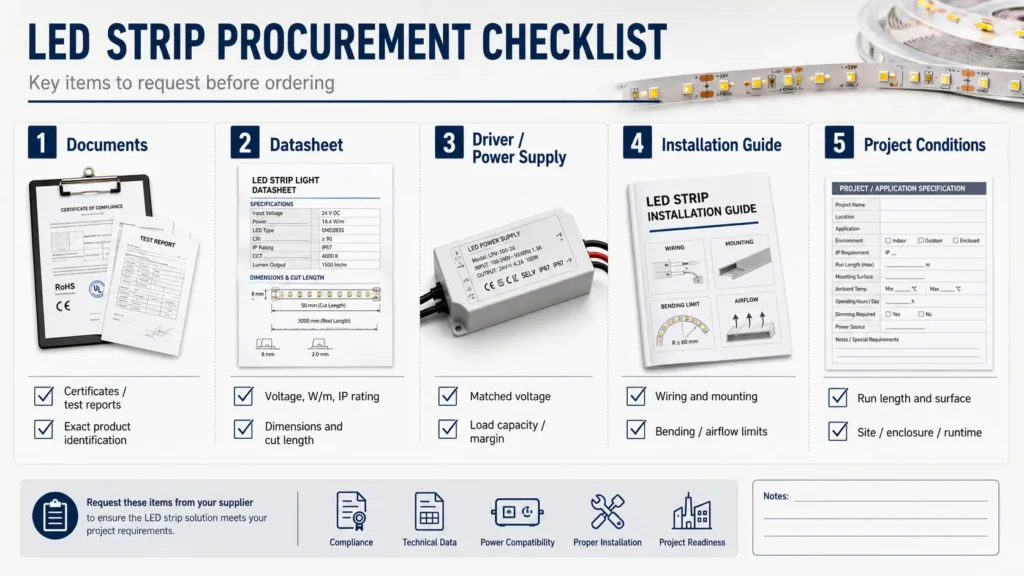
For B2B projects, buying should cover more than color temperature and brightness. In addition, buyers should ask for the data needed to check load, site conditions, and document limits.
| Request | Why to ask | Safe wording |
|---|---|---|
| Product datasheet | Shows voltage, wattage, size, IP rating, and other basic details. | “Can you provide the datasheet for this exact product?” |
| Power data | Helps calculate total load and choose a suitable power supply. | “What is the wattage per meter and recommended power supply range?” |
| Driver / power supply guidance | Reduces mismatch risk. | “Which driver or power supply type is recommended for this setup?” |
| Install instructions | Clarifies mounting, cutting, wiring, bending, airflow, and site limits. | “Are install instructions available for this strip series?” |
| Test or certification documents | Supports compliance review when required. | “What applicable test or certification documents are available for this exact product and market?” |
| Use conditions | Helps the supplier understand risk factors. | “The strip will be used in [surface/enclosure/site/run time]. Is there anything we should review?” |
| Custom/OEM needs | Avoids assuming a standard strip fits every job. | “Do we need a custom setup, sample test, or engineering review?” |
However, do not assume a supplier has every document unless they provide it for the exact product. Safety testing can check hazards such as electrical shock, overheating, insulation failure, and fire risks. Even so, that does not prove any specific product has been tested unless the supplier provides matching documents. Intertek lighting safety testing overview
Ask for review before purchase or install when the project includes:
As a result, review can help catch mismatches before the strip is placed in a spot that is hard to reach, repair, or inspect.
LED strip lights are not a fire hazard by default. However, risk can rise when product design, power supply, wiring, connectors, heat escape, installation, or run conditions are not suitable. Treat the strip as part of a complete lighting system.
Yes, they can be part of a fire-risk situation if the system is poorly designed, powered the wrong way, badly wired, damaged, overloaded, or installed where heat cannot escape. Official product safety reports have identified LED strip/light products with high fire risk linked to wiring and protective-part issues. GOV.UK product safety report
Yes. They can become too hot if the load, driver, wiring, mounting, airflow, or site conditions are not suitable. During testing, check heat at the strip, connector, driver, and wiring. If any part becomes too warm, stop and review the setup.
Do not answer this with a blanket yes. Instead, long run time should be checked against the product rating, power supply, heat escape, airflow, wiring, and site setup. Closed or hidden installs need more care than open, easy-to-reach installs.
No. Low voltage does not remove all system-level risk. The power supply, current, wiring, connectors, load, and heat escape still matter.
Ask for the datasheet, power data, driver or power-supply guidance, install instructions, and any applicable test or certification documents available for the exact product and market. Also, share the mounting surface, strip length, run time, site conditions, and enclosure details.
For project use, prepare the strip length, voltage, wattage, mounting surface, run time, power supply plan, site conditions, and any document needs before ordering.
Then, share these conditions with ElstarLED and ask what datasheets, install guidance, and applicable test or certification documents are available for the exact LED strip product and project. Avoid relying on a general “safe” answer when the site conditions are specific.
Contact ElstarLED or review the custom LED strip project page.

 English
  Spanish
  French
  Arabic