Vous avez besoin d'un produit de qualité en peu de temps ? Nous avons un plan pour vous.


LED strip voltage affects run length, power draw, controller choice, voltage drop, and safe wiring. In a 5V vs 12V LED strip comparison, 5V strips are useful for USB, battery, and high-density pixel projects, while 12V strips are usually better for longer runs.
Therefore, do not choose voltage by price alone. First, check the strip label. Next, match the controller and power supply. Then, plan wire size and power injection before final installation.
For related internal resources, review Elstar’s Bande LED, Contrôleurs LED, LED power supplieset LED strip installation guide. For helpful external references, see SparkFun’s voltage, current, and resistance guide and the U.S. Department of Energy’s LED lighting overview.
Choose 5V strips for short runs, USB projects, battery projects, and high-density addressable effects. Choose 12V strips for longer runs, brighter accent lighting, and layouts where lower voltage drop matters.
At the basic level, 5V strips use a lower power rail and need more care with voltage drop. In contrast, 12V strips can usually run farther before brightness drops at the far end.
5V strips are common in USB, battery, PC lighting, and addressable pixel projects. Also, they can support tight pixel spacing for detailed effects.
12V strips are common in home accent lighting, cove lighting, under-cabinet lighting, and longer decorative runs. As a result, they are often easier to power over several meters.
A 5V strip and a 12V controller are not interchangeable. If the voltage does not match, the strip or controller may fail.
Power depends on voltage and current. Therefore, compare both the strip voltage and the watts per meter before choosing a power supply.
| Tension | Current per m | Power per m | Typical max run without injection |
|---|---|---|---|
| 5V | 1.2 A | 6 W | About 2 m |
| 12V | 1.2 A | 14.4 W | About 5 m |
A 12V rail can deliver more power at the same current. As a result, 12V strips often support longer practical runs before injection is needed.
Use a power supply that matches the strip voltage. Also, choose enough wattage headroom so the supply does not run at its limit.
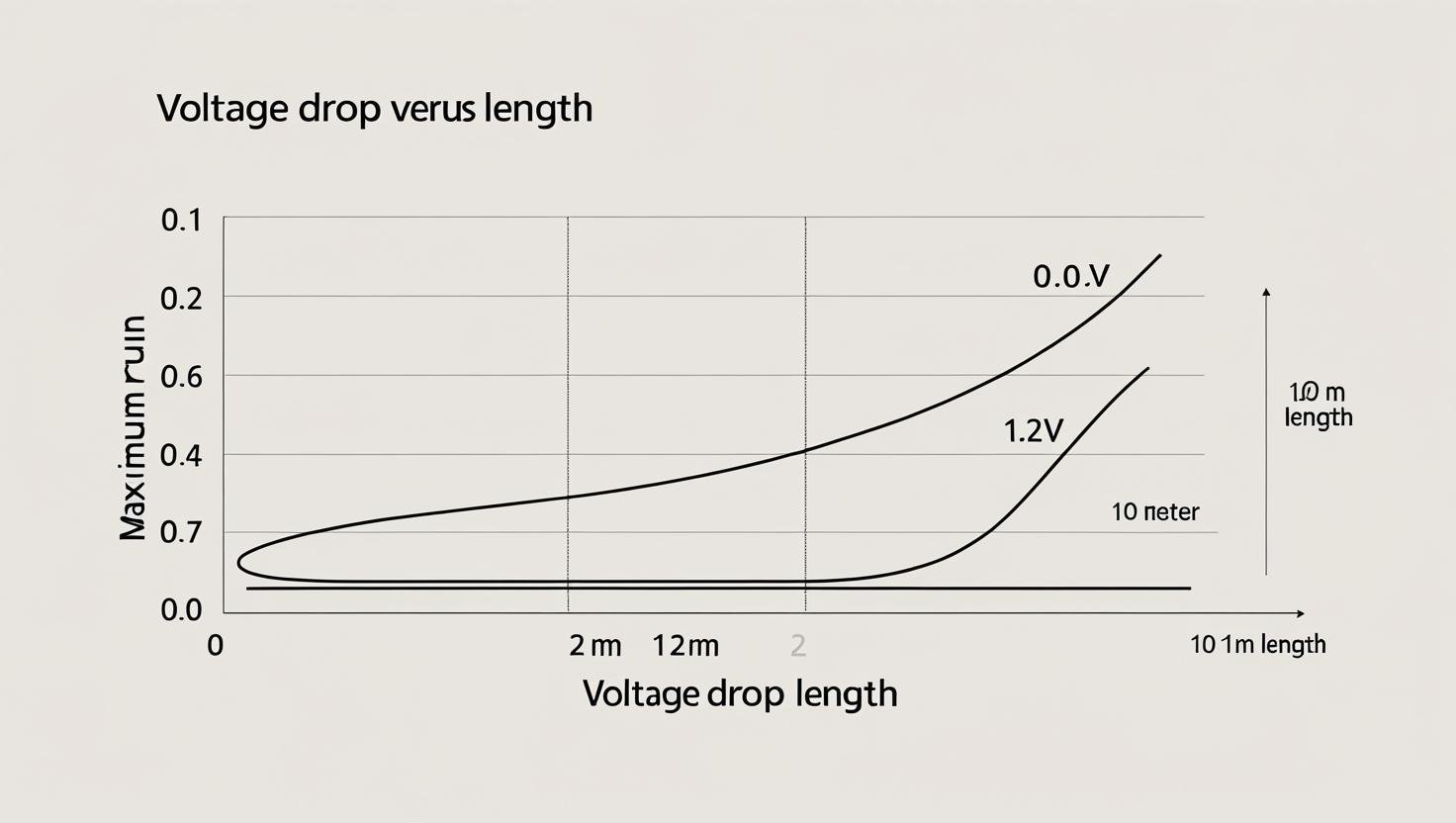
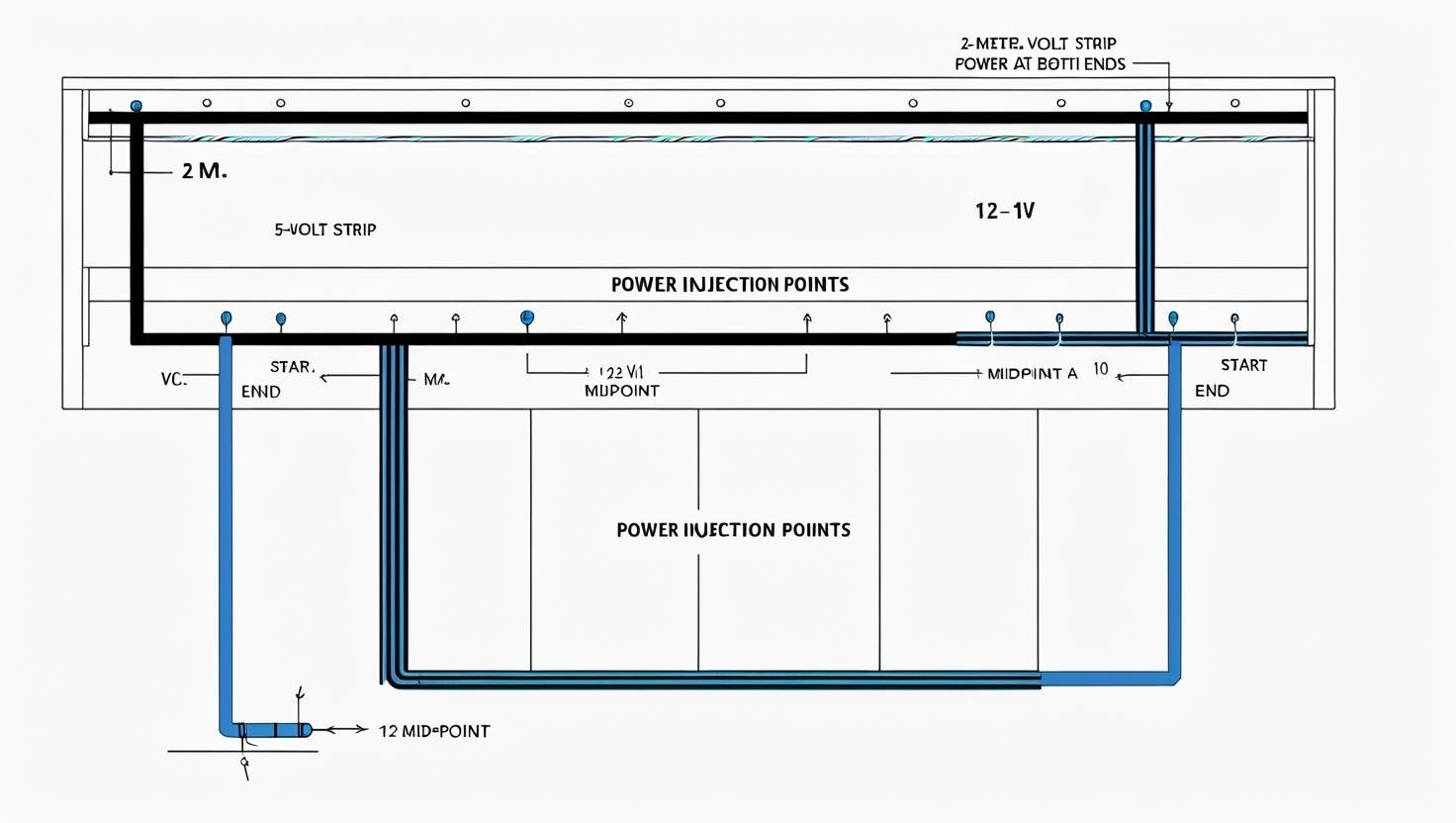
Voltage drop increases as the strip gets longer. Because of this, the far end of a strip can look dimmer than the feed end.
Use this simple formula as a planning guide:
Voltage drop = current × resistance × length
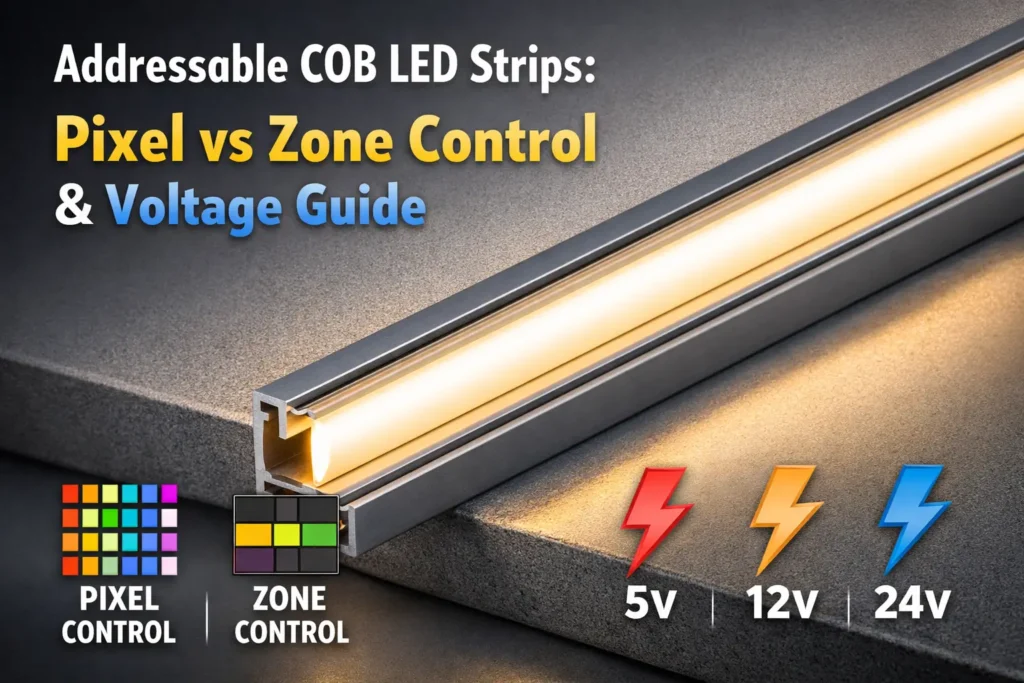
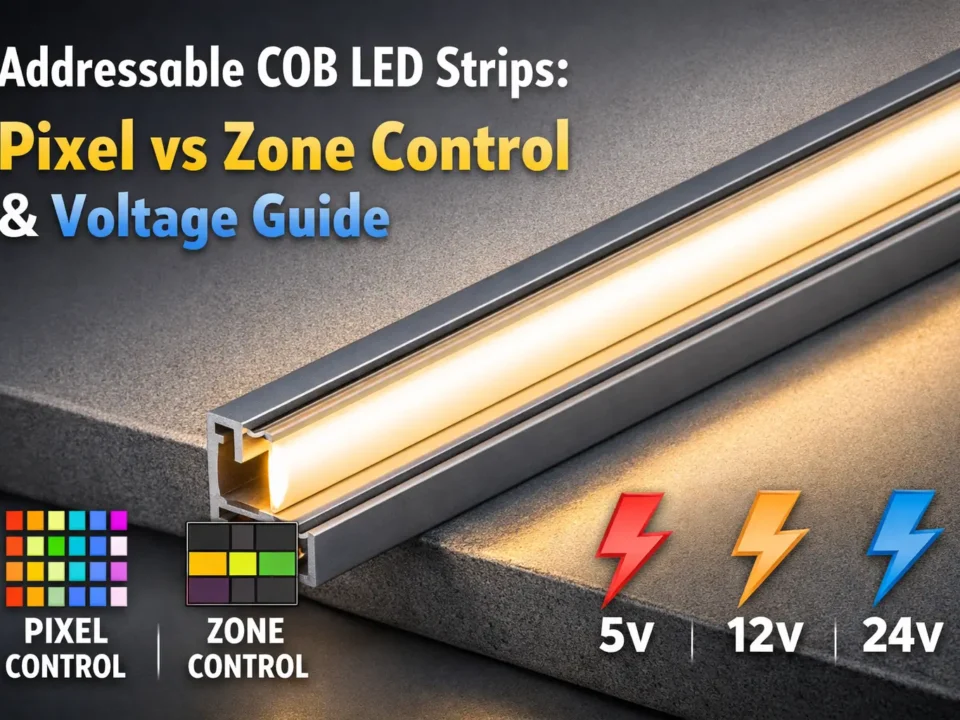
LED strip voltage also affects pixel projects. In general, 5V addressable strips can offer tighter pixel spacing, while 12V addressable strips often group LEDs to support longer runs.
No. A 5V ARGB strip needs a 5V power rail and a compatible data signal. If you plug it into 12V, the LEDs may burn out and the controller may be damaged.
Choose the voltage by layout first. Then, check the controller, power supply, and wire plan.
Some projects use both voltages. In that case, use proper converters, separate power planning, and matched controllers.
Applying 12V to a 5V strip can destroy the LEDs quickly. Therefore, always match the power supply voltage to the strip label.
Check the strip markings near the copper pads, the product page, or the controller label. Also, do not guess before powering the strip.
No. 12V is often better for longer runs, but 5V is better for short pixel projects and USB-powered setups.
Usually, yes. Because 5V strips are more sensitive to voltage drop, they often need injection sooner than 12V strips.
Choosing LED strip voltage depends on run length, pixel density, power source, and controller type. First, choose 5V for short USB, battery, and high-density pixel projects. Then, choose 12V for longer runs and simpler power distribution.
Before installing, confirm the strip voltage, controller voltage, wire size, and power supply size. As a result, the system will be safer, brighter, and easier to maintain.
For next steps, browse Elstar’s Bande LED, Contrôleurs LED, or contact Elstar for project support.
 English
  Spanish
  French
  Arabic