Vous avez besoin d'un produit de qualité en peu de temps ? Nous avons un plan pour vous.


LED strip light lifespan is often shown as a simple hour number. However, that number does not tell the full story.
For a home user, the question may be, “Will these lights still work next year?” For a buyer, distributor, OEM, or installer, the better question is: under what use conditions will this LED strip stay useful, stable, and fit for the job?
Therefore, the answer depends on more than rated hours. It also depends on what the rating means, heat, power supply quality, setup, site conditions, daily use hours, and the proof behind the supplier’s claim.
LED strip lights are usually rated in hours. However, there is no single lifespan that fits every strip or every setup. For example, a strip rated for 50,000 hours would equal about 17.1 years at 8 hours per day, or about 5.7 years at 24 hours per day. Still, this is rated-hour math, not a real-life guarantee. In practice, service life depends on heat, power supply, setup, site conditions, use pattern, and part quality.
When people ask how long Bande LED last, they may mean different things:
For LED products, lifespan is often discussed through lumen maintenance, or how much light output remains after use. One common term is L70. It means the projected time until light output falls to 70% of its first level. As a result, the strip does not suddenly turn off at L70. Instead, the light output has dropped to a set threshold.
ENERGY STAR guidance explains how LM-80 reports document subcomponent lumen-maintenance testing and how temperature and drive-current conditions matter. For buyers, the key point is simple: lifespan should not be treated as a universal promise. Instead, read it together with the rated conditions and the real use site.
LED strip lights can fail. However, they do not always “burn out” like older lamp types.
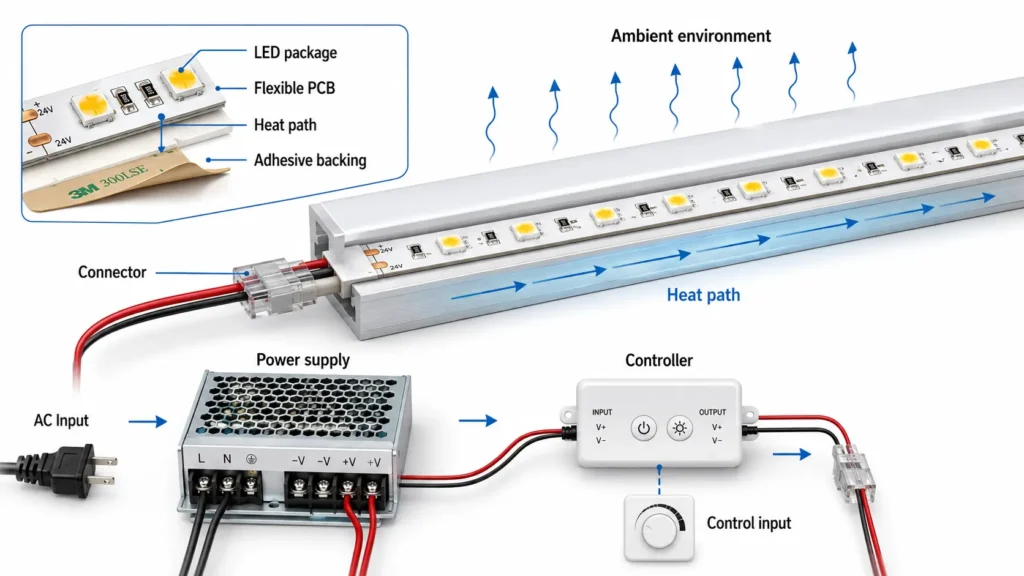
In many cases, the useful-life issue is gradual dimming, color shift, dead sections, flicker, or system-level failure. The LED packages may still emit light, but another part of the installed system may become the weak point.
For example, weak points can include:
DOE guidance on LED luminaire lifetime notes that lumen loss is important, but other failure paths and parts also need to be considered when describing product life. Therefore, for LED strip projects, the LED chip rating is only one part of the system.
A lifespan claim is useful only when the use conditions are realistic. Therefore, buyers and specifiers should check the factors below before they trust a rated-hour claim.
| Facteur | Why It Matters | What Buyers Should Check | Risk If Ignored |
|---|---|---|---|
| Heat | Excess heat can speed up light loss and part stress. | Mounting surface, aluminum profile, airflow, site temperature, power density. | Faster dimming, color shift, adhesive issues, or early failure. |
| Power supply | Poor or mismatched power can stress LEDs and controls. | Correct voltage, safe wattage margin, power-supply quality, and voltage drop over long runs. | Flicker, uneven brightness, overheating, or dead sections. |
| Setup method | The same strip can act differently based on how it is mounted. | Mounting surface, heat flow, bend radius, soldering or connection quality, pull protection. | Hot spots, loose links, damaged PCB, weak adhesion. |
| Site conditions | Moisture, dust, heat, UV, and chemicals can affect service life. | Indoor/outdoor use, IP rating need, humidity, cleaning chemicals, enclosure airflow. | Corrosion, water ingress, yellowing, or electrical faults. |
| Daily use hours | More hours per day use up rated hours faster. | 4h/day, 8h/day, 12h/day, 24/7 use, dimming schedule. | Shorter calendar life under heavy use. |
| Product and part quality | Materials, LED package, PCB design, adhesive, and build quality affect reliability. | Supplier docs, rated conditions, sample testing, use fit. | Uneven brightness, color shift, higher failure risk. |
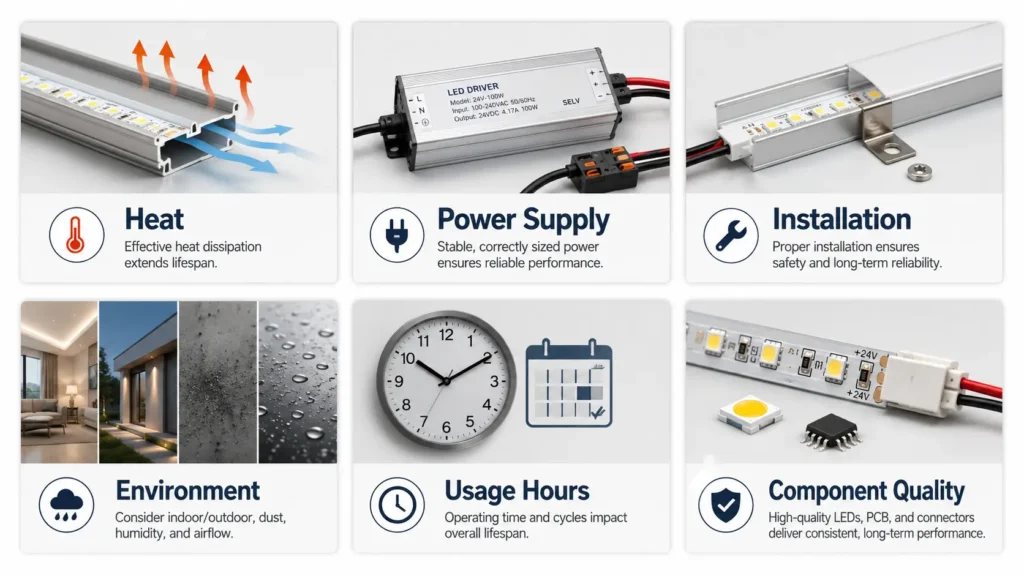
A common mistake is to compare LED strips only by one hour rating.
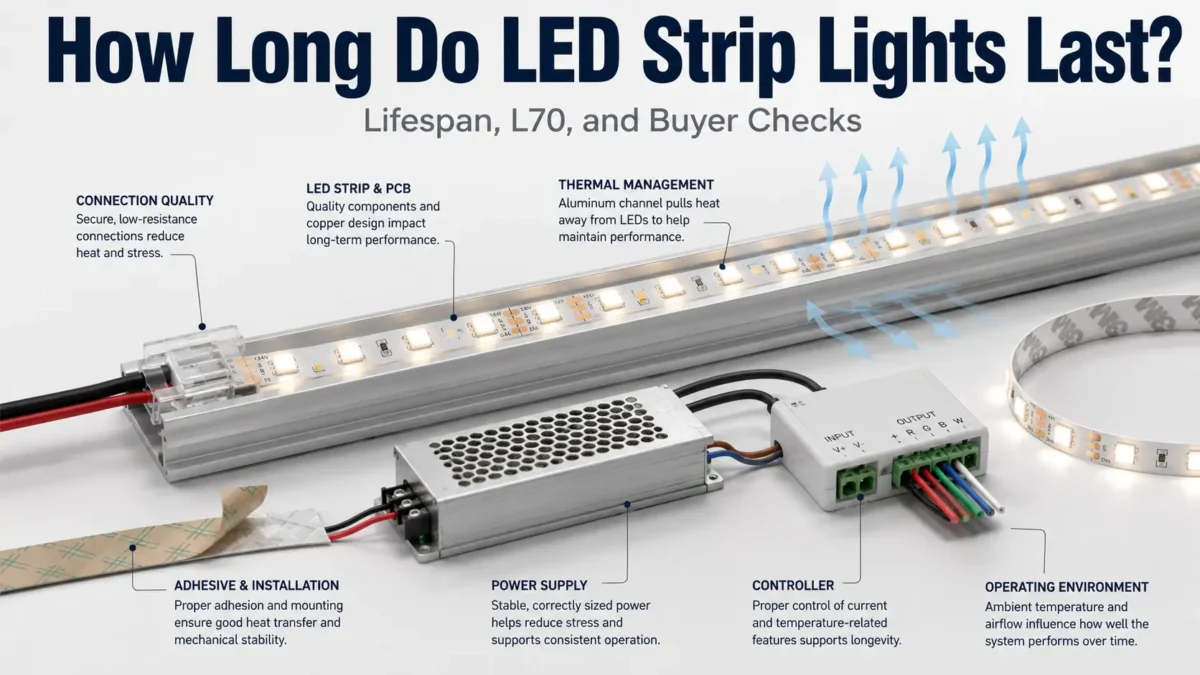
However, that can mislead buyers because the installed strip is a system. Even when the LED package has strong lumen-maintenance data, the finished setup may be limited by other parts.
| System Part | What to Check |
|---|---|
| LED package | Lumen-maintenance basis, color match, drive current, heat condition. |
| Flexible PCB | Copper weight, heat path, bend limits, solder quality. |
| Adhesive backing | Mounting surface fit, temperature exposure, long-term adhesion. |
| Power supply | Voltage match, load margin, stability, location, airflow. For power setup context, see LED Driver vs Strip Light: Key Differences & When to Use Each. |
| Connectors and solder joints | Connection quality, strain relief, current load, moisture protection. |
| Controller or dimmer | Fit with strip voltage, power load, and dimming method. |
| Use site | Room or site temperature, humidity, dust, UV exposure, cleaning conditions. |
As a result, the same strip may perform differently in a dry indoor display, a warm cabinet, a sealed channel, or an outdoor setup. A spec alone does not guarantee the result; the use condition also matters.
Rated hours can help you compare products. However, they should be converted with care.
The table below uses 50 000 heures only as a sample rated-hour case. It does not mean every LED strip is rated for 50,000 hours. Also, it does not guarantee real-life installed service.
| Daily Use | Approximate Calendar Time for 50,000 Rated Hours | How to Read It |
|---|---|---|
| 4 hours/day | About 34.2 years | Low daily use spreads the rating over many calendar years. |
| 8 hours/day | About 17.1 years | Common reference point for home or light commercial use. |
| 12 hours/day | About 11.4 years | Heavier use consumes rated hours faster. |
| 24 hours/day | About 5.7 years | Round-the-clock use needs more care with heat, power, and setup. |
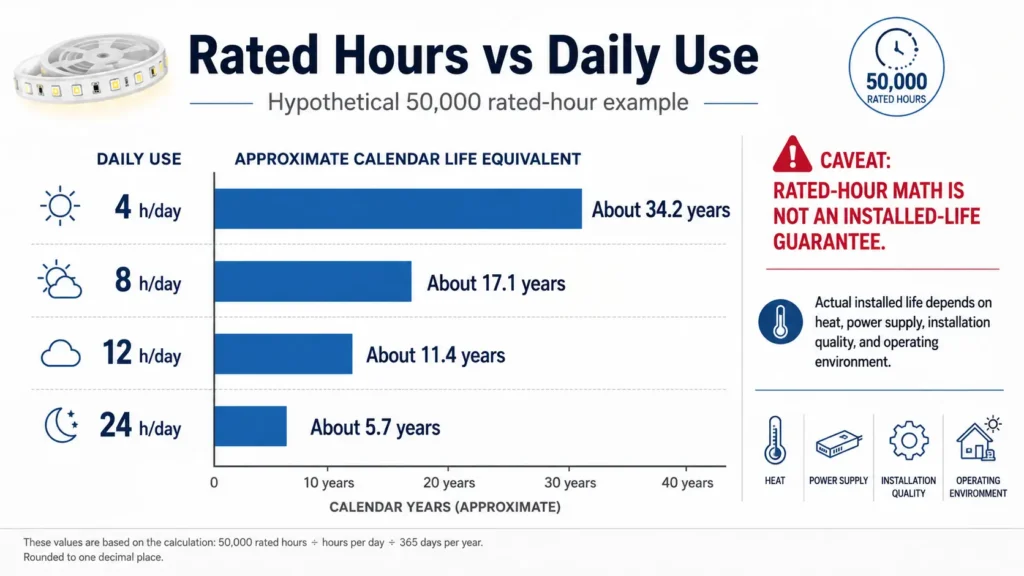
In short, this table is math only. Real installed life may be shorter or longer based on the product rating, site temperature, heat path, power supply, setup quality, and site conditions.
In many uses, LED strip lights may run for long periods. However, “can I leave them on all night?” should not be answered as a blanket yes.
Because long run time adds heat and uses rated hours, check these points first:
For project use, confirm the expected daily use hours during spec work. For example, a decorative strip used a few hours each evening is not the same as a strip used in 24/7 commercial signage.
Lower-cost LED strips are not always a poor choice. Also, higher-cost strips are not always the right choice for every job. The real question is whether the strip fits the use conditions and whether the supplier can explain the basis of the lifespan claim.
| Buyer Check | Why It Matters |
|---|---|
| Rated voltage and wattage per meter | Higher power density can increase heat load if it is not managed. |
| PCB and heat flow | The heat path affects long-term stability. |
| LED and part choice | Part quality can affect lumen maintenance and color match. |
| Adhesive and mounting method | Poor adhesion can cause setup failure even if LEDs still work. |
| Power supply quality | A weak or mismatched supply can create flicker, heat, or early issues. |
| IP rating and site | Indoor, outdoor, humid, dusty, or enclosed use needs different protection. |
| Docs | A supplier should be able to explain rated conditions and limits. |
Therefore, do not choose only by the longest hour claim. Instead, choose by use conditions, proof, setup method, and supplier support.
If lifespan matters to a project, ask the supplier what the rating is based on.
This matters because LM-80/TM-21 can support lumen-maintenance review, but they should not be stretched into a full installed-system guarantee. In addition, DOE guidance stresses that LED product lifetime involves more than lumen loss alone.
For procurement teams, the goal is not to ask for every document on every low-risk order. Instead, match the proof level to the project risk.
A supplier can give better advice when the RFQ includes real use conditions. Before asking for a quote or product suggestion, prepare:
For custom or project orders, also provide drawings, setup photos, samples, or use notes where available. Next, see Elstar’s LED strip light customization page for custom project context, or use the contact page to send use requirements.
LED strip lifespan depends on the rated hours and the setup conditions. Instead of treating one number as universal, check the product rating, heat control, power supply, mounting method, site conditions, and daily use hours. For example, a 50,000-hour rating equals about 17.1 years at 8 hours per day, but that math is not a real-life guarantee.
They can fail. However, LED strip lifespan is often about gradual dimming or system-level issues rather than sudden burnout. A strip may become less useful because of lumen loss, color shift, flicker, dead sections, connector problems, power supply issues, or site damage.
L70 refers to the projected time until light output falls to 70% of its first level. Therefore, it is a lumen-maintenance metric, not a promise that the complete installed LED strip system will work perfectly until that point.
They may be used for long periods when correctly specified and installed. However, long run time increases operating hours and heat exposure. Check the product guide, power supply, airflow, mounting surface, and site conditions before using LED strips overnight or 24/7.
Common factors include excess heat, poor heat flow, mismatched power supply, voltage drop, weak connections, harsh site conditions, high daily use hours, poor setup, and poor product fit.
They may carry higher risk if the design uses weak heat paths, poor adhesive, unstable power, lower-grade parts, or limited protection for the use site. However, price alone does not prove lifespan. Buyers should compare construction, rated conditions, supplier docs, and setup fit.
If a strip is rated for 50,000 hours, that equals about 34.2 years at 4 hours per day, 17.1 years at 8 hours per day, 11.4 years at 12 hours per day, or 5.7 years at 24 hours per day. However, these are math examples, not installed-life guarantees.
Ask what the rated hours mean, what conditions apply, whether the claim is based on LM-80/TM-21 or other data, what temperature and drive current were assumed, whether the rating covers the complete strip system, and what warranty terms are written in official docs.
For better advice, prepare your voltage, wattage per meter, run length, mounting surface, site temperature, IP requirement, daily use hours, dimming or control method, quantity, and document needs.
Then, Elstar can review the use conditions and discuss suitable LED strip options. For custom projects, include drawings, samples, setup photos, or technical needs where available.

 English
  Spanish
  French
  Arabic