Choosing the right RGB LED strip is much easier when you understand the main RGB strip families and what each one is good at. In this guide, we explain RGB, RGBW, RGBWW/RGBCCT, non-addressable and addressable RGBIC strips in plain language, then show how to match them to real projects so you can get the effects you want without overcomplicating your installation.
RGB LED strips are flexible LED tapes that use red, green and blue channels to create a wide range of colours along a line of light. Each strip carries small RGB LEDs on a flexible PCB, powered by a constant voltage supply and controlled by a controller or dimmer.
Because they are slim, bendable and easy to cut, RGB strips are used everywhere—from gaming desks and living rooms to shop displays and stage sets. You can mount them in perfiles de aluminio for a clean, professional look, or hide them behind coves and furniture for indirect glow.
At a high level, most RGB LED strips fall into the following families:
The rest of this guide simply digs into these families, compares their strengths and trade-offs, and shows you where each one fits best.
When you compare RGB families, the most important questions are how good the white light needs to be y how flexible the colour and ambience must be.
If you mainly want colour effects, standard RGB strips are often enough.
RGB strips:
Their main limitation is white light: mixing red, green and blue to produce “white” often leads to slight tints and uneven spectrum, which is fine for colour-focused ambiences but less ideal for reading, working or accurate colour viewing.
If you care about both good white light y colour effects, RGBW and RGBWW/RGBCCT families are usually the better choice.
RGBW strips:
RGBWW / RGB+CCT / RGBCCT strips:
The trade-offs:
Addressable RGB (often marketed as “RGBIC”) lets you go beyond whole-strip colour changes to per-segment or per-pixel control. That opens the door to gradients, chase patterns and advanced effects—but it also adds complexity.
Addressable or RGBIC strips contain smart LEDs or ICs that store digital instructions for each LED or group of LEDs. Instead of the entire strip showing the same colour, you can create:
This makes addressable strips ideal for:
Non-addressable (analog) and addressable (digital/pixel) RGB strips differ significantly in how they are wired and controlled:
– Use a small number of channels (e.g. R, G, B and possibly W). – Connect to a constant voltage controller whose outputs set the colour for the whole strip or for large zones. – Wiring is relatively simple: power supply → controller → strip.
– Use a data line and integrated ICs (e.g. WS2812, SK6812). – Each LED or group is addressed individually by the controller; you send patterns or frame data, not just static colours. – Wiring includes power, ground and one or more data lines, and often requires more careful attention to data integrity and grounding.
This added complexity is often worth it for dramatic, evolving effects, but it also:
For simple ambience and colour scenes, standard RGB or RGBW strips are usually the better choice, because they are easier to wire, control and scale. They are ideal for rooms, bars, restaurants and many retail environments where whole-zone colour changes are sufficient.
RGBIC or addressable strips are better when:
If your project does not genuinely require complex animations, choosing solid, non-addressable RGB/RGBW strips will often save time, cost and troubleshooting.

SMD chip packages like 5050 y 3528 describe the physical size of each LED package (roughly in tenths of a millimetre) and give you a rough sense of how the strip is built.
– Frequently used for RGB and RGBW strips because they can house multiple LED dice in a single package. – Often support higher brightness per LED and are common in multi-colour products.
– Frequently used for single-colour or tunable white strips, and sometimes for more compact RGB designs. – Can be very efficient, but RGB implementations may require different layouts.
For RGB strips, 5050 packages are still very common and work well, but real performance depends on:
Treat chip package as one signal among many, not the only indicator of quality.
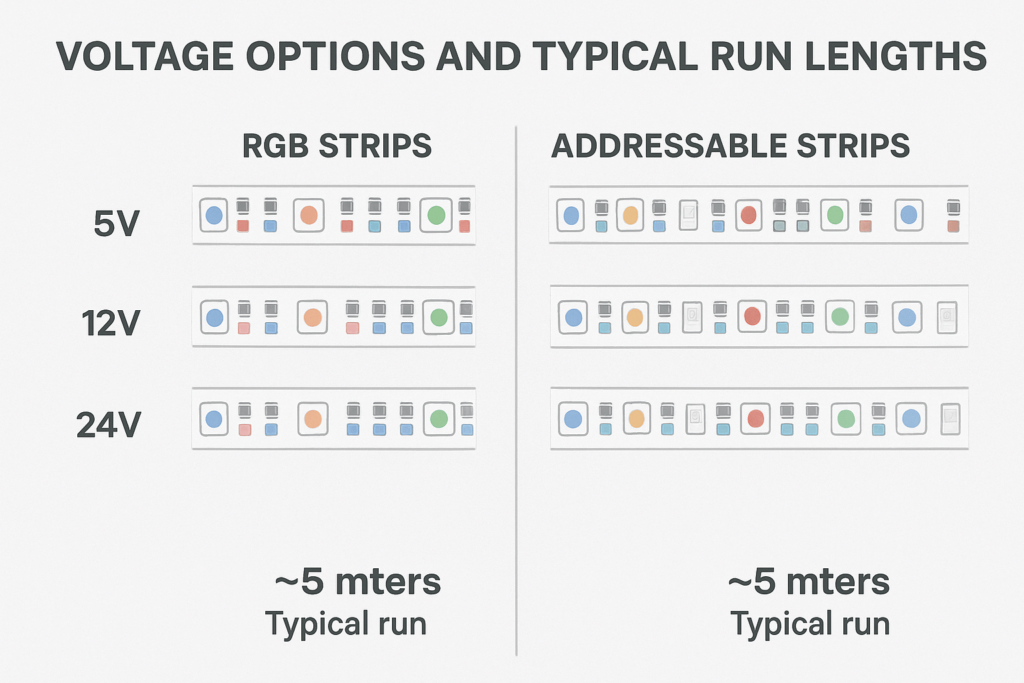
For RGB and addressable strips, voltage affects how far you can run a strip and how much current flows:
– Common in addressable/pixel strips (e.g. WS2812-based). – Allows fine per-LED control but can suffer from voltage drop on longer runs; power injection becomes more important.
– Common for conventional RGB strips and some addressable strips. – Good middle ground for short to medium runs, especially in residential and smaller commercial projects.
– Often used for longer analog RGB runs or higher power installations. – Lower current for the same power, making voltage drop less of an issue and simplifying cabling.
Simple guidance:
Whatever you choose, always pair strips with matching constant voltage power supplies and follow sensible power injection practices on long runs.
RGB and addressable strips typically specify power usage as watts per metre (W/m). To size your power supply:
For example, if a 12V RGB strip uses 14.4 W/m and you plan 10 m:
If you are working with high-density RGBIC strips, peak current can be significant; distribute power and keep conductor sizes appropriate. Our LED power supply range is organised by voltage and output power so you can match supplies to calculated loads.
A useful way to think about RGB strip choice is by application. Different scenarios call for different families.
| Application / project type | Recommended RGB families | Typical control approach | Notes |
|---|---|---|---|
| Room ambience (living/bedroom) | RGB, RGBW, RGBWW/RGBCCT | Remote/app controller, sometimes smart home | RGB for mood; RGBW/RGBCCT if white light quality matters |
| Gaming setups & desks | RGB, RGBW | PC or app control, sometimes addressable accents | RGB for simple effects; RGBW if you also work at the desk |
| Retail displays & shelving | RGBW, RGBWW/RGBCCT | DMX/DALI, smart controllers, scene controllers | Brand colours + accurate white for products |
| Signage & logos | RGBIC/addressable, waterproof RGB | Pixel controllers, DMX/Art-Net | Dynamic animations; IP-rated construction for outdoors |
| Stage & entertainment lighting | RGBIC/addressable, RGBW | DMX, media servers, show control systems | Effects-heavy; consider pixel density and robust power design |
| Outdoor architecture & facades | Waterproof RGBW, RGBIC/addressable as needed | DMX/networked controllers with suitable enclosures | Long runs; high IP; careful power injection and cabling |
Para rooms and gaming setups, the main questions are how much you care about white-light quality and how complex you want the effects to be:
– Standard RGB strips are often enough. – Choose RGBW if you want occasional clean white light for reading or working.
– Consider RGBW o RGBWW/RGBCCT so you can use strips for everyday white lighting and switch to colour for scenes.
Addressable RGB can look impressive in gaming setups, but if you do not need complex animations, it’s often more cost-effective and easier to run well-designed analog RGB/RGBW strips.
Retail and brand environments typically demand:
For these needs:
You can combine RGB strips with neutral white strips, but using a single RGBW or RGBWW/RGBCCT solution often simplifies wiring and control, especially when integrated with DMX or DALI systems.
For high-impact signage, stage and entertainment projects, animation and durability become more important:
– Per-letter or per-segment animations in signs. – Chase and effect patterns across stages or trusses. – Media-driven effects synchronised with audio or video.
– Installations are exposed to weather or moisture. – There is risk of water spray or condensation.
In these scenarios, plan for:

Even the best strip type won’t perform well with the wrong controller. Matching controllers to strip families is essential.
For non-addressable RGB and RGBW/RGBCCT strips:
– Use constant-voltage RGB controllers with three output channels. – Control interfaces can be IR, RF remotes, wall panels, Wi-Fi/app or DMX/0–10V gateways.
– Use multi-channel RGBW/RGBCCT controllers that support four or more outputs. – Consider DMX, DALI or networked controllers for larger systems where scenes and integration are important.
Make sure:
Addressable RGB strips require pixel controllers that understand the specific IC protocol (e.g. WS2812, SK6812, TM1814):
Key considerations:
When in doubt, it can be more efficient to standardise on a controller platform across your project and work with a manufacturer to ensure strip and IC choices align with that platform.
You can mix different RGB strip families in a single project, but you should be careful about:
Good practice:
For complex mixed systems, it’s wise to consult a technical partner. Our team can help you match strips and controllers across multiple zones and families.
Choosing the right RGB strip becomes straightforward once you frame it as a series of small decisions.
Use this checklist to narrow down to 1–2 RGB strip families:
– Ambient/atmospheric, task + ambient, brand lighting, signage, or stage effects?
– If you rarely need white, RGB is often enough. – If you need good white for everyday use, choose RGBW o RGBWW/RGBCCT.
– Whole-strip colours and simple fades → analog RGB/RGBW. – Pixel-level patterns and animations → RGBIC/addressable.
– Dry indoor → IP20 strips may be fine. – Damp, outdoor or exposed areas → IP65+ and suitable accessories.
– Short runs or separated segments → 5V or 12V can work. – Longer continuous runs → lean towards 24V for analog, careful injection for addressable.
– Accent-only vs task + accent; CRI and CCT requirements in retail or work areas. – Direct-view lines or shallow profiles may favour COB-based solutions within your chosen RGB family.
– Match strip type and channel count to controller type (RGB, RGBW, pixel). – Ensure the control interface (app, DMX, automation) fits your overall system.
By walking through these steps, most projects naturally converge on one or two best-fit RGB strip families, which can then be refined by product series, wattages and mounting details.
Which chip types (e.g. 5050 vs 3528) are best for RGB LED strips? For most RGB and RGBW strips, 5050 packages are common because they can house multiple colour dice in a single package and deliver good brightness. Smaller packages like 3528 or 2835 are more common in white strips and some compact RGB designs. Always check actual lumens per metre y density rather than relying on chip code alone.
What voltage should I use for RGB and addressable RGB LED strips? Use 5V when you’re working with popular pixel ICs for short or segmented addressable runs, 12V for typical analog RGB strips and many small projects, and 24V when you need longer analog runs and want lower current. Match your power supplies carefully and plan power injection for longer or high-power runs.
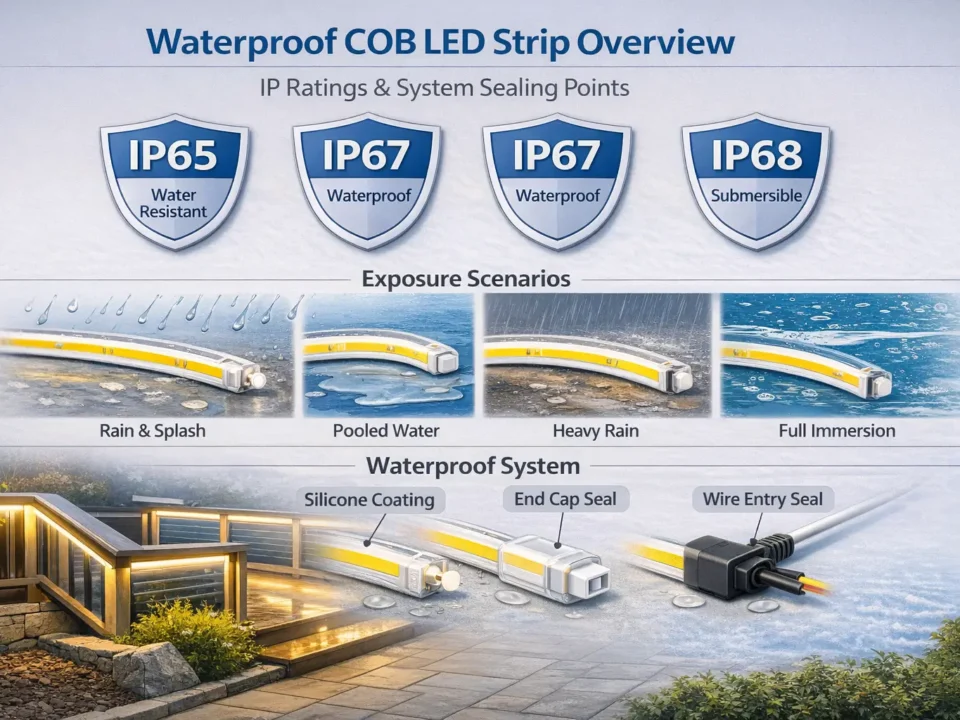
How do IP ratings and waterproofing affect RGB strip choice? Use IP20 strips for dry indoor installations, IP65 for damp or splash-prone areas, and IP67/IP68 for harsher outdoor conditions when backed by correct installation and sealing. Remember that connectors, power supplies and junctions must also be rated appropriately.
How much power do RGB and addressable strips use? Each product specifies watts per metre; multiply by the total length and add around 20–30% as headroom when sizing power supplies. Addressable strips, especially high-density ones, may have higher peak currents and often require multiple injection points on longer runs.
Can I mix RGB, RGBW and RGBIC strips in one system? Yes, but only if you keep voltages and control methods separated. Do not run analog and pixel strips from the same controller channels, and make sure each strip type has compatible controllers and power supplies.
Picking the right RGB LED strip type is about matching family capabilities a project realities. When you understand RGB families and their trade-offs, you can design systems that are both impressive and maintainable.
Key takeaways:
If you are planning a larger or more complex system, we can help you map strip families, voltages, ICs and controllers into a coherent design that fits your project and budget.
You can explore our LED strip light range and, for tailored RGB solutions or OEM/ODM projects, get in touch via our contact page.

 English
  Spanish
  French
  Arabic