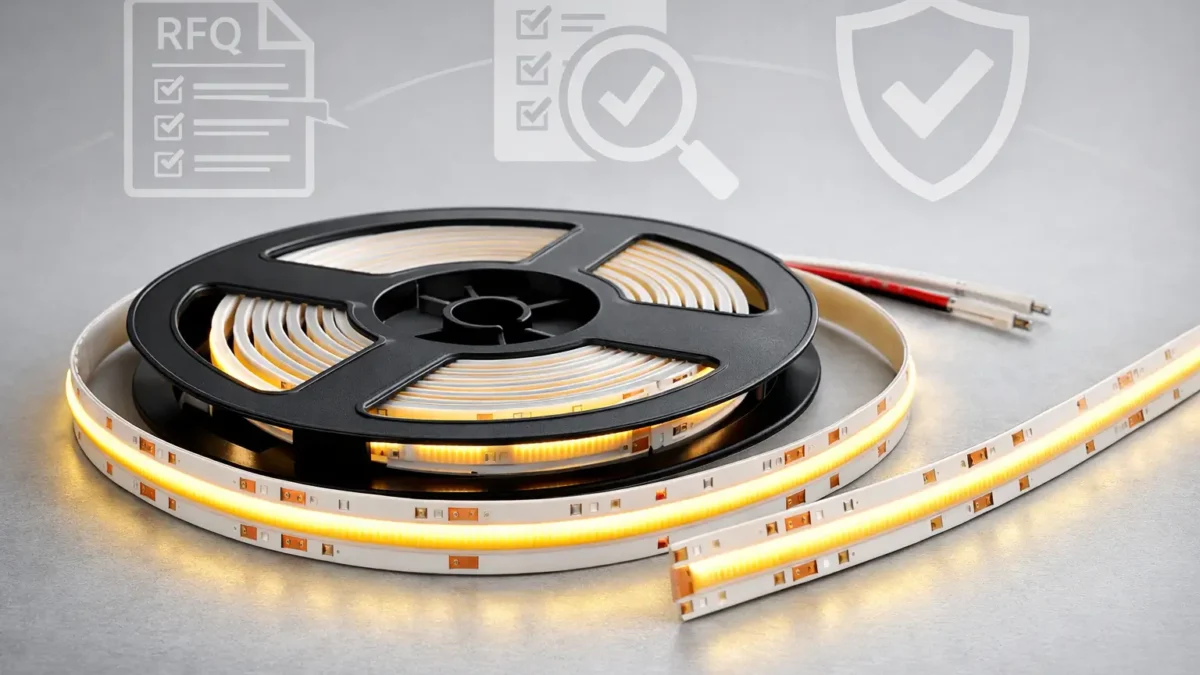
Shortlist a COB LED Strip Manufacturer (5-Step Checklist + RFQ Must-Haves)
If you’re searching “COB LED strip manufacturer,” the fastest way to get comparable quotes is to standardize your requirements and verify scope (QC + compliance) by model/series—not by marketing claims.
| Step | What to do (procurement-friendly) |
|---|---|
| 1) Define the application | Where it’s used (project vs product line), environment, and the visual goal (dotless line, bending needs, etc.). |
| 2) Build a short list | Choose suppliers whose product range and customization scope match your use case. |
| 3) Send one RFQ to all | Use the same RFQ version so quotes are comparable. |
| 4) Verify proof, not promises | Request model/series datasheets and any available QC/compliance evidence tied to the quoted item. |
| 5) Sample and approve | Approve against written acceptance criteria; treat any later change as a re-validation trigger. |
RFQ must-haves (minimum fields):
- Application + environment (dry / damp / wet / outdoor, exposure risks)
- COB variant needs (single color / tunable white / RGB-type) and control expectation
- Installation constraints (layout, mounting surface, feeding/power plan concept)
- Required documents (datasheet by model/series, wiring notes if needed, labeling/packaging needs)
- Compliance requirements (confirm scope by model/series; project requirements vary)
Boundary conditions:
- Do not assume universal certifications, universal “no voltage drop,” fixed lead times, or fixed MOQs—confirm in the quotation and written scope.
- Tie any performance/compliance statement to the exact quoted model/series documentation.
What Buyers Mean by “COB LED Strip Manufacturer” (US Market, B2B Context)
In B2B sourcing, “COB LED strip manufacturer” usually means you need a supplier that can support repeatable supply (or a one-off project) with clear documentation, controlled changes, and predictable handover—not just a product page.
Key points:
- This guide is for lighting brands, distributors, and project/engineering teams (not DIY retail).
- “Reliable” typically means: fit-for-use product options, clear RFQ communication, verifiable scope, and consistent outputs over time.
- In the US, compliance expectations can be project- and jurisdiction-dependent; the safe stance is always “verify scope for the exact model/series.”
Boundary conditions:
- Requirements (including compliance) can differ by spec and Authority Having Jurisdiction (AHJ); confirm your requirement set before locking a model.
- If you don’t know a parameter, document the constraint and ask for options—don’t guess.
Options & Comparison: COB vs SMD vs LED Neon (When Each Format Makes Sense)
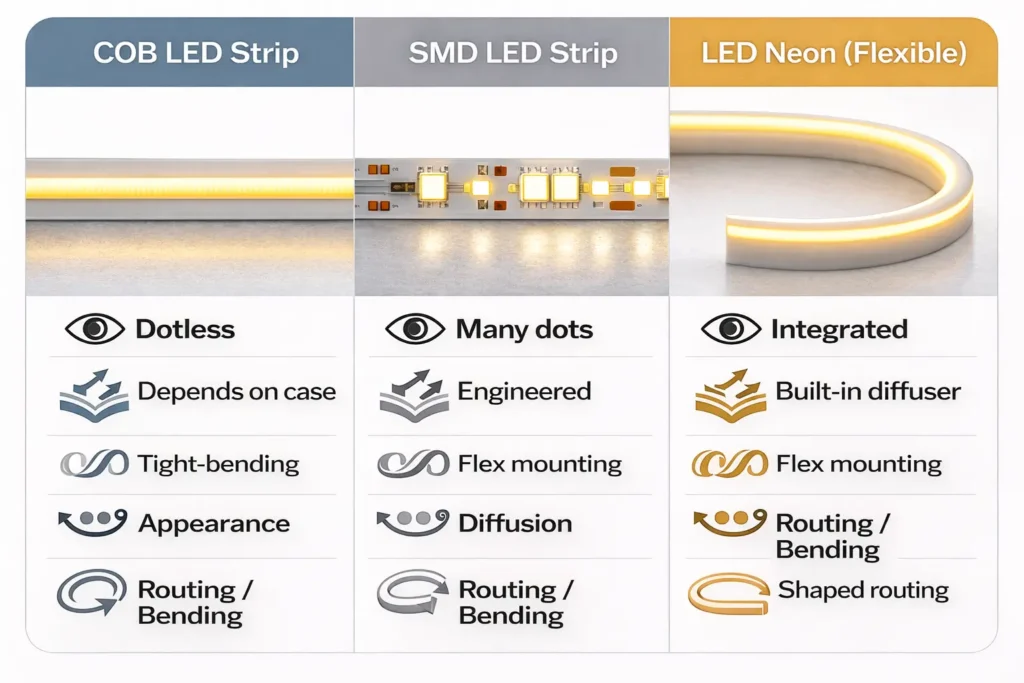
COB strips are often chosen for a more continuous “dotless” line appearance, while SMD strips and neon formats can be better fits depending on diffusion, bending, installation method, and enclosure needs.
Key points:
- COB: typically used when you want a smooth line of light with less visible “pointing.”
- SMD: often more modular; diffusion/enclosure design can strongly affect the final look.
- LED neon (flex): often used when you want an integrated diffuser/enclosure style or specific shapes/routes.
Boundary conditions:
- Avoid universal performance assumptions; confirm any series-level claims by the quoted model/series datasheet.
- “Better” depends on the real installation and visual requirements.
Comparison Table (COB vs SMD vs Neon): What Changes for Procurement
Choose the format that meets the visual goal and installation constraints first—then align RFQ fields (controls, environment/IP, mounting, documentation) to that choice.
| Format | Why teams choose it | Common trade-offs | Procurement implications |
|---|---|---|---|
| Tira de LED COB | Smooth, continuous-looking line for many linear lighting uses | Bending/mounting constraints can matter; series options vary | Specify visual goal, mounting approach, and control method clearly; request datasheet by model/series |
| Tira de LED SMD | Flexible options; diffusion can be engineered via channels/lenses | May show “dots” without diffusion; appearance depends on optics | RFQ must state diffusion/enclosure plan and viewing distance expectations (qualitative) |
| LED neon (flex) | Integrated diffuser/enclosure style; often used for shaped runs | Larger profile; installation method differs by design | RFQ should include routing/bending needs and environment; confirm installation method and documentation |
“Pick this when…”:
- Pick COB when: the clean line look is the priority and your mounting route supports it.
- Pick SMD when: you need broad option variety and can manage diffusion/enclosure design.
- Pick neon when: you want an integrated diffuser/enclosure aesthetic or routed shapes.
Boundary conditions:
- Final suitability depends on your exact model/series and installation; verify with datasheets and the installation plan.
Decision Guide: How to Evaluate and Shortlist a COB LED Strip Manufacturer
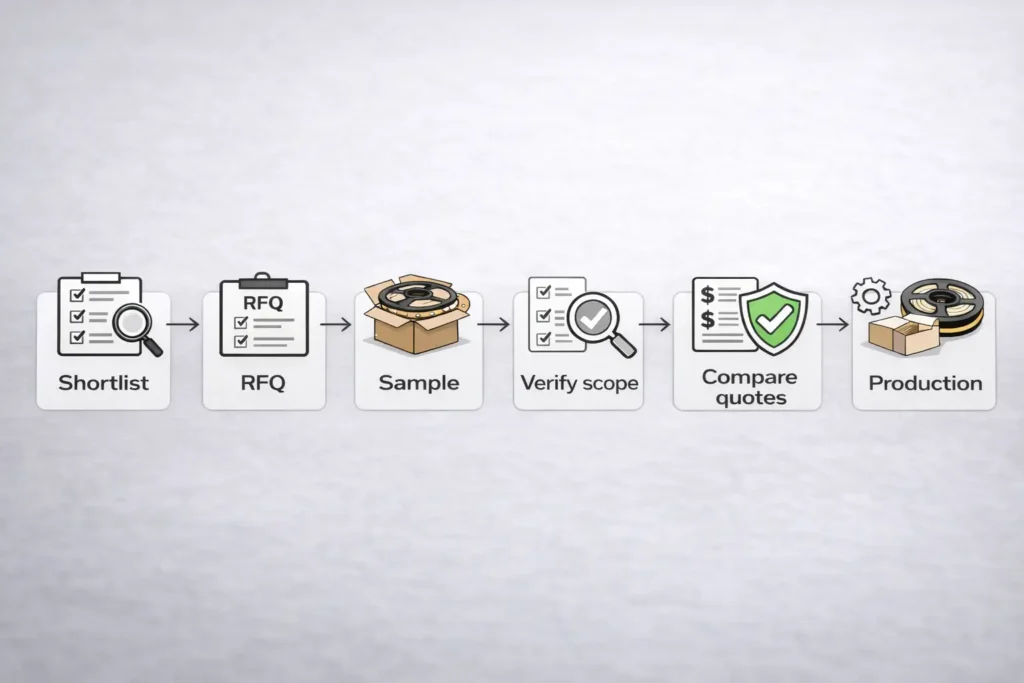
A good shortlist is built on capability fit + verifiable scope + clear process—not on the loudest claims.
Key points (what “shortlisting” should accomplish):
- Ensure the supplier can support your use case (project vs product line) without constant re-quoting.
- Ensure claims (QC, compliance, consistency) can be verified for the exact quoted model/series.
- Ensure you can define and approve samples against clear acceptance criteria.
Boundary conditions:
- Capabilities and available documents vary by manufacturer and by product series—verify per model/series.
- Avoid assuming “fastest” or “best” without a comparable RFQ and evidence package.
Shortlist Checklist: Capability Fit, Proof, and Project Support
Shortlist manufacturers by how well they can meet your requirements with clear scope, clear documentation, and a stable sample-to-production process.
Checklist (copyable):
- Product fit: Can they offer COB variants aligned to your needs (single color / tunable white / RGB-type) and your environment (indoor/outdoor/wet-area options as needed)?
- Documentation readiness: Can they provide a model/series datasheet for the quoted item and the basic installation/wiring notes your team needs?
- Customization scope (if needed): Can they clearly define what is customizable versus what needs engineering validation and re-approval?
- QC evidence approach: Can they explain what they check and what evidence they can provide (as available) for the quoted model/series?
- Compliance scope discipline: Can they confirm compliance/certification scope for the exact model/series you are buying (not just “company-level” claims)?
- Communication and change control: Can they track RFQ revisions, sample approvals, and changes without confusion?
- Project support fit: Can they support your handover needs (labels, packaging notes, documentation set) appropriate to a brand line or a site project?
Boundary conditions:
- If a supplier can’t tie scope to a model/series reference, treat that as a risk to be managed—not a detail to ignore.
- Any “we can do anything” statement should be converted into a written scope + sample build aligned to final requirements.
Red Flags That Cause Re-Quoting, Delays, or Field Issues
Most sourcing failures come from scope ambiguity—especially unclear RFQs, unverified compliance scope, and undefined acceptance criteria.
Red flags (risk checklist):
- Quotes without a clear model/series reference (hard to compare, hard to verify later).
- “Certified” claims without scope evidence tied to the quoted item (model/series scope unclear).
- Vague QC promises (“strict QC”) without describing what evidence can be provided or what acceptance criteria will be used.
- Supplier asks no questions about environment, mounting, or controls (likely mismatch later).
- Sampling is treated as a formality, not an approval milestone with sign-off criteria.
- Changes requested after approval are treated as “no impact” (should trigger review/re-validation).
Boundary conditions:
- A red flag doesn’t always mean “reject,” but it does mean “add verification steps and tighten scope.”
Process / How-to: RFQ Checklist, OEM/ODM Scope, and Sampling Workflow
To get accurate, comparable quotes from multiple manufacturers, you need one RFQ template, a clear customization scope (if any), and a sample approval workflow that prevents “surprises at mass production.”
Key points:
- Use one RFQ version across all suppliers (same fields, same assumptions).
- Split customization into “straightforward” vs “needs engineering validation.”
- Treat sampling as a gated milestone: approval criteria + sign-off owner(s) are defined in advance.
Boundary conditions:
- If you can’t define a parameter yet, state the constraint and request options; do not invent values.
- Any change after approval can affect output consistency; treat it as a trigger for review (and sometimes re-sampling).
RFQ Checklist Table: What to Specify (Must-Have vs Nice-to-Have)
A complete RFQ tells the manufacturer what the strip must do in your real environment and system—so you get quotes that can be compared fairly.
| RFQ field | Why it matters | What to confirm / attach |
|---|---|---|
| Application scenario | Sets the baseline expectations for consistency and documentation | Project vs product line; who installs; who signs off |
| Environment exposure | Drives IP selection and installation approach | Dry/damp/wet/outdoor; chemicals, heat, UV exposure (if relevant) |
| Visual goal | Prevents “looks different on site” disputes | Dotless line priority, diffusion/enclosure intent (qualitative) |
| Control requirement | Prevents compatibility problems | Dimming/control method expectation; system components plan |
| Run layout + feeding concept | Avoids surprises with longer runs | Sketch/notes: approximate run segments and feed locations (no need for exact numbers at first) |
| Mounting method | Affects reliability and appearance | Surface/channel/profile intent; bends/routing constraints |
| Documentation deliverables | Reduces back-and-forth | Datasheet by model/series; wiring notes if needed; labeling/packaging needs |
| Compliance requirement set | Avoids late-stage compliance issues | What the project/spec requires; request scope proof by model/series |
| Acceptance criteria | Makes sampling meaningful | Sample evaluation checklist; incoming inspection expectations |
Common mismatch causes (mini-list):
- Environment/IP not specified (quotes assume different protection levels).
- Control method not specified (compatibility risks appear late).
- No run layout notes (feeding plan and installation details are discovered too late).
- No model/series reference required (you get “brochure quotes,” not quoteable scope).
Boundary conditions:
- Require a model/series reference for every quoted line item; otherwise quotes are not comparable.
- Keep RFQ assumptions consistent across suppliers and track revisions.
OEM/ODM Customization Scope Table: Common Changes vs Needs Engineering Validation
Most OEM/ODM success comes from defining customization scope clearly and aligning the sample build to the final spec before production.
| Commonly customizable (often straightforward) | Usually needs engineering validation (confirm feasibility before committing) |
|---|---|
| Connector/termination preferences (type and placement) | Non-standard mechanical routing/bending constraints that change the design approach |
| Cable exit direction / lead orientation | Major changes to construction approach or special durability requirements |
| IP option selection (based on environment) | Complex environment demands where installation method is a key variable |
| Labeling, packaging, and documentation set | Any change requested after sample approval (treat as re-validation trigger) |
| Project-specific documentation formatting (as requested) | Compatibility-dependent system requirements that need component-level validation |
Change-control note (keep it practical):
- Any “small change” after sample approval can affect build, installation, or verification scope. Confirm the impact and decide whether re-sampling is needed.
Boundary conditions:
- Feasibility depends on the supplier’s platforms and the target model/series—confirm scope in writing.
- Avoid treating customization as “guaranteed”; validate via a matched sample build.
Sampling Workflow: RFQ → Sample → Evaluation → Approval → Production
Sampling should be a controlled mini-project: you evaluate fit (appearance + system compatibility + documentation) and approve against written criteria.
- Freeze RFQ v1: agree on the baseline scope and required documents.
- Request sample build: ensure the sample matches the RFQ scope (including any customization).
- Evaluate sample: check appearance in your intended mounting/enclosure style, and confirm system compatibility (driver/controller/wiring plan).
- Confirm scope evidence: collect model/series datasheet and any available evidence relevant to your project requirements.
- Approve with criteria: document acceptance criteria and sign-off owner(s).
- Produce and receive: align incoming inspection with the same acceptance criteria.
- Manage changes: treat post-approval changes as review/re-validation triggers.
Sample approval checklist (short):
- Appearance and application fit (qualitative acceptance statements)
- Controls/dimming compatibility confirmed for the intended system design
- Documentation package received (datasheet by model/series; wiring notes if needed)
- Any required compliance scope checks completed (as applicable)
- Sign-off record stored for handover and future repeat orders
Boundary conditions:
- Timelines and batch sizes vary—confirm in the quotation and production plan.
- If requirements change after approval, re-check scope and decide on re-validation.
If you want a faster quotation cycle, prepare your RFQ using the table above and include a simple run-layout note, environment description, and control requirement. That single step typically reduces re-quoting loops.
Risks & Mistakes to Control Upfront: QC Evidence, Compliance Scope, Installation, Controls, and Quote Comparability
Most project problems are preventable when you convert “quality” and “compliance” into procurement actions: request evidence, verify scope, and record what was approved.
Key points:
- QC: focus on what you can request/verify/record for the quoted model/series.
- Compliance: confirm scope for the exact model/series and keep records for handover.
- Installation + controls: treat the strip as part of a system (layout, feeding, mounting, driver/controller/wiring).
- Quote comparability: normalize scope before you compare prices.
Boundary conditions:
- Evidence availability can vary by series; request what is available and document what you received.
- Compliance needs vary by project and jurisdiction; confirm your requirement set before locking a model.
- Avoid universal run-length claims; feeding strategy depends on model and site conditions.
QC Evidence Buyers Should Request (Request / Verify / Record)
You don’t need “perfect claims”—you need a repeatable way to request, verify, and archive evidence tied to the quoted model/series.
Request / Verify / Record (procurement checklist):
- Request:
- Model/series datasheet for every quoted item
- Basic wiring/installation notes if your use case needs it (especially for controlled/dimmed systems)
- Any available test summaries or inspection records relevant to the quoted series (as available)
- Batch/traceability identifiers (if available) and labeling conventions
- Verify:
- The documents refer to the same model/series as the quotation
- The sample build matches the RFQ scope and the quoted item
- Acceptance criteria are defined for appearance + system operation (and used consistently)
- Record:
- RFQ version used for quoting
- Sample approval record (who approved, what criteria)
- Document package received (file names/versions)
- Any agreed change-control rules for production
Boundary conditions:
- Avoid “zero defects” expectations; use agreed acceptance criteria and incoming inspection plans.
- Not all suppliers provide the same evidence depth; if critical, require it upfront in RFQ.
Compliance & Certifications: Verify Scope for the Exact Model/Series (US-Friendly Workflow)
For US-market projects, treat compliance as “scope to be confirmed for the exact model/series,” and keep records. A label or broad claim isn’t the same as verified scope.
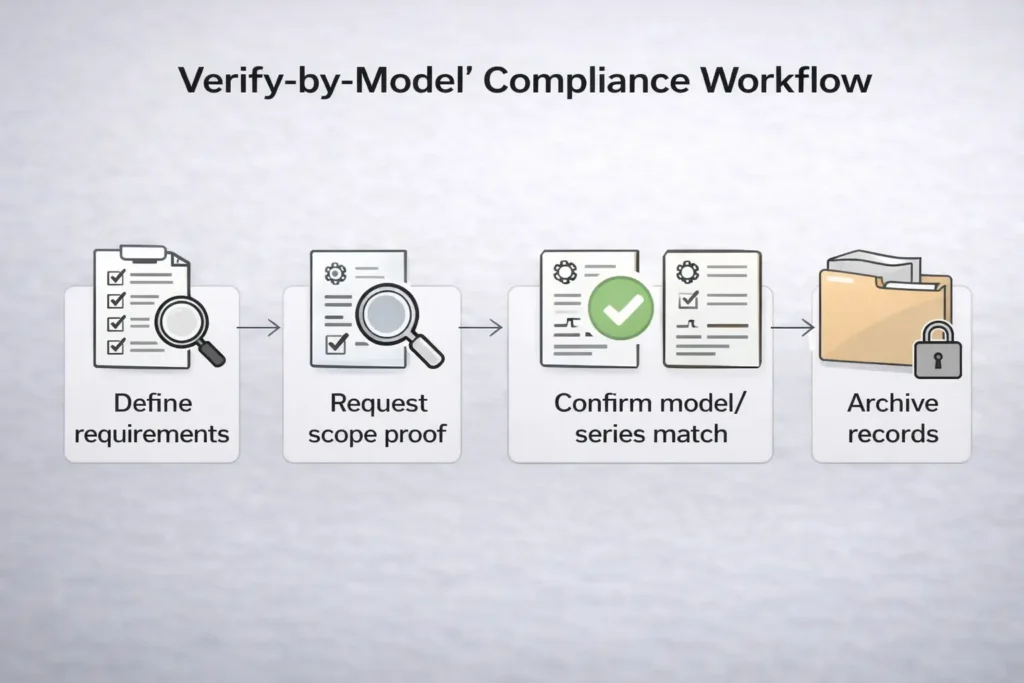
Workflow (verify-by-model steps):
- Define your requirement set: what the project/spec actually requires (and what is optional).
- Ask for scope proof tied to the quoted item: request documents that reference the exact model/series.
- Validate the provider: understand how certification bodies and test labs define scope; avoid “company-level badge” assumptions.
- Archive for handover: keep the RFQ version, quote model/series references, and the document package.
Helpful references (definitions and scope concepts):
- OSHA’s NRTL Program overview (scope and how NRTLs fit US product safety certification): https://www.osha.gov/nationally-recognized-testing-laboratory-program
- OSHA’s current list of NRTLs (for confirming recognized labs): https://www.osha.gov/nationally-recognized-testing-laboratory-program/current-list-of-nrtls
Document request list (keep it practical):
- A model/series datasheet tied to the quoted item
- Any certification scope document(s) that clearly indicate what the mark covers (model/series-specific)
- Any project-required documentation for handover/audit (as applicable)
Boundary conditions:
- Certification scope is not universal across all products; confirm it for the exact model/series you are buying.
- Compliance requirements can vary by jurisdiction and project specification; confirm early.
Installation Constraints (Pre-Quote): Layout, Feeding Strategy, Mounting/Heat, and IP Selection
Installation constraints should be captured before ordering—because layout, feeding strategy, mounting, and environment often change what “fits” in practice.
Risk checklist (pre-quote constraints):
- Run layout notes: where runs start/stop, where feeding points might be feasible
- Environment reality: water exposure, cleaning methods, outdoor UV, condensation risk (as applicable)
- Mounting and routing: channels/profiles intent, bends, corners, surface material, access constraints
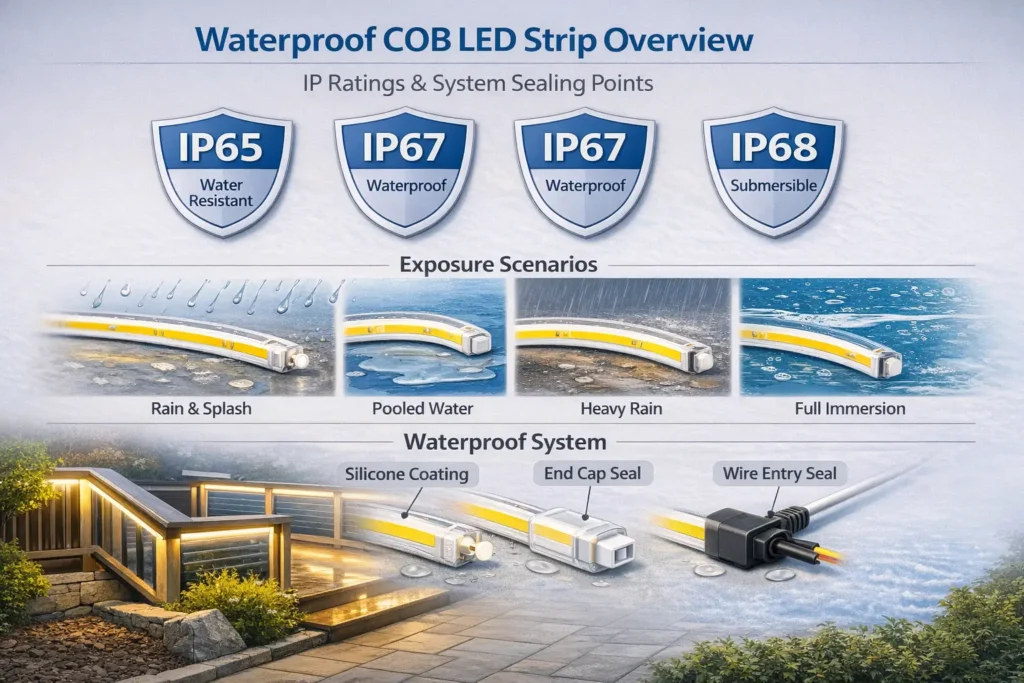
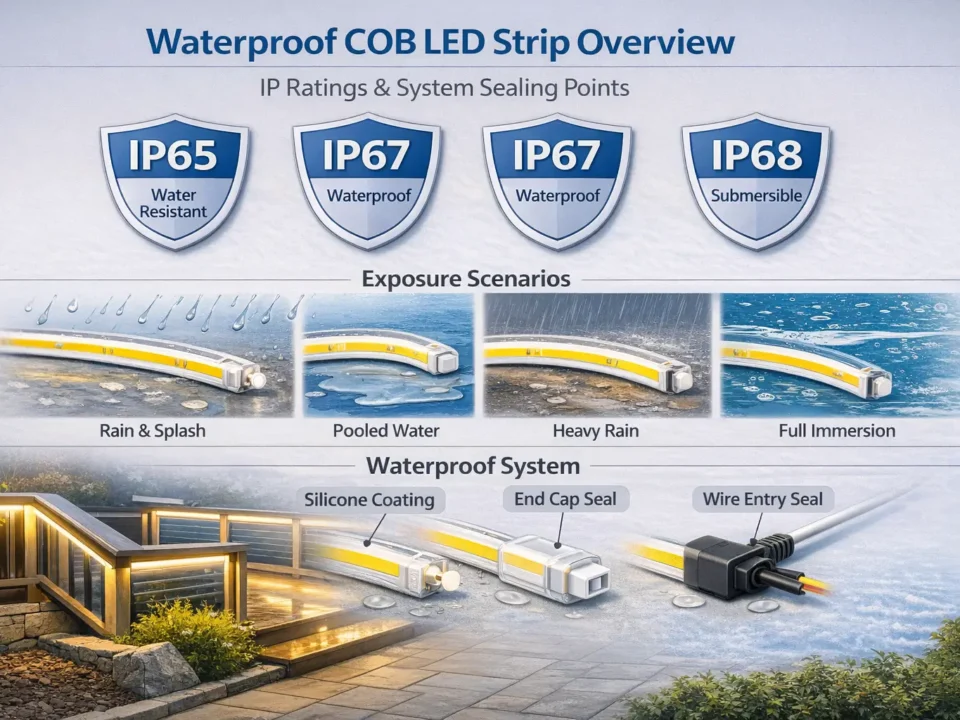
- Protection level: IP selection should match the environment and the installation method (not just the product label)
- System design: driver location, wiring paths, and service access
IP rating reference (for definition-level clarity): https://en.wikipedia.org/wiki/IP_code
Boundary conditions:
- Run length and feeding strategy depend on the model and the site conditions; confirm with the datasheet and your layout plan.
- “Waterproof” depends on product + installation method; match IP choice to real exposure.
Controls & Dimming Compatibility Checklist (Strip ↔ Controller ↔ Driver ↔ Wiring)
Flicker and instability problems are often system problems. Confirm compatibility across the strip, controller, driver/power supply, and wiring plan before ordering.
Compatibility checklist (confirm-before-order):
- Control/dimming method requirement is clearly stated (project/system-driven)
- Controller (if used) is compatible with the strip type/variant and the intended wiring method
- Driver/power supply is appropriate for the system design (avoid “unknown driver” assumptions)
- Wiring plan is documented (routing, connections, polarity expectations, service access)
- Sample test includes the actual (or equivalent) controller/driver setup used in the project
Boundary conditions:
- Compatibility is system-specific; verify using the exact components and wiring plan where possible.
- Do not assume one dimming method works universally across all drivers/controllers.
Quote Comparison Table: Normalize Scope Before You Compare Prices (Avoid Apples-to-Oranges)
Compare quotes only after you standardize the scope. If scope is different, price is not comparable.
| Scope field to normalize | How to standardize it | Hidden differences to watch |
|---|---|---|
| Quoted model/series reference | Require a model/series identifier on each line item | “Similar” descriptions that actually refer to different series |
| RFQ version | All suppliers quote the same RFQ version | Old revisions mixed into the comparison |
| Environment/IP assumptions | RFQ states environment and protection needs | Different IP options quoted without being stated |
| Documentation deliverables | List required documents (by model/series) | Some quotes include docs/support; others don’t |
| QC evidence expectations | State what evidence is requested (as available) | “Strict QC” claims without defined deliverables |
| Termination/connector scope | Define connector/lead needs | Accessories/termination included vs excluded |
| Acceptance criteria | State sample approval + incoming inspection basis | Disputes later due to undefined criteria |
| Packaging/labeling needs | Define if needed (brand/distributor) | Private label scope differs widely |
Normalization checklist:
- Same RFQ version and same assumptions across suppliers
- Same deliverables (docs, labels, packaging needs)
- Same acceptance criteria and sample approval approach
- Model/series scope verified for each quoted line
Boundary conditions:
- Avoid general price or lead-time claims; comparisons are valid only within standardized scope.
- Any scope change can invalidate the comparison—re-check before negotiating.
If you’re comparing multiple supplier quotes and need a neutral “scope checklist” to avoid apples-to-oranges decisions, use the table above as your internal evaluation sheet and keep the RFQ version consistent across all suppliers.
PREGUNTAS FRECUENTES
- Q: What is a COB LED strip, and how is it different from SMD LED strip?
A: A COB LED strip is commonly chosen for a more continuous-looking line of light, while SMD strips often rely more on diffusion/enclosure design to achieve a similar appearance. The best choice depends on your visual goal, routing/bending constraints, and system design (controls and mounting). Confirm final suitability by the quoted model/series and your installation plan. - Q: How do you choose a reliable COB LED strip manufacturer for bulk or project supply?
A: Choose by capability fit plus verifiable scope: require a model/series reference for quotes, request documents tied to the quoted item, and use a defined sample approval process. Reliability improves when the supplier can clearly state what they can deliver, what they can evidence (as available), and how changes are controlled. Avoid relying on broad claims that are not tied to specific models/series. - Q: What information should be included in an RFQ for COB LED strip lights?
A: Your RFQ should state the application, environment exposure, control/dimming expectations, run layout notes, mounting constraints, required documents, and acceptance criteria. These fields reduce re-quoting and prevent mismatched assumptions across suppliers. If you don’t know a parameter, document the constraint and request options rather than guessing. - Q: What can be customized (OEM/ODM) when ordering COB LED strips from a manufacturer?
A: Common OEM/ODM work often includes termination/connector preferences, packaging/labeling, and environment-aligned options, while more complex changes typically require engineering validation and re-approval. The safe approach is to define customization scope in writing and request a sample build that matches the final requirements. Any post-approval change should trigger a review for re-validation impact. - Q: What QC documents or test evidence should you request from a COB LED strip manufacturer?
A: Request at least the model/series datasheet for the quoted item and any available QC/test summaries relevant to that series (as available), then verify that the documents match the quoted model/series. Also define sample approval and incoming inspection criteria so “QC” becomes actionable. Keep a record set that includes RFQ version, approvals, and the document package for handover. - Q: How do you confirm whether a certification or compliance claim applies to the exact COB strip model you’re buying?
A: Ask for scope evidence tied to the exact model/series and confirm it matches the quoted line item, rather than relying on a general “certified” statement. In the US, understanding NRTL scope and keeping records helps reduce compliance surprises; project requirements can vary by spec and jurisdiction. Archive the RFQ, quote model/series identifiers, and scope documents as part of project handover.
Summary & Next Steps (Brand Line vs Project Procurement)
Takeaways:
- Build a shortlist using the same criteria across suppliers (capability fit + proof + process).
- Standardize RFQ fields to get comparable quotes and reduce re-quoting.
- Treat compliance as “verify-by-model/series scope,” and keep records.
- Convert “QC” into procurement actions: request, verify, and record.
- Compare quotes only after scope is normalized (apples-to-oranges prevention).
Scenario-based next steps:
- If you’re sourcing for a brand/distributor product line:
- Lock RFQ fields, packaging/labeling needs, and change-control rules early.
- Use a documented sample approval record as your repeat-order baseline.
- If you’re sourcing for a contractor/project:
- Capture environment and installation constraints before selecting the final model.
- Confirm system compatibility (driver/controller/wiring plan) during sample evaluation.
- Archive scope documents and approvals for handover.
Boundary conditions:
- Do not generalize performance, run length, or compliance from one series to another—verify by the quoted model/series documents.
- Confirm lead time, MOQ, and warranty terms in the quotation and written agreement.
For custom specs, long-run layouts, wet-area installations, or projects with strict compliance requirements, prepare your RFQ and include a simple run-layout note plus the required document list. That makes it easier to confirm scope and reduce surprises during sampling and installation.

 English
  Spanish
  French
  Arabic