If you are specifying an IP67 COB LED strip for a wet area or outdoor-adjacent project, the rating is only part of the decision. You also need sealed ends, protected connectors, safe cable exits, and protected drivers or controllers.
IP67 COB LED Strip (Meaning, Boundaries, and Quick Selection Cues)
First, IP67 usually means strong dust protection plus short-term water exposure under test rules. However, that does not mean the full installed lighting system is automatically waterproof.
Fast meaning
First, the strip body may be rated for the stated IP level.
Next, every cut end, cable exit, connector, and driver box must match the site risk.
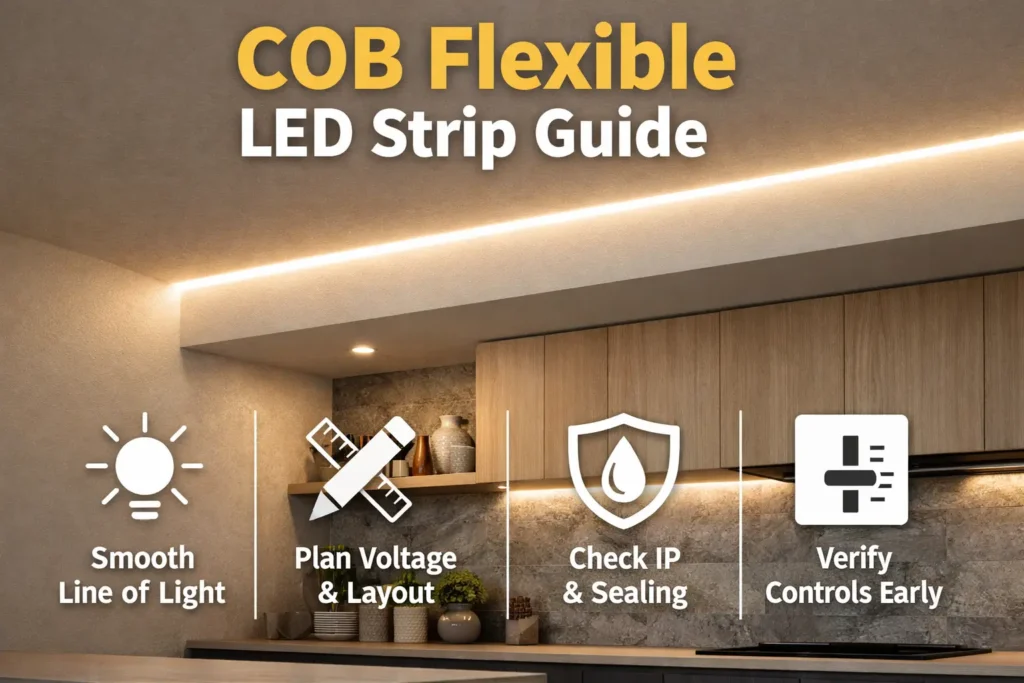
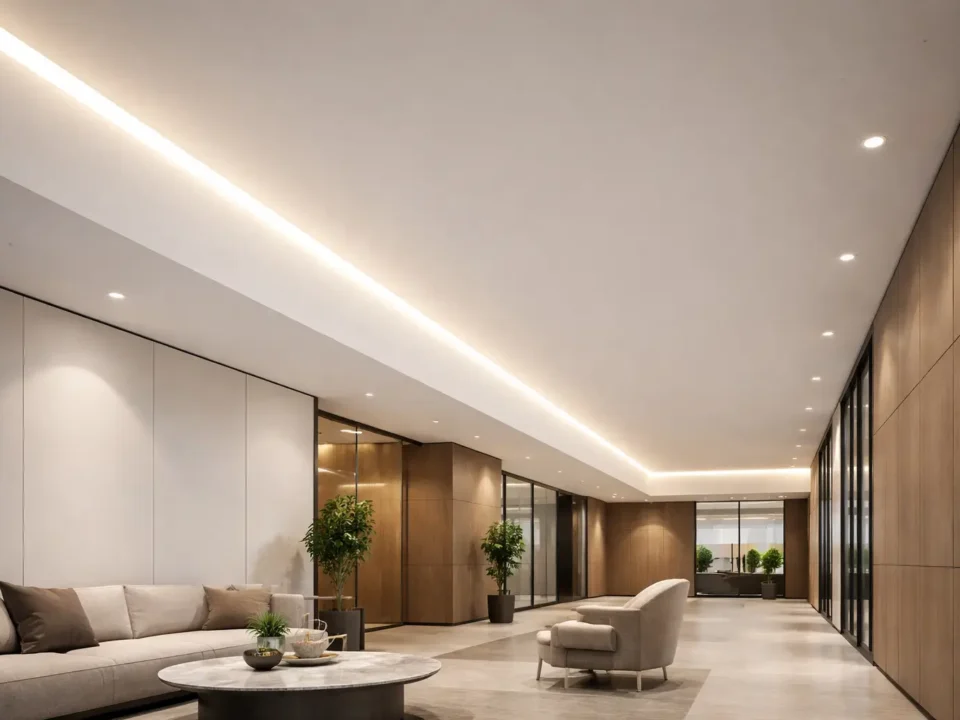
Also, COB gives a smoother light line, which helps in visible architectural runs.
Finally, the real result depends on the full install, not the strip label alone.
Quick selection table
Exposure scenario
Starting direction
Humidity or light splash, with no pooling
IP65 may be enough
Rain or splash zones with possible pooling
IP67 often fits
Always underwater or long submersion
Consider IP68 and confirm by model
Fast checks before buying
First, choose by real exposure: splash, rain, pooling, or underwater use.
Next, protect the whole chain: strip, ends, cable exits, joints, and power gear.
Also, ask how field cuts are resealed before you approve samples.
Therefore, treat IP67 as one project input, not the final answer.
Boundary conditions: IP labels describe test-based water and dust protection. However, one weak connector or open cable exit can lower the whole system’s protection.
Understanding IP67 for COB LED Strips: What It Covers (and What It Doesn’t)
IP67 is an Ingress Protection code under the IEC framework. In simple terms, it describes how well a product keeps out dust and water under defined test conditions. For background, see the IEC overview: https://www.iec.ch/ip-ratings.
What the “6” and “7” mean
First, the “6” relates to dust-tight protection.
Next, the “7” relates to short-term water exposure under test rules.
However, the test does not cover every real site condition.
What IP67 does not cover
It does not automatically cover UV, salt, chemicals, or corrosion.
Also, it does not fix poor cutting, loose seals, or weak cable exits.
In addition, it does not protect a driver or controller unless those parts are also protected.
Therefore, outdoor use still needs a full system plan.
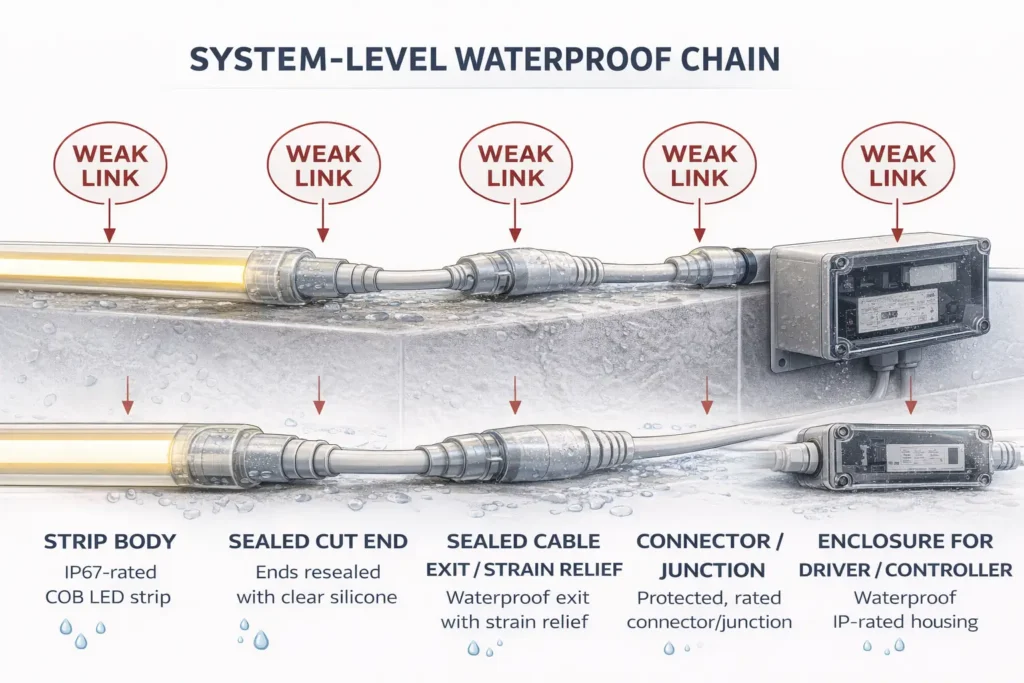
System-level waterproof chain
Your install only performs well when every exposed part matches the site risk. For this reason, plan the strip body, cut ends, wire exits, connectors, and power boxes together.
What must match the environment
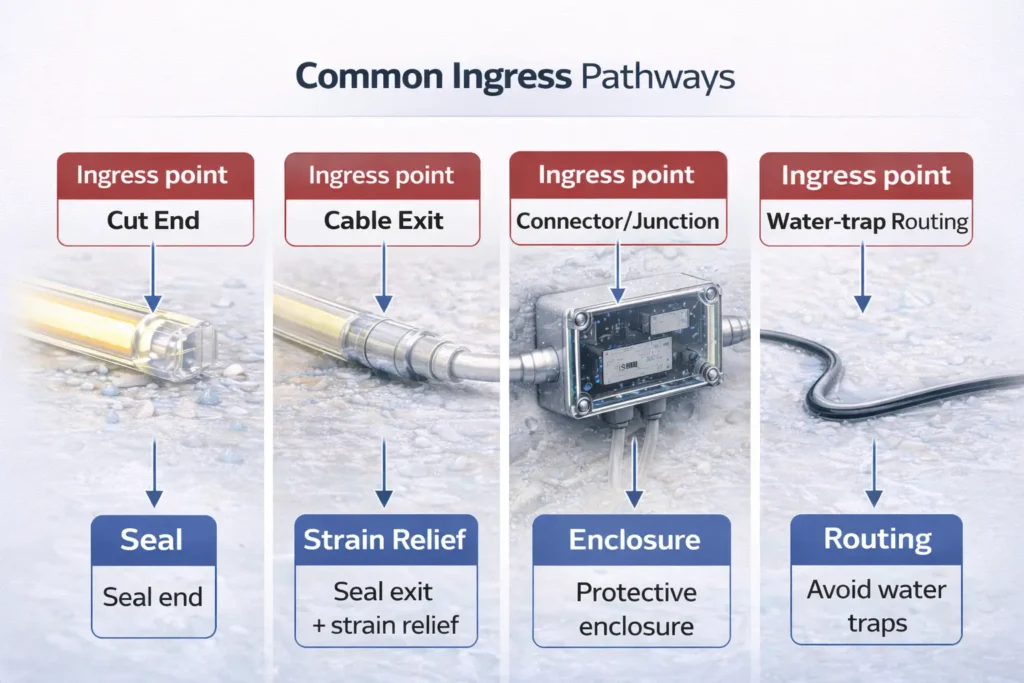
Ends and exits need sealing plus strain relief.
Also, connectors and joints need rating or protection that fits the site.
Next, drivers and controllers need a dry zone or a suitable enclosure.
Finally, the layout should avoid water traps and cable pull.
Boundary conditions: Therefore, treat “IP67 strip” as a component spec. The project still needs a system spec.
IP65 vs IP67 vs IP68 for COB LED Strips: Choose the Right Rating by Environment
Choose IP65, IP67, or IP68 by the real exposure. Then, check the weak links: ends, cable exits, joints, connectors, and power boxes. For testing context, see Intertek’s ingress protection overview: https://www.intertek.com/lighting/performance/ingress-protection/.
Simple difference
IP65 often fits splash or spray use, not immersion.
IP67 often fits rain, pooling risk, or short water exposure when the system is sealed.
IP68 is usually considered when the product must stay underwater, but model conditions matter.
Decision table
Environment / exposure
Starting point
What to verify
Damp air, no direct spray
IP65
Protect connectors and power gear from moisture paths
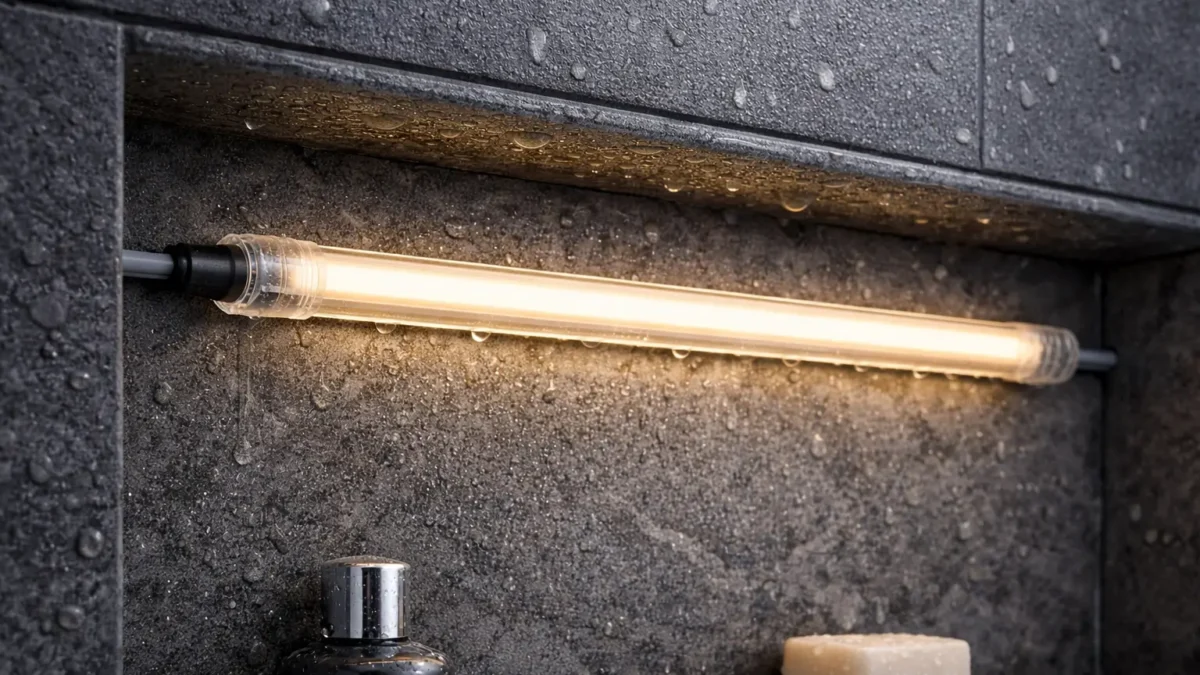
Splash zones or wet rooms
IP65–IP67
Match the zone and protect control gear
Outdoor under eaves
IP67 often
Seal ends and stop water tracking into joints
Outdoor exposed or pooling risk
IP67 often
Add physical protection and protected joints
Short flooding events
IP67
Confirm termination method and inspection plan
Always underwater
IP68
Confirm rating conditions by model
When IP68 is needed
IP68 is mainly relevant when the strip is meant to work underwater for longer periods. However, IP68 details depend on the maker’s stated test conditions. Therefore, ask for model-level documents before choosing it.
Boundary conditions: Higher IP can add cost and make service harder. Therefore, choose the level that fits the actual exposure and access plan.
How IP-Rated COB LED Strips Are Built (and the Trade-Offs That Matter)
IP-rated COB strips use extra protection to reduce water and dust entry. However, each build has trade-offs. For this reason, ask how the exact series is made before you approve it.
Common build types
Coated strips use a surface layer to protect the strip.
Sleeved or jacketed strips add an outer cover.
Encased strips use a heavier sealed build.
However, the exact method varies by model and supplier.
Trade-offs to check
More sealing can affect heat handling.
Also, thicker builds can bend less easily.
In addition, field cutting and repair may become harder.
Therefore, confirm cut, join, and service rules before bulk order.
Boundary conditions: Do not assume one waterproof method fits all sites. Instead, confirm limits by datasheet and sample.
Wet-Area Installation Checklist for IP67 COB LED Strips (Sealing, Mounting, Routing, Inspection)
In wet areas, focus on the main water paths: cut ends, cable exits, and connectors. Also, add physical support so seals stay closed over time.
Before installation
First, confirm the exposure type and needed IP level.
Next, plan the driver or controller location.
Also, place joints where they are protected and accessible.
Finally, plan routing so water does not run into joints.
During installation
Mount the strip with physical support, such as a channel or clips where needed.
Next, seal every cut end and cable exit.
Then, add strain relief so movement does not pull seals open.
Also, protect connectors with rated parts or an enclosure.
Finally, inspect seals before power-on.
Inspect before power-on
Ends are sealed and no conductors are exposed.
Cable exits are sealed and strain-relieved.
Joints are protected from direct water and pooling.
Power gear is protected, enclosed, or placed in a safe area.
Cutting and resealing
You can cut an IP67 COB strip only if the model allows it and every new opening is resealed. Therefore, treat each cut as a new risk point.
First, cut only at approved cut marks.
Next, seal the cut end.
Also, seal and support wire exits.
Finally, protect joints in an enclosure or with rated parts.
Boundary conditions: Field cutting changes the protection system. As a result, resealing quality often decides success or failure.
Power Planning for Longer IP67 COB Strip Runs (Voltage Drop and Power Injection Without Fixed Run-Length Claims)
Voltage drop depends on load, wire length, strip design, and layout. Therefore, plan power from the project drawing instead of using a fixed run length rule.
Planning steps
First, sketch the run with segments, distances, and junction points.
Next, confirm the driver, power supply, and controller method.
Then, decide where the driver can sit safely.
Also, plan single feed or multiple feeds based on layout.
Finally, test with the exact model before final closure.
Wet-area power notes
Keep junctions accessible and protected.
Also, do not place power gear in a water path.
In addition, protect feed points with the same care as the strip body.
Boundary conditions: “Depends on model and layout” is normal for power planning. Therefore, verify instead of assuming.
Controls and Dimming in Wet Environments: Compatibility Checks and What Must Be Protected
Controls work well only when the driver, controller, wiring, and strip match. In wet areas, those parts must also be protected from moisture.
Control checks
First, confirm whether dimming is driver-based or controller-based.
Next, confirm that the control method fits the strip and power supply.
Also, confirm that control wiring is protected in wet areas.
Finally, test dimming before closing enclosures or channels.
Boundary conditions: Compatibility is system-level. Therefore, confirm the setup before ordering.
Why “Waterproof” COB LED Strips Fail Outdoors (and How to Prevent the Most Common Failures)
Outdoor failures usually start at weak points, not in the middle of the strip. For example, water often enters through cut ends, cable exits, connectors, or junctions.
Common causes and fixes
Unsealed ends or exits: use a repeatable seal method plus strain relief.
Connector mismatch: use rated connectors or place joints inside enclosures.
Water-trap routing: avoid low points and add drip loops.
Adhesive-only outdoor mounting: use profiles, clips, or other physical fixing.
Failure table
Symptom
Likely cause
First fix
Flicker after rain
Moisture at connector or exit
Protect or move the joint and reseal exits
End segments fail
Unsealed cut end
Reseal end and add physical protection
Random segments out
Water at splice or junction
Move splice into an enclosure or upgrade connector
Dimming far end
Voltage drop
Review feed and injection plan
Boundary conditions: These steps reduce risk. However, no method guarantees every outdoor result in every site.
Buyer Specification Checklist: What to Confirm Before Ordering an IP67 COB LED Strip (Project-Ready)
Project-ready ordering means you define the site, the strip, the termination plan, and the control gear together. Therefore, the buyer and supplier can avoid gaps before installation.
Ordering checklist
First, describe the exposure: splash, rain, pooling, short flooding, UV, salt, or chemicals.
Next, define the target IP level and where it must apply.
Also, state the driver, power supply, and control method.
Then, state whether cutting is factory-done or field-done.
In addition, define connector, cable-exit, and seal method.
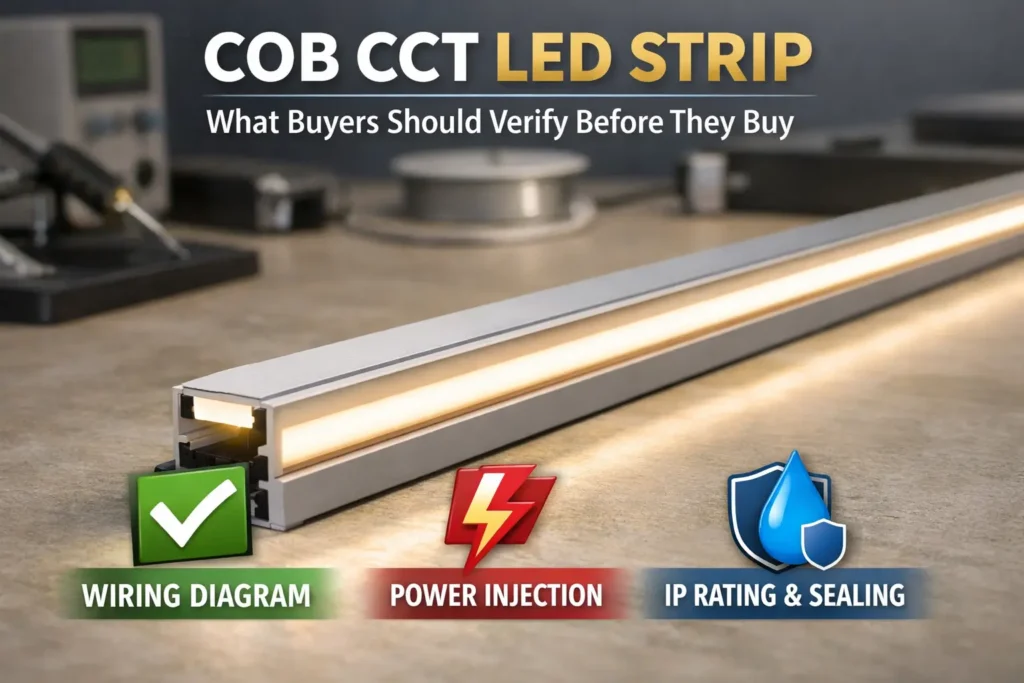
Finally, list needed documents: datasheet, wiring diagram, and control notes.
Before PO approval
Confirm certification scope if the project needs it.
Also, confirm how sealing is kept after cutting or joining.
Finally, confirm that connectors and enclosures do not lower the system rating.
Need a project-ready configuration, custom lengths, factory ends, or accessory matching to reduce field sealing risk? Share your exposure scenario and layout at https://www.elstarled.com/.
Boundary conditions: Environmental fit and certificates are model-specific. Therefore, verify them for the chosen product.
FAQ (IP67 COB LED Strip Projects)
What does IP67 mean on a COB LED strip?
Answer: It means the strip has dust-tight protection and short water exposure protection under test rules. However, the full system still needs sealed ends, cable exits, connectors, and power gear.
Can an IP67 COB LED strip be used outdoors in rain?
Answer: Often, yes, if the ends, connectors, enclosures, and cable exits are protected. However, suitability still depends on pooling, spray, UV, salt, chemicals, and the install method.
IP65 vs IP67: which is safer for bathrooms and wet zones?
Answer: IP65 may be enough for light splash with no immersion risk. However, IP67 is often chosen where exposure is higher or temporary pooling is possible. In both cases, the full protection chain must match the zone.
Can you cut an IP67 COB strip and keep it waterproof?
Answer: Yes, but only if you reseal every new opening. Therefore, cut ends, cable exits, and junctions need sealing, strain relief, and protection.
Why do waterproof LED strips fail outdoors?
Answer: They often fail at weak points such as ends, exits, connectors, or exposed junctions. Also, stress and water-trap routing can make the problem worse.
What should buyers specify before ordering?
Answer: Specify exposure, IP target, termination plan, connector or enclosure plan, power and control method, mounting method, and required documents. Also, verify certificate scope for the exact model if needed.
Summary & Next Steps
Finally, treat IP67 as part of a full system plan. First, choose the rating by exposure. Next, protect ends, exits, connectors, and enclosures. Then, test the layout before final closure.
Key takeaways
Use the environment table to compare IP65, IP67, and IP68.
Also, design the waterproof chain before installation starts.
For long runs, plan power feeds and injection from the layout.
Finally, confirm model documents and test a sample where risk is high.
Next steps
If you want less field sealing risk, ask about factory terminations.
If compliance is required, confirm certificate scope by model or series.
If the job is wet or outdoor, request a connector and enclosure plan.
To reduce rework in wet-area projects, consider factory terminations and a connector or enclosure plan that keeps system-level water protection throughout the run.




 English
  Spanish
  French
  Arabic