Índice
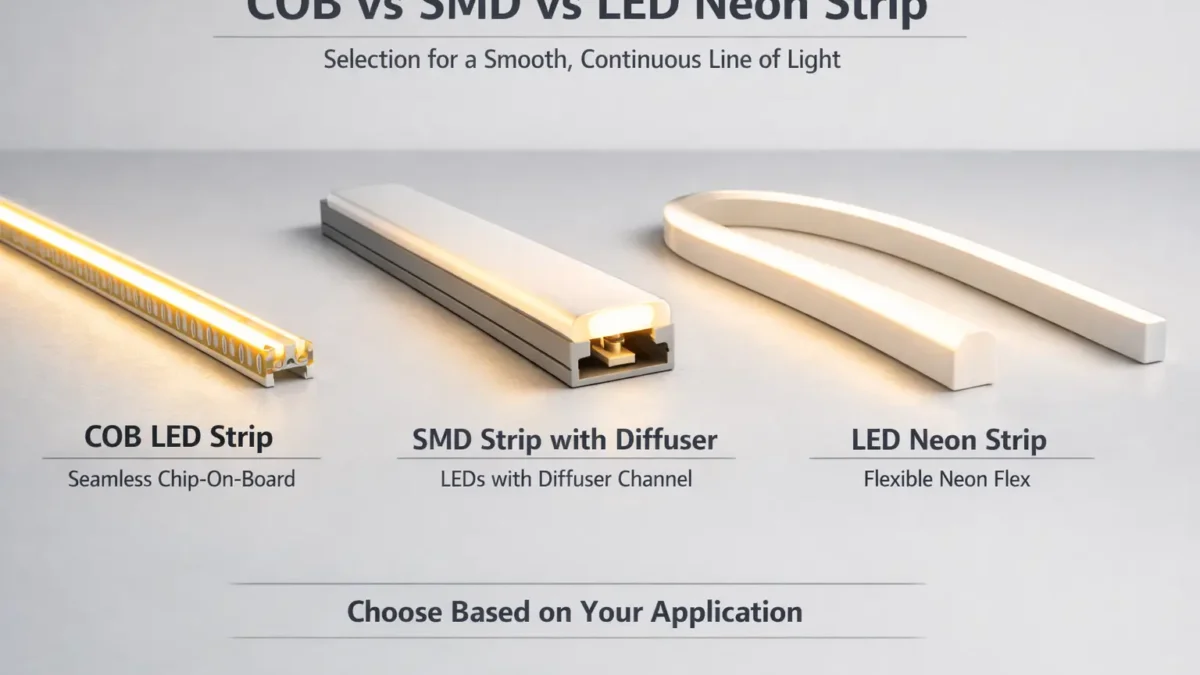
First, COB is not the opposite of LED. COB is one type of LED strip build. In most buying discussions, the real comparison is COB strip vs SMD strip. Also, LED neon may be part of the choice when the project needs a very even line.
In most projects, the COB LED strip vs SMD LED strip decision starts with how close people will view the light and how much space you have for diffusion.
| Option | Best at | Watch-outs | Choose it when… |
|---|---|---|---|
| Tira de LED COB | Smoother line in close-view or shallow installs | Still needs good profile, heat, and control checks | You need a cleaner line in tight channels or reflective areas |
| SMD LED strip + diffuser | Flexible options and broad product choice | Can show dots if the channel is too shallow | You can design channel depth and diffuser type |
| LED neon strip | Even line with built-in diffuser body | Bend and mounting rules vary by model | You want a simple uniform-line look |
Boundary conditions: However, “dot-free” is not automatic. The final look depends on profile depth, diffuser, viewing angle, and sample testing.
COB and SMD describe how LEDs sit on the strip. Therefore, both are LED strip lights. The difference is the package style and how the light appears through the diffuser or profile.
To make the COB LED strip vs SMD LED strip choice clearer, start with the build style of each strip.
COB, or chip-on-board, usually places many small LED chips close together under a more continuous light layer. As a result, the light can look smoother and less dotted.
SMD strips use separate LED packages on a circuit board. Because those LEDs are spaced apart, dots may show when the diffuser is too close or too clear.
| Decision factor | Tira de LED COB | Tira de LED SMD |
|---|---|---|
| Visual uniformity | Often smoother in shallow or close-view installs | Can look dotted without enough diffusion |
| Diffuser need | Often less dependent, but still useful | Often more dependent on profile depth and diffuser |
| Best-fit areas | Mirrors, shelves, shallow coves, visible lines | Deeper channels and general strip lighting |
| Service and joining | Model-specific, so verify | Also model-specific, so verify |
| Power and control | Needs the same system planning | Needs the same system planning |
Boundary conditions: In short, do not rely on labels alone. Instead, compare the exact series, datasheet, profile, and sample.
COB can look smoother because the light points are less separate. However, SMD can also look smooth when the diffuser and channel give enough mixing distance.
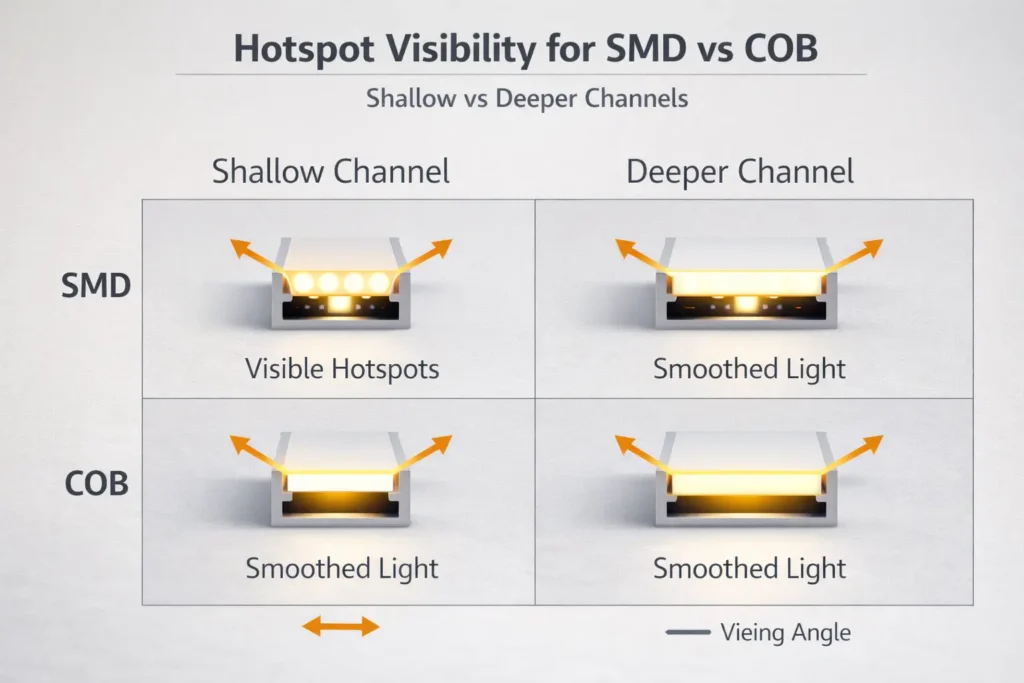
The main visual difference in a COB LED strip vs SMD LED strip comparison is hotspot risk in shallow profiles.
Often, yes. A diffuser can improve comfort, hide the strip, protect the LEDs, and finish the look. Therefore, COB does not always remove the need for a profile or cover.
Boundary conditions: Therefore, treat uniformity as a system result, not only a strip feature.
Use the application to choose the strip format. For example, a mirror line, cove, under-cabinet light, and signage outline may need different products.
| Aplicación | Recommended option | Why it fits | What to verify |
|---|---|---|---|
| Under-cabinet task light | SMD + diffuser or COB | Both can work if glare is controlled | Channel depth, glare, and dimming |
| Cove lighting | SMD + diffuser often works | Indirect light hides dots better | Feed layout and heat path |
| Mirror or glossy surface | COB or neon | Reduces point-source reflections | Mockup on the actual surface |
| Display shelf or accent line | COB or tuned SMD | Hotspot control matters | Viewing angle, diffuser, heat |
| Long architectural line | COB or neon | Less dot risk when depth is limited | Power plan and service access |
| Signage outline | Neon or SMD | Neon gives a clean line; SMD can support effects | Bend rules and controller fit |
For B2B projects, the COB LED strip vs SMD LED strip choice should also include power, control, and service access checks.
Boundary conditions: Neon bend and mounting limits vary by model. Therefore, confirm by datasheet before specifying it.
Cutting, joining, bending, and service access all depend on the exact series. Therefore, treat “can it be cut or reconnected?” as a check, not an assumption.
Installation details can change the result of a COB LED strip vs SMD LED strip comparison, especially when the run has corners, cuts, or hidden joins.
Boundary conditions: Since cut length and connector fit vary by series, verify with datasheet and sample.
For reliable results, plan power before installation. In longer runs, voltage drop can cause dim ends, color shift, or uneven brightness. Therefore, use zones, feed points, and commissioning checks.
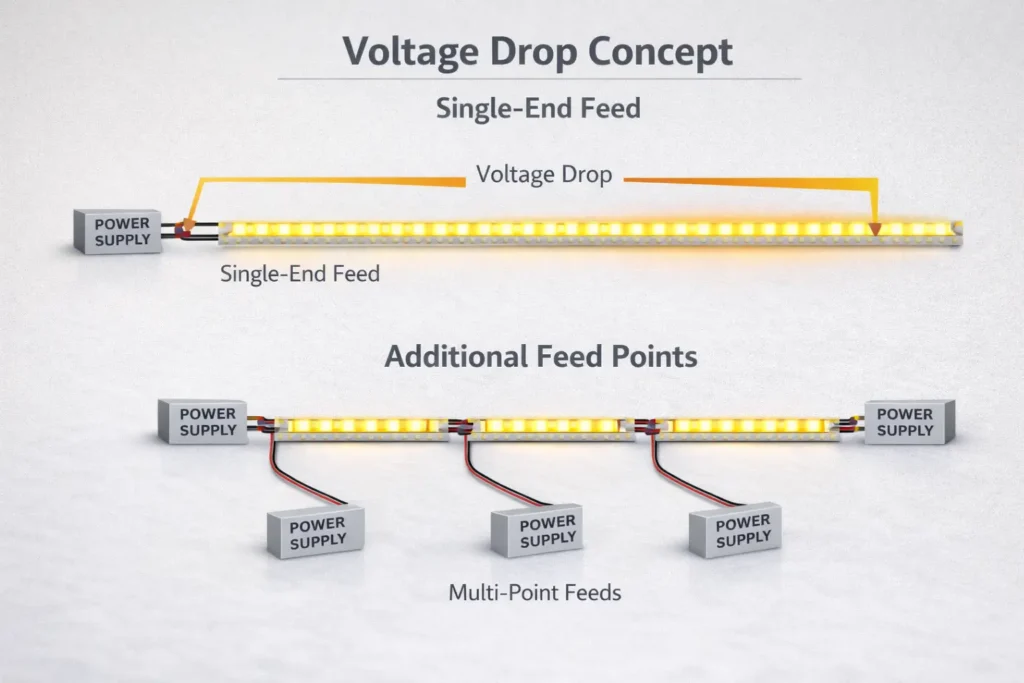
Power planning matters for both COB and SMD strips. Therefore, the COB LED strip vs SMD LED strip choice should not ignore run length, feed points, or dimming zones.
For electrical background on power and current, see this OpenStax overview of electrical energy and power.
Boundary conditions: Feed strategy depends on voltage, load, wire size, and acceptable brightness change. Therefore, use the datasheet and layout, not a universal claim.
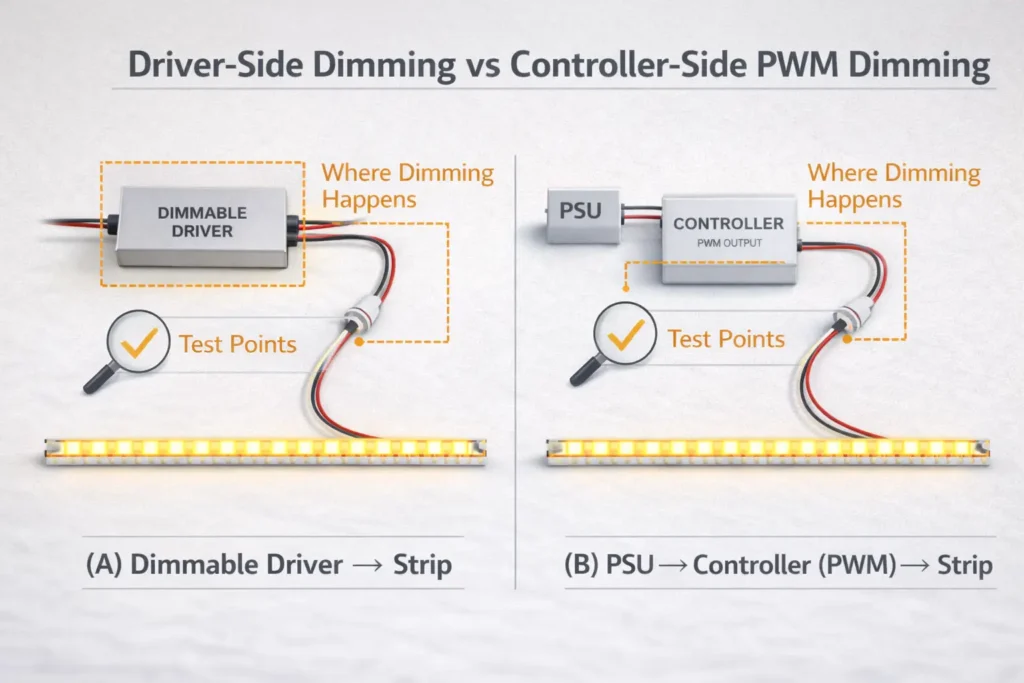
“Dimmable” does not always mean compatible. Instead, dimming depends on the driver, controller, load, wiring, and strip type.
| Control method | Typical role | What must match |
|---|---|---|
| PWM | Strip controllers, zones, color control | Controller rating, voltage, load type, wiring |
| 0–10V | Architectural dimming systems | Driver input type, sizing, dim curve |
| DALI | Addressable lighting control systems | DALI driver and system requirements |
| DMX | RGB and dynamic effects | Controller support, power plan, addressing |
For lighting flicker background, see the U.S. Department of Energy’s article on flicker and LED lighting.
Boundary conditions: Avoid absolute “flicker-free” claims. Instead, define what is acceptable for the project and test it.
Heat affects long-term reliability. Therefore, profiles and channels often help more than they seem to at first glance.
Boundary conditions: Thermal behavior depends on power, profile, airflow, and site conditions. Therefore, validate in the real setup.
IP ratings help buyers choose dust and water protection. However, real performance depends on how installers protect ends, joins, connectors, and cable exits.
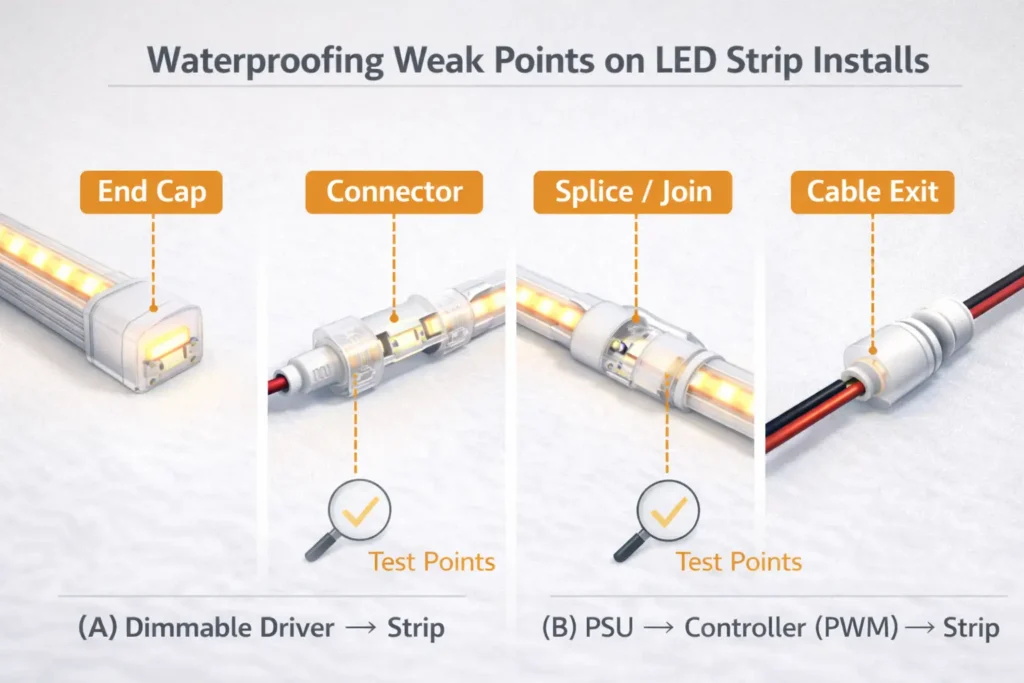
For an official overview of ingress protection terms, see the IEC IP ratings reference.
Boundary conditions: IP rating is product-specific. Also, field cuts can reduce protection. Therefore, confirm the method by model.
Most rework comes from treating strip choice as a product-only decision. Instead, treat it as a system decision.
Boundary conditions: Outcomes depend on model and install conditions. Therefore, verify with datasheet and sample.
The safest way to compare COB and SMD strips is to request the same document pack and sample checks for each option. As a result, you can compare them more fairly.

When you compare COB LED strip vs SMD LED strip options from suppliers, request the same documents for both choices.
If you need supplier support for a project, you can also use Elstar’s Fabricante de tiras de LED page as an internal sourcing reference.
Need a quote pack or sample plan for a project? Share mounting depth, diffuser or channel, run layout, control protocol, and environment. Then, the supplier can recommend a practical setup and provide supporting documents for the exact series.
Boundary conditions: Numeric specs must come from the exact datasheet. Also, certificate scope must be checked by model or series.
Answer: COB is still LED. It is a build type for LED strips. Therefore, the better choice depends on the visual goal, profile, diffuser, power plan, and install limits.
Answer: COB usually looks more continuous because the light surface is more even. However, SMD uses separate LED packages, so dots can show without enough diffusion.
Answer: COB can reduce visible points in shallow or close-view installs. Also, it often works well near mirrors, glossy panels, and display shelves.
Answer: COB still needs heat planning, feed planning, and service access. Also, cut, join, and connector behavior depends on the model.
Answer: Yes, if the channel is deep enough and the diffuser spreads the light well. Therefore, test SMD in the real profile before ruling it out.
Answer: Use power injection when end dimming is visible or not acceptable. Also, use it when the layout has long wires or high-visibility runs.
Answer: Request the datasheet, wiring guide, control notes, IP notes if needed, and compliance documents by model. Then, validate with a sample build.
Choose COB for smooth lines in shallow, close-view, or reflective installs. However, choose SMD with a diffuser when you can design enough depth. Also, choose neon when you want a built-in diffuser body and a simpler uniform-line path.
If your project needs custom lengths, special mounting, long runs, outdoor exposure, or compliance documents, prepare a short requirement pack with layout, zones, control protocol, and environment. As a result, suppliers can propose a tested and document-backed solution.

 English
  Spanish
  French
  Arabic