Low-voltage LED strip lights are generally safe when you choose good products, size the power supply correctly, mount them on suitable surfaces, and protect them from the wrong environment. However, safe low voltage does not mean zero risk.
Therefore, treat low-voltage LED strip lights like any other electrical system. The main safety points are power, heat, wiring, ventilation, and surroundings.
Next, keep total load below the safe driver range.
Also, mount strips where heat can escape.
Then, use the right IP rating for wet or outdoor areas.
Finally, use a qualified electrician for code-sensitive or hidden installs.
Understand Low-Voltage LED Strip Lights Power
Before judging safety, understand the power terms. As a result, you can avoid overloads and poor driver choices.
Power terms in plain language
Watts per metre: how much power the strip uses for each metre.
Strip length: how many metres of strip you install in each run.
Strip voltage: the DC voltage the strip expects, often 12V or 24V.
Power supply rating: the voltage and wattage the driver can safely provide.
Simple strip power formula
For one strip run, the power is simple:
strip_watts = watts_per_metre × strip_length
Why the power supply matters
The power supply changes mains AC into low-voltage DC. It must provide the right voltage and enough wattage. Also, it needs airflow so heat can escape.
Boundary note: Low-voltage LED strip lights reduce shock risk, but they still need correct power and heat control.
Are Low-Voltage LED Strip Lights a Fire Hazard?
Most low-voltage LED strip lights are not a fire hazard when installed correctly. However, poor products, overloads, trapped heat, and bad wiring can create risk.
Where real risks come from
Overloading the power supply.
Using very cheap or unclear products.
Mounting strips on fabric, foam, dust, or other heat-trapping surfaces.
Squeezing strips into sealed cavities with no airflow.
Ignoring voltage, polarity, or IP rating.
How to reduce fire risk
Choose a reputable strip and driver.
Also, check datasheets before installing.
Then, keep drivers and strips away from soft materials.
Finally, test the system before leaving it on for long periods.
Boundary note: Safe design depends on the full system, not only the low-voltage label.
How to Size a Power Supply for Low-Voltage LED Strip Lights
One of the biggest safety steps is driver sizing. Therefore, calculate total strip wattage before choosing a power supply.
Step-by-step sizing
Find watts per metre and length. For example, a 10 W/m strip at 8 m uses 80 W.
Calculate strip power. Use 10 W/m × 8 m = 80 W.
Add headroom. A common target is to use about 80–90% of the driver rating.
Match voltage. A 24V strip needs a 24V power supply.
Check airflow. The driver must sit in a ventilated, reachable location.
Example with several runs
If three strip runs each use 80 W, total strip power is 240 W. Then, a 300 W supply at 80% gives about 240 W of usable load. However, if the space is hot or future expansion is likely, a larger supply may be safer.
Golden rule
Keep total strip wattage at or below about 80–90% of the power supply rating. Also, always match strip voltage to supply voltage.
Wire Low-Voltage LED Strip Lights in Parallel
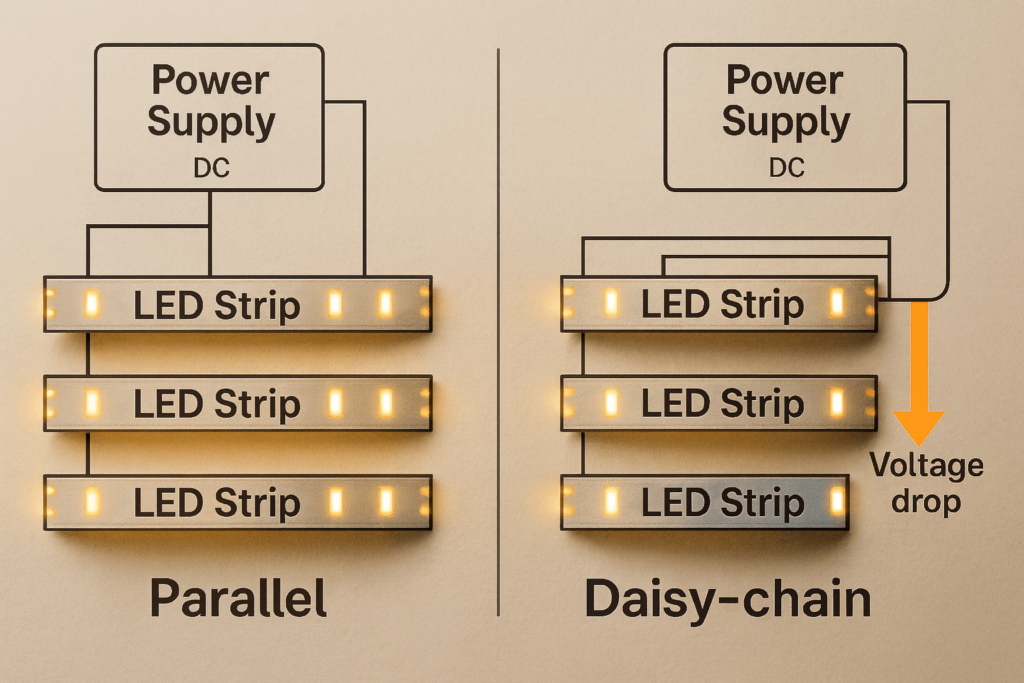
For most projects, low-voltage LED strip lights should use parallel wiring. In other words, each major strip run should connect back to a driver, junction block, or distribution board.
Why parallel wiring helps
Each run receives the same voltage.
Also, one failed run does not shut down every other run.
Then, troubleshooting becomes easier.
Finally, the first strip does not carry all current for the whole chain.
Why long daisy chains are risky
Voltage drops along the run.
The far end can look dimmer.
The first strip can carry more current than intended.
As a result, heating and stress can increase.
Practical wiring rule
Run each major strip section back to a junction point. Also, limit run length based on the strip type and supplier guidance.
Voltage Drop and Power Injection for Low-Voltage LED Strip Lights
Even when the driver is sized well, long wires can cause voltage drop. Therefore, wire length and wire size still matter.
What causes voltage drop?
Distance: longer cables drop more voltage.
Current: higher current causes more drop.
Wire gauge: thinner wire has more resistance.
How to reduce voltage drop
Use thicker wire for long or high-current feeds.
Also, keep the power supply close to the strip when possible.
Then, avoid tight cable bundles that trap heat.
Finally, add power injection for long or high-load runs.
Power injection patterns
Feed a strip from both ends.
Feed very long runs from the middle and ends.
Split long runs into shorter branches.
Use more than one power supply if the project needs it.
Boundary note: Every injection point still counts toward total driver load.
Are Cheap Low-Voltage LED Strip Lights Safe?
Price alone does not decide safety. However, very cheap no-name strips and drivers are often where problems begin.
Common quality problems
Thin copper paths that heat more easily.
Poor soldering that creates weak points.
Plastic materials that discolor or crack.
Drivers with poor heat design.
Missing test reports or safety marks.
What to look for
Recognized safety marks such as UL, ETL, or CE, where relevant.
Clear datasheets and honest wattage ratings.
Real support contacts from the supplier.
Correct pairing between strip and power supply.
Boundary note: Certified and well-made low-voltage LED strip lights often cost more upfront, but they are safer for continuous use.
Low-Voltage vs High-Voltage LED Strip Safety
Low-voltage and high-voltage strips serve different projects. Therefore, do not treat them as interchangeable.
Comparison table
Tipo
Typical voltage
Shock risk
Install burden
Typical use
Low-voltage LED strips
12V / 24V DC
Baja
Simpler, but still needs correct wiring
Indoor accent, furniture, signage, and architectural details
High-voltage LED strips
120V / 230V AC
Más alto
Needs stronger enclosures and stricter code handling
Long exterior runs and professional projects
Which should you choose?
For touchable indoor spaces, low-voltage LED strip lights are usually the safer choice. However, they still need correct power sizing, heat control, and wiring.
Boundary note: For high-voltage strip work, use qualified electrical support and follow local rules.
Environment Safety for Low-Voltage LED Strip Lights
Where you install the strip matters as much as what you buy. As a result, bedrooms, bathrooms, ceilings, and outdoor areas need different safety choices.
Bedrooms and kids’ rooms
Keep strips away from bedding, curtains, and soft items.
Also, use aluminum channels or covers where touch risk is high.
Then, mount strips out of easy reach of children and pets.
Finally, keep drivers in ventilated, non-flammable locations.
Walls, ceilings, and enclosed spaces
Do not bury strips in insulation, foam, or heat-trapping material.
Use low-voltage cable rated for the location.
Place power supplies in accessible boxes or service spaces.
Also, ask an electrician before hiding electrical parts in walls or ceilings.
Bathrooms, kitchens, and outdoors
Use a suitable IP rating for splash, wet, or outdoor areas.
Keep drivers and controllers out of wet zones.
Seal joints, ends, and cable entries.
For outdoor projects, choose parts made for UV, heat, cold, and moisture.
Reference note: The IEC explains that IP ratings grade enclosure resistance to dust and water, while OSHA rules note that ventilating openings should not be blocked. Use those ideas when choosing locations and enclosures.
Quick Checklist for Low-Voltage LED Strip Lights
Use this checklist before powering a new strip system. It helps catch the most common safety issues.
Safety checklist
Have you matched strip voltage and power supply voltage?
Have you calculated total wattage?
Is the load below about 80–90% of the driver rating?
Are the strips and drivers from a reputable supplier?
Are the strips mounted where heat can escape?
Are IP ratings suitable for wet or outdoor areas?
Are wires sized and routed well?
Are power supplies ventilated and accessible?
For complex installs, have you asked a qualified electrician?
Summary: When Low-Voltage LED Strip Lights Are Safe
Low-voltage LED strip lights are one of the safer ways to add flexible lighting. However, they are only truly safe when voltage, power, heat, environment, and wiring are handled well.
Final safety rules
Tensión: match 12V or 24V strips to the right supply.
Power: keep load below about 80–90% of driver rating.
Quality: choose clear datasheets and safety marks where needed.
Heat: mount strips and drivers where heat can escape.
Environment: use the right IP rating and seal method.
Wiring: use proper wire size, parallel feeds, and power injection where needed.





 English
  Spanish
  French
  Arabic