LED strip lumens tell you how bright an LED strip is. In simple terms, more lumens mean more visible light. However, the right lumen level depends on the room, the task, the strip length, and the mood you want.
Therefore, do not choose brightness by guesswork. Instead, match the lumen level to the use case. Then, check LED density, color temperature, power supply size, and heat control.
Introduction to LED Strip Lumens
LED strip brightness is measured in lumens. This value helps you compare strips and choose the right light level for your project.
Lumens matter because each space needs a different light level. For example, a kitchen counter needs more light than a bedroom cove. As a result, choosing the right lumen level improves comfort and function.
Fast rule
First, use low lumens for mood light.
Next, use medium lumens for accent light.
Then, use high lumens for task or commercial light.
Also, add dimming if you are unsure.
Finally, test a short strip before final installation.
How Lumens Affect LED Strip Brightness
Lumens affect how strong the light feels in the room. However, the final result also depends on strip density, color, distance, diffuser, and surface color.
What lumens mean for brightness
More lumens usually mean brighter light. Therefore, high-lumen strips suit work areas, shops, and bright task zones. Lower-lumen strips suit soft mood lighting and decorative lines.
Brightness levels by lumens per meter
Low brightness: 150–300 lm/m for soft mood light and decor.
Medium brightness: 300–600 lm/m for accent light and feature highlights.
High brightness: 600–1200+ lm/m for tasks, kitchens, shops, and work areas.
What changes perceived brightness?
LED density: more LEDs per meter can create brighter and smoother light.
Color temperature: cool white often feels brighter than warm white.
Component quality: better LEDs often give more stable output.
Diffuser and profile: covers can soften light and reduce glare.
Quick answer
If you ask, “How many lumens do I need?” start with the application. Then, choose a brightness band and test the strip in the real space.
LED Strip Lumens Chart
A lumens chart helps you choose faster. First, match the lighting goal. Then, choose the lumen range that fits the job.
LED strip lumens chart by application
Application Type
Recommended Lumens per Meter
Typical Use and Effect
Ambient lighting
150–300 lm/m
Soft light for bedrooms, living rooms, coves, and background glow.
Iluminación de acento
300–600 lm/m
Moderate light for shelves, displays, signs, and feature walls.
Task and commercial lighting
600–1200+ lm/m
Bright light for kitchens, workspaces, retail, and detailed tasks.
LED lumens chart by LED density
Densidad LED
Typical Lumens per Meter
Uso recomendado
30 LEDs/m
~300–450 lm/m
Low-density ambient or decorative lighting.
60 LEDs/m
~600–900 lm/m
Standard accent and moderate task lighting.
120+ LEDs/m
1200+ lm/m
High-density task or commercial lighting.
Choosing color temperature
Warm white, 2700K–3000K: softer light for homes and cozy rooms.
Neutral white, 4000K–4500K: balanced light for kitchens, bathrooms, and offices.
Cool white, 6000K–6500K: sharper light for shops, work areas, and high-clarity spaces.
Quick answer: For most general LED strip projects, 300–600 lm/m is a practical starting point. However, task lighting often needs 600 lm/m or more.
Choosing the Right Lumens for Your Application
The right brightness depends on what the light must do. Therefore, choose the lumen level by application instead of choosing the brightest strip every time.
Ambient and decorative lighting: 150–300 lm/m
Best for: bedrooms, living rooms, coves, shelves, and soft decor.
Why choose it: lower brightness creates a relaxed mood without glare.
Accent lighting: 300–600 lm/m
Best for: artwork, feature walls, display cases, shelves, and signs.
Why choose it: medium brightness draws attention without overpowering the room.
Task and commercial lighting: 600–1200+ lm/m
Best for: kitchens, desks, workshops, retail, and work areas.
Why choose it: higher brightness improves visibility for detailed work.
Special checks before buying
Check room size because larger rooms may need more light.
Also, check surface color because dark finishes absorb more light.
Then, check strip distance from the lit surface.
Finally, add dimming if the room has more than one use.
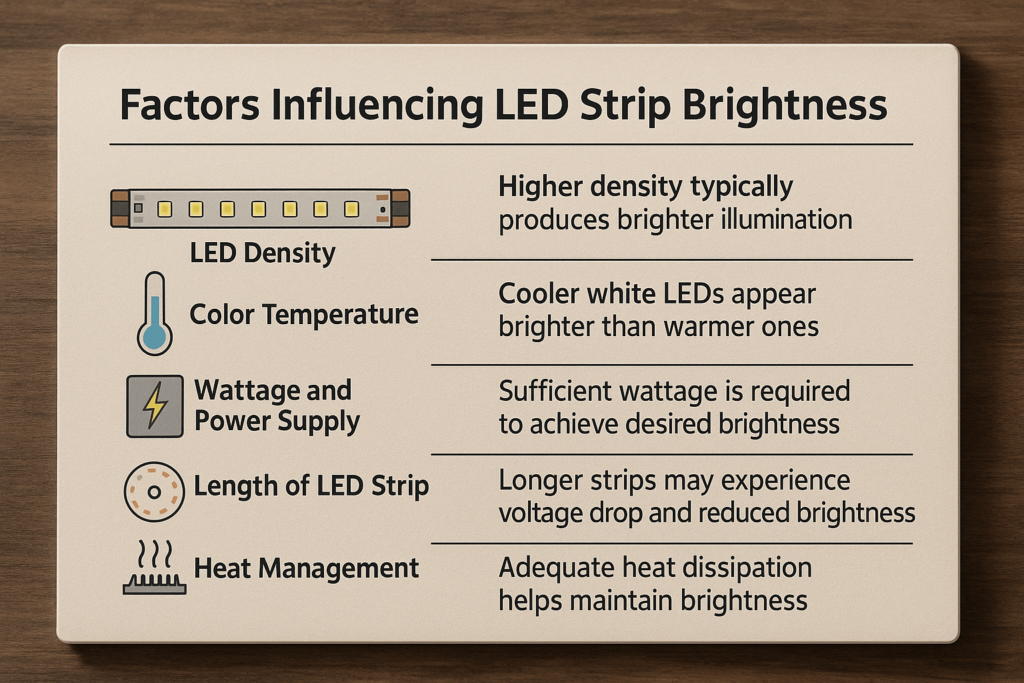
Factors That Influence LED Strip Brightness
Lumens are important, but they are not the only factor. In addition, LED density, color, power, strip length, and heat control all affect the final result.
LED density
Higher LED density often creates brighter and smoother light.
For strong, even brightness, choose 120 LEDs/m or more when the project needs it.
Temperatura de color
Cool white can look brighter than warm white at the same lumen level.
However, warm white may feel better in bedrooms, living rooms, and hospitality spaces.
Wattage and power supply
The power supply must support the strip load.
Otherwise, the strip may dim, flicker, or show uneven brightness.
Strip length
Long runs can lose brightness toward the end.
Therefore, use shorter segments or power injection when needed.
Mounting and heat control
Aluminum channels can help manage heat.
Also, good heat control helps preserve brightness over time.
Common Mistakes When Selecting LED Strip Brightness
Many brightness problems come from choosing too much or too little light. Also, some projects fail because power and heat were not planned.
Choosing too much brightness
Problem: too many lumens can create glare and waste power.
Fix: match brightness to the real task and use dimming.
Choosing too little brightness
Problem: low lumens can make task areas hard to use.
Fix: choose higher lumens for kitchens, worktops, shops, and work areas.
Ignoring color temperature
Problem: the wrong color can make light feel harsh or too weak.
Fix: use warm light for comfort and neutral or cool light for clarity.
Undersizing the power supply
Problem: a weak power supply can cause dimming or flicker.
Fix: check wattage and use a properly sized driver.
Ignoring heat
Problem: heat can reduce brightness and shorten life.
Fix: use aluminum channels, airflow, and correct mounting.
Recommended LED Strip Brightness Options
Use these ranges as a simple starting point. Then, test a sample if the project has special needs.
High brightness: 800–1200+ lm/m
Best for: kitchen counters, workspaces, shops, and commercial areas.
Good options: high-density strips and CRI 90+ premium strips.
Medium brightness: 400–800 lm/m
Best for: shelves, cabinets, displays, and feature lighting.
Good options: 60 LEDs/m strips and RGBW strips for color plus white.
Low brightness: 150–400 lm/m
Best for: bedrooms, living rooms, coves, and soft background light.
Good options: 30 LEDs/m strips and warm white 2700K–3000K strips.
Quick answer: For task lighting, use higher lumens. For accents, use medium lumens. For relaxed mood light, use low lumens.
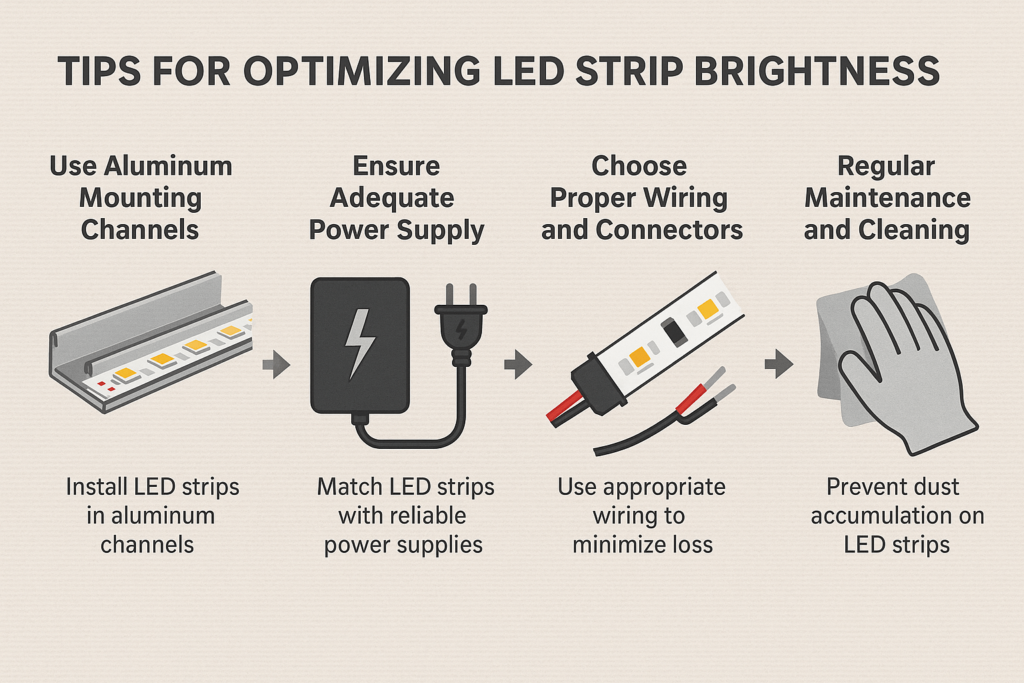
Expert Tips for Optimizing LED Strip Brightness
After choosing the lumen level, improve the final result with better power, mounting, and cleaning. As a result, the strip can stay brighter and more stable.
Use aluminum mounting channels
Install strips in aluminum channels for better heat flow.
Also, use diffusers if glare or dots are visible.
Use the right power supply
Match voltage and wattage to the strip.
Then, allow headroom so the driver is not overloaded.
Choose proper wires and connectors
Use the right wire size for the run length and load.
Also, use strong connectors to reduce voltage drop.
Pick higher-density strips when needed
Use higher density when you need brighter and smoother light.
However, plan heat control when output is high.
Clean and maintain the strip
Dust can reduce brightness and trap heat.
Therefore, clean strips and profiles with a soft cloth when needed.
FAQs About LED Strip Lumens and Brightness
What does lumens mean for LED strips?
Lumens measure visible light output. Higher lumens mean brighter light, while lower lumens create softer light.
How many lumens do I need for my LED strip lighting?
It depends on the use.
For ambient lighting, choose 150–300 lm/m.
For accent lighting, choose 300–600 lm/m.
For task lighting, choose 600–1200+ lm/m.
Can high-lumen LED strips overheat?
Yes. Higher output can create more heat. However, aluminum channels, airflow, and proper driver sizing help reduce heat issues.
What is the best lumen rating for kitchen lighting?
Kitchen task lighting often works best around 800–1200 lm/m. Still, dimming can help you adjust brightness for comfort.
Conclusion and Next Steps
LED strip lumens help you choose the right brightness for each project. First, decide whether the light is for mood, accent, or task use. Next, choose a lumen range that fits that goal.
Then, check LED density, color temperature, power supply size, strip length, and heat control. If you follow these steps, your LED strip lighting will look better and work more reliably.





 English
  Spanish
  French
  Arabic