People often remove Tiras de luces LED because the layout changed, the adhesive failed, someone cut off a section, or a project had leftover strip. In many cases, the strip does not need to go to waste. However, reuse is not a simple yes-or-no choice.
Instead, the safe answer depends on the strip condition, adhesive or mounting method, cut points, polarity, voltage, connector type, controller type, and how reliable the next setup needs to be.
Yes, LED strip lights can sometimes be reused. However, you should first check the strip condition, mounting method, and electrical match. Removed strips usually need fresh tape, clips, or channel support. Also, you should only reuse cut or leftover sections when you know the cut point, copper pads, polarity, voltage, connector, controller, and power supply all match.

| Situation | Likely Option | What to Check First | When Replacement Is Safer |
|---|---|---|---|
| You removed the strip carefully and it still works | Reuse | Check for a torn PCB, damaged LEDs, exposed conductors, and known voltage/control type. | Replace it if the strip has damage or unknown specs. |
| The strip still lights up but will not stick | Restick with new mounting support | Use a clean, dry surface. Then choose suitable tape, clips, or channel. | Replace or remount it if the surface is rough, oily, dusty, hot, damp, or under cable pull. |
| You cut off a leftover strip section | Reconnect only if compatible | Check the marked cut point, copper pads, polarity, voltage, connector, and controller match. | Replace it if you cut outside the correct point or do not know the power/control setup. |
| The strip is for a finished commercial or customer-facing project | Check before reuse | Review appearance, mounting strength, wiring match, and project risk. | Replacement is usually safer when the project needs strong long-term reliability. |
| The strip has damaged waterproof coating or insulation | Avoid casual reuse | Look for product-specific repair or sealing guidance. | Replace it if you cannot restore waterproofing or insulation the right way. |
This table helps you decide, but it does not give a guarantee. A strip that still lights up may still be a poor choice for a permanent or customer-facing setup. For example, weak adhesive, bad wiring, or poor appearance can still cause problems later.
Removed LED strip lights make better reuse candidates when you peeled them off slowly, the circuit board has no tears, the LEDs and copper pads show no visible damage, and the strip still works with the correct power supply. In addition, reuse is easier when you know the voltage, color type, controller type, and setup area.
The strip may be reusable when:
For a home shelf, display mockup, temporary event, or test layout, reuse may be reasonable. However, for a finished retail display, cabinet project, built-in lighting detail, or customer project, you should set a higher standard. In other words, the more important the appearance and long-term use, the more carefully you should check the strip before reusing it.
Related internal guide: LED Strip Keeps Falling Off: How to Securely Install Your LED Strips
The original adhesive backing often loses strength after removal. Also, dust, paint texture, heat, humidity, cable tension, and repeated repositioning can reduce adhesion. Therefore, do not expect the old adhesive to work again. Instead, treat the strip as needing a fresh mounting method.
First, remove loose adhesive residue carefully. Do not scrape so hard that you damage the strip.
Next, clean the mounting surface. Many people prepare tape-bonding surfaces with a 50:50 isopropyl alcohol and water mixture. However, some surfaces need different prep steps; see 3M surface preparation guidance for general tape-bonding background.
Then, let the surface dry fully.
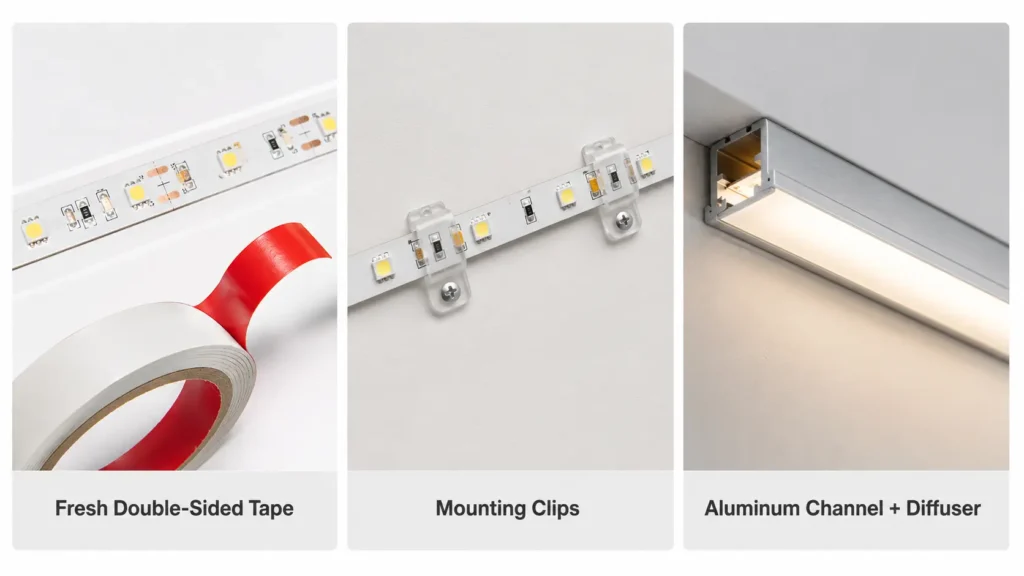
After that, use fresh mounting support. This may be fresh double-sided tape, mounting clips, or an aluminum channel, depending on the surface and setup.
Also, reduce strain. Avoid letting the strip hang from its own weight or from cable pull.
Finally, test the placement before final mounting.
| Mounting Method | Best Use | Limitations | Project Note |
|---|---|---|---|
| Fresh double-sided tape | Smooth, clean, dry surfaces | It may perform poorly on dusty, textured, oily, hot, or damp surfaces. | Check the surface material before using it in repeat projects. |
| Clips de montaje | Areas where gravity, cable pull, or movement may affect the strip | Clips may be visible and may need screw holes. | Use clips when adhesive alone is not reliable enough. |
| Canal de aluminio | Cleaner appearance and more stable mounting | It needs planning, cutting, and install space. | This is often better for finished projects where appearance matters. |
| Original adhesive only | Very light temporary reuse | It is usually weaker after removal. | Avoid relying on it for critical setups. |
Related internal guide: ¿Se pueden cortar las tiras de LED?
You can reuse some cut LED strip sections, but only if the strip is designed to be cut and the cut was made at the correct location. Many cuttable LED strips have marked cut lines near copper pads. If you cut away from those points, the circuit may be damaged or the segment may be difficult to reconnect safely.
Before reusing a cut section, check whether it was cut at a marked cut line or copper-pad area, whether the copper pads are still intact, and whether the connector contacts align with the pads. Also confirm polarity, voltage, strip type, controller type, and waterproof coating condition before powering the section.
| Check | Why It Matters | Safe Guidance |
|---|---|---|
| Marked cut point | Not every part of the strip is meant to be cut. | Cut only where the strip is designed to be cut. |
| Copper pads | Connectors usually need clean contact points. | Do not reconnect if pads are missing or damaged. |
| Polarity | LED strips use marked polarity. | Match positive to positive and negative to negative. |
| Tensión | Wrong voltage can damage the strip or prevent operation. | Confirm the strip voltage before powering it. |
| Controller type | RGB, RGBW, tunable white, addressable, and single-color strips use different control logic. | Match the reused strip to a compatible controller. |
| Power supply capacity | Longer or reused runs may affect load. | Review total wattage and power supply rating. |
| Waterproof coating | Cutting may compromise protection. | Do not casually reseal without product-specific guidance. |

Before powering a reused or leftover LED strip, check the basics. This step is especially important when someone cut the strip, the original packaging is gone, or you are mixing parts from different projects.
Do not power reused strip sections by guesswork. If you do not know the strip type, voltage, power supply rating, or controller type, ask the supplier or a qualified installer before powering it. For general setup-planning background, review Armacost’s LED strip installation guide.
Replacement is usually the safer option when:
Reuse can reduce waste. However, it should not create a reliability problem. If the strip is unknown, damaged, or hard to mount securely, replacement is often the cleaner choice.
For installers and project buyers, the question is not only “Can this strip light up again?” Instead, it is also “Will this reuse choice create callbacks, uneven appearance, weak mounting, or compatibility issues later?”
Before reusing LED strips in a project, record:
For distributors or sales teams, avoid giving a simple “yes” until the customer provides those details. A safer response is: reuse may be possible. However, you should first check the strip condition, cut point, voltage, polarity, controller type, connector type, mounting surface, and project use before recommending reuse, accessories, or replacement.
Yes, sometimes. You can reuse a removed strip if it has no physical damage, still works with the correct power supply, and can mount securely again. However, if the original adhesive is weak, use a fresh mounting method instead of relying on the old adhesive.
First, remove loose adhesive residue carefully. Next, clean and dry the surface. Then, use a suitable fresh mounting method, such as new tape, clips, or an aluminum channel. Surface prep matters because dirt, oil, dust, texture, and moisture can reduce tape adhesion. For more detail, 3M’s surface-preparation guidance explains common surface-cleaning points.
Yes, you can use leftover LED strips if the section matches the power supply, connector, and controller. Before powering it, check the voltage, polarity, cut marks, copper pads, strip type, and total power load.
Yes, but only when the maker designed the strip for cutting and you cut it at the correct marked cut point. Also, the copper pads should remain usable, and the reused section must match the correct voltage, polarity, connector, and controller.
In some LED strip systems, feeding power from both ends helps manage voltage drop on longer runs. However, treat this as a wiring-design question, not a casual reuse trick. Follow the product wiring guide or ask a qualified installer or supplier before using both-end feeding. For general setup risks such as voltage drop and overload, see Armacost’s installation guide.
Replace them when the strip has damage, the specs are unknown, the copper pads are unusable, the waterproof coating has damage, the strip flickers during testing, or the project needs a clean and reliable finished setup.
You may reuse removed LED strips in some low-risk or temporary uses. However, for finished commercial or customer-facing projects, check mounting, wiring match, appearance, and long-term reliability first. If the strip condition or specs are unclear, replacement is usually the cleaner choice.
If you are not sure whether you can reuse a removed or leftover LED strip, prepare the key details before asking a supplier or installer:
Then, share those details with ElstarLED before choosing reuse, accessories, or replacement. This makes the discussion more practical and helps everyone avoid guessing about compatibility.



 English
  Spanish
  French
  Arabic