Outdoor COB LED strip lighting can work well on patios, facades, steps, and outdoor accents. However, you need to treat it as a full outdoor lighting system, not only as a waterproof strip.
Therefore, choose the IP rating by real exposure. Then, protect the driver, controller, connectors, cable entries, and cut ends. Finally, test the full run before final close-up.
Outdoor COB LED Strip (IP Choice + Waterproof System Checklist)
Yes, COB LED strip lights can work outdoors when the IP rating matches the site and the full system is protected. In other words, the strip, power gear, wire exits, joints, and enclosures must all fit the same outdoor risk.
Quick IP map
Outdoor scenario
Common IP target
Key install note
Covered patio or under eaves
IP65
Seal terminations and keep the driver in a protected box.
Fully exposed rain or splash zones
IP67
Seal ends, protect connectors, and seal cable entries.
Standing water or immersion risk
IP68, only if stated for that use
Confirm the exact immersion test rules for the model.
Waterproof system checklist
First, check the LED strip body and its IP rating.
Next, seal cut ends, end caps, and terminations.
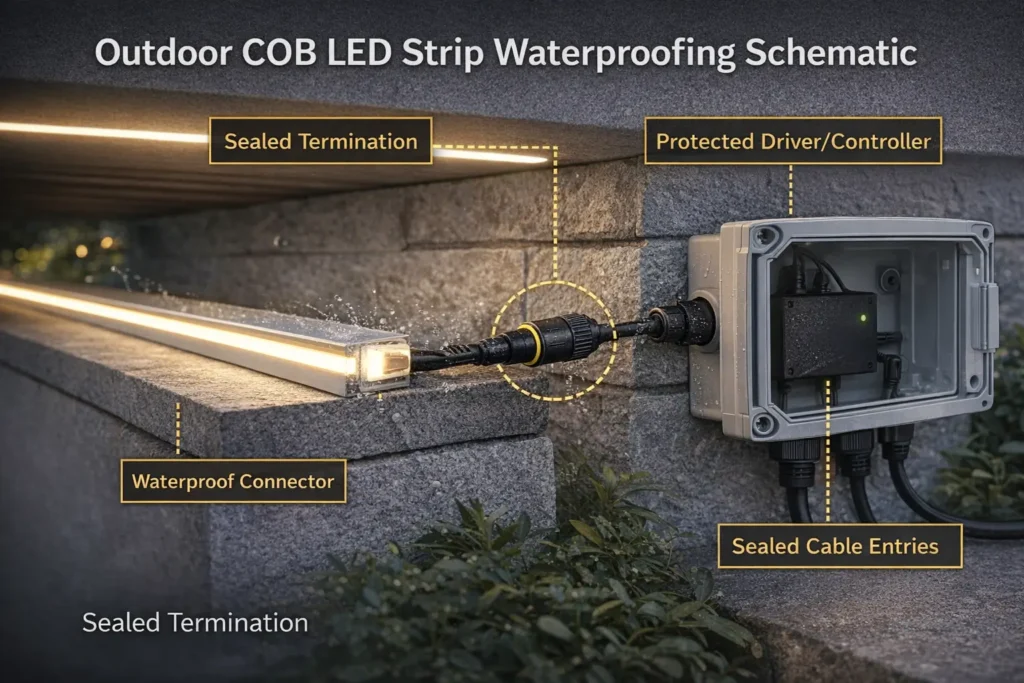
Also, protect connectors, splices, and cable exits.
Then, place the power supply in a protected location or enclosure.
In addition, protect the controller or dimmer if the system uses one.
Finally, use drip loops or sealed entries where water may track along cables.
Fast boundary notes
However, IP68 is not a blank promise. The maker must state the test limits.
Also, a strip IP rating does not make the whole install waterproof by itself.
Therefore, check every weak point before you sign off the project.
Outdoor COB LED Strips in 2 Minutes: What They Are and When They Work Outdoors
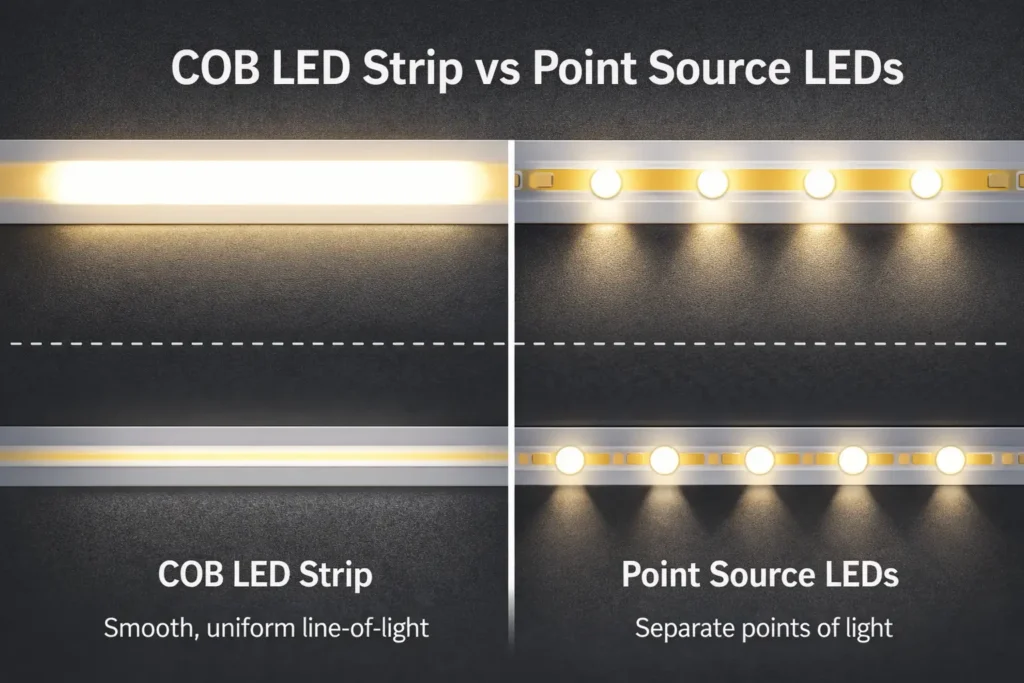
A COB LED strip creates a smooth and more continuous line of light. As a result, it works well when the project needs a clean outdoor accent without a bulky fixture.
What COB means
COB means chip-on-board. This design places LEDs close together, so the light can look smoother than many dotted LED strips. However, the final look still depends on the profile, cover, mounting, and viewing distance.
When COB works well outdoors
First, COB works well when the site exposure is clear.
Next, it works well when the strip sits in a channel, profile, or protected area.
Also, it works well when ends and connectors can be sealed and supported.
Finally, it works well when the driver and controller can stay in a protected enclosure.
When COB is risky outdoors
It is risky when cut ends face direct rain or spray.
Also, it is risky when cable entries into boxes are not sealed.
In addition, adhesive-only mounting can fail under heat, UV, and weather cycles.
Finally, standing water or immersion needs a clearly rated product and a full system plan.
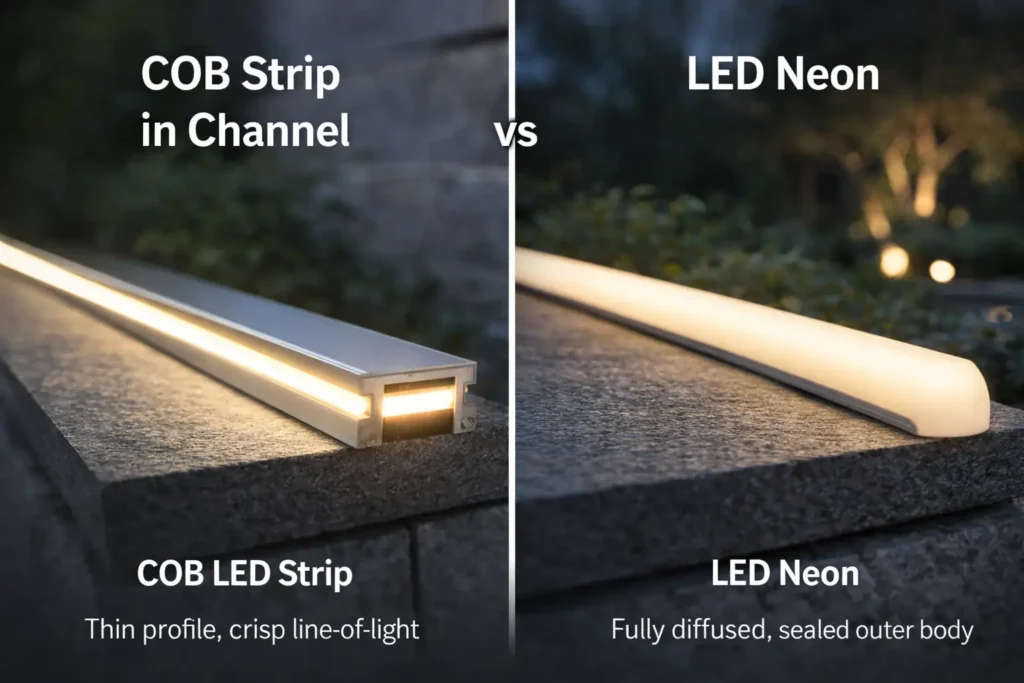
COB strip vs LED neon
LED neon may be better when you need a sealed, diffused, fixture-like outdoor line. However, COB strip may be better when you need a thin profile and flexible layout.
Choose LED neon when the line is directly visible and needs a sealed body.
However, choose COB strip when you need a slim line and can protect all ends and joints.
Also, confirm the outdoor rating and install method for either option.
Choose the Right IP Rating (IP65 vs IP67 vs IP68) for Your Outdoor Site
The right IP rating depends on the site. For example, a covered patio does not face the same risk as a low step, exposed facade, or wet landscape area.
First, IP ratings describe protection against solids and water.
Next, they help match a product to an exposure level.
Also, they give buyers a clearer term than vague “weatherproof” wording.
What IP ratings do not do
They do not seal cut ends that installers add onsite.
Also, they do not protect drivers, controllers, or cable entries by themselves.
In addition, they do not replace the need to check stated test conditions.
Scenario-to-IP table
Site exposure example
What happens at the strip
Common IP target
Specifier note
Covered eaves or soffits
Humidity and light splash
IP65
Seal ends and keep power gear protected.
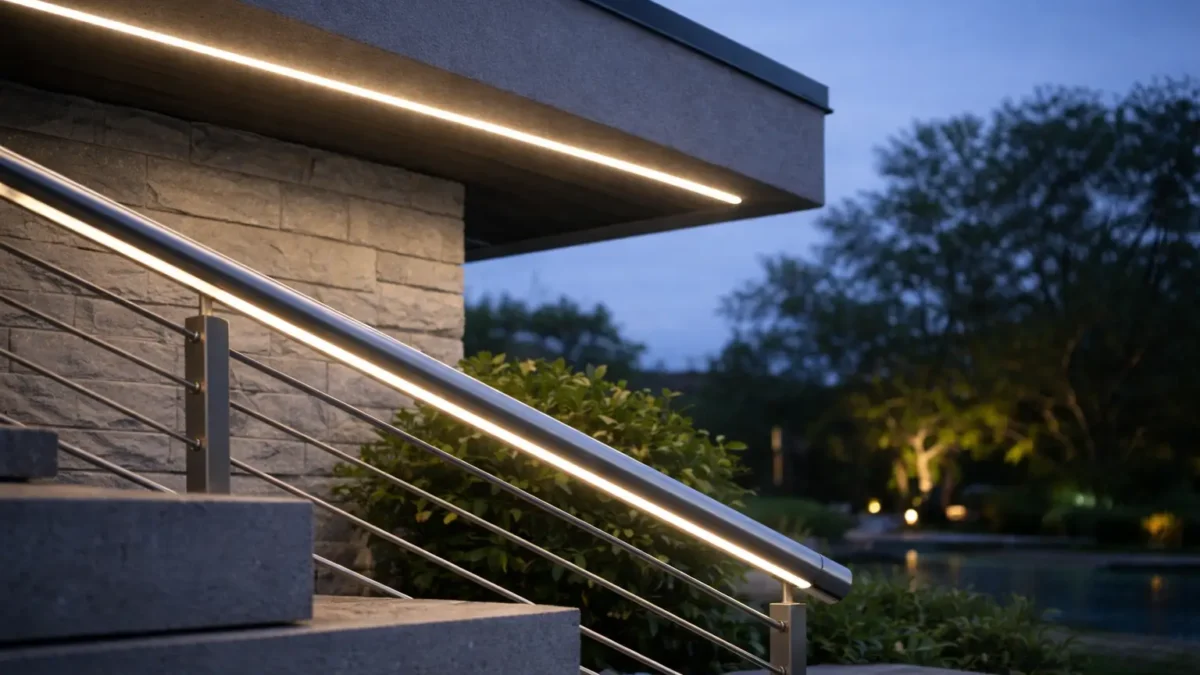
Open facade or railing
Direct rain and spray
IP67
Use sealed ends, protected connectors, and profiles where needed.
Near-grade steps or landscaping
Repeated wetting and puddle risk
IP67 or higher if stated
Protect cable exits, joints, and feed points.
Immersion risk
Possible sustained water contact
IP68 only if rated for it
Confirm exact test conditions for that model.
Weatherproof vs waterproof
“Weatherproof” and “waterproof” can be vague. Therefore, use a documented IP rating and ask what it covers. Also, ask whether cut ends, connectors, and enclosures are included in the protection plan.
Boundary note: IP works as a starting point. However, the full system must use the right sealing, cable routing, and enclosures.
Waterproof the Whole System (Not Just the Strip): Drivers, Controllers, Connectors, and Cable Entries
Outdoor reliability depends on the weakest link. Even if the strip body has a strong IP rating, water can still enter through a joint, cable entry, or enclosure.
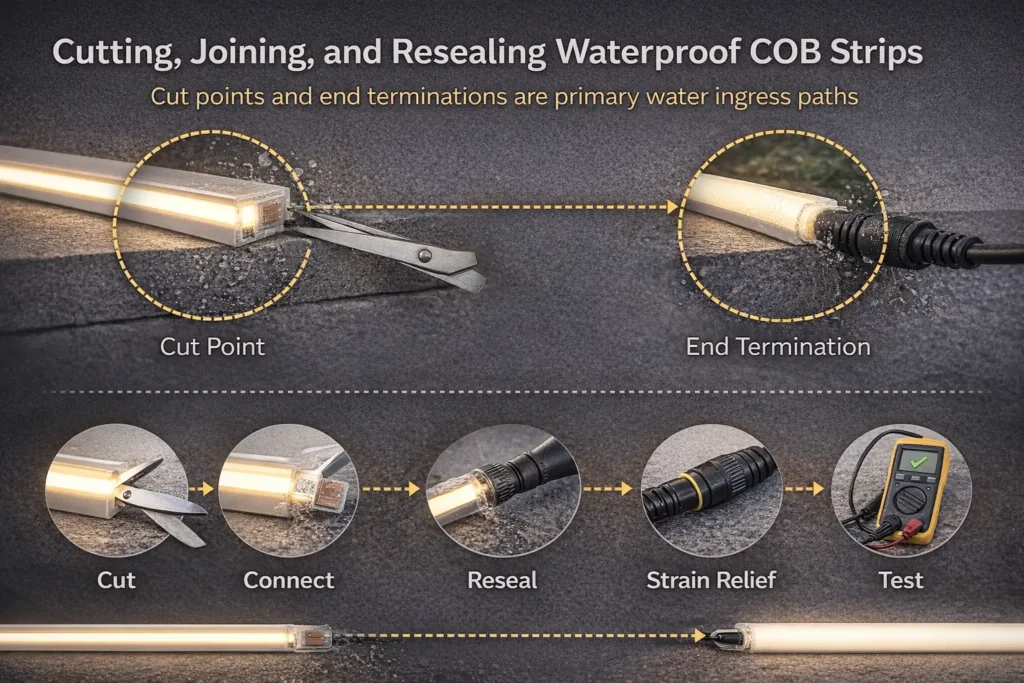
Cutting, Joining, and Resealing Waterproof COB Strips for Outdoor Use
Cutting and joining create the highest outdoor leak risk. Therefore, plan the cut, connector, seal, strain relief, and test steps before the strip goes on site.
Before you cut
First, find the allowed cut marks.
Next, decide where the wire, connector, or splice will sit.
Also, check whether the joint will remain serviceable.
Finally, confirm the reseal method for that exact product build.
Cut, connect, reseal, test
First, cut at the approved mark.
Next, attach leads or connectors with correct polarity.
Then, reseal the termination using the recommended end-cap or seal method.
Also, add strain relief so cables do not pull on the seal.
After that, test function and dimming if used.
Finally, close the profile, enclosure, or cable entry after the test passes.
Field cuts vs sealed lengths
Field cuts can work in protected areas when the team can reseal well. However, pre-made sealed lengths are often safer for exposed rain, hard-to-access locations, or repeatable B2B projects.
Use field cuts when access, skill, and reseal steps are controlled.
However, use pre-made sealed lengths when field resealing adds too much risk.
Also, consider factory leads when many similar runs repeat across a project.
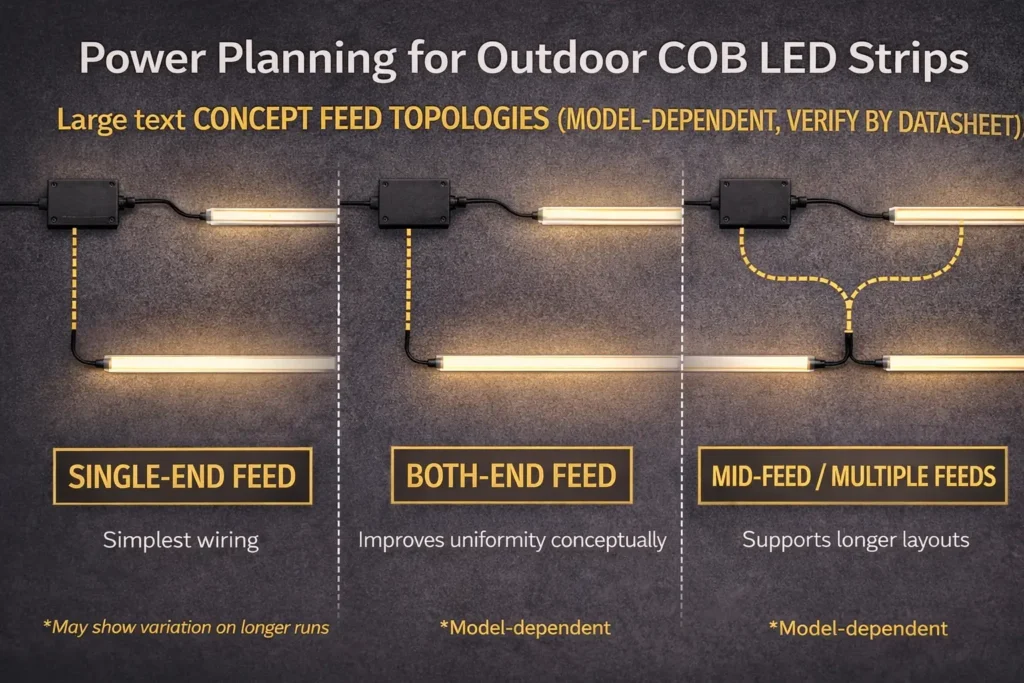
Power Planning for Outdoor COB LED Strips: Reliability and Consistent Brightness on Longer Runs
Outdoor power planning means more than choosing a driver. You also need to place the power gear safely, route cables well, and reduce uneven brightness on longer runs.
Driver or power supply checks
First, confirm the exact strip model and rated voltage.
Next, list total run length per zone.
Also, get power per length from the datasheet.
Then, check heat, enclosure, and access conditions.
Finally, confirm the control method if dimming or a controller is used.
Outdoor cable routing
Use protected routes where possible.
Also, support cables near terminations and box entries.
Next, seal cable entries and avoid straight water paths into boxes.
Finally, keep drivers and controllers reachable for service.
Feed topology options
Topology
Why it is used
Outdoor note
Single-end feed
Simple wiring
Fewer entry points, but longer runs may vary in brightness.
Both-end feed
Helps balance voltage
Needs more sealed cable entries.
Mid-feed or multiple feeds
Supports longer layouts
Needs more boxes, joints, and service planning.
Parallel-fed zones
Makes zones easier to control
Needs more planning, but can reduce surprises.
Boundary note: Feed spacing depends on strip design and site layout. Therefore, verify by datasheet and test the planned run.
12V vs 24V and Outdoor Mounting Durability (Profiles, Clips, and Adhesive Limits)
Voltage choice and mounting choice should work together. For example, voltage affects wiring sensitivity, while mounting affects how well seals and joints survive weather.
12V vs 24V table
Decision factor
12V
24V
Long-run wiring
Often more sensitive
Often more forgiving
Feed planning
May need more care on longer runs
Often simpler, but still needs planning
Parts fit
Must match strip and driver
Must match strip and driver
Best fit
Shorter runs and tight layouts
Longer runs and fewer feed issues
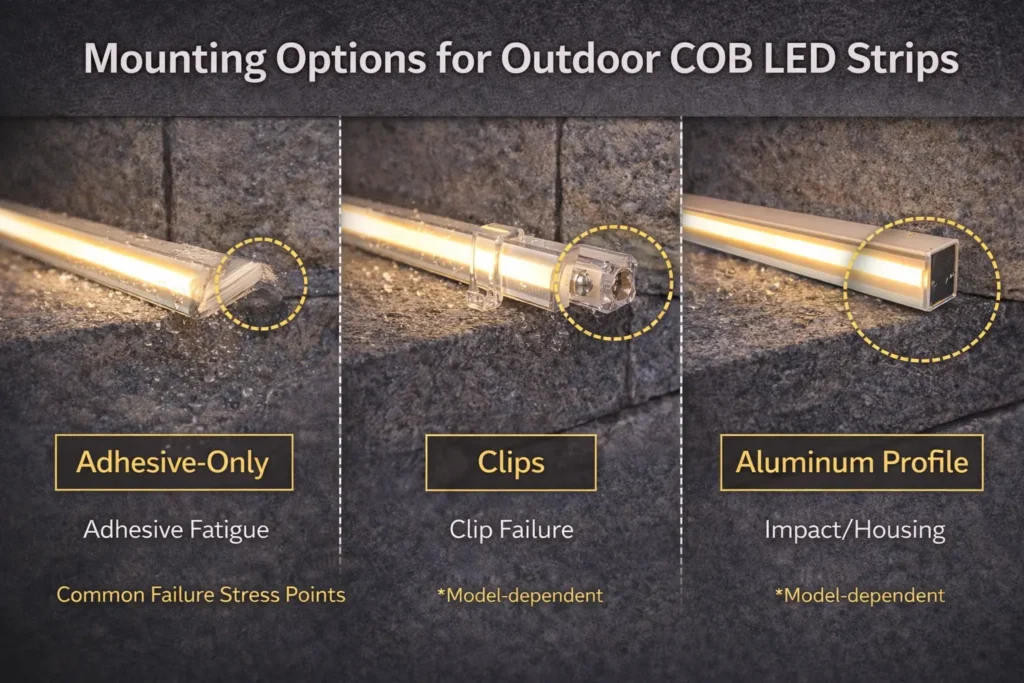
Mounting options
Mounting option
الإيجابيات
Common outdoor risk
Adhesive-only
Fast and clean
Can loosen under UV, heat, cold, or moisture.
Clips
More secure
Needs planned spacing and fastener points.
Aluminum profile
Clean finish and physical protection
Needs correct end treatment and cable routing.
Outdoor durability checklist
First, use physical support where exposure is high.
Next, avoid tight bends near cut ends or connectors.
Also, make sure clips or profiles do not crush sealed parts.
Finally, keep service access for connectors, controllers, and feed points.
Control outdoors
Outdoor dimming can work well, but the full control chain must fit the site. Therefore, match the driver, controller, wiring, enclosure, and strip before ordering.
PWM control needs a compatible controller and protected wiring.
0–10V control needs a matching driver.
DALI or DMX needs compatible gear and a clear wiring plan.
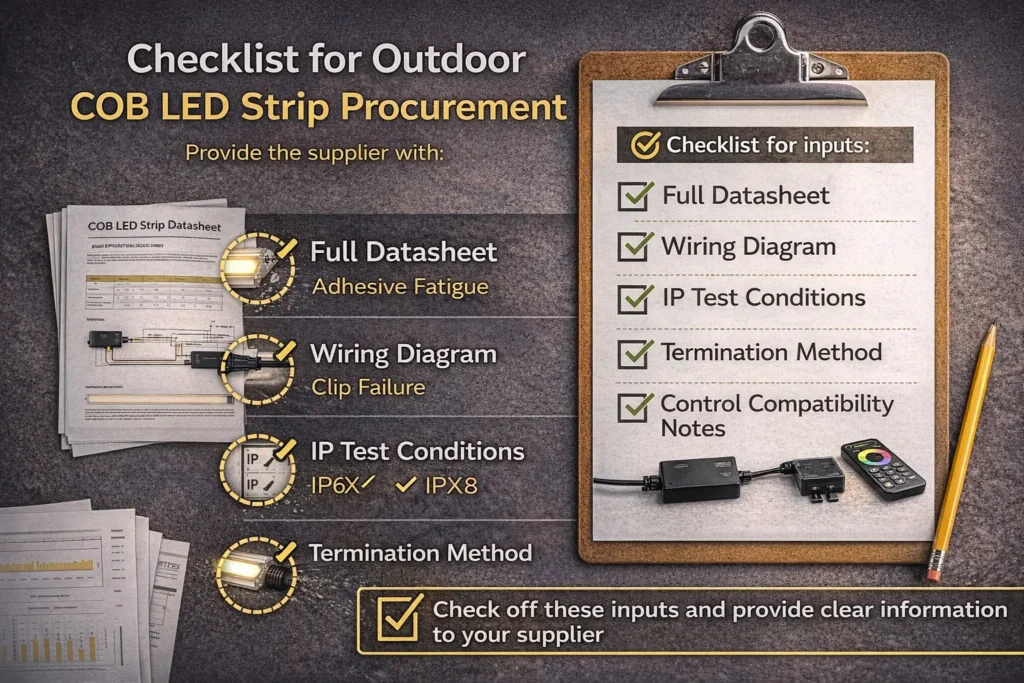
Procurement Checklist for Outdoor COB LED Strip Projects (What to Ask and What to Provide)
Good outdoor procurement starts with documents. First, confirm the model. Next, confirm IP test conditions. Then, confirm termination and wiring guidance.
What to ask for
Exact model or series ID.
Also, IP rating and stated test conditions.
Next, termination method for end caps, wire exits, and reseal steps.
Then, connector or splice guidance.
In addition, wiring diagram and feed notes.
Finally, control or dimming notes if the project needs them.
What to provide the supplier
Site exposure, such as covered, exposed, splash, or immersion risk.
Also, total run lengths, zones, corners, and transitions.
Next, mounting method, profile type, and service access.
Then, driver and controller location limits.
Finally, control needs, such as single color, CCT, RGB, or dimming.
When to consider custom sealed lengths or LED neon
Choose custom sealed lengths when field sealing is too risky.
Also, consider them when runs are hard to access later.
In addition, consider LED neon when the project needs a sealed diffuser body.
Finally, use a different form factor when heavy exposure makes many joints risky.
Need help specifying an outdoor COB strip system for a project layout? Provide the exposure scenario, run lengths per zone, mounting method, and control needs. Then, the supplier can confirm IP build, termination method, and feed plan based on the exact model documents.
FAQ (Outdoor COB LED Strip Projects)
What is a COB LED strip, and why is it dotless?
Answer: A COB LED strip creates a smoother light line than many dotted LED strips. However, the final look still depends on the profile, diffuser, and viewing distance.
Can COB LED strip lights be used outdoors year-round?
Answer: Yes, if the strip rating and full system match the exposure. Also, ends, connectors, cable entries, and power gear must stay protected year-round.
What IP rating do you need outdoors?
Answer: Use IP65 for covered splash areas, IP67 for direct rain or spray, and IP68 only when the exact model states immersion use. However, always protect the whole system.
What is the difference between weatherproof and waterproof?
Answer: Weatherproof is often a loose term. Therefore, rely on documented IP ratings and stated test conditions instead of labels alone.
What else must be waterproof besides the strip?
Answer: The driver, controller, connectors, splices, enclosure, and cable entries also need protection. Otherwise, those parts can fail before the strip body.
How do you keep the strip waterproof after cutting?
Answer: Cut at the correct mark, connect leads, reseal the end, add strain relief, and test before final close-up. Also, consider pre-made sealed lengths for high-risk sites.
Should you choose 12V or 24V outdoors?
Answer: Choose based on layout and part compatibility. In general, 24V may help longer runs, but feed planning and sealing still matter.
When should you choose LED neon instead of COB strip?
Answer: Choose LED neon when you need a sealed diffuser body, a fixture-like finish, or fewer exposed joints in harsh areas. However, verify its outdoor rating too.
Summary and Next Steps (Spec, Verify, and Install with Fewer Outdoor Failures)
Finally, outdoor COB LED strip projects work best when you plan the full system. First, choose the IP rating by exposure. Next, protect ends, joints, enclosures, and cable entries. Then, test before final close-up.
Project checklist
First, confirm the site exposure and IP target.
Next, design the waterproof chain: strip, ends, connectors, boxes, and cable entries.
Then, define the reseal workflow before any field cutting.
Also, plan power feeds for longer runs.
In addition, choose voltage and mounting method together.
Finally, request the datasheet, IP test notes, termination method, and wiring guide.
For complex outdoor layouts, prepare one short spec brief: exposure scenario, run lengths per zone, mounting method, control needs, and service access limits. As a result, the supplier can confirm the right construction and a project-ready install plan faster.


 English
  Spanish
  French
  Arabic