Before choosing between LED strip lights and tube lights, define the main job of the light. In many projects, one product is not “better” overall. Instead, each one fits a different use.
What are LED strip lights?
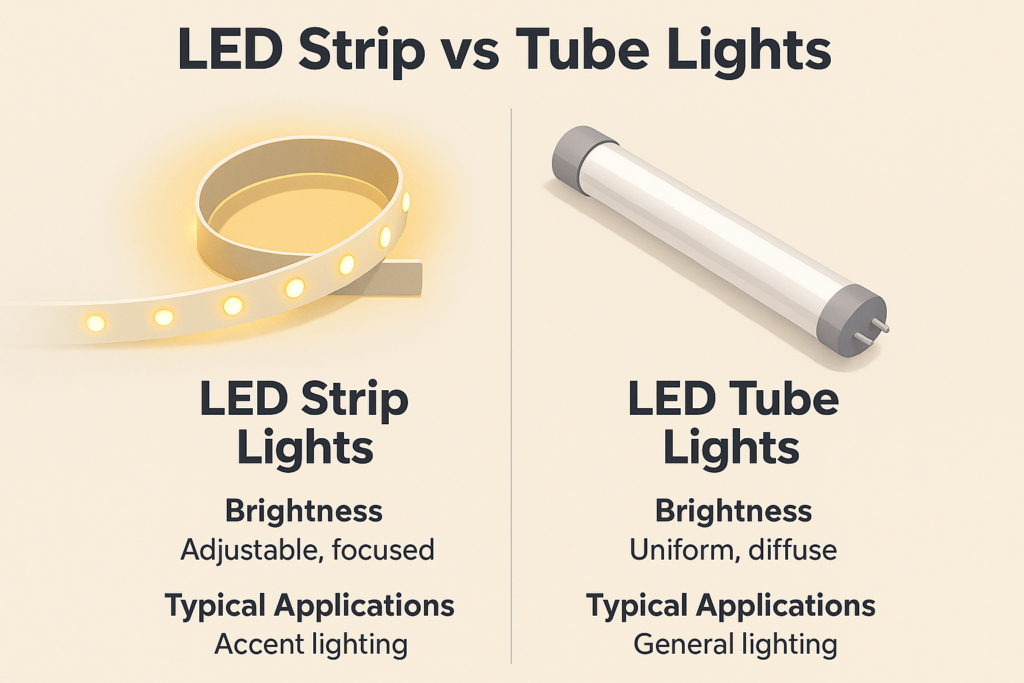
LED strip lights use a flexible circuit board with many small LEDs. They can bend, cut at marked points, and fit into tight spaces. As a result, they work well for accent lighting, under-cabinet light, shelf light, signage, and mood effects.
What are LED tube lights?
LED tube lights look like long tube lamps. They are often used to replace fluorescent tubes in standard fixtures. Also, they provide wide and even light for offices, garages, kitchens, basements, schools, and commercial spaces.
Quick answer
In short, this LED strip vs tube light choice depends on whether you need detail or broad room light.
LED strips give more layout freedom and style control. Meanwhile, LED tube lights give simple, even room light. Therefore, use strips for detail and tubes for general lighting.
LED Strip vs Tube Light: Technical Differences
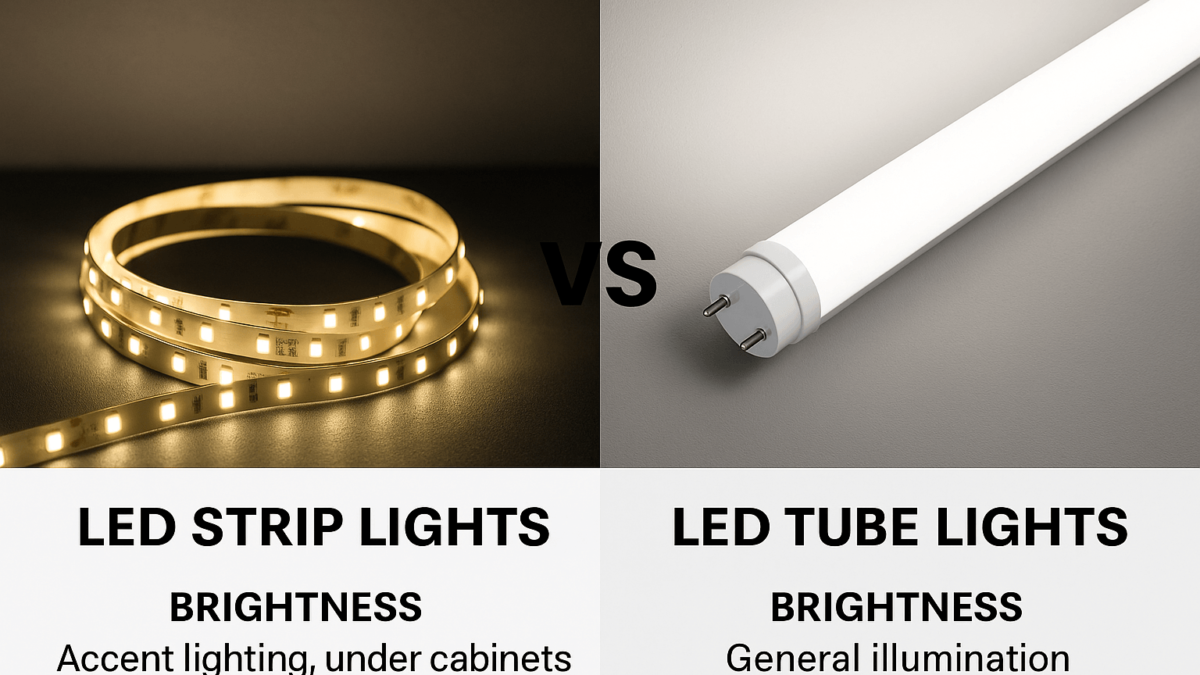
The main differences are brightness style, shape, install method, power setup, and use case. Also, the way each product spreads light is very different.
Brightness and light quality
LED strip lights: give focused or hidden light. They can be bright, but the result depends on length, density, diffuser, and mounting.
LED tube lights: give steady and even light across a wider area. They are made for broad room lighting.
Flexibility and installation
LED strip lights: fit curves, corners, shelves, coves, and cabinets. However, they need planning for wiring, power, and mounting.
LED tube lights: fit standard fixtures. As a result, they are often faster to install or replace.
Energy use and control
LED strip lights: can save power when dimmed or used only in target zones.
LED tube lights: provide steady output for full-room lighting and often use energy well for large areas.
Next, use this table to compare the two options side by side.
Comparison table
Feature
أضواء شريطية LED
LED Tube Lights
Brightness style
Focused, flexible, and adjustable
Even and wide
المرونة
Very flexible
Fixed shape
التركيب
Needs more planning
Usually simple in fixtures
Energy use
Efficient and dimmable by zone
Efficient for broad light
Best use
Decorative, task, accent, display
General room and work lighting
التكلفة
Moderate to higher for full systems
Often cost-friendly for large areas
Simple takeaway
Choose LED strips when layout control matters. For broad and steady light, tube lights often make more sense.
Advantages and Disadvantages of LED Strip Lights
For shape, detail, or mood, LED strip lights are a strong choice. However, they need better planning than tube lights.
First, look at where LED strips add the most value.
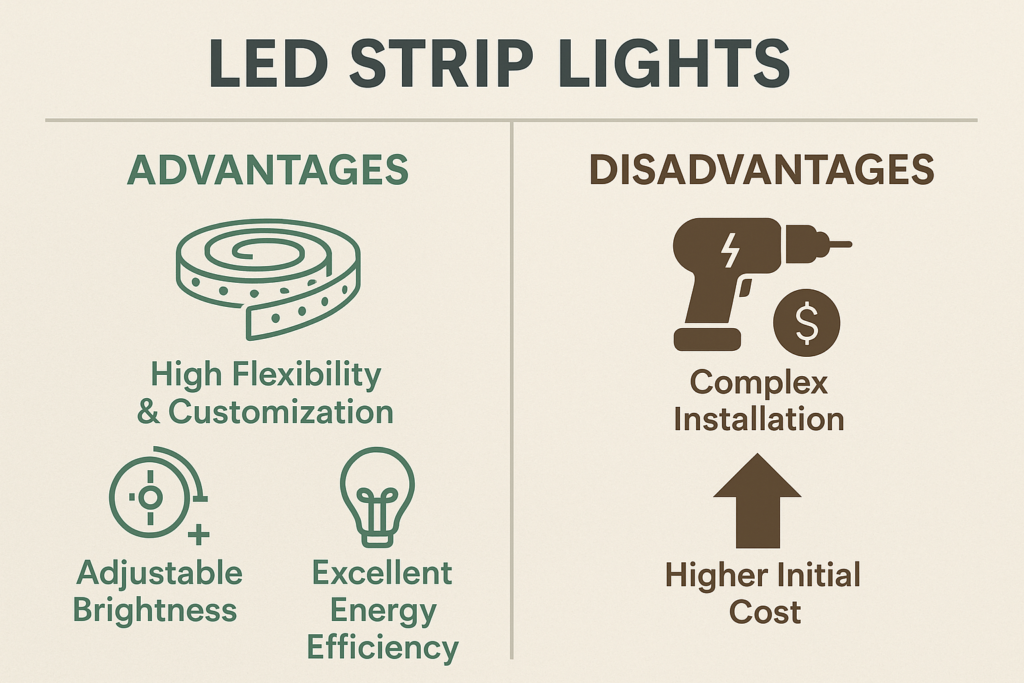
Advantages of LED strip lights
Flexible shape: strips can fit cabinets, coves, shelves, signs, and tight spaces.
Custom look: they can create accent lines, hidden glow, and color effects.
Task lighting: they work well under cabinets and near work surfaces.
Dimming control: many strips can dim or change color with the right controller.
However, these benefits also come with a few limits.
Disadvantages of LED strip lights
More install planning: strips need power supplies, wiring, and mounting choices.
Surface issues: weak adhesive or poor surface prep can cause peeling.
Heat control: bright strips may need aluminum channels.
Higher system cost: advanced strips, drivers, and profiles can add cost.
Best fit summary
LED strip lights are best for accent, task, and custom lighting. Therefore, they are a good choice when you want more design control.
Advantages and Disadvantages of LED Tube Lights
For steady room light with little design work, LED tube lights are simple and practical. As a result, they are often used in offices, garages, kitchens, and shops.
Next, compare that with the simpler tube-light format.
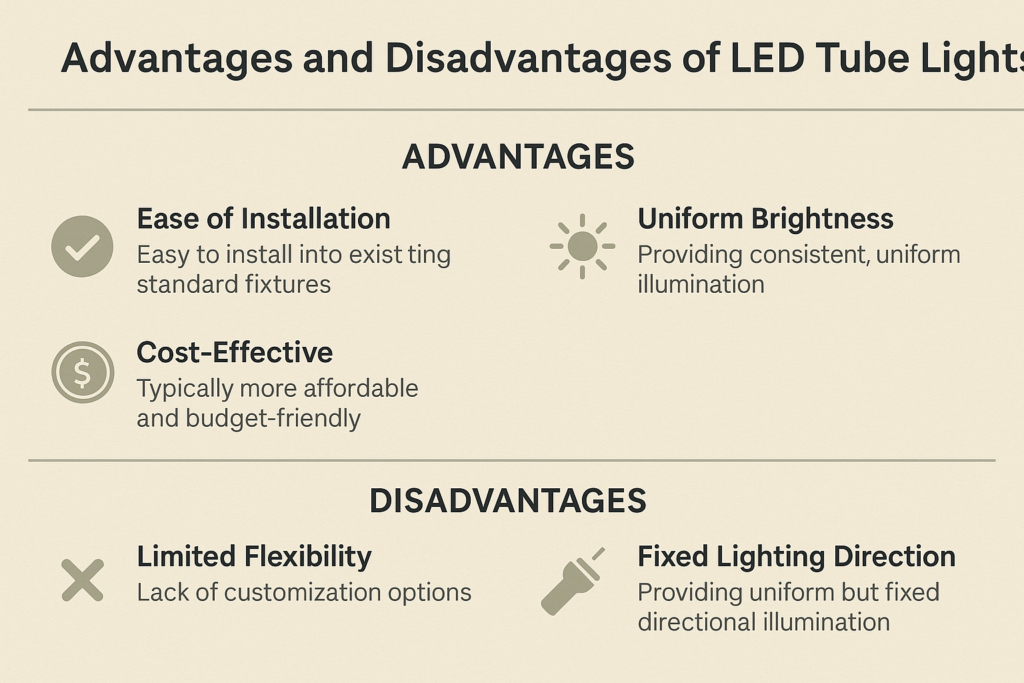
Advantages of LED tube lights
Easy replacement: many tube lights fit common fixtures.
Even light: they spread light across a larger area.
Lower starting cost: they can be cost-friendly for large spaces.
Good daily use: they work well for offices, garages, kitchens, and shops.
Even so, tube lights have limits when the design needs detail.
Disadvantages of LED tube lights
Less flexible shape: tubes cannot bend around corners or fit narrow details.
Limited style control: they are not ideal for hidden glow or decorative effects.
Fixed direction: light spread depends on the fixture and tube design.
Best fit summary
LED tube lights are best for general lighting. Therefore, they are a strong choice for workspaces and rooms that need even light.
Best Applications for LED Strip Lights and Tube Lights
Use the project goal first. Then, match the product type to the space and lighting task.
For a practical choice, start with where the light will be used.
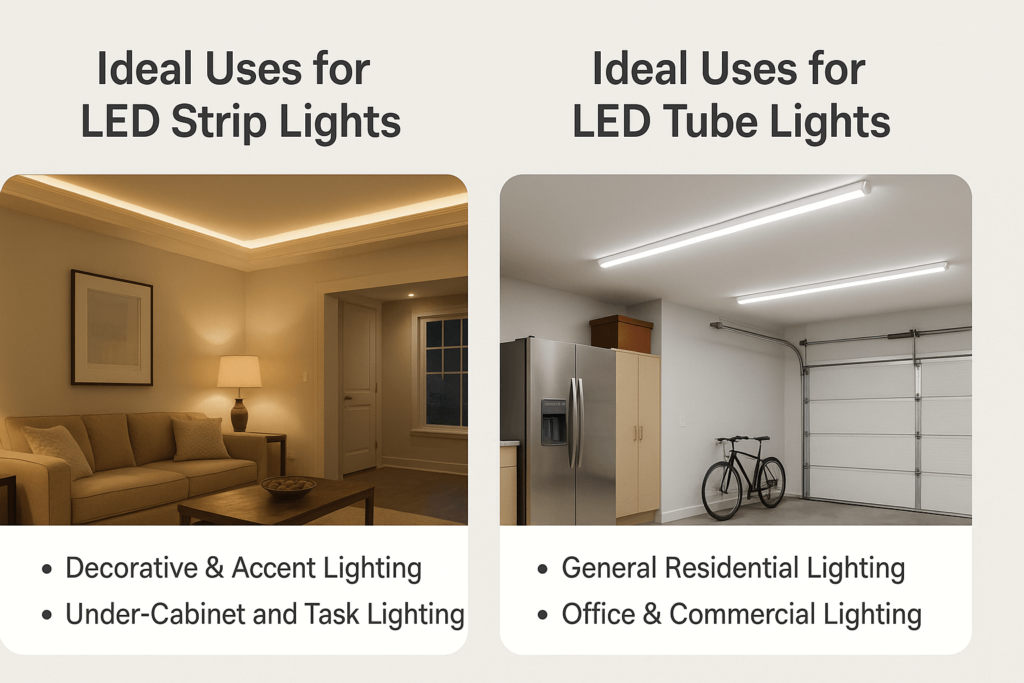
Ideal uses for LED strip lights
Decorative and accent lighting: use strips for coves, shelves, signs, and mood lighting.
Under-cabinet and task lighting: use strips for counters, desks, and work surfaces.
Retail and display lighting: use strips for product highlights and custom shapes.
Then, compare the same idea with wider room-lighting needs.
Ideal uses for LED tube lights
Office and shop lighting: use tubes for broad, even light.
Garage and basement lighting: choose tubes for simple bright coverage.
Warehouse and work areas: use tubes when simple, steady light matters.
Kitchen example
In a kitchen, LED strips work well under cabinets for task light. Meanwhile, tube lights work well for broad ceiling light. In many kitchens, using both gives the best result.
How to Choose: LED Strip vs Tube Light
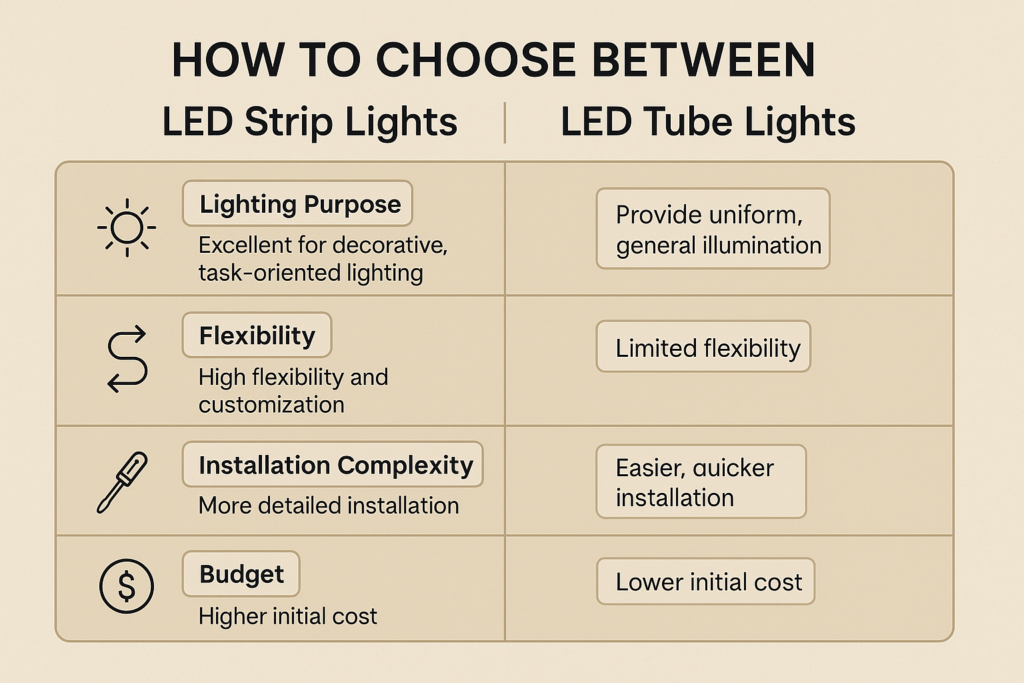
To choose well, compare the lighting purpose, flexibility, install effort, and budget. Also, think about maintenance and future changes.
After that, use these decision factors to narrow the choice.
Key decision factors
Lighting purpose: use strips for detail and tubes for broad light.
المرونة: choose strips for custom shapes and tight spaces.
Install effort: choose tubes when you want a faster fixture-based install.
Budget: compare the full system cost, not only the product price.
Common mistakes
Do not choose tube lights when you need hidden glow or accent lines.
Also, do not choose strips for broad general light unless the layout supports it.
Finally, do not judge only by price. Compare light quality, install work, and long-term use.
Practical advice
For living rooms, bedrooms, and displays, LED strips can add style. However, for offices, shops, and garages, LED tubes are often easier and more direct.
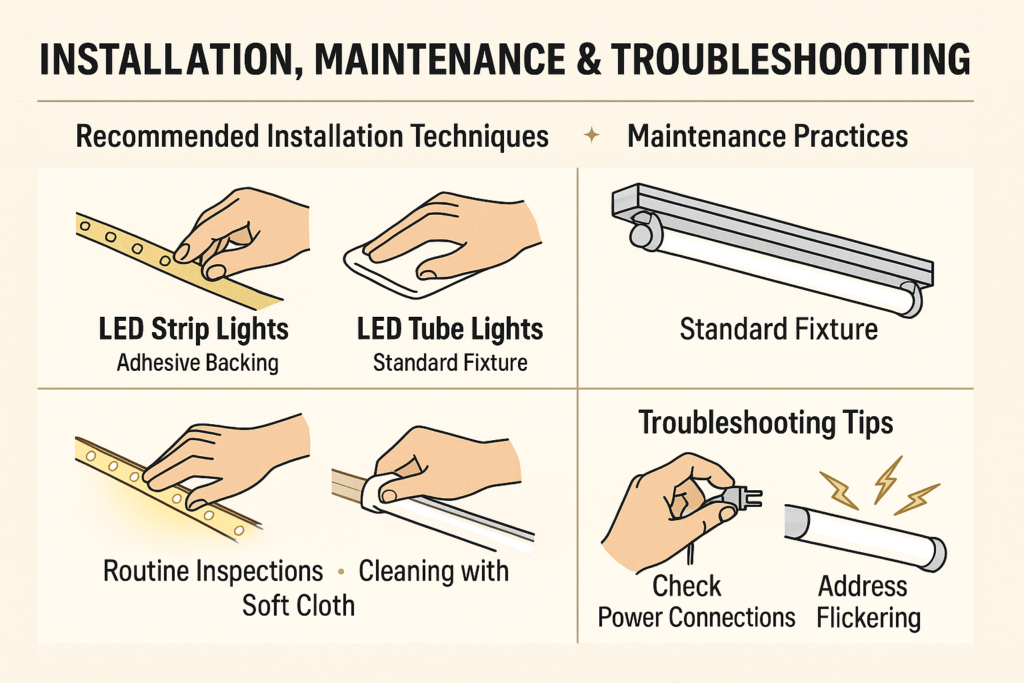
Good installation improves safety, light quality, and product life. Therefore, plan the wiring, mounting, and cleaning method before final setup.
Installation tips for LED strip lights
Measure the area before cutting strips.
Clean and dry the surface before mounting.
Use a matching power supply and controller.
Also, use aluminum channels for cleaner lines and heat control.
Installation tips for LED tube lights
Check fixture type and tube size first.
Confirm wiring fit before replacing old fluorescent tubes.
Then, make sure the tube is seated firmly in the fixture.
After installation, simple upkeep helps both product types last longer.
Maintenance tips
Inspect for flicker, loose wires, and dim spots.
Also, clean lenses, diffusers, and strip channels with a soft cloth.
For LED strips, check adhesive, clips, and heat areas over time.
Troubleshooting quick checks
Lights not working: check power, wiring, and polarity.
Flicker: check driver fit, loose joints, and voltage.
Strip adhesion issues: clean the surface and add clips or channels.
FAQs About LED Strip Lights and Tube Lights
Are LED strips brighter than tube lights?
LED strips can be very bright in focused areas. However, tube lights usually provide broader and more even room light.
Which is better for kitchen lighting, LED strips or tube lights?
Use LED strips for under-cabinet task lighting and accent light. Meanwhile, tube lights work better for general ceiling light. In many kitchens, both are useful.
Do LED strip lights use more power than tube lights?
Power use depends on brightness, length, and control settings. However, both options can be efficient when matched to the right task.
Are LED strip lights good for general home lighting?
They can support general lighting, but they are usually better for task and accent lighting. However, for whole-room light, tube lights may be simpler.
Conclusion: LED Strip vs Tube Light
Both lighting types have strong uses. LED strips offer flexible design, task light, and accent effects. In contrast, LED tube lights offer simple, even light for general use.
Start with the lighting goal. Then, choose the product that fits the space, install method, and budget. If needed, combine both for a better lighting plan.


 English
  Spanish
  French
  Arabic