Vous avez besoin d'un produit de qualité en peu de temps ? Nous avons un plan pour vous.


LED strip lights come in many forms, and choosing the right type is often the difference between a clean, reliable installation and a frustrating one. In this guide, we explain the main LED strip light types, the technical factors that matter, and how to match them to real projects so you can make confident, project-ready decisions.
LED strip lights are flexible circuit boards populated with small LED chips and electronic components, usually supplied on a reel with an adhesive backing so you can stick light exactly where you need it. They are used for everything from under-cabinet lighting and shop displays to hotel coves and outdoor signage, because they are slim, efficient and easy to integrate into architectural details.
A typical strip includes:
Compared with rigid fixtures like panels or downlights, strip lights are especially good at creating continuous lines of light along surfaces, edges and recesses.
Most LED strip lights fall into a handful of main families. Understanding these quickly makes all the detailed choices easier.
At a glance, the main LED strip light types are:
The rest of this guide simply dives deeper into these types, explains the technical factors behind them, and shows which ones are best for specific projects.
Colour and control capability are one of the biggest ways strip types differ. If you know whether you need fixed white, adjustable white or full colour effects, you’ve already narrowed the field dramatically.
If you primarily need functional, consistent light, single-color and tunable white strips are usually the best place to start.
Single-color strips:
Tunable white strips:
In both cases, consider CRI (Colour Rendering Index): for retail, hospitality and high-end residential, aim for CRI 90+ so colours and materials look natural.
If you want coloured effects, RGB and RGBW/RGBCCT strips give you more creative control.
RGB strips:
RGBW or RGBCCT strips:
For both families, you’ll need a suitable multi-channel controller and power supply. As a rule:
Individually addressable (pixel) strips have tiny control ICs on board so each LED or small group of LEDs can be controlled independently. That allows you to create chasing patterns, gradients, waves and complex animations that standard RGB/RGBW strips simply cannot match.
They make sense when:
However, addressable strips come with trade-offs:
If you mainly want static scenes or simple colour transitions, standard RGB/RGBW is usually enough. Choose addressable strips when you genuinely need those advanced animations and are ready to manage the extra complexity.
Not all LED strips look like the familiar dotted flexible tape. Some projects benefit from alternative constructions and form factors that change both the appearance and practicality of the installation.
COB (Chip-on-Board) strips pack many tiny LEDs very close together under a single continuous phosphor layer. Compared with standard SMD strips, they offer:
Standard SMD strips:
In practice, COB strips are ideal when the light source is directly visible – under open shelves, in mirrors, along furniture edges – and you want a clean, continuous effect. SMD strips remain a cost-effective, versatile option for indirect or diffused lighting.
Sometimes a flexible strip is not the easiest or best mechanical solution.
Rigid LED bars:
LED neon flex strips:
When you need perfect straightness, rigid bars beat flexible strips. When you want a strong, visible line that can bend around corners and withstand outdoor conditions, neon flex is often the best choice.

Choosing a strip type is not just about colour and format; technical parameters determine whether the installation is safe, reliable and bright enough.
For most LED strip projects, you will choose between 5V, 12V, 24V or high-voltage strip systems. The key relationship is:
> Higher voltage usually supports longer runs and lower current, which simplifies wiring and reduces voltage drop.
Typical guidance:
Whatever voltage you choose, you must pair strips with compatible constant voltage power supplies, sized for total wattage with a comfortable margin (often 20–30%). For longer runs, consider multiple feed points or power injection to keep brightness consistent.
Brightness and visual quality are mainly driven by:
As a simple rule:
Higher wattage per meter usually means higher brightness, but it also means:
When in doubt, check lumen-per-meter figures and match them to the application (for example, more lumens per meter for task surfaces than for mood lighting).
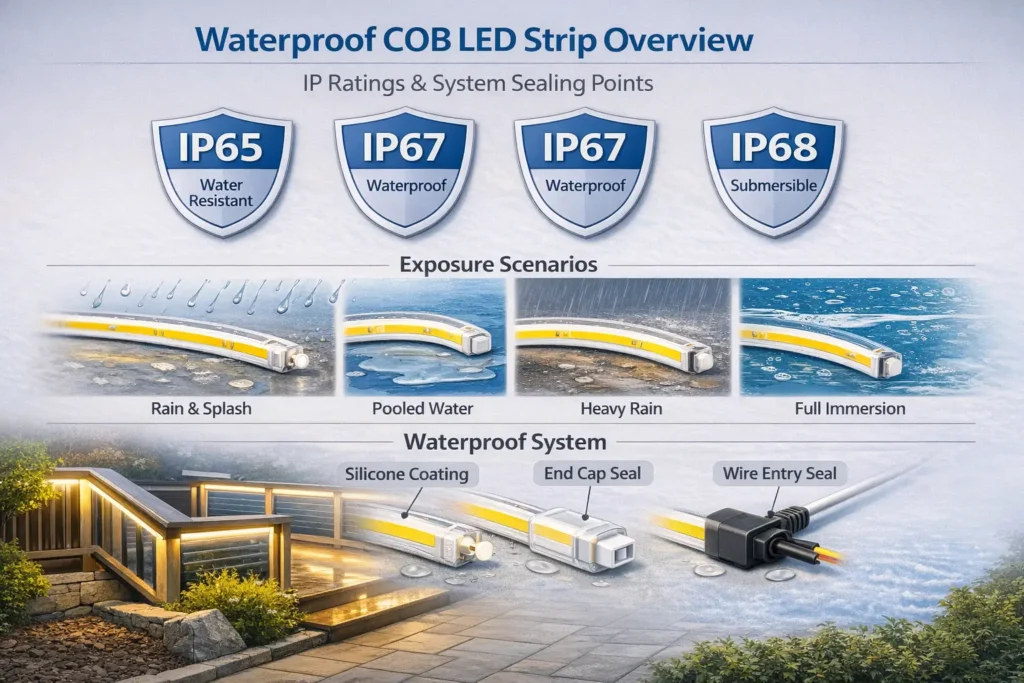
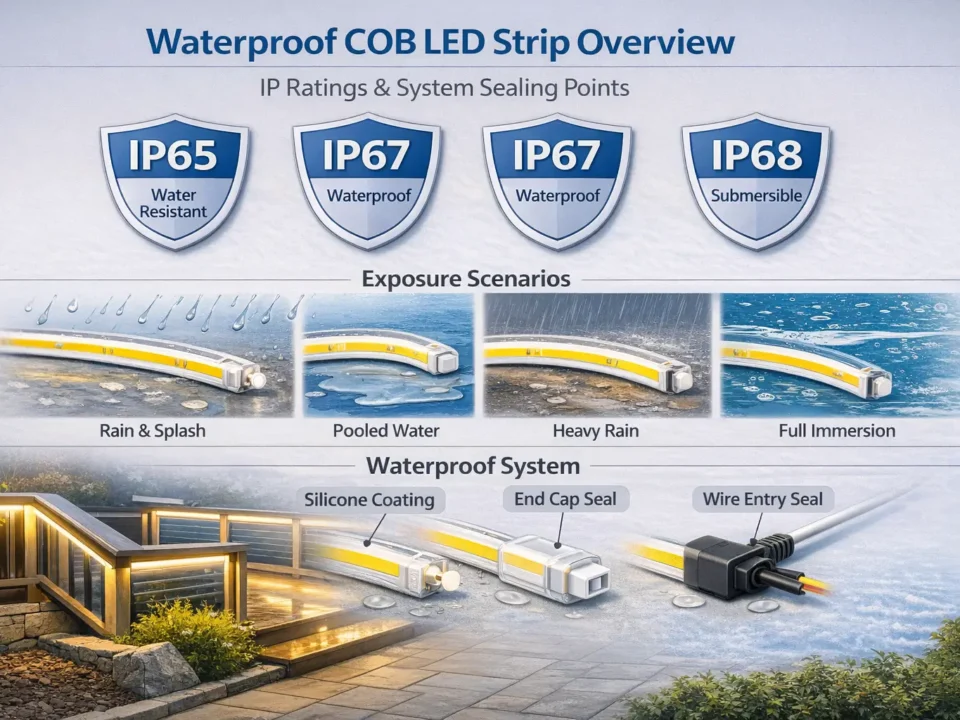
Not every strip is waterproof. Indices IP tell you how well protected a strip is against dust and moisture.
In broad terms:
Strips for outdoor signage, facades or wet areas should typically be IP65 or above and installed with compatible sealed connectors and junctions. Neon flex and encapsulated flexible strips are often used outdoors because they combine IP protection with visual impact.
Even outdoors, consider:
Two parameters strongly influence how spaces feel:
– 2700–3000K: warm, cosy. – 3500–4000K: neutral, balanced. – 5000–6500K: cool, crisp, more “daylight” feel.
– CRI ≥80 is acceptable for many basic applications. – CRI ≥90 is recommended for retail, hospitality, galleries and premium residential.
For example:
Tunable white strips let you adjust CCT while still targeting high CRI for good colour rendering.
Chip codes like 2835, 3528, 5050 ou 5730 refer to the approximate size of the SMD package in tenths of a millimetre (e.g. 5050 ≈ 5.0 x 5.0 mm). They give you clues about:
However, chip code alone doesn’t tell the whole story. You still need to check:
Treat chip codes as part of the technical picture, not the only selection criterion.

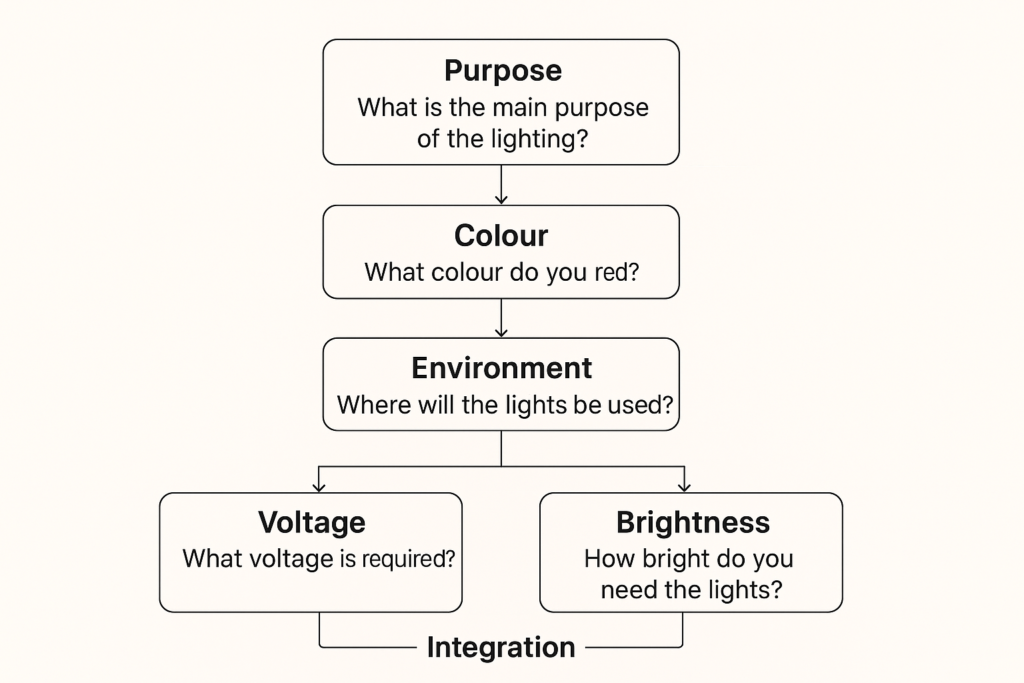
When you combine type families, technical factors and specific applications, choosing the right strip becomes a structured decision, not guesswork.
Here is a simple decision checklist you can follow:
– Task, accent, decorative, architectural, signage?
– Fixed white only → single-color or COB. – Adjustable white → tunable white. – Basic colour scenes → RGB or RGBW. – Advanced animations → addressable.
– Dry indoor → IP20 is usually fine. – Damp or outdoor → IP65+ and appropriate accessories.
– Short runs → 12V is often fine. – Long continuous lines or high power → consider 24V or multiple feed points.
– Accent vs task brightness; CRI ≥90 for colour-critical areas. – Direct-view or shallow profiles → COB or high-density strips.
– Power supplies sized with margin. – Controllers matched to strip type and channels. – Use aluminum profiles and diffusers where needed for cooling and visual quality.
By walking through these steps, you can narrow down from many types to one or two good candidates for each project.
Every project involves compromises. Common trade-offs include:
– Single-color strips are simple and robust but less flexible in ambience. – RGBW/RGBCCT and addressable strips offer more flexibility but demand more planning and commissioning.
– Higher-CRI, COB or high-density strips cost more but can deliver better light and fewer headaches. – Cheaper strips may lead to uneven light, faster degradation or more maintenance.
– Neon flex and addressable strips look spectacular but can draw more power and require heavier control gear. – Standard RGB or single-color strips use simpler power and control solutions.
It often makes sense to invest in higher-quality, more flexible strips in flagship areas (front-of-house, brand showcases) and use simpler, cost-effective types in back-of-house or low-importance zones.
A scenario-based view makes type selection much easier. The table below summarizes common applications and recommended strip types.
| Application / environment | Recommended strip types | Notes |
|---|---|---|
| ———————————— | ————————————————— | ———————————————————————– |
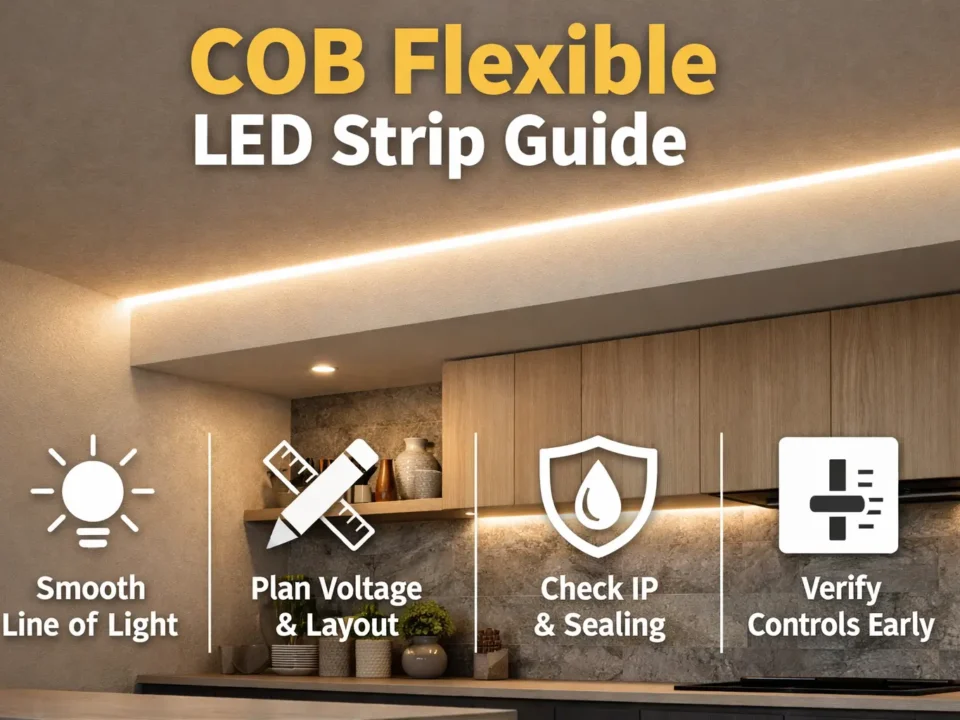
| Under-cabinet kitchen lighting | High-CRI single-color or COB; sometimes tunable | Focus on task brightness, CRI ≥90, good diffusion in shallow profiles |
| Shelves and display cases | COB or medium/high-density single-color; RGBW | Continuous lines and good colour; RGBW for brand or mood effects |
| Cove and indirect ceiling lighting | Single-color, tunable white, RGB/RGBW | Long runs; consider 24V, moderate density and good profiles |
| Feature walls and media zones | RGBW/RGBCCT or addressable | Colour and animations; plan control and power carefully |
| Retail shelving and product areas | High-CRI single-color or tunable white | CRI ≥90, neutral CCT, uniform illumination |
| Outdoor signage and logos | Neon flex, addressable, sealed flexible strips | High IP rating, strong visual impact, robust mechanical design |
| Outdoor facades and outlines | Neon flex, high-IP flexible strips | Long runs, weather resistance, clear viewing distances |
For indoor spaces, the best results come from matching strip type to whether the light is accent or task-oriented:
– Use high-CRI single-color or COB strips, often 3000–4000K, with sufficient density for smooth, shadow-minimising light. – Install in aluminum profiles with diffusers to avoid glare and protect the strip.
– For general accent, single-color or tunable white strips often give the most natural ambience. – For mood lighting, RGBW allows colour scenes without sacrificing everyday white.
– Tunable white or high-quality single-color strips at around 3500–4000K work well. – Use higher densities or COB where uniformity on work surfaces is important.
If you’re planning a full kitchen or office fit-out, you may want to mix types: functional high-CRI strips for work areas and RGBW or tunable strips for accent and ambience.
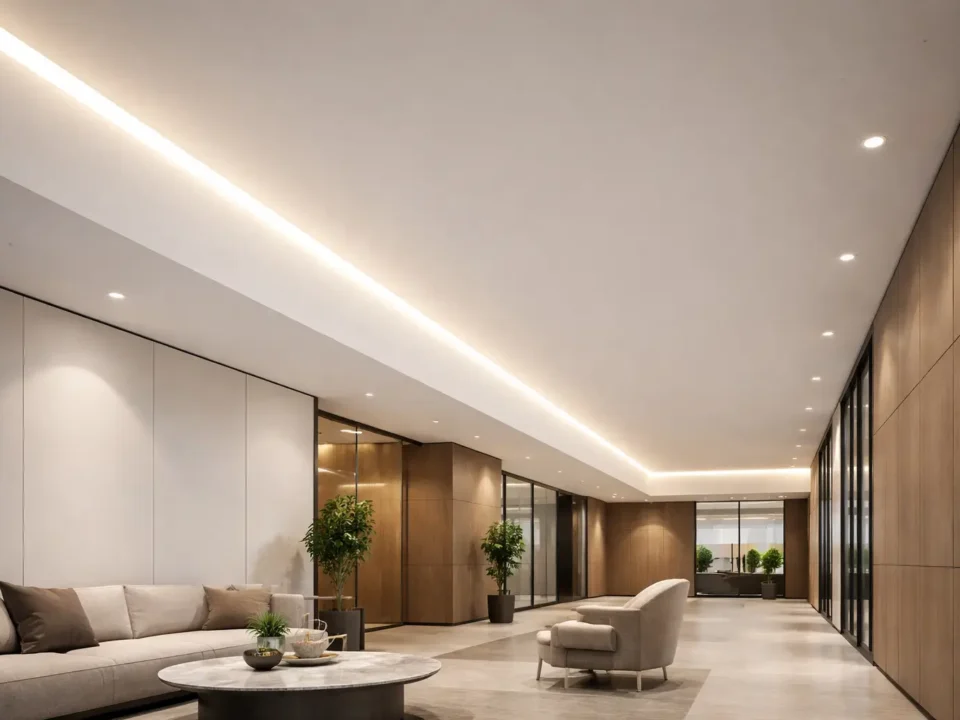
Coves, recessed channels and feature walls often call for continuous lines of light that shape the architecture.
– Single-color or tunable white strips on 24V are common, with densities sufficient for smooth indirect light. – RGB or RGBW strips work where you want coloured ambience in hotels, restaurants or entertainment spaces.
– COB strips can provide perfectly continuous light lines along walls or ceilings. – Rigid bars with diffusers are useful where perfectly straight lines and robust mounting are critical.
– RGBW/RGBCCT strips suit spaces that shift between neutral and colourful scenes. – Addressable strips shine in media walls, interactive features and showpiece installations.
For outdoor and wet areas the primary concern is IP rating and robustness.
– Neon flex is often the first choice because it is visually strong, flexible and typically high-IP rated. – Addressable strips inside suitable diffusers can create dynamic signage and animations.
– High-IP flexible strips or neon flex can trace building outlines and architectural features. – Plan long runs with higher voltage (often 24V) and adequate power injection.
– IP65 or higher strips in suitable profiles with sealed terminations. – Choose single-color or tunable white strips with CRI ≥90 where appearance matters.
In all wet-area and outdoor projects, the strip is just one part of the system. Ensure power supplies, connectors, and profiles are also rated and installed correctly.
If you’re upgrading or extending an existing installation, it helps to know what you’re working with. A quick identification checklist:
– Two pads/wires: usually single-color. – Four pads/wires: often RGB. – Five or more pads/wires: RGBW/RGBCCT or addressable.
– Labels like “D”, “DI”, “DO” or “DIN/DOUT” and 3-wire connections (power, ground, data) usually indicate addressable strips.
– Voltage (e.g. 12V, 24V) and sometimes IP rating are printed on the strip PCB or on the power supply label.
– Bare PCB: likely IP20 and for indoor use. – Encased in silicone or jacketed: higher IP rating.
If you’re still unsure after these checks, it’s safer to consult the original supplier or a professional rather than guessing.
Most LED strips are designed to be cut at specific, marked cut points, but how and where you can cut depends on the type and encapsulation.
General guidelines:
Extra care is needed for:
If you aren’t comfortable soldering or resealing, working with pre-terminated lengths and accessories from a manufacturer or supplier can reduce risk and installation time.
Choosing the right controller is just as important as choosing the strip itself:
– Use constant voltage dimmers or simple on/off switching, often between the power supply and the strip. – For multiple zones or larger loads, use multi-channel dimmers or drivers.
– Need multi-channel constant voltage controllers that match the number of channels (3 for RGB, 4+ for RGBW/RGBCCT). – Controllers may support DMX, DALI, 0–10V, Zigbee, Wi-Fi or other protocols; choose based on how you want to control scenes.
– Require pixel controllers designed for the specific IC protocol (e.g. WS2812, SK6812, etc.). – These often connect to media servers, DMX/Art-Net, or standalone effect engines.
Always check that:
For a deeper look at power options, you can review our LED power supply range and, for custom control and strip setups, our custom LED strip solutions.
How long do different types of LED strip lights typically last? Quality LED strip lights are often rated for tens of thousands of hours (e.g. 30,000–50,000+) when properly cooled and powered. Actual lifetime depends heavily on installation (thermal management, voltage, environment), so we recommend focusing on reputable manufacturers, adequate profiles and correctly sized power supplies instead of any single lifetime figure.
Are some LED strip types more energy-efficient than others? All modern strips are relatively efficient compared to older technologies, but efficiency varies by chip type, CRI and CCT. High-CRI and very warm strips may use slightly more power for the same lumen output than lower-CRI or cooler strips. Comparing lumens per watt for similar products is the best way to judge efficiency.
What does “5050” mean for LED strips? “5050” refers to an SMD package that is approximately 5.0 x 5.0 mm in size. These chips are often used for RGB and RGBW strips because they can house multiple dies. Smaller packages like 2835 or 3528 are widely used for white strips and can be very efficient, especially in high-density layouts.
Do COB strips last as long as traditional SMD strips? COB strips can offer similar lifetimes if designed and installed correctly. They often rely on good thermal management and constant voltage driving, just like SMD strips. Using aluminum profiles and avoiding excessive temperature helps both COB and SMD strips reach their rated lifetimes.
Where do LED strip lights fit in the wider LED lighting family? LED strip lights sit alongside downlights, panels, linear fixtures and modules as part of the broader LED ecosystem. Strips are uniquely suited to continuous lines, edge details and custom shapes, while panels and downlights cover broad general illumination.
Choosing the right LED strip type becomes straightforward once you think in terms of purpose, environment and technical constraints. If you know what you’re lighting, where it’s installed and how you want it to behave, you can quickly narrow down to a few suitable strip families.
Key takeaways:
For complex or large projects, working directly with a manufacturer like us can simplify specification, ensure consistent performance and adapt strip designs to your exact requirements.
You can explore our LED strip light range and, if you have project-specific requirements, reach out via our contact page to discuss tailored options.

 English
  Spanish
  French
  Arabic