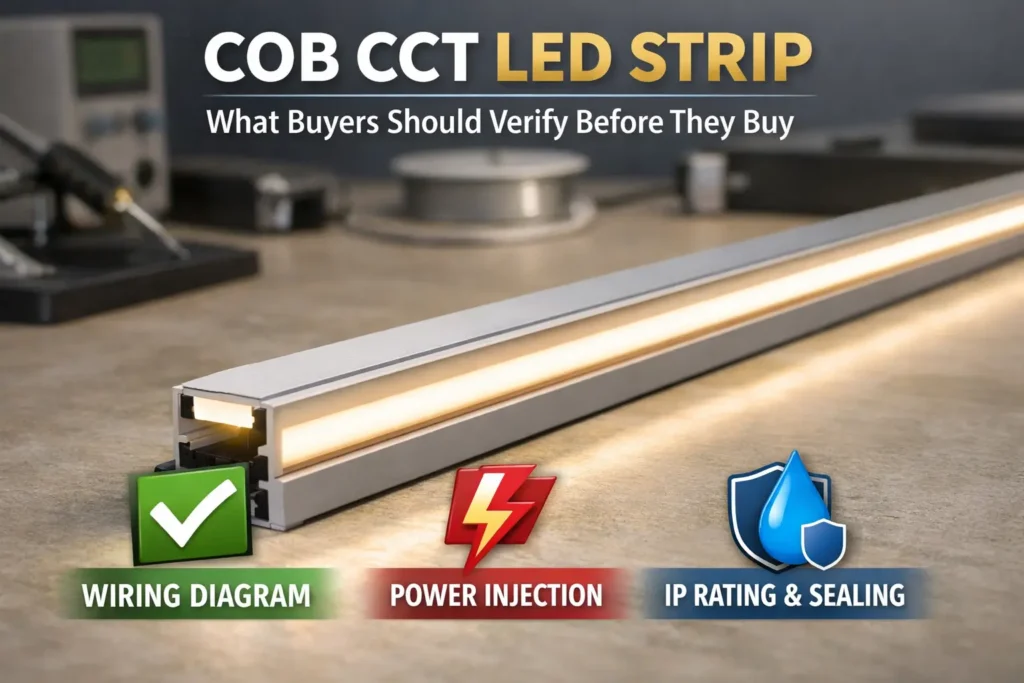
Sourcing a COB LED strip “wholesale factory” is easiest when you treat it like a procurement workflow: shortlist suppliers, send an RFQ that is quote-ready, request evidence that matches the exact model/series, then validate with samples before bulk production.
OEM COB LED Strip Wholesale Factory Checklist (US)
If you’re sourcing OEM/wholesale COB LED strips in the US, the fastest path is: shortlist factories with buyer-verifiable evidence, send a complete RFQ, request QC/compliance scope documents for the exact model, and validate long-run/IP/dimming risks on samples before bulk ordering.
Key points (quick checklist):
Shortlist: confirm capability, documentation readiness, QC/traceability, and sample support (not just marketing claims).
RFQ: include environment, run plan, control/dimming, cut/length constraints, and packaging/labeling needs to avoid misquotes.
Evidence: request datasheets, wiring notes, inspection/traceability approach, and scope confirmation for any certifications/marks.
Project checks: long runs need a power plan (voltage drop awareness + injection concept), wet areas need sealing discipline (IP is not a full-system guarantee), and dimming must be verified as a system (strip + PSU/driver + controller + wiring).
Boundary conditions:
Verify every configuration detail by model/series datasheet and written scope; don’t assume one spec applies to all.
Long-run performance depends on voltage, load, wiring, and feed strategy; validate with your run plan.
Compatibility (especially dimming) is system-dependent; test in a representative setup.
Decide → Send → Request → Verify
Decide (fit)
Send (RFQ)
Request (evidence)
Verify (sample)
COB vs SMD fit, environment, control method
Run plan, IP needs, cut/length, packaging/labeling
Confirm the exact model/series and scope in writing before mass production.
COB LED Strips Basics: What “Dotless” Means and When COB Beats SMD
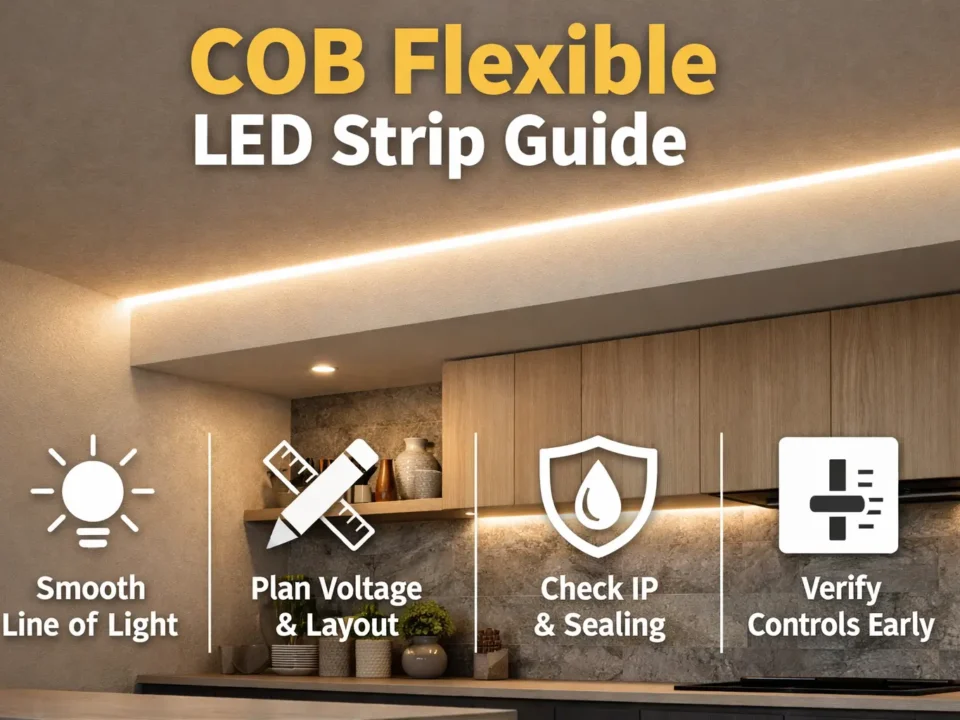
A COB LED strip uses closely packed LED chips to create a more continuous line of light, which can reduce the “dotting” you see with some SMD strips—especially at closer viewing distances.
Key points:
“Dotless” is relative: viewing distance, profile/diffuser choice, and brightness target still matter.
COB often shines in linear accents/coves where a smoother line is important.
SMD can still be a strong choice when you rely on diffusion, need certain form factors, or have different color/control priorities.
Boundary conditions:
Final visual acceptance should be based on a sample in the intended profile/location, not a generic photo.
What Is a COB LED Strip (Buyer Definition)
A COB LED strip is a flexible LED strip where many small LED chips are mounted close together to produce a smoother, more continuous line of light.
Key points:
Typical use: architectural linear accents, coves, under-cabinet/task areas, and continuous lines in profiles.
Common benefit: reduced visible “dots” compared with some SMD strips at similar viewing distances.
Common trade-off: visual outcome still depends on optics (profile/diffuser) and installation details.
Boundary conditions:
“Dotless” depends on distance and diffusion; validate with a sample in the actual build.
COB vs SMD Comparison Table (Quick Decision)
Decision factor
COB LED strip (typical)
SMD LED strip (typical)
Buyer note
Line-of-light appearance
Smoother/less dotting at close view
Dots may be visible unless diffused
Validate with sample + profile
Need for diffuser/profile
Often still recommended for finish/thermal
Often used with diffuser/profile
Choose based on fixture design
Typical project fit
Linear accents, coves, clean lines
Broad range; can be excellent with diffusion
Match to viewing distance
Installation sensitivity
Still sensitive to power planning and mounting
Same fundamentals; may vary by build
Plan wiring early
Sourcing implications
Often many variants; clarify the exact configuration
Many variants; clarify the exact configuration
RFQ completeness matters
Trade-offs
Depends on application priorities
Decide “what matters most” first
Takeaway: Choose COB when the continuous line look is a priority at close viewing distances; choose SMD when your fixture design already diffuses well or your project priorities point elsewhere.
Boundary conditions:
Visual and electrical outcomes depend on the full system and installation conditions.
How to Shortlist an OEM/Wholesale COB LED Strip Factory (Buyer Checklist)
To shortlist an OEM/wholesale COB LED strip factory, focus on what you can verify: documentation quality, evidence scope (by model/series), QC/traceability practices, and a realistic sample-to-production workflow.
Shortlist checklist (buyer-verifiable):
Can the supplier clearly confirm the exact COB strip configuration you need (voltage class, color/CCT/CRI preference, IP method, width/cut constraints, control needs)?
Do they provide a usable datasheet and wiring/install notes for the specific model/series being quoted?
Do they explain how they handle batch consistency (traceability labels, batch identification, change control after approval)?
Can they describe QC checkpoints (incoming/in-process/final) and what evidence they can share?
Can they confirm certification/report scope for the exact model/series (not “we have certificates” generically)?
Are quote assumptions explicit (what is included/excluded, what is optional, what needs confirmation)?
Can they support sampling that matches your real setup (control system, profile, environment)?
Do they respond clearly and consistently to technical questions (a proxy for future issue resolution)?
Can they align packaging/labeling to reduce installer errors and enable traceability?
Are customization requests handled with a clear validation plan (what requires new samples vs standard options)?
Evidence to request (mini-table):
Request
Why it matters
Model/series datasheet + wiring notes
Prevents spec drift and misapplication
Scope confirmation for any certification/mark
Avoids assuming compliance where it doesn’t apply
QC evidence summary (what’s checked and when)
Helps reduce batch-to-batch risk
Sample plan + acceptance criteria
Aligns expectations before production
Traceability/labeling approach
Speeds troubleshooting and reduces returns
Red flags (neutral, practical):
“We have all certifications” without model/series scope confirmation.
No datasheet or unclear wiring guidance for the quoted configuration.
QC described as slogans (“100% tested”) without explaining what is tested and how evidence is handled.
Quotes that omit assumptions (environment, control method, run plan) but still promise outcomes.
Unwillingness to align on a written “spec lock” after sample approval.
Boundary conditions:
Capability and compliance evidence varies by model/series; confirm in writing for the exact configuration.
Quote killers (common missing info → what to do instead):
Missing run plan → include a run schedule/drawing with segment lengths and intended feed points.
Unclear environment → describe exposure (damp, direct spray, outdoor UV, cleaning chemicals) and sealing expectations.
“Dimmable” with no system detail → specify the dimming/control method and (if possible) the driver/PSU interface.
Unspecified cut/length constraints → state minimum cut increments and installation tolerance requirements.
Packaging/labeling not discussed → define reel/carton labels and batch ID expectations early.
Boundary conditions:
Avoid assumptions about long-run limits or brightness uniformity; these depend on the exact model, load, wiring, and feed strategy.
If you don’t know a field yet, state it as “TBD” and ask the supplier what options are standard vs custom.
Need help turning drawings and constraints into an RFQ package? Share your run plan (segments + environment + control method) and request a spec review before sampling to reduce quote cycles and rework.
QC Evidence and Compliance Scope: What to Request Before Bulk Ordering
QC claims are common on supplier pages; what reduces risk is requesting evidence that matches the exact model/series and the configuration you’re actually ordering.
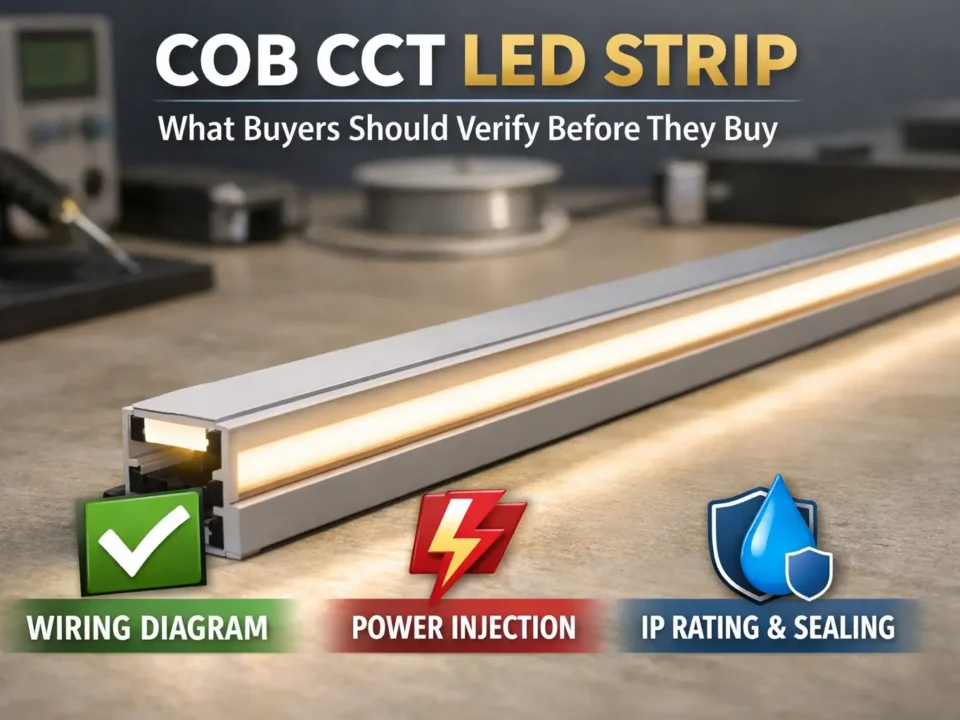
Model/series datasheet for the quoted configuration (keep it attached to the quote).
Wiring/install notes (polarity, cutting guidance, connector guidance where applicable).
Traceability approach: what identifiers appear on reels/cartons (batch ID/date code/config ID).
Inspection checkpoints: what is checked at incoming, in-process, and final stages (at a high level).
Final functional check confirmation (what is verified before packing).
Color/consistency control approach (how the supplier manages consistency across batches; request a practical explanation, not slogans).
Sample-to-production alignment plan (how the approved sample config is locked for mass production).
Change control expectation: how changes are communicated and approved after spec lock.
Packaging QC: how reels/cartons are checked against labeling requirements.
For waterproof products: what sealing steps are required at cut ends and cable exits (and what is the buyer/installer responsibility).
If any certification/marks/reports are required: request written scope confirmation for the exact model/series and configuration.
If a directory/listing exists (e.g., for certain marks): ask for the exact listing reference that matches the product category and model.
Nonconformance handling: how issues are traced back to batch/configuration and what information is needed to investigate.
Scope confirmation (US procurement note):
In the US, many projects require products to be certified by a Nationally Recognized Testing Laboratory (NRTL) for applicable safety standards; treat this as configuration- and scope-specific, not a blanket promise. Reference: OSHA NRTL program overview. OSHA: Nationally Recognized Testing Laboratory Program
If you see “ETL Listed” on a product, confirm the exact mark scope and how it applies to the product category and configuration. Reference: Intertek ETL mark description. Intertek: ETL Listed Mark
Always request scope confirmation in writing for the exact model/series you are ordering (and retain it with the PO).
Boundary conditions:
Do not assume certifications apply to all products or all variants; scope matters by model/series and configuration.
Evidence should match the quoted configuration; if the configuration changes, re-confirm scope and documents.
If your project requires specific compliance documentation, long runs, outdoor exposure, or dimming integration, request scope confirmation and a sample validation plan before placing a bulk PO.
Quote-to-Sample Workflow and Spec Lock (Reduce Production Surprises)
A practical workflow reduces the most expensive failure mode in OEM sourcing: approving one configuration on a sample and receiving a different configuration in production.
Installation practicality: cutting, connector fit, mounting method, and routing constraints.
Labeling clarity: voltage/polarity, batch/config ID, reel length/cut guidance where needed.
Boundary conditions:
Workflow timing and iteration count depend on customization depth; avoid fixed lead-time assumptions.
Testing must be done in a representative setup; lab-only tests can miss real-world constraints.
Project Risk Controls: Long Runs, IP/Waterproofing, and Dimming Compatibility
Most project failures trace back to three gaps: power planning for long runs, over-trusting IP labels without sealing discipline, and assuming dimming will “just work” without system testing.
Key points:
Long runs: voltage drop is a physics problem; solve it with a wiring/feed plan and verification, not hope.
IP selection: IP ratings describe enclosure protection levels; installation sealing is often the weak link.
Dimming: compatibility depends on the full system (strip + power supply/driver + controller/dimmer + wiring), so sample testing matters.
Boundary conditions:
Long-run limits depend on the exact model, load, wiring gauge/length, and feed strategy; verify with datasheet + project plan.
IP ratings are defined by IEC 60529; they don’t guarantee the full system if installation introduces ingress points. Reference: IEC overview. IEC: Ingress Protection (IP) ratings
Dimming behavior depends on the system; validate in a representative setup.
Long Runs: Voltage Drop Awareness and Power Injection Planning (Conceptual)
Voltage drop happens because conductors have resistance; as current flows over distance, the voltage available at the far end can decrease, which can show up as dimming, color shift (in multi-channel systems), or instability.
Key points:
Voltage drop risk increases with higher current, longer conductors, and smaller conductor cross-section.
Planning is about distributing power effectively (feed points/injection concept) and verifying under real load.
Even “good” strips can show issues if the wiring plan is not designed for the run plan.
How to plan (conceptual steps):
Create a run schedule: segment lengths, where feeds can enter, where connections will be.
Confirm the system voltage class and the control method (impacts wiring and testing approach).
Identify long segments where end-of-run performance matters most (critical viewing zones).
Plan feed points and power injection conceptually (avoid relying on a single long, single-end feed).
Prefer wiring approaches that reduce cumulative voltage loss (often parallel distribution vs long daisy chains).
Prototype the longest/most critical run with a sample and your real power/control setup.
Measure/observe at the far end under steady load and during dimming changes.
Lock the wiring plan assumptions into the final RFQ/production spec notes.
Common mistakes to avoid (checklist):
Feeding a long run from only one end without a plan for distribution.
Ignoring connector/wiring resistance in addition to strip resistance.
Testing samples on a short bench run, then assuming long-run behavior will match.
Mixing control/driver components without confirming compatibility under real wiring lengths.
Evidence (concept support):
Ohm’s Law explains the relationship between voltage, current, and resistance and is commonly used to reason about voltage drop. Fluke: What Is Ohm’s Law?
Boundary conditions:
Do not assume universal run-length limits; verify using the exact model datasheet and your installation conditions.
Final wiring should follow applicable codes and qualified electrical practice.
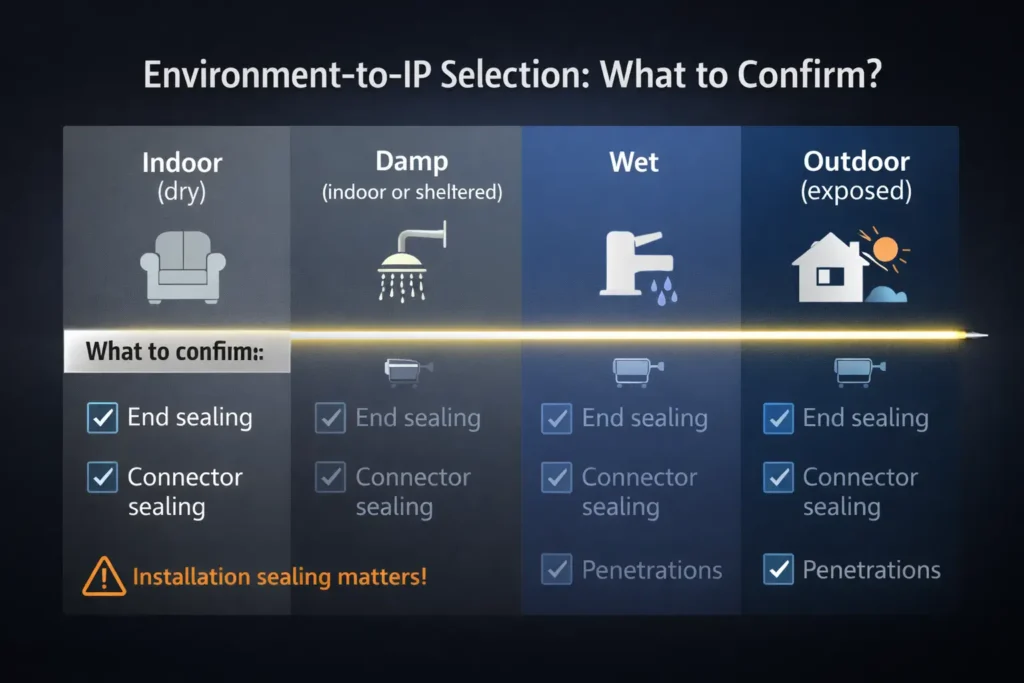
IP Rating and Waterproof Construction: Choose by Environment (Table)
IP ratings are defined under IEC 60529 and describe how well an enclosure resists ingress of solids and liquids; they are more precise than vague terms like “waterproof.” Reference: IEC IP overview. IEC: Ingress Protection (IP) ratings
Environment mapping (selection reminder):
Environment
What to confirm
Practical note
Indoor, dry
Non-waterproof vs protected mounting
Many installs rely on profiles/fixtures for protection
Indoor, occasional moisture
Exposure type (condensation vs splash)
Sealing at ends/cable exits often matters more than the label
Wet areas / cleaning exposure
Direct spray, cleaning chemicals, water jets
Define how water contacts the strip and where ingress points exist
Outdoor exposure
UV, temperature swing, wind-driven rain
Specify mounting, drainage, and sealing approach early
Common waterproof failure modes → prevention checks:
Cut ends not sealed correctly → define end-seal method and inspection responsibility.
Cable exits/penetrations left unsealed → plan grommets, sealants, and strain relief.
Waterproof layer punctured during installation → define handling and mounting practices that avoid damage.
Boundary conditions:
IP rating is not a full-system guarantee; installation practices can create ingress points.
Confirm the waterproof method and installer responsibilities during RFQ and sampling.
Dimming and Control Compatibility: Prevent Flicker and Instability
COB strips are typically part of a system: the strip itself, the power supply/driver, the controller/dimmer, and the wiring all influence dimming smoothness and stability.
Compatibility checklist:
Confirm the strip’s electrical type and the intended control approach (e.g., constant-voltage control with an appropriate controller and power source).
Confirm voltage matching across the system (strip and power source must align).
Confirm the dimming interface and method (controller/dimmer and power source must be compatible).
Test with representative wiring lengths and connection methods (bench tests can hide issues).
Verify behavior at low dim levels and during transitions (common stress points).
Document the tested configuration as part of your “spec lock.”
Optional quick troubleshooting cues (symptom → likely cause → check):
Symptom
Likely cause (common)
Check
Flicker during dimming
Control/power incompatibility or wiring effects
Test with the exact controller/driver and real wiring length
Stepping or uneven dimming
Control method mismatch
Confirm dimming method and load behavior
Instability at low levels
System sensitivity
Validate low-end dim performance on sample
Boundary conditions:
Compatibility is system-dependent; validate with a sample in the real controller/driver setup.
If the control system is not finalized, keep it explicit in the RFQ as “TBD” and plan a validation step before spec lock.
OEM/ODM Options: Customization, Packaging, and Labeling for Wholesale Orders
OEM/ODM COB strip sourcing often includes standard options and true customization; the key is knowing what can be selected quickly and what requires extra validation.
Common customization menu (typical categories):
Length/delivery format (standard reels vs custom lengths)
Feasibility varies by request complexity; confirm via samples and lock the final spec before production.
Packaging needs vary by channel (brand distribution vs project delivery); confirm early.
Customization Requests That Usually Need Extra Validation
Requests that change materials, construction, or integration details often need extra validation to avoid surprises in production or installation.
Key points:
New PCB designs and unusual mechanical constraints require clear drawings and acceptance criteria.
Waterproof construction changes require sealing discipline and responsibility assignment (factory vs installer).
Integration changes (connectors, leads, mounting methods) are best validated in a representative build.
Boundary conditions:
Validate on samples and document the approved configuration in a written spec lock.
Packaging and Labeling Checklist (Traceability + Installer Clarity)
Labeling is part of risk control: it reduces installer errors and speeds troubleshooting if something goes wrong.
Key points:
Include configuration ID, voltage/polarity, and batch ID on reels/cartons.
Match labels to the spec lock so production and installation stay aligned.
Add handling/sealing reminders for waterproof variants where installers commonly make mistakes.
Boundary conditions:
Packaging/labeling requirements differ by channel; confirm constraints early in the RFQ.
FAQ (OEM COB LED Strip Wholesale Factory Sourcing)
What is a COB LED strip, and why is it used for dotless linear lighting?
Q: What is a COB LED strip, and why is it used for dotless linear lighting? A: A COB LED strip uses closely packed LED chips to create a more continuous line of light. The “dotless” effect depends on viewing distance and diffusion (profile/diffuser), so it should be confirmed with a sample in the intended fixture and location.
How do you evaluate and shortlist a reliable OEM/wholesale COB LED strip factory?
Q: How do you evaluate and shortlist a reliable OEM/wholesale COB LED strip factory? A: Shortlist based on what you can verify: model/series datasheets, scope confirmation for any compliance marks, QC/traceability practices, and a clear sample-to-production spec lock workflow. If a supplier cannot provide configuration-specific documents or relies on blanket claims, treat it as a risk signal.
What information should you include in an RFQ for OEM COB LED strip manufacturing?
Q: What information should you include in an RFQ for OEM COB LED strip manufacturing? A: Include environment, run plan, system voltage class, control/dimming method, cut/length constraints, and packaging/labeling needs so the supplier doesn’t have to guess. If anything is unknown, mark it as “TBD” and plan a sample validation step before spec lock.
What QC checks and documentation should you request before bulk ordering?
Q: What QC checks and documentation should you request before bulk ordering? A: Request the model/series datasheet and wiring notes for the quoted configuration, traceability/labeling approach, QC checkpoint summary, and written scope confirmation for any required certifications/marks. Evidence should match the exact model/series you are ordering, not a generic company certificate page.
How do you plan power supply and power injection for long COB strip runs?
Q: How do you plan power supply and power injection for long COB strip runs? A: Plan from a run schedule: segment lengths, feed points, and where voltage drop would be most visible, then validate on a representative sample run. Long-run performance depends on the exact load, wiring, and feed strategy, so avoid universal run-length assumptions and verify with the model datasheet and project plan.
How do you choose the right IP rating and waterproof construction?
Q: How do you choose the right IP rating and waterproof construction? A: Choose by environment exposure first (dry/damp/wet/outdoor) and confirm how water/dust actually contacts the installation, then select an IP approach and sealing method that matches that exposure. IP is defined under IEC 60529 and does not guarantee the full system if installation creates ingress points, so sealing responsibilities must be clarified. IEC: Ingress Protection (IP) ratings
What dimming/control compatibility checks prevent flicker and instability?
Q: What dimming/control compatibility checks prevent flicker and instability? A: Treat dimming as a system verification: confirm voltage matching, dimming method/interface, and test with the real controller/driver and representative wiring lengths. The safest confirmation is sample testing in the intended setup before spec lock, especially for long runs or low-level dimming use cases.
Summary and Next Steps (RFQ Pack + Evidence Requests + Project Checks)
Key takeaways:
Start with a buyer-verifiable shortlist (documents, scope confirmation, QC/traceability, sample support).
Use a complete RFQ to prevent misquotes (environment + run plan + control/dimming + cut/length + packaging).
Convert QC claims into evidence requests tied to the exact model/series.
Validate the highest-risk constraints on samples (long runs, waterproof sealing, dimming stability).
Lock the approved configuration in writing before production (spec lock + change control expectations).
Next steps checklist (quote-ready pack):
A run schedule or drawing with segment lengths and feed entry points.
Compliance expectations (if project-driven) and a request for written scope confirmation by model/series.
If you’re sourcing for a project with custom lengths, long continuous runs, outdoor exposure, specific compliance requirements, or a complex dimming system, request a spec review + sample validation plan before finalizing a bulk order.