Vous avez besoin d'un produit de qualité en peu de temps ? Nous avons un plan pour vous.


Table des matières
If you are specifying an RGBW COB LED strip for a project, the product page is only the starting point. You also need to check the white channel, the controller, the wiring plan, and the power layout. As a result, the strip will look and work better in the real install.
An RGBW COB LED strip is a constant-voltage tape light with red, green, blue, and white channels. It also uses a COB LED layout, so the light line can look smoother than many strips with spaced LED dots.
However, the strip alone does not make a good system. You still need the right driver, RGBW controller, wiring map, power feeds, and IP build.
RGBW COB strips are often chosen when a project needs color scenes plus a usable white channel. In addition, the COB layout can help create a cleaner light line.
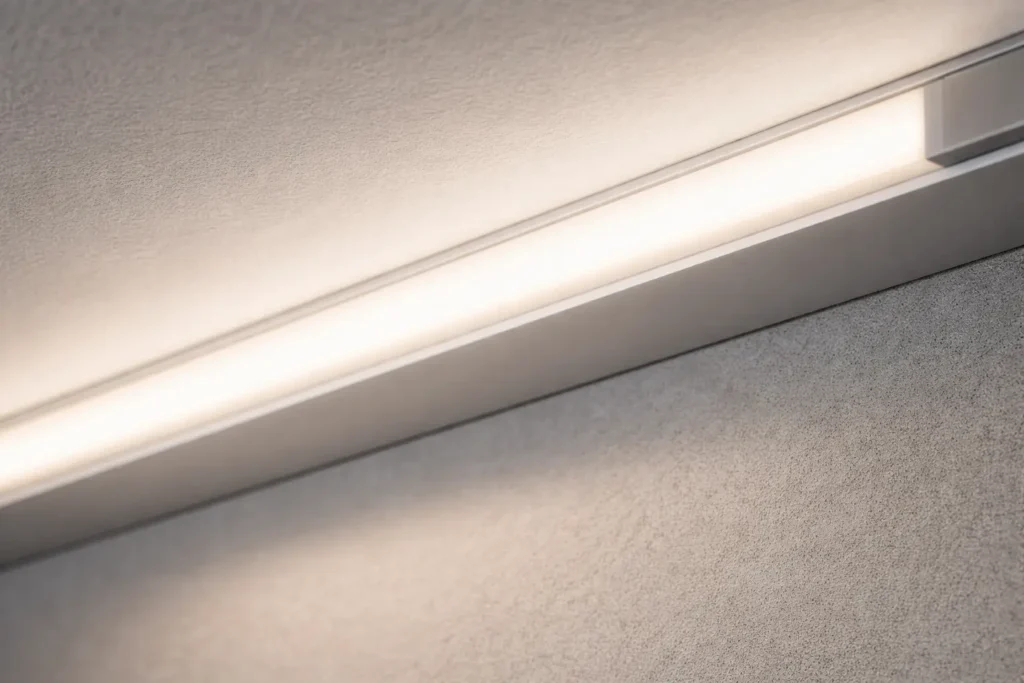
If the strip is hidden behind a strong diffuser, SMD RGBW may be enough. Also, SMD may offer other price or size options. Therefore, choose by the real fixture and view distance, not only by the LED type.
RGBW does not automatically guarantee perfect white. The actual white depends on the W LEDs in that model and the controller setup. Therefore, confirm the white type in the datasheet and sample it when white quality matters.
Choose the white setup based on how flexible the white light must be. For example, RGBW gives one white channel. However, RGBCCT adds warm and cool white channels for tunable white scenes.
| Option | White behavior | Best fit | Control impact |
|---|---|---|---|
| RGBW | One dedicated white channel | Color scenes plus practical white | Needs RGBW controller and correct channel map |
| RGBWW | Often adds warmer white behavior, depending on model | Warmer white scenes plus color | Needs more channel checks |
| RGBCCT | RGB plus warm and cool white channels | Tunable white plus color scenes | Needs CCT-capable controller and correct wiring |
Do not assume CCT, CRI, or white quality from the product name. Instead, confirm the datasheet and channel map. Then, test a sample if the white tone is important to the project.
A typical RGBW COB system uses a constant-voltage driver for power and an RGBW controller or decoder for the channels. Therefore, treat power and color control as two separate checks.

Evidence note: For background on LED strip dimming and PWM-style control, see MEAN WELL’s overview: How to select a LED driver to DIM LED Strip?
Boundary conditions: Terminal names and wiring rules vary. Therefore, check the strip wiring diagram and controller manual before power-up.
Voltage drop happens when current moves through wire and strip copper. As a result, long runs can become dimmer, shift color, or act unstable. Therefore, longer RGBW COB runs need a power feed plan.
For the same load, a higher voltage often lowers current. As a result, 24V can reduce voltage-drop risk. However, a poor 24V layout can still show problems. Therefore, the layout still matters most.
Do not promise max run length without the exact datasheet and layout. Instead, verify performance under full load with the real wiring, controller, and feed points.
Choose IP construction by exposure. However, the real result depends on how ends, joints, and connectors are sealed. Therefore, IP is both a product choice and an installation choice.
| Scenario | Typical IP direction | Install notes that matter |
|---|---|---|
| Dry indoor | Lower IP builds are often used | Focus on profile, wire routing, and access |
| Splash or humidity | Higher protection is often selected | Seal joints and protect connectors |
| Outdoor rain | Higher protection is often selected | Seal ends, add strain relief, and protect joints |
| Wash-down or harsh exposure | Project-specific build may be needed | Confirm sealing, parts, and service access |
Evidence note: For IP background, see the IEC overview: Ingress Protection (IP) ratings.
Boundary conditions: Outdoor conditions can include UV, heat, cold, rain, and spray. Therefore, describe the real exposure before choosing the IP build.
Before ordering RGBW COB strips, confirm the key details on the datasheet. Also, request the wiring diagram for the exact model or series.
| Category | What to confirm | Why it matters |
|---|---|---|
| Electrical | Voltage, power, and driver method | Prevents low voltage and unstable output |
| Channels | RGBW, RGBWW, or RGBCCT | Confirms white behavior |
| Contrôle | Controller or decoder support | Prevents wrong colors or missing white |
| IP build | Sealing method and install notes | Prevents leaks at ends and joints |
| Mechanical | PCB width, bend limits, and cut points | Prevents fit and stress issues |
| Documents | Datasheet, wiring diagram, install notes | Supports buying, install, and service |
| Compliance | Scope by model or series | Avoids wrong certificate assumptions |
Boundary conditions: Do not assume long-run behavior or certificate scope. Instead, check the exact model and the real layout.
Answer: An RGBW COB LED strip has RGB color channels plus a dedicated white channel. It also uses a COB LED layout, so the light line often looks smoother than many spaced SMD strips.
Answer: Usually, RGBW gives a more useful white than RGB mixed white because it has a dedicated W channel. However, the exact white look depends on the model’s white LEDs.
Answer: Choose RGBW for color plus one white type. However, choose RGBWW or RGBCCT if you need warm-to-cool white control. Also, make sure the controller supports the extra channels.
Answer: In many long-run projects, 24V is easier because it can lower current for the same load. However, feed planning and power injection still matter most.
Answer: A common setup is constant-voltage driver to RGBW controller, then controller outputs to R, G, B, W, and common terminals. First, check the wiring diagram. Then, test a short section before the full run.
Answer: Confirm voltage, channel setup, white behavior, controller fit, IP build, strip size, cut points, and documents. Also, request the datasheet and wiring diagram for the exact model.
Finally, choose an RGBW COB LED strip by system fit, not by the product name alone. First, choose the white setup. Next, confirm control. Then, plan power, IP, and documents.
If you want help checking an RGBW COB strip for a project, request the datasheet and wiring diagram for the exact model. Then, share layout limits, control needs, and site exposure for review.
 English
  Spanish
  French
  Arabic