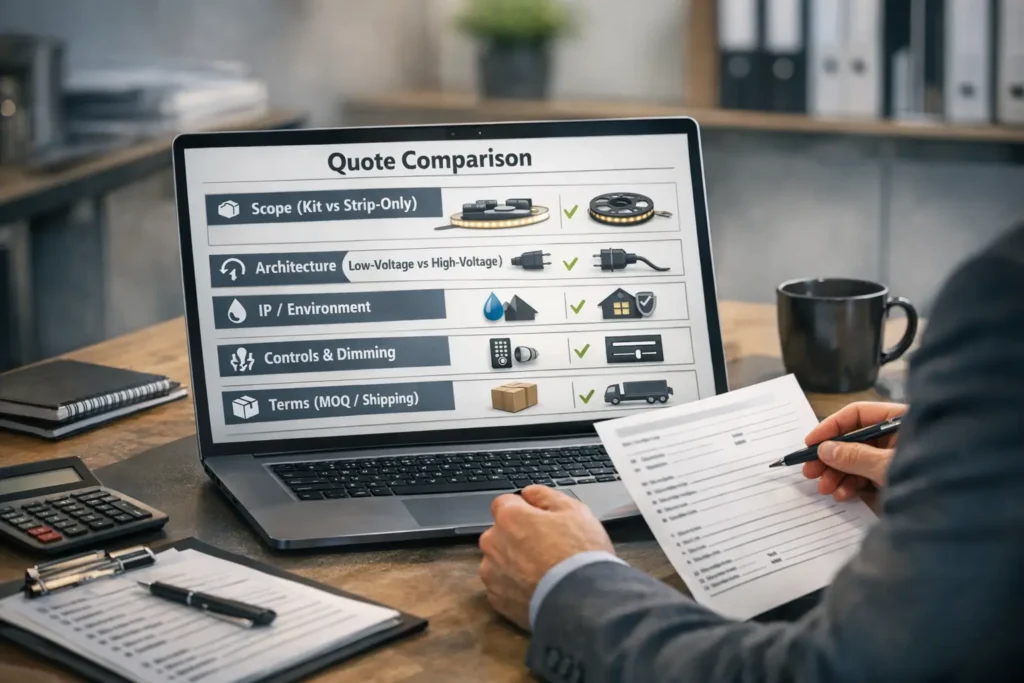
Vous avez besoin d'un produit de qualité en peu de temps ? Nous avons un plan pour vous.


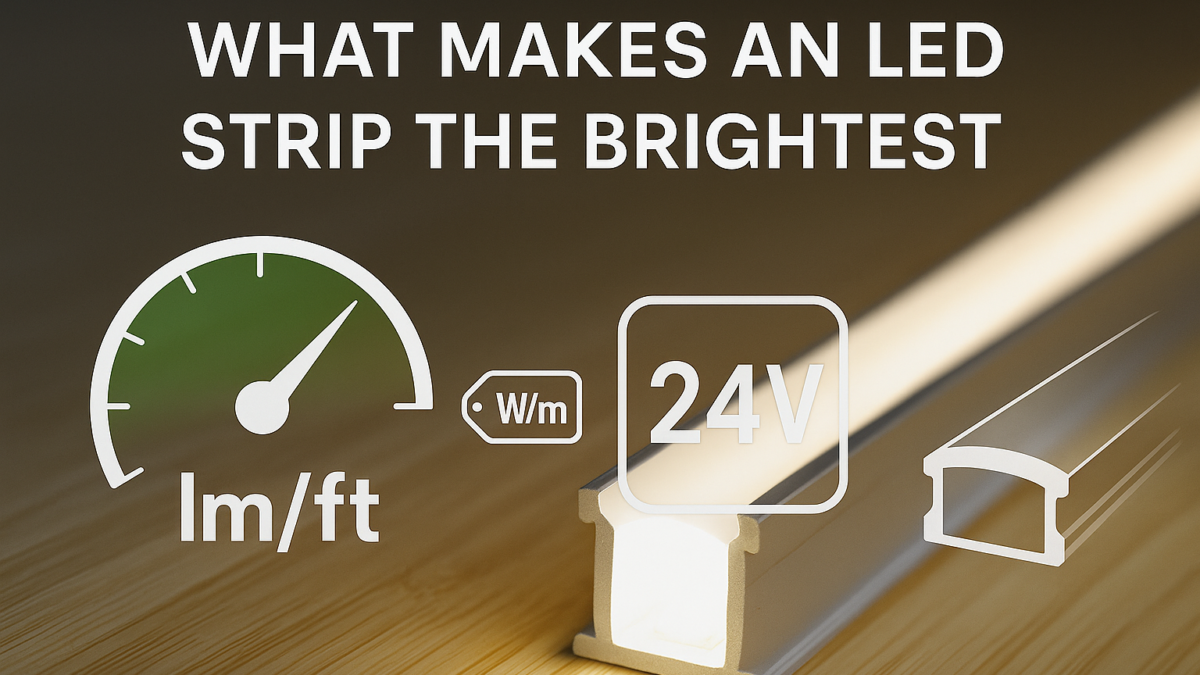
Les brightest LED strips are not always the strips with the highest watts. Instead, compare strips by lumens per foot, LED density, package type, heat control, voltage, and driver size.
Therefore, use lumens per foot as the main brightness value. Then, check watts per metre, strip layout, power supply headroom, and mounting profile before choosing a high-output strip.
For related product planning, see Elstar’s Bande LED, Bandes LED COB, LED power supplieset Profilés LED en aluminium. For external background, see the U.S. Department of Energy guide to Eclairage LED, ENERGY STAR’s guide to brightness and lumens, and the IEC overview of Indices IP.
Measure the brightest LED strips by lumens per foot, not watts alone. Watts show input power, while lumens show visible light output. As a result, two strips with the same wattage can look very different.
For long bright runs, 24V is often easier to manage than 12V. However, the right voltage still depends on run length, wattage, controller type, and wire route.
Lumens per foot shows what you see. Meanwhile, watts per metre shows power input and heat load. LED density affects smoothness and the possible output limit.
| Application | Target lm/ft | Typical W/m | LED/ft band | Package / Rows | Suggested CCT / CRI | Profile & Diffuser | PSU |
|---|---|---|---|---|---|---|---|
| Architectural wall-wash | 300–500 | 12–18 | 60–120 | COB / Dual-row | 3000–4000K / CRI≥90 | Deep channel + opal | 1.2–1.5× total W |
| Signage / display | 700–1000+ | 18–24+ | 120–180 | Quad-row 5050 | 4000–6500K / CRI≥90 | Deep channel + glare control | 1.2–1.5× total W |
Start with the application. Then, choose the target lm/ft band. After that, confirm heat, driver size, and profile depth.
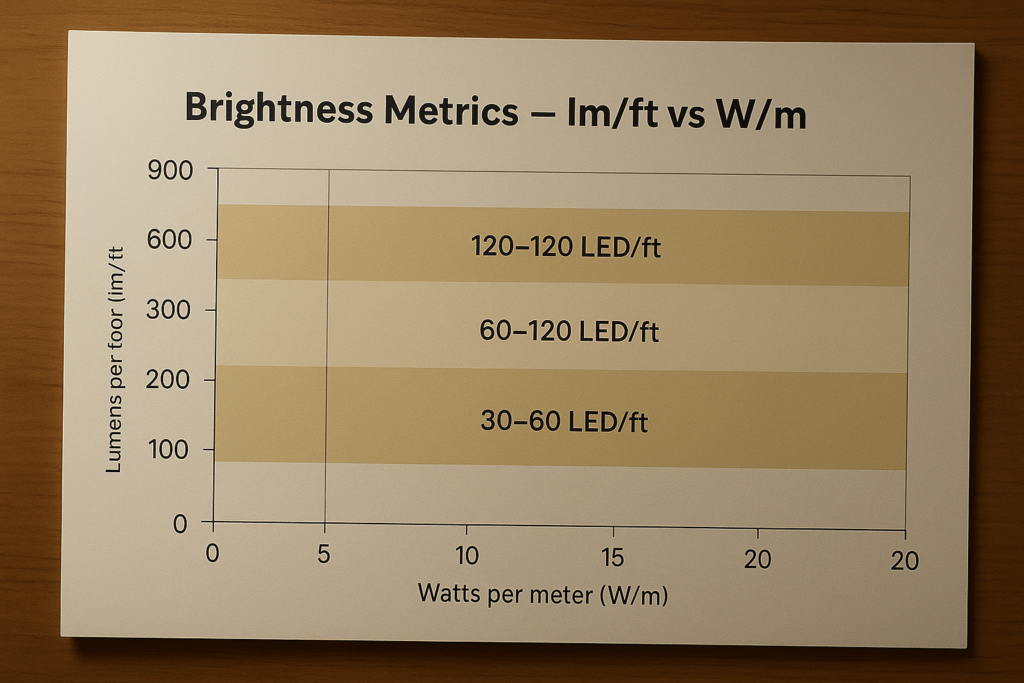
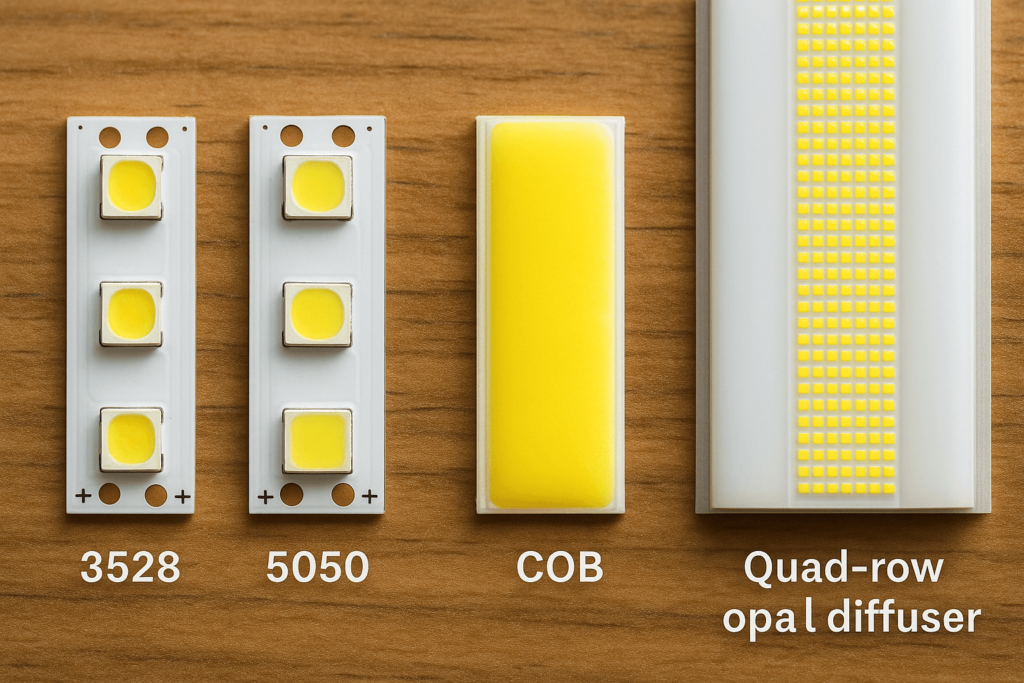
Package and board layout affect both brightness and smoothness. For example, 5050 packages often give higher output per LED than 3528 packages. However, COB can look smoother because it spreads light into a more continuous line.
COB is often chosen for dot-free lines. However, the absolute highest lm/ft may still come from multi-row SMD layouts. Therefore, choose COB for smoothness and multi-row SMD for peak output.
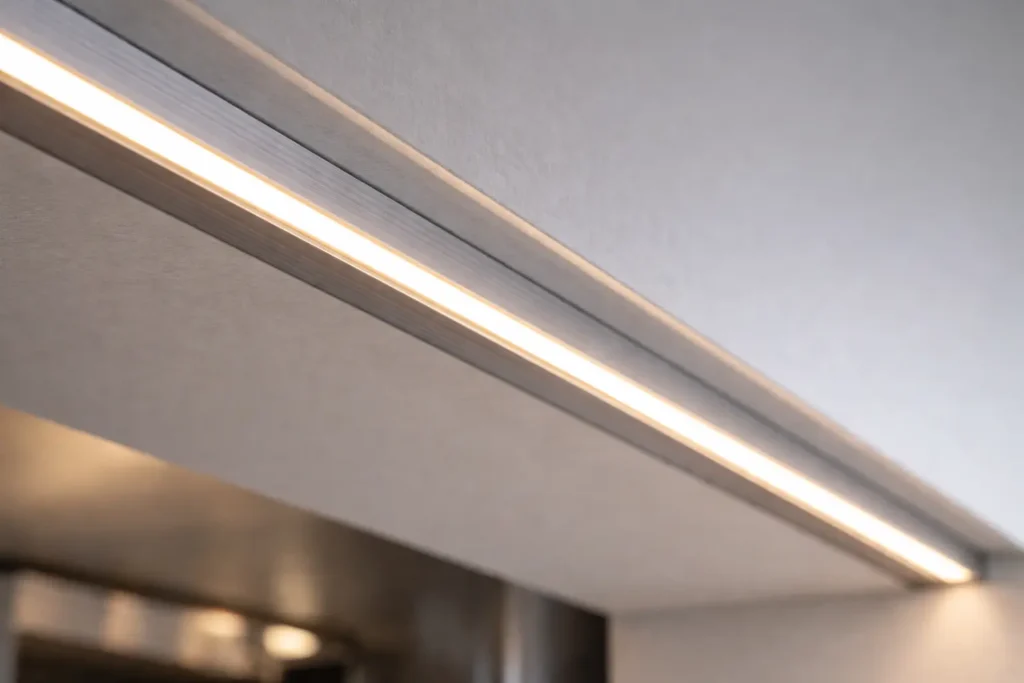
Use a deeper opal aluminum profile when brightness is high. As a result, the light can look smoother and the strip can shed heat better.
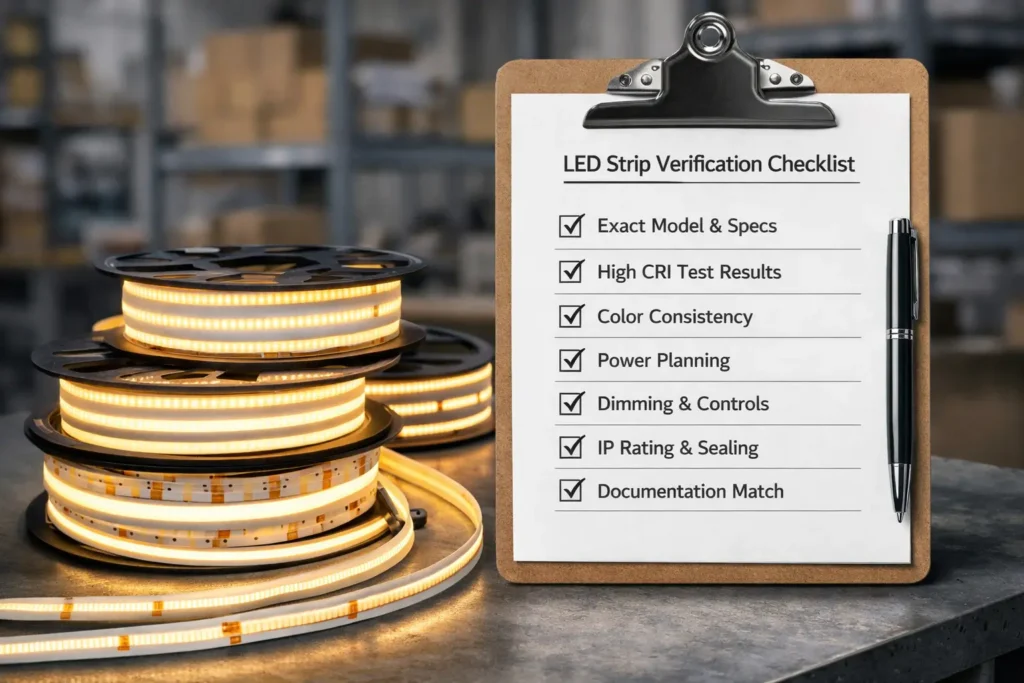
High brightness should still look clean and true. Therefore, check color quality along with lumens per foot.
A very bright strip can still look poor if the white is green, blue, or uneven. As a result, high-output retail, display, and task lighting should use reliable color specs.
For premium work, choose high output and good color quality together. Also, test a sample in the real profile before buying in bulk.

Voltage affects bright runs. In general, 24V helps reduce current for the same power. Therefore, 24V often works better for long, bright strips.
| Tension | Watts/m | Max run single-end | Wire gauge | Injection points | Notes |
|---|---|---|---|---|---|
| 12V | 12 | 5–7 m | 16–18 AWG | Center-feed above 5 m | Short bright runs |
| 24V | 12 | 10–15 m | 16–18 AWG | Multi-injection above 10 m | Better for high output |
| 24V | 18–24 | 7–12 m | 14–16 AWG | Early multi-injection | Heat and drop rise with W/m |

High watts per metre create more heat. Therefore, heat control is a key part of choosing the brightest LED strips.
Do not place high-output strips in tight sealed spaces without heat paths. Also, avoid mounting them on soft or heat-trapping materials.

Most bright LED strips use a constant-voltage driver. Therefore, match the driver voltage to the strip and size the driver above the calculated load.
Calculate the total strip wattage first. Then, choose a driver at about 120–150% of that load. As a result, the driver has more headroom for heat and inrush current.
For matched options, review LED power supplies for the voltage and wattage your layout needs.

Bright strips need matching controls. Otherwise, dimming can flicker, shimmer, or feel rough at low levels.
Check PWM frequency, low-end trim, and driver fit. Also, test the strip on camera if the space will be filmed.
For more detail on control hardware, review Elstar’s LED controllers and dimmers.

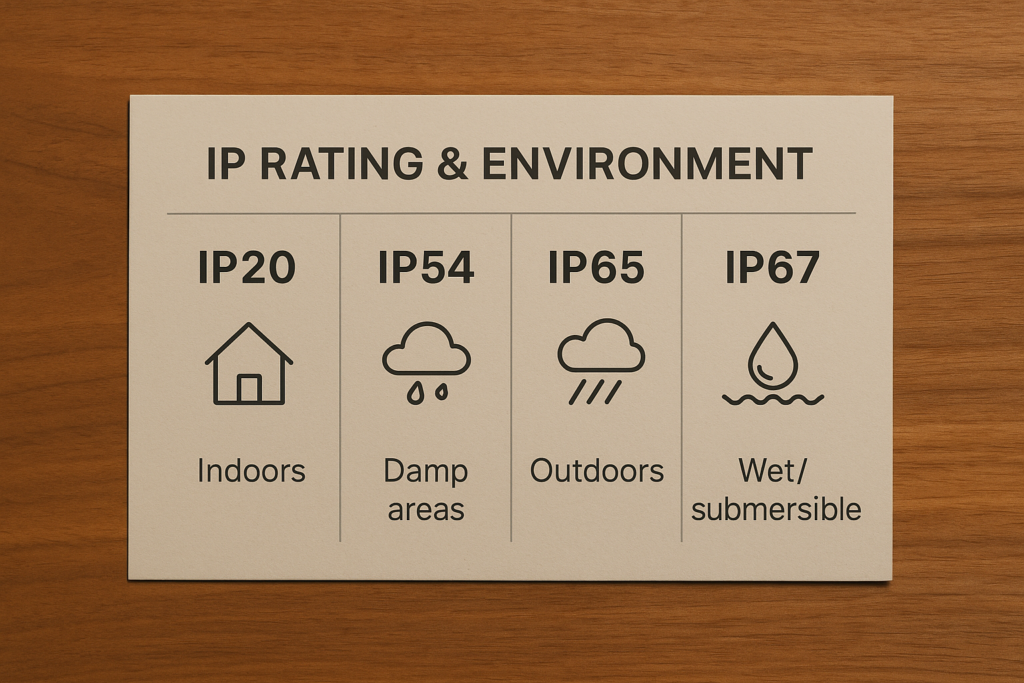
Environment affects brightness and life. Therefore, choose protection based on moisture, cleaning, dust, and heat.
Encapsulation can protect the strip from moisture. However, it can also hold in heat. Therefore, balance IP rating with heat control.
A bright strip install works best when each step is tested. Therefore, dry-fit, route, clean, mount, connect, dim-test, and finalize in order.
If the project uses high output, long runs, or outdoor exposure, ask for a matched layout and driver plan before ordering.

Use lumens per foot verified by data when possible. Also, check W/m and LED density for heat and smoothness.
COB is usually smoother, not always the brightest. The highest lm/ft often comes from multi-row SMD designs.
Use 24V for long, even, high-output runs. However, 12V can work for short bright spans.
Plan center-feed or multi-injection layouts. Also, choose the right wire gauge for the run.
Use enough depth to hide hot spots and spread heat. Deeper channels with opal diffusers work best.
Choose about 1.2–1.5× the calculated load. Then, keep the driver ventilated and accessible.
To choose the brightest LED strips, start with real brightness metrics. First, compare lumens per foot. Next, check W/m, LED density, package type, voltage, and heat control. Finally, size the driver with enough headroom.
Request a quote or browse Bande LED to get started.

 English
  Spanish
  French
  Arabic