Vous avez besoin d'un produit de qualité en peu de temps ? Nous avons un plan pour vous.


Choosing between rope lights et Bande LED is not only about style. For a business, building, retail, OEM, or contractor project, the better choice depends on where the light will sit, how much of the fixture people will see, how bright it must be, what control is needed, and which setup risks must be checked before purchase.
Both rope lights and LED strip lights can create linear light effects. However, they are built in different ways. As a result, each one solves a different set of project needs. This guide compares their shape, best uses, setup needs, power, brightness, control, and RFQ details so buyers can make a clear choice.
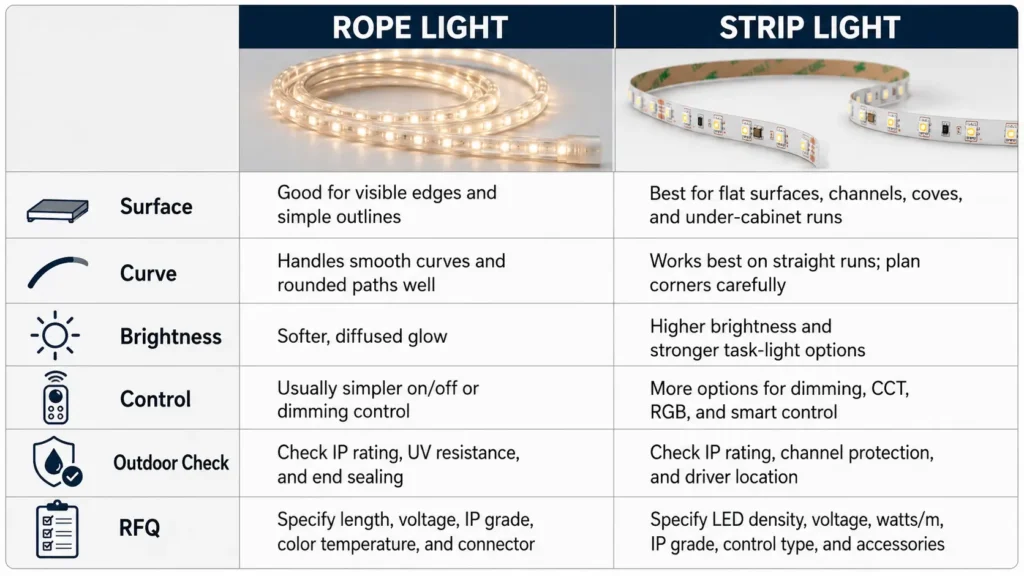
There is no single winner between rope light and strip light. In many cases, LED strip lights work better on flat surfaces, inside channels, under cabinets, in coves, and in projects that need more direct light or control. By contrast, rope lights are often used for soft outline lighting, gentle curves, and visible round light lines. Therefore, the right choice depends on the use case, surface, brightness goal, control needs, site conditions, power plan, and access for setup or service.
| Facteur | Lumière de corde | Bande LED | What Buyers Should Check |
|---|---|---|---|
| Basic shape | Often round or tube-shaped | Usually a flat flexible PCB with LEDs on the surface | Check the exact type, size, and build |
| Light look | Soft, round, and visible | More direct and low-profile | Decide whether the fixture should be seen or hidden |
| Mounting style | Often uses clips, brackets, or channels | Often uses adhesive backing, channels, clips, or profiles | Match the method to the surface |
| Best-fit surfaces | Curves, outlines, and decorative runs | Flat surfaces, channels, coves, cabinets, shelves, and displays | Match the product to the surface shape |
| Luminosité | Depends on the product | Many strip lights have higher-output options, but specs vary | Compare wattage, LED density, diffuser, voltage, and datasheet |
| Control options | Product-dependent | Often chosen when dimming, color, or controllers matter | Check the driver and controller match |
| Cutting and length | Product-dependent | Cut only at marked points and follow the maker’s guide | Check cut points and max run length |
| Outdoor use | Depends on rating and setup | Depends on rating and setup | Check IP rating, seals, connectors, driver, and site conditions |
| B2B sourcing note | Useful for decorative outlines and visible light lines | Useful for flat or recessed projects with clear specs | Share use case, length, voltage, color, control, quantity, and document needs in the RFQ |
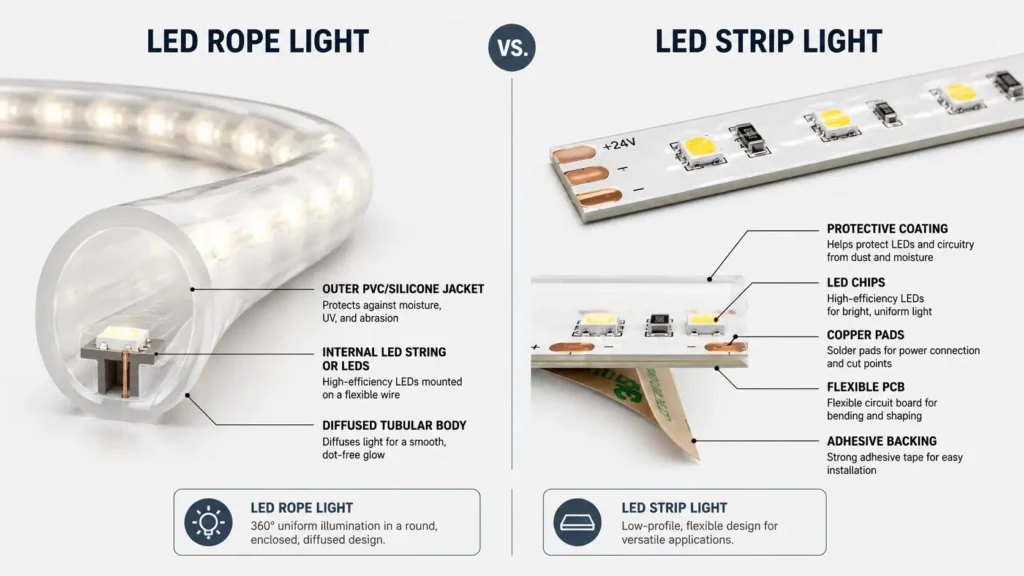
A rope light is usually a round or tube-shaped linear light. Its light source sits inside a casing, so the product can give a soft and steady-looking line. Because of this shape, rope lights can work well for decorative outlines, contour lighting, event décor, sign edges, and gentle curves.
In B2B projects, rope lights are often reviewed when the light itself will be part of the design. They can create a softer outline effect. Even so, final fit depends on the product design, mounting method, voltage, IP rating, run length, and site conditions.
Rope lights are not the right choice for every curved or outdoor project. Before you specify one, check bend limits, power setup, fixing method, IP rating, and connection method. For more sourcing context, review ElstarLED’s LED rope light manufacturer page.
An LED strip light is usually a flat, flexible PCB-based light with LEDs mounted on its surface. Because it is thin, it is often used on flat surfaces, inside channels, under cabinets, on shelves, in coves, in retail displays, in signs, and in OEM builds. For more internal background, see ElstarLED’s guide on what strip lights are.
For extra background on strip-light choice, you can review this LED strip lighting guide. It explains common factors such as strip type, color, indoor or outdoor use, brightness, and length. However, use that type of guide as learning support, not as proof of any ElstarLED product spec.
LED strip lights are often chosen when a project needs more control over brightness, color temperature, RGB or RGBW effects, dimming, or driver and controller setup. Still, these benefits depend on the exact product. Therefore, buyers should compare the actual datasheet, wattage per meter or foot, LED density, voltage, CRI, CCT, controller type, and mounting method.
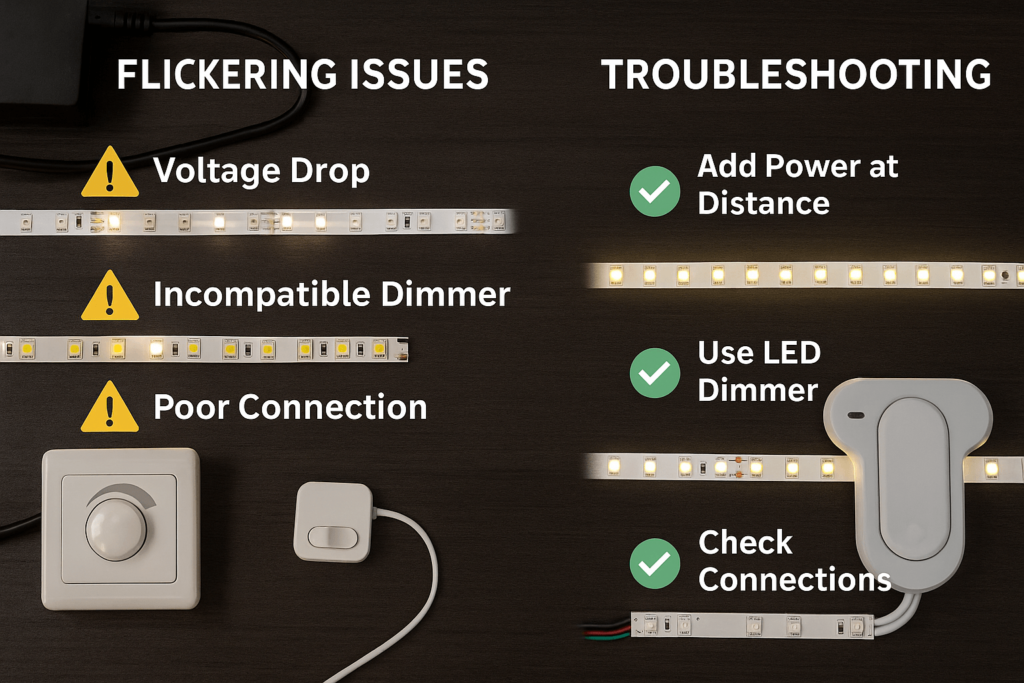
During setup, handle LED strips with care. Cut only at marked points. Also, follow the supplier’s guide for the power supply, connections, heat control, and mounting.
| Project Condition | Check Rope Light When… | Check LED Strip Light When… | Confirm Before Buying |
|---|---|---|---|
| The light will be visible | You want a round decorative line | You want a slim line or a hidden light source | Look, diffuser, profile, and mounting method |
| The surface is flat | A rope light may look too bulky | A strip light often fits flat surfaces or channels better | Adhesion, channel, clips, and surface type |
| The project uses curves | You need gentle outline bends | The strip can bend in the needed direction and radius | Bend direction, minimum bend radius, and product guide |
| The light is hidden in a cove | You want a soft effect | You need a flat light for cove or recessed use | Heat, driver access, diffusion, and brightness goal |
| The project needs strong direct light | You have checked the product specs | You need higher-output strip options | LED density, wattage, diffuser, and voltage |
| The project needs dimming or color control | The product supports the needed control | The system will use drivers or controllers | Driver, controller, voltage, and wiring plan |
| The project is outdoors or exposed | The full system is rated for the site | The full system is rated for the site | IP rating, connectors, seals, driver location, and site exposure |
| The project has long runs | Max run and voltage drop are checked | Max run and voltage drop are checked | Voltage, driver load, wiring, and feed points |
| The project needs custom work | The supplier supports the format | You need clear specs for size, voltage, color, or control | Drawings, length, voltage, color, control, packing, and documents |
| Application | Rope Light Fit | LED Strip Light Fit | Buyer Notes |
|---|---|---|---|
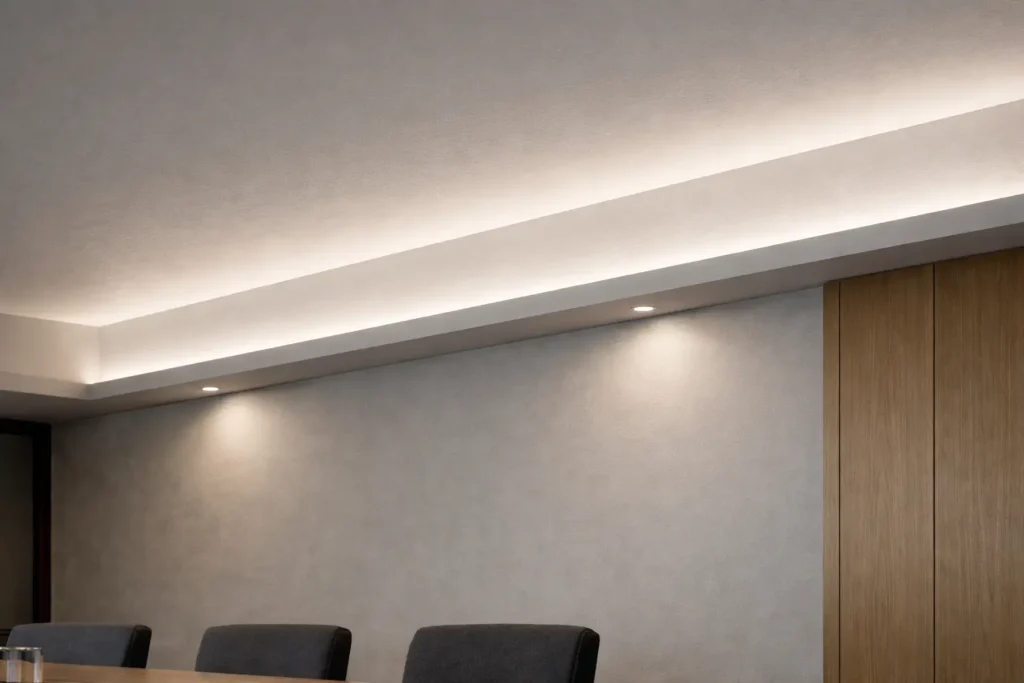
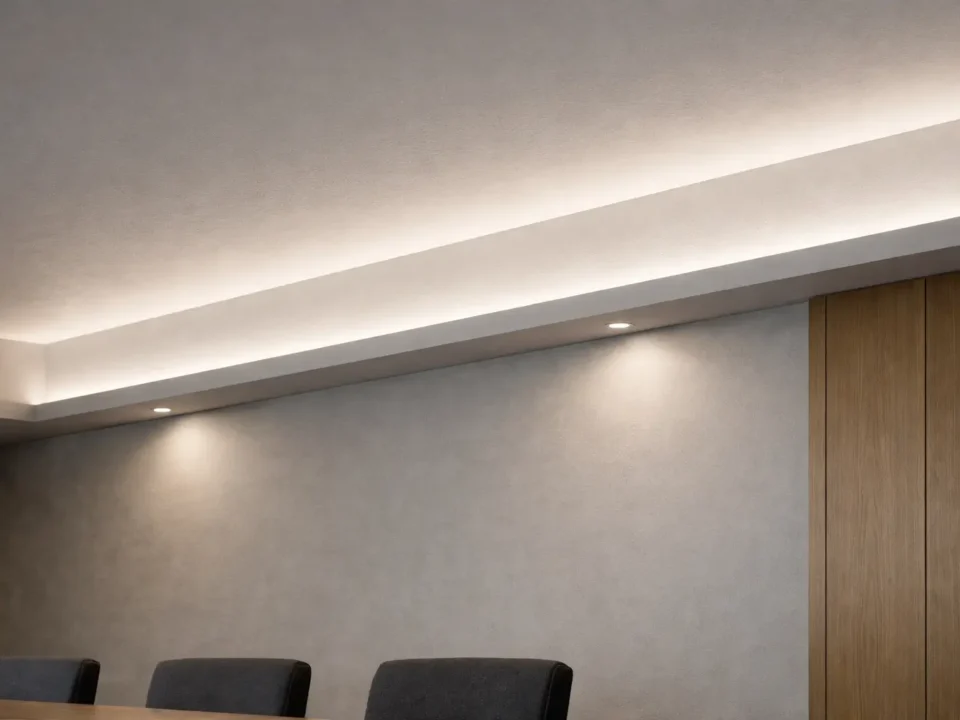
| False ceiling or cove lighting | Can create a soft decorative line if the design allows | Often used for hidden cove lighting because it is flat | Check brightness goal, heat path, driver access, and channel or diffuser needs |
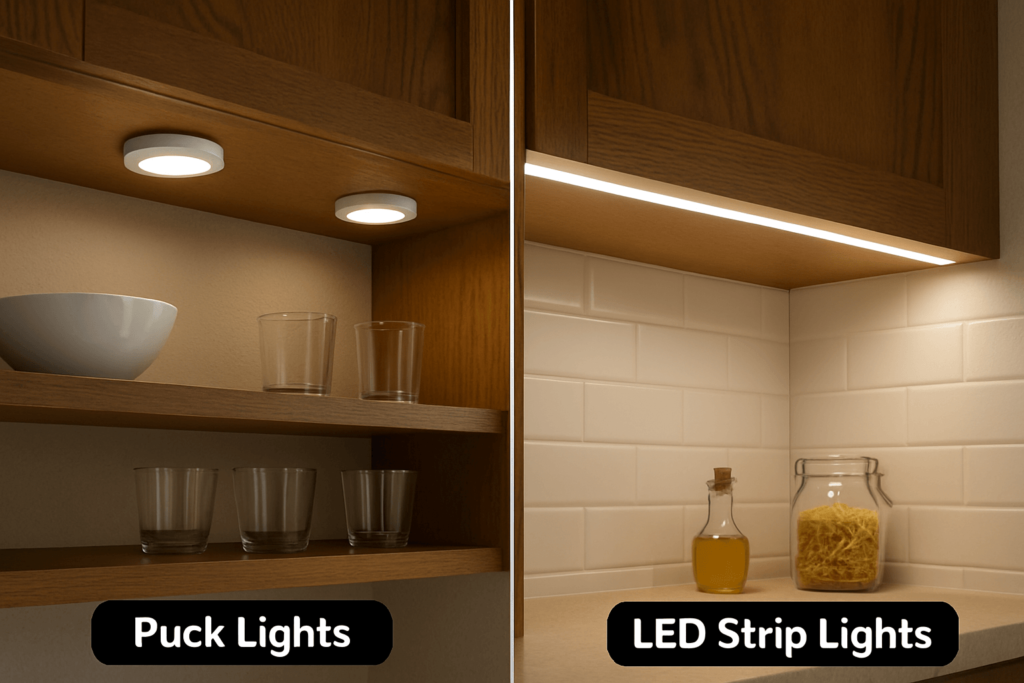
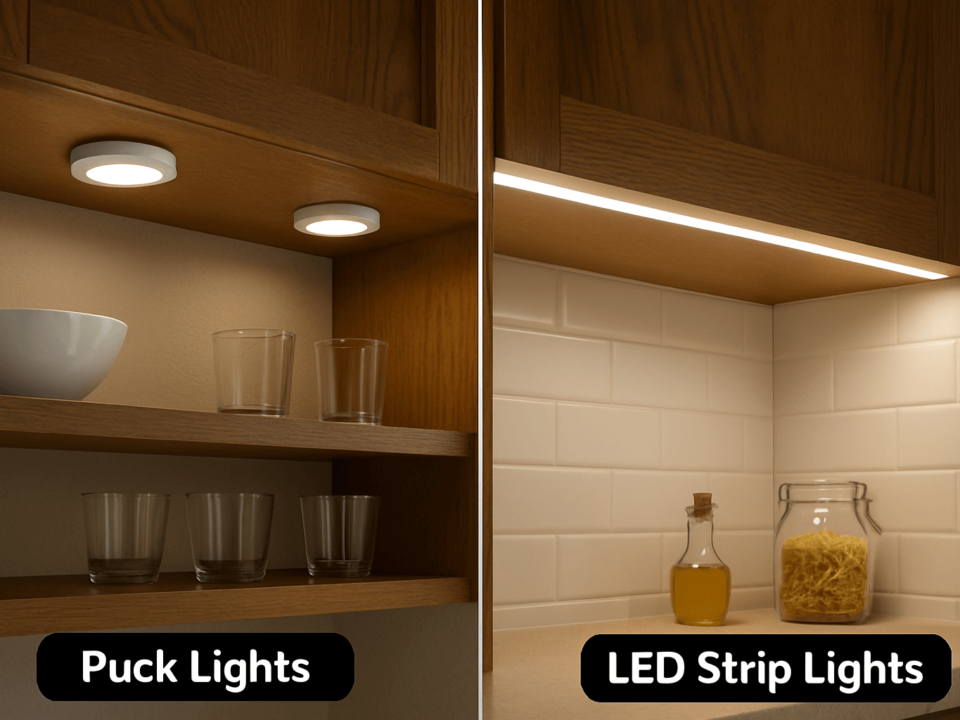
| Cabinet or shelf lighting | Less common when a slim hidden fixture is needed | Often a strong fit for low-profile mounting | Check CCT, CRI needs, adhesive or channel method, and power location |
| Sign outline | Often used for visible outlines and curved shapes | Often used for channel letters, edge lines, or controlled effects | Check bend needs, visibility, color, voltage, and setup method |
| Retail display lighting | Can add decorative accent light | Often used for display shelves, cases, and linear accents | Check brightness, glare, color match, and service access |
| Building outline | Often useful for soft visible outlines | Useful when a flat or recessed light line is preferred | Check fixture visibility, surface type, and weather exposure |
| Outdoor accent | Possible only when product and system match the site | Possible only when product and system match the site | Check IP rating, seals, connectors, driver, power supply, and site conditions |
| Event or temporary décor | Often used for visible decorative runs | Often used when control, color, or low-profile mounting is needed | Check fixing method, power access, reuse plans, and handling |
| OEM or custom build | Possible when the supplier supports the needed format | Often used when size, voltage, color, and control must be set | Check drawings, target specs, samples, tests, and packing needs |
If the design needs a smooth, diffused light line rather than a visible tube or flat PCB strip, buyers can also compare related options such as LED neon light products.
A rope light or LED strip light may fail to meet the project goal if the buyer looks only at the product name. Instead, check the full system before you choose. For additional internal safety context, review ElstarLED’s guide to common LED strip fire hazards and safer planning checks.
| Item to Check | Why It Matters |
|---|---|
| Mounting surface | Adhesive, clips, brackets, and channels work differently on metal, wood, glass, painted surfaces, plaster, and outdoor materials |
| Fixture visibility | A visible product may need a clean look; a hidden product may need better diffusion and heat control |
| Bend direction | Some products bend only in certain ways; the wrong bend can damage the light |
| Cut points | LED strips and some linear lights should be cut only at allowed points |
| Total run length | Long runs can affect voltage drop, brightness match, and power layout |
| Tension | The product, driver, controller, and wiring must match |
| Driver or power supply | The driver must suit the load and the site |
| Controller match | Dimming, CCT tuning, RGB, or digital control depends on the product and system |
| Connectors and feed points | The connection method affects reliability, labor, and service |
| Heat control | Some strip-light jobs may need aluminum channels or other heat support |
| Environment | Indoor, outdoor, damp, wet, dusty, or high-touch sites need different checks |
| Service access | Drivers, connectors, and long runs should be easy enough to inspect or replace |
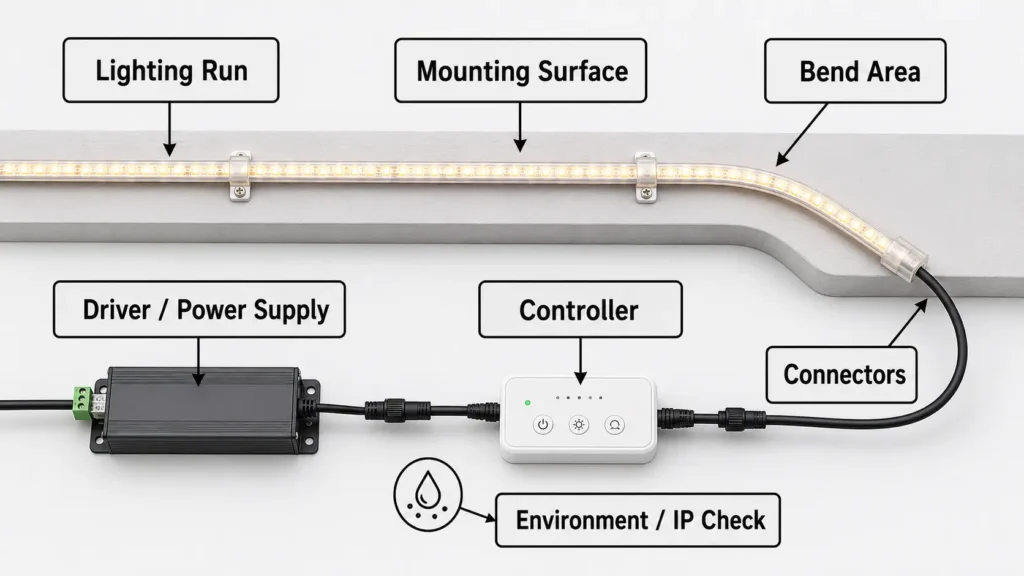
Many buyers ask whether rope lights or strip lights are brighter, more efficient, or easier to control. The safest answer is simple: it depends on the product specs and the setup plan.
For general LED background, the U.S. Department of Energy LED lighting overview is a useful reference. Even so, a rope-light or strip-light project still needs a load check based on the datasheet, total run length, driver size, and wiring layout.
For extra learning on matching linear lights with a driver or transformer, you can review 1000Bulbs’ guide to rope light and strip light drivers and installation. For strip-specific setup details, see its LED strip light installation guide. Final driver choice should still follow the product datasheet and a qualified setup review.
When sourcing parts from ElstarLED, buyers can also compare LED power supply options, LED strip controllers and amplifiers, and ElstarLED’s article on LED driver vs strip light planning.
Do not choose by product name alone. A high-output strip light, a decorative rope light, and a neon-style linear light can all have different power, light, and setup needs.
A clear RFQ helps the supplier or project team suggest a better product. Before you ask for a quote, gather as much of the following information as you can.
| RFQ Item | What to Provide |
|---|---|
| Application | Cove lighting, cabinet lighting, sign lighting, outline lighting, retail display, building face, OEM product, event décor, or other use |
| Indoor or outdoor | State the site and whether the product may face water, dust, heat, cleaning, or direct exposure |
| Total length | Give total length, segment lengths, and drawings if available |
| Voltage preference | State the required voltage if the project already has one |
| Brightness goal | Share the desired effect, distance from the surface, or target light level if known |
| Color need | Single color, CCT, RGB, RGBW, tunable white, or custom color |
| Control method | On/off, dimming, remote control, DMX, app control, sensor, or other system |
| Mounting method | Adhesive, clips, aluminum channel, recessed channel, brackets, or custom housing |
| Surface type | Metal, wood, glass, plaster, concrete, painted wall, sign material, or other base |
| Quantity | Estimated order quantity or project phase quantity |
| Drawings or photos | Site drawings, site photos, product sketches, or profile needs |
| Documents needed | Datasheet, setup guide, IP rating proof, test report, certificate, warranty terms, or packing details |
| Packing or labels | Standard packing, project labels, distributor packing, or OEM packing |
| Timeline needs | Share the project schedule, then confirm whether it is possible with the supplier |
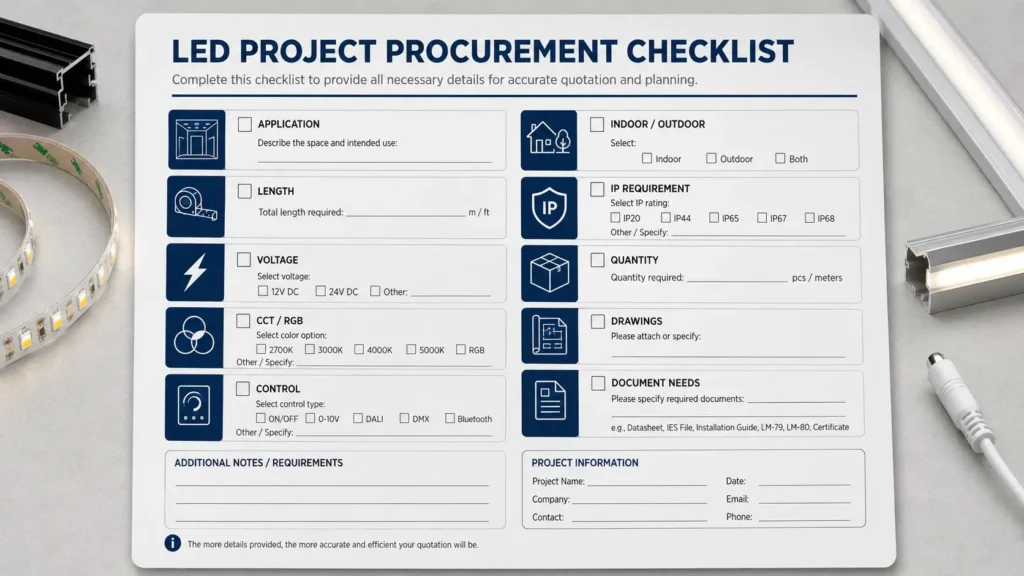
This checklist does not replace a technical review. However, it helps the supplier understand the job. As a result, the product, driver, controller, and mounting method can be checked more carefully. For LED strip project customization context, see ElstarLED’s customization page.
For B2B buying, the key question is not only “rope light or strip light?” Buyers also need to know whether the supplier can support the project with clear facts and useful documents.
Before approval or bulk purchase, ask for the documents that match your project, such as:
Do not assume a document exists just because it is common in the industry. Instead, ask for the exact document your project, market, or customer requires.
Neither one is better for every project. Rope lights are often used for soft decorative outlines and visible round light lines. In contrast, LED strip lights are often used for flat, recessed, cabinet, cove, display, or control-focused projects. The better choice depends on the use case, surface, brightness goal, control needs, site conditions, and setup method.
LED strip lights are often considered for false ceiling or cove lighting because they are flat and can fit into channels or recessed areas. However, rope lights may still work when the design needs a softer decorative line. Final choice should be based on brightness, diffusion, heat, mounting, driver access, and service access.
Rope lights are commonly used for decorative outlines, gentle curves, contour lighting, event décor, sign edges, and visible linear accents. For outdoor or exposed use, check the IP rating, seals, connectors, driver location, and site conditions before purchase.
Power use depends on wattage per meter or foot and total installed length. To estimate energy demand, check the datasheet, calculate the total load, and confirm driver or power supply capacity. Therefore, do not compare energy use by product name alone.
Brightness depends on the actual product, not only the name. Compare LED type, LED density, wattage, diffuser, voltage, beam direction, and mounting method. Many strip lights offer higher-output options, but the final check should come from datasheets.
Ease of setup depends on the surface and mounting method. Many LED strip lights use adhesive backing, clips, or aluminum channels. Meanwhile, rope lights often use clips, brackets, or channels. For both options, check surface prep, bend direction, cut points, power supply, connectors, and service access.
They can be used outdoors only when the product and full system suit the site. First, check IP rating, connector seals, driver location, power supply, mounting method, and exposure. Also, do not assume any rope light or strip light is outdoor-ready without checking the spec.
Include the application, total length, indoor or outdoor site, voltage, color or CCT, brightness goal, control method, mounting method, quantity, drawings or photos, and any required documents. For example, you may need datasheets, setup guides, IP rating details, test reports, certificates, warranty terms, or packing requirements.
Rope lights and LED strip lights can both work well when they match the project conditions. Before you choose, define the use case, surface, site conditions, brightness goal, color, control method, voltage, run length, quantity, and document needs.
Then, prepare drawings, photos, length needs, voltage preference, color or CCT needs, control method, indoor or outdoor details, and packing or document needs. With those details, ElstarLED can review your project against available rope light, LED strip light, or related linear lighting options. To start the sourcing discussion, contact ElstarLED with your project details.

 English
  Spanish
  French
  Arabic