Vous avez besoin d'un produit de qualité en peu de temps ? Nous avons un plan pour vous.


LED strip lights can look bright, flexible, and easy to install, so it is natural to ask whether they can also help plants grow. The answer depends on the type of LED strip, the plant, the growing area, and how the light is installed.
A decorative LED strip, an RGB strip, and a strip designed for grow-light use are not the same thing. Before using LED strips for plants, check the light output, spectrum, mounting distance, runtime, heat, and the plant’s light needs.
Yes, LED strip lights may help plants in limited or supplemental setups if their light output, spectrum, distance, duration, and heat are suitable for the plant. Regular or RGB decorative strips should not be treated as grow lights just because they look bright. When plant growth is the main goal, choose LED strips designed and specified for grow-light use.
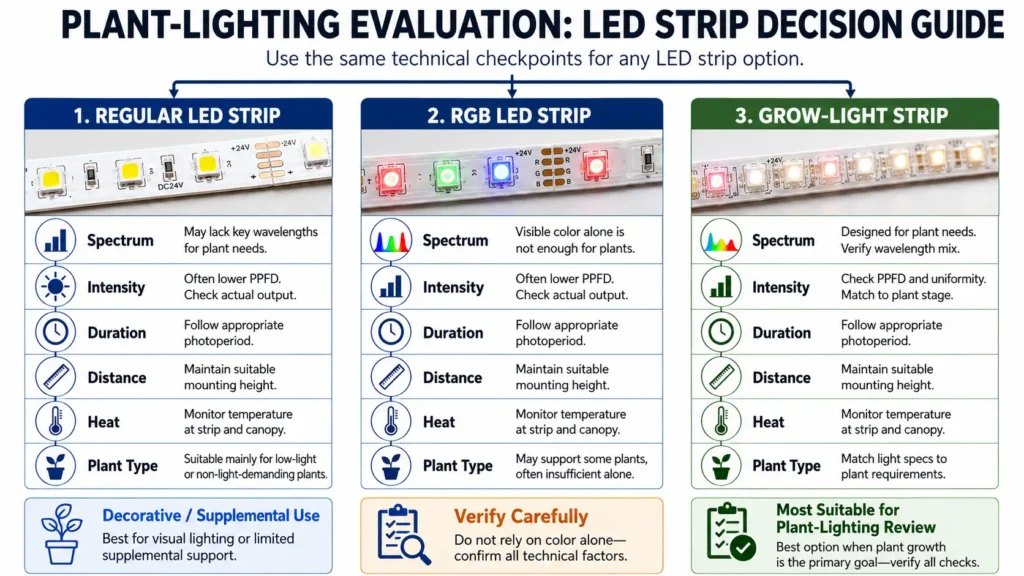
A regular LED strip can produce visible light, but visible light alone does not prove that the strip is suitable for plant growth.
Plants respond to several lighting factors at the same time. The most important ones include light quality or spectrum, light quantity or intensity, exposure duration, and how much light actually reaches the leaves. University extension resources describe quality, intensity or quantity, and duration as important factors for indoor or supplemental plant lighting. See Oklahoma State Extension et Iowa State Extension for general plant-lighting context.
This is especially important with RGB LED strips. RGB strips can display red, blue, purple, or white-looking colors, but the visible color setting does not confirm that the strip has the right output or spectral balance for plants. If the strip was designed mainly for decoration, it should be treated as decorative lighting unless the supplier provides plant-lighting specifications.
| LED Strip Type | Typical Use | What to Check | When to Avoid | Buyer Note |
|---|---|---|---|---|
| Regular white LED strip | General lighting, shelf lighting, accent lighting | Output, color temperature, heat, distance, runtime | When the plant depends on the strip as its main growth light and no plant-lighting specs are available | May help as supplemental light, but do not assume it is enough for active growth |
| RGB LED strip | Decorative color effects, room lighting, visual display | Whether the strip has usable plant-lighting output, not just red/blue color modes | When growth performance matters and no spectrum/output data is available | Color alone does not make an RGB strip a grow light |
| LED grow-light strip | Plant-lighting applications where the product is designed and specified for that use | Spectrum, output, power, heat, mounting layout, environment, and supplier documentation | When specs do not match the application or cannot be verified | More relevant when plant growth is the main purpose |
The main difference is not just the shape of the strip. It is the intended use and the specifications behind it.
LED strip lights may be useful in some plant-lighting situations, especially when they are used as supplemental lighting rather than the only light source. They can also be practical for shelves, small indoor displays, or projects where the strip format makes installation easier.
However, “may help” is not the same as “will grow any plant.” The result depends on the plant’s needs and the lighting setup.
| Cas d'utilisation | Regular or RGB Strip Fit | Grow-Light Strip Fit | What to Verify |
|---|---|---|---|
| Decorative shelf with plants | May be acceptable for visual effect and mild supplemental light | May be used if plant support is also required | Plant type, existing daylight, heat, runtime |
| Indoor plants near a window | May help supplement natural light | Useful when additional plant-focused light is needed | Available daylight, distance from plants, output |
| Seedlings or young plants | Not recommended unless the strip has suitable specs and layout | More relevant to review when growth support is required and specifications are available | Light output, spectrum, coverage, duration |
| Plants far from natural light | Often insufficient unless properly specified | More relevant if designed for plant lighting | Growing area, output, mounting distance |
| Commercial, OEM, or repeatable setups | Should not rely on decorative strips without technical review | Use project-specific strip specs and supplier review | Samples, specifications, layout, environment |
For casual decorative setups, a regular LED strip may be enough to improve the appearance of a plant area. For actual plant growth support, especially away from windows or in repeatable projects, the strip should be evaluated like a lighting component, not just a decoration.
Regular or RGB LED strips are more likely to be a poor fit when the plant depends on the strip as its main light source. They may also be unsuitable when the project needs consistent results, repeatable installation, or technical documentation.
A simple rule: if plant growth matters, do not buy based only on color or brightness. Ask for specifications.
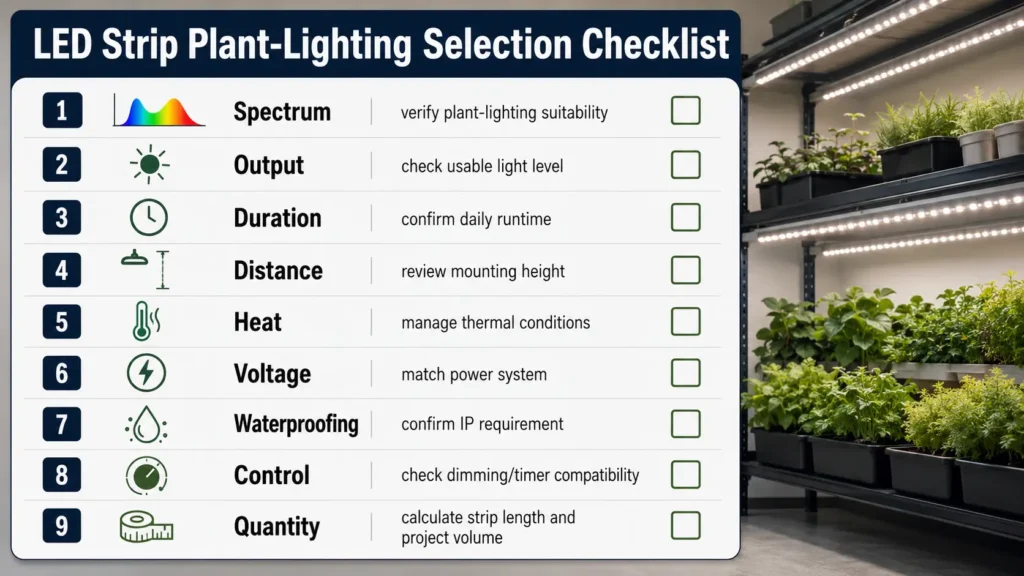
Before choosing LED strip lights for plants, check the factors that affect whether the strip can support the application. These are especially important for buyers, engineers, procurement teams, OEM projects, and distributors. The University of Minnesota Extension explains that watts alone are not a measure of actual light intensity and describes light quality, distance, and duration as practical plant-lighting factors.
This checklist does not guarantee plant-growth results. It helps buyers ask better questions before choosing a strip.
Even when the strip type is suitable, setup can change the result. Two users may buy similar LED strips and see different outcomes because their installation conditions are different.
Mounting distance affects how much light reaches the leaves. A strip installed too far away may look bright to the eye but still provide limited usable light to the plant. Avoid using a fixed distance rule unless it is based on the specific strip, plant, and layout.
Plants need a balance between light exposure and rest. A longer runtime is not automatically better. The right duration depends on plant type, growth stage, existing daylight, and light output.
LED strips are generally compact, but heat still matters. Poor heat management can affect the strip, adhesive, surrounding material, and plant area. For enclosed shelves or custom fixtures, check thermal conditions before scaling the setup.
Different plants and growth stages need different light levels. A plant that tolerates lower light may respond differently from seedlings, flowering plants, or high-light plants. Do not assume one strip setup fits every plant.
A strip used near a bright window is not doing the same job as a strip used in a dark room. Always consider the total light environment, not the LED strip alone.
Choose LED strips designed and specified for grow-light use when plant growth is the main goal. This is especially relevant when the strip will be the main light source, the setup is far from natural light, or the project needs repeatable results.
Grow-light strips are more relevant to review when:
For a product bridge, review ElstarLED 2835 LED Grow Light Strips as a specification reference, then confirm the final fit against your application details. For broader product context, see ElstarLED LED Strip Lights.
If you are comparing products, ask whether the strip is intended for plant-lighting use and what specifications are available. Avoid relying only on marketing images or color names.
If you are asking a supplier to recommend LED strip lights for plant-related use, provide enough application details. This helps the supplier understand the project instead of guessing from a general keyword like “grow light strip.”
Do not expect a reliable recommendation from “I need LED strips for plants” alone. The more application details you provide, the easier it is to narrow down the strip type and specifications.
LED strip lights may work only in limited or supplemental setups if the strip’s output, spectrum, distance, duration, and heat are suitable for the plant. A decorative strip should not be treated as a grow light unless its specifications support plant-lighting use.
Regular LED lights may help some plants as supplemental light, especially when there is already natural light. But regular lighting is not automatically suitable for plant growth. Check the light quality, output, distance, runtime, and plant needs before relying on it.
RGB LED strips should be used carefully. A red, blue, or purple color setting does not prove that the strip provides enough suitable light for plants. If the RGB strip is decorative and has no plant-lighting specifications, it should not be used as the main grow light.
General LED strip lights are often designed for decoration, room lighting, cabinets, signage, or accent lighting. Grow-light strips are intended for plant-lighting applications and should provide specifications that help buyers evaluate spectrum, output, power, heat, and installation conditions.
There is no single runtime that fits every plant and every strip. Runtime depends on the plant type, growth stage, existing daylight, light output, and mounting distance. Use supplier guidance or project testing instead of assuming one fixed number of hours works for all plants.
Check spectrum or light quality, output or intensity, runtime, mounting distance, heat, voltage, power supply, environment, waterproofing needs, control method, strip length, and quantity. For B2B projects, also ask what product data or samples are available for review.
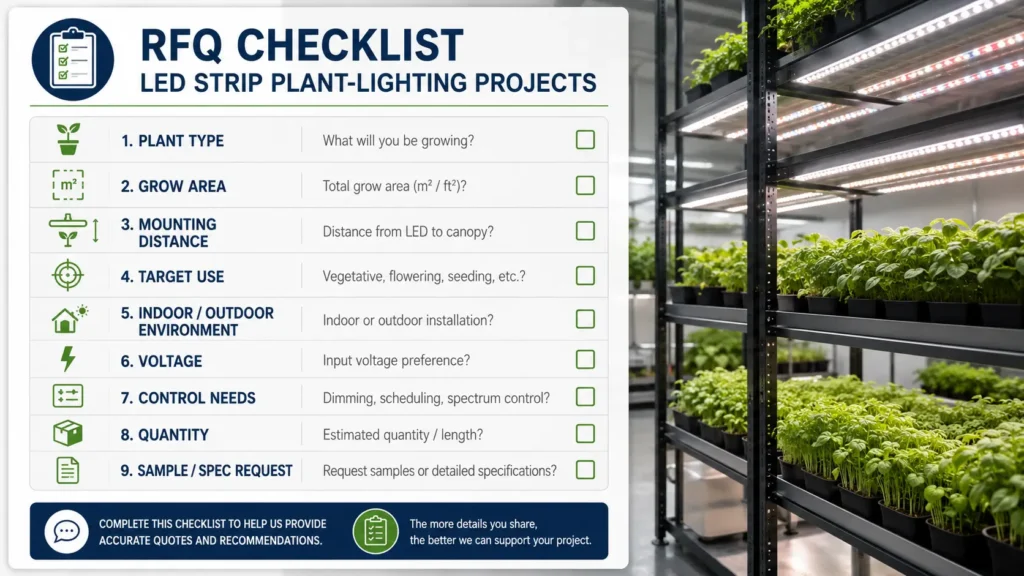
Planning an LED strip setup for plant lighting? Share your plant type, grow area, mounting distance, voltage, installation environment, control needs, and quantity.
Share these details with ElstarLED for application review and specification comparison.

 English
  Spanish
  French
  Arabic