If you’re specifying RGBW COB LED strips for a project, the “product page specs” are only half the story. The other half is system design: choosing the right white architecture, confirming control compatibility, and planning power distribution so the run stays uniform in the real installation.
RGBW COB LED Strip (What It Is + What to Verify Before Buying)
An RGBW COB LED strip is a constant-voltage tape light that uses a COB-style LED array (to create a more continuous light line) and four channels—Red, Green, Blue, plus a dedicated White (W)—so one strip can deliver color scenes and a more usable white channel.
Key points (why it matters):
COB vs SMD: COB packaging typically reduces visible “dot” hotspots compared with separated SMD emitters—especially when paired with a suitable profile/diffuser.
RGBW vs RGB mixing: A dedicated W channel gives a more practical white output than relying only on RGB mixed white (which can look tinted).
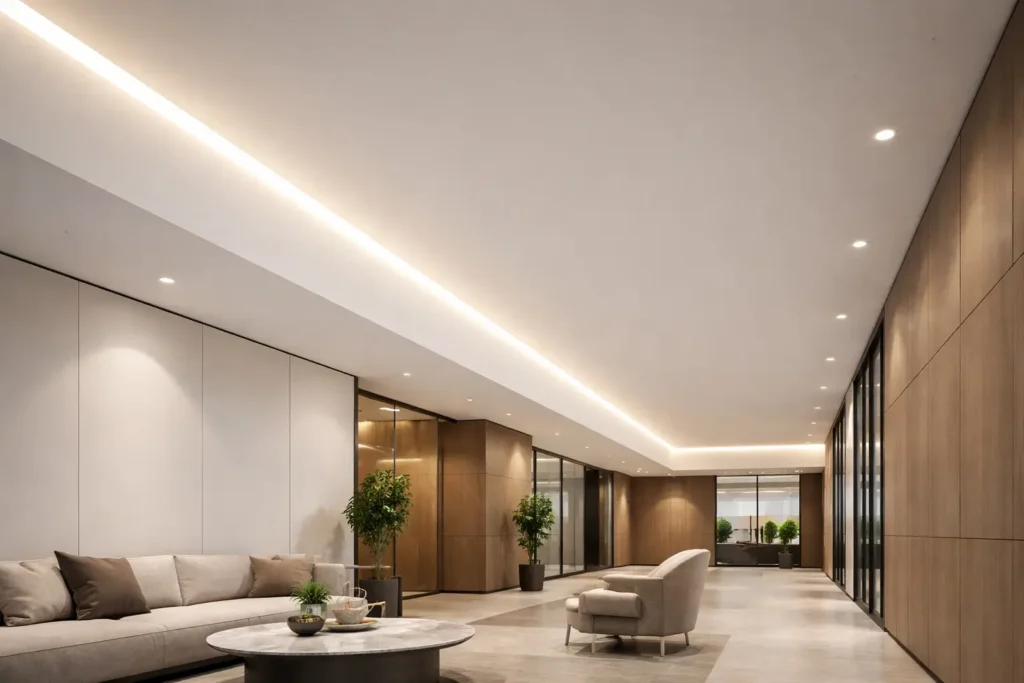
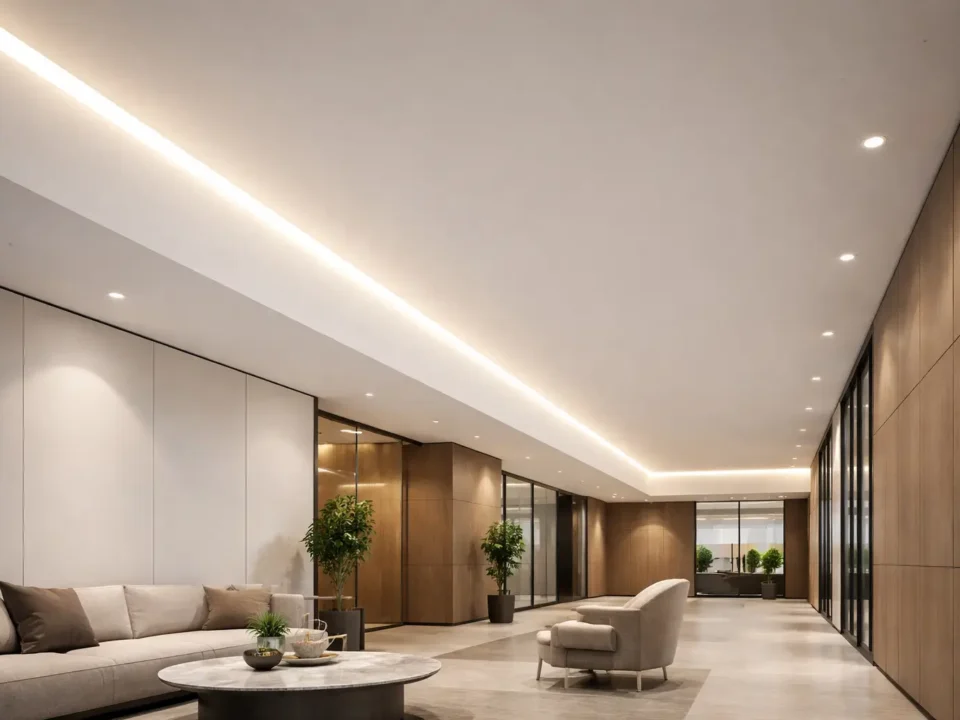
Project fit: RGBW COB is commonly used where you want linear, low-hotspot color + a white channel in architectural details (coves, reveals, feature lines).
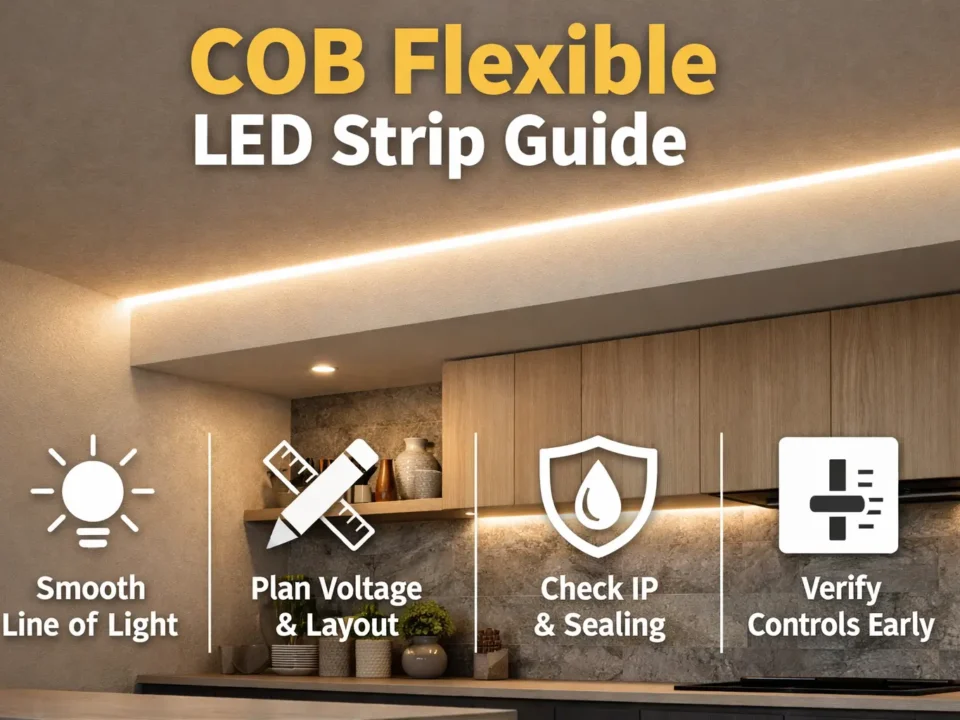
Verify before buying (quick checklist):
Channel architecture: Confirm it’s RGBW (not RGB, not RGBCCT/RGBWW) and matches the white behavior you need.
Voltage & power approach: Confirm constant-voltage system plan (driver + distribution), and plan for multi-feed/power injection on longer runs.
Control compatibility: Confirm controller/decoder supports RGBW output type and wiring method (do not assume based on “RGBW” label alone).
Environment/IP: Match IP construction to the exposure scenario (dry, splash, rain, wash-down).
Documentation: Request the datasheet + wiring diagram for the exact model/series before ordering and before installation.
Boundary conditions (read before you commit):
“Dotless” appearance depends on viewing distance, mounting profile, and diffusion—not just the LED type.
Long-run performance depends on layout, load, wiring, and feed strategy; verify with the real layout and full-load testing.
RGBW COB LED Strip Basics: What It Is, What COB Changes, and Where It Fits
RGBW COB strips are chosen when a project needs a cleaner-looking linear output than typical point-source strips, plus the flexibility to run both اللون and a dedicated white channel from the same installation.
Key points (how COB changes the result):
Visual continuity: COB arrays can appear more continuous because the emitting surface is more uniform than spaced SMD packages.
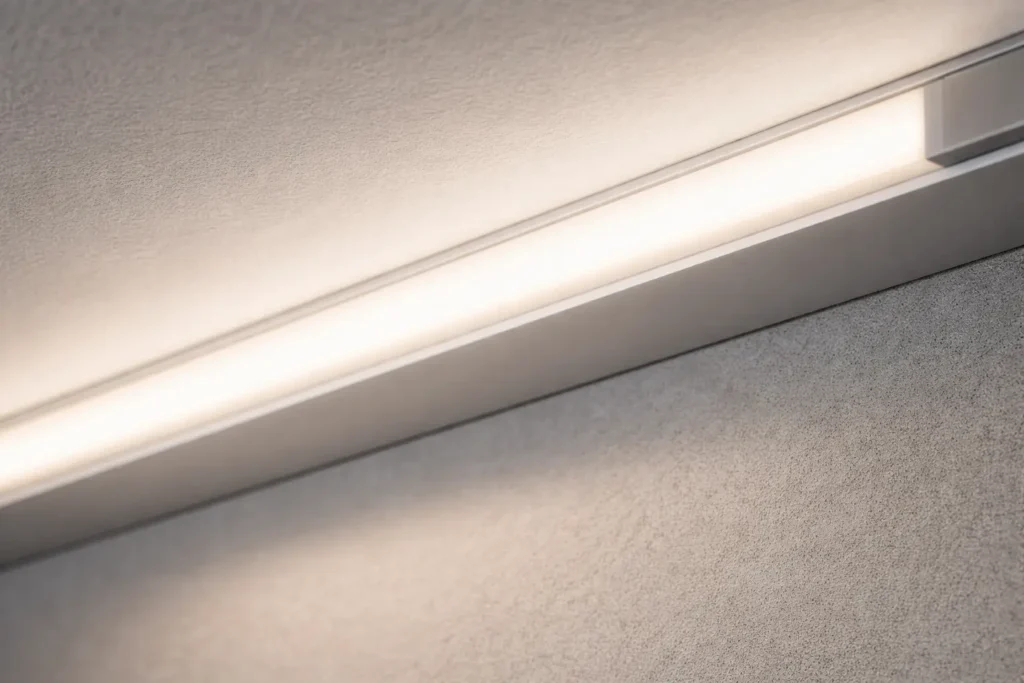
Diffusion still matters: Many architectural installs use aluminum profiles and diffusers to improve appearance, protect the strip, and keep the installation consistent.
Where it fits best: Cove lighting, wall grazes in controlled conditions, feature lines, under-shelf accents in commercial spaces, and hospitality/retail details where hotspot control matters.
When SMD may be enough: If the strip is hidden from direct view, or if a strong diffuser is already mandated, SMD RGBW can be acceptable—often with different cost/availability trade-offs.
Boundary conditions:
COB “dotless” is not automatic; it depends on optics, profile choice, and viewing distance.
“White quality” is not guaranteed by the word “RGBW”; it depends on the actual W LEDs used in the model and how the system is controlled.
Choosing the Right White: RGBW vs RGBWW vs RGBCCT (What Changes + How to Decide)
Choose the channel architecture based on how much white flexibility the project needs and what your control system can support. RGBW is often best for “color + a single dedicated white,” while RGBWW/RGBCCT are often considered when you need warm/cool flexibility (tunable-white behavior) alongside color.
Comparison table (decision view):
Option
What “white” looks like in practice
Best-fit project needs
Control implications
RGBW
One dedicated W channel (fixed white type by model) + RGB color
Color scenes plus a dedicated white channel for practical white use
Needs RGBW-capable controller/decoder and correct channel mapping
RGBWW
Dedicated warm-white + (often) cool-white style behavior (varies by product naming) plus RGB color
White scenes with warmer feel and more flexibility than a single W
Higher channel complexity; must confirm wiring type and channel count
RGBCCT
RGB plus warm & cool white channels intended for tunable-white scenes
Projects that need adjustable warm-to-cool white (CCT behavior) plus color
Requires controller/decoder that supports CCT-style control and correct channel mapping
Choose this if…
Choose RGBW if you mainly need color + a dedicated white (and you can accept that “white type” is determined by the model’s W channel).
Choose RGBCCT/RGBWW if the project requires warm-to-cool flexibility in white scenes (tunable-white behavior), and the control system can support it.
Boundary conditions (don’t skip):
Do not assume CRI/CCT range or “white quality” from naming alone—confirm by the exact model datasheet.
Controller/decoder must match the channel architecture and wiring method; confirm the terminal mapping before ordering.
A typical RGBW COB system uses a constant-voltage LED driver for power delivery and an RGBW controller (or decoder) to modulate the R/G/B/W channels. Treat power delivery and channel control as separate design steps. Step list (basic setup workflow):
Confirm strip type: Verify the strip’s channel wiring method from the wiring diagram (e.g., common terminal + individual channels).
Choose the driver: Use a constant-voltage driver that matches the strip’s rated voltage and supports the total load for the planned installation (do not guess—calculate and verify).
Choose the controller/decoder: Ensure it explicitly supports RGBW output and matches the strip’s wiring method.
Plan distribution: Decide where power enters the system (single feed vs multi-feed) and how controller output lines will route to the strip.
Wire the driver to the controller: Connect driver output to controller input terminals per the controller manual.
Wire controller outputs to strip channels: Map R/G/B/W to the corresponding strip channel pads/terminals and connect the common terminal as specified.
Test in a short section first: Power up and verify correct colors/white response before committing to the full run.
Finalize installation: Secure connections, add strain relief, and protect joints according to the environment and IP construction.
Key points (compatibility reminders):
RGB controller ≠ RGBW controller: An RGB-only controller typically cannot control the W channel.
Channel mapping matters: Incorrect terminal mapping can cause wrong colors, missing white, flicker, or unstable dimming.
Dimming approach varies: Controllers/decoders and drivers can implement dimming in different ways; confirm compatibility through manuals and system design notes.
Boundary conditions:
Terminal conventions vary; always confirm with the strip wiring diagram and the controller manual before applying power.
Avoid mixing incompatible control methods; if building control integration (e.g., via a decoder) is required, confirm the exact channel mapping and control method up front.
Evidence note (general background): For a practical overview of dimming LED strip systems (including PWM approaches commonly used in strip-lighting applications), see MEAN WELL’s discussion here: How to select a LED driver to DIM LED Strip?
Verify First: Strip Wiring Type + Controller Output Type (Common Mistake Prevention)
Before power-up, verify that the strip’s wiring architecture and the controller’s output type are truly compatible—this prevents the most common “it powers on but behaves wrong” failures.
Verify-first checklist:
Confirm the strip’s wiring type from the wiring diagram (do not infer from a product name).
Confirm controller/decoder supports RGBW and the correct output type for the strip.
Confirm terminal labels and channel mapping (R, G, B, W, and the common terminal).
Confirm polarity conventions and connector pinouts (especially if using pre-wired leads).
Confirm the driver is constant-voltage and matches the strip’s rated voltage.
If anything is unclear, pause and request the correct documentation before installation.
Boundary condition:
If wiring documentation is missing or inconsistent, treat it as a procurement/verification issue—don’t troubleshoot in the ceiling.
Long Runs & Reliability: 12V vs 24V, Voltage Drop, Power Injection, and Common Mistakes
Voltage drop happens because current flowing through conductors and strip traces creates a voltage loss over distance, which can cause uneven brightness و color/white shift along a run. Longer runs require power distribution planning (often multi-feed/power injection), regardless of LED type.
Planning checklist (layout-first approach):
Start from the physical layout (run lengths, turns, access points, and where drivers/controllers can be placed).
Decide the feed strategy early: single feed vs multi-feed (power injection points).
Avoid long thin feed cables; route power logically and minimize unnecessary cable length.
Validate with a full-load test on a representative section before final installation.
Document final channel mapping and feed points for commissioning and maintenance.
12V vs 24V (principles, not promises):
For the same load, higher system voltage often reduces current, which can reduce voltage-drop sensitivity.
That said, layout and feed strategy still dominate: a poorly planned 24V layout can still show uneven output.
Common mistakes (seen in the field):
Daisy-chaining long runs without a feed strategy (brightness fade and color shift).
Undersizing the driver or ignoring controller/decoder limits.
Using long, thin feed wires and then troubleshooting “flicker” that’s actually voltage instability.
Poor joints or exposed connectors, especially in humid or vibration-prone installs.
Skipping the short-section test and discovering mapping/power issues after the full install is mounted.
Boundary conditions:
Do not promise maximum run lengths without the exact model datasheet and the actual installation layout.
Always verify performance under full load with the real wiring and feed points.
IP Rating and Installation Scenarios: Indoor, Wet Areas, and Outdoor Use
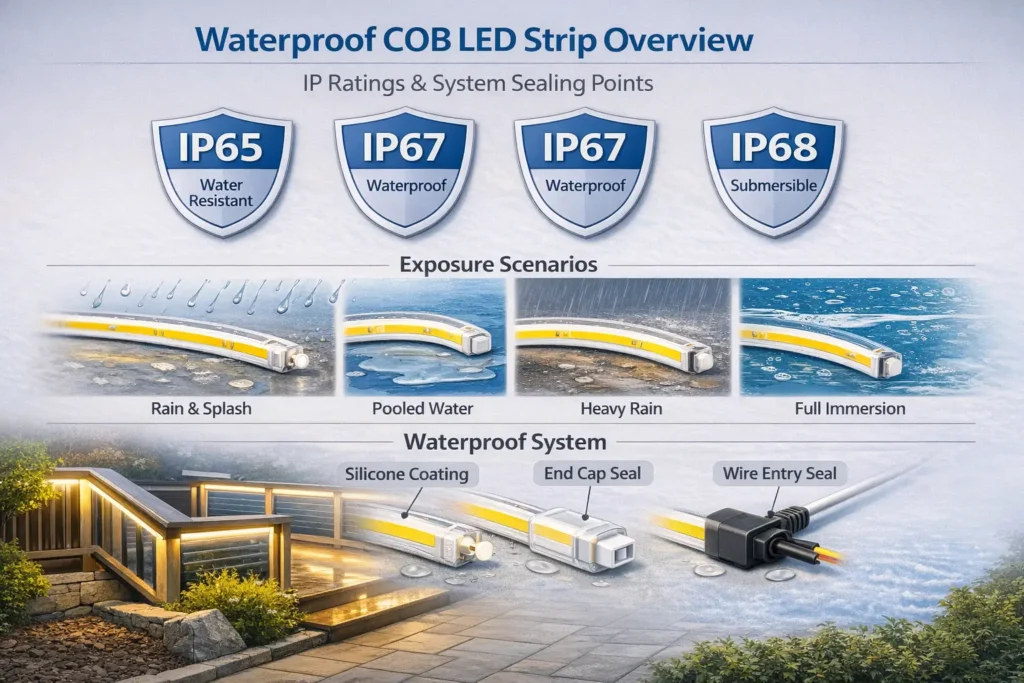
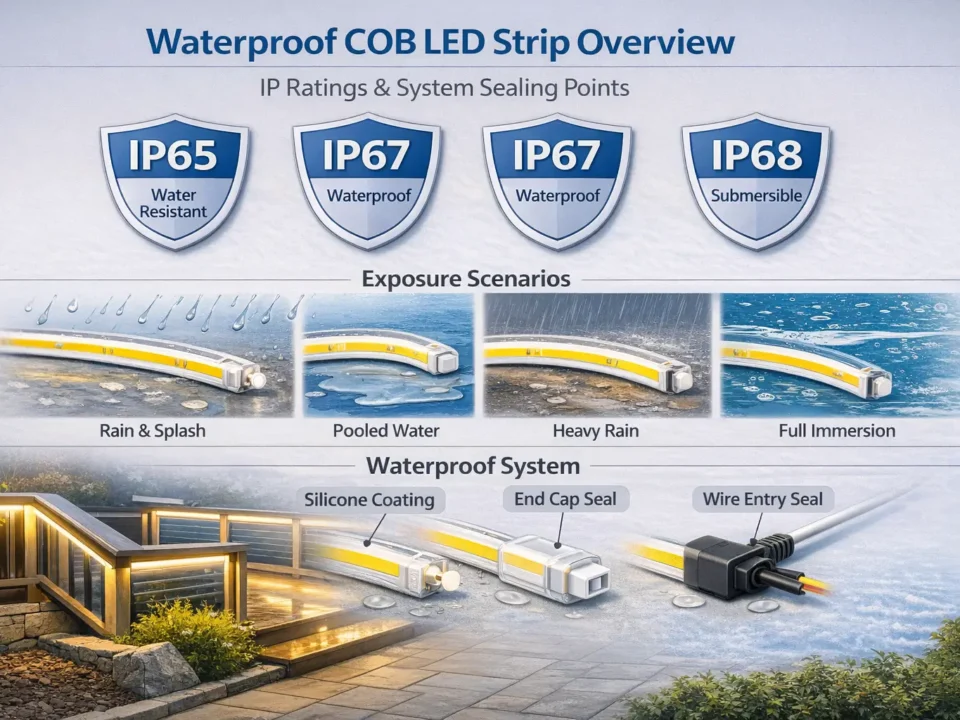
Choose IP construction based on the exposure scenario (dry, splash, rain, wash-down, or potential immersion), and remember that real-world reliability depends heavily on how ends, joints, and connectors are sealed—not only the label on the strip.
Scenario mini-table (selection view):
Scenario
Typical IP approach (confirm by model)
Installation notes that decide outcomes
Dry indoor (coves, millwork)
Lower IP constructions are often used
Focus on profiles, cable management, and service access
Splash/humidity (kitchens, bathrooms)
Higher ingress protection is commonly selected
Prioritize sealed joints, protected connectors, and correct routing
Outdoor exposed to rain
Higher ingress protection is commonly selected
Seal ends/joints, provide strain relief, and protect connection points
Wash-down / harsh exposure
Project-specific build is often required
Confirm construction details, sealing method, and maintenance access
Seal ends و cut points per the strip’s construction method (end caps, sealant, or manufacturer method).
Treat connectors and joints as primary failure points; protect them mechanically and against moisture ingress.
Add strain relief so movement doesn’t open micro-gaps in sealing.
Route cables to avoid water collection points and allow drainage where relevant.
Consider heat management (profiles/ventilation) to reduce stress on materials.
Boundary conditions:
An IP code is a definition of ingress resistance; installation quality is what makes it succeed in the field.
Outdoor environments vary (UV, temperature swing, direct spray); specify the real exposure scenario and confirm the appropriate construction.
Evidence note (IP definition): IEC provides a practical overview of IP ratings as defined under IEC 60529 here: Ingress Protection (IP) ratings (IEC)
Pre-Purchase Datasheet Checklist: What to Confirm (and What to Request for Custom Builds)
Before ordering RGBW COB strips for a project, confirm electrical, control, environmental, and mechanical constraints on the datasheet—and request a wiring diagram and build details for the exact model/series to prevent mis-spec and rework.
What is an RGBW COB LED strip, and what does COB change compared to standard LED strips?
An RGBW COB LED strip combines RGB color channels with a dedicated white channel and uses a COB-style LED array that often appears more continuous than spaced SMD emitters.
COB can reduce visible hotspots, especially with the right profile/diffuser.
RGBW adds a dedicated white channel rather than relying only on RGB mixed white.
Boundary note: “Dotless” appearance still depends on optics and viewing distance.
Does RGBW give a real white, and how is it different from mixing RGB to make white?
RGBW generally provides a more practical white output because the W channel is a dedicated white source, while RGB mixed white can look tinted depending on the color mix and application.
Dedicated W improves “usable white” behavior for many projects.
RGB mixed white is mainly a color effect and can be less consistent for white-critical scenes.
Boundary note: White appearance depends on the exact W LEDs used; confirm by model datasheet.
RGBW vs RGBWW vs RGBCCT: which is better if you need warm white and cool white flexibility?
If your project requires warm-to-cool flexibility (tunable-white behavior), RGBCCT (or some RGBWW implementations) is often a better fit than a single RGBW white channel—provided your control system supports the additional channels.
Choose RGBW for color + a single dedicated white.
Choose RGBCCT/RGBWW if tunable white scenes are required.
Boundary note: Confirm channel mapping and controller/decoder capability before specifying.
Should you choose 12V or 24V for RGBW COB strips in longer commercial runs?
Many longer-run projects prefer higher system voltage because it can reduce current for the same load, which can reduce voltage-drop sensitivity—but layout and feed strategy still matter most.
Plan feed points (power injection/multi-feed) for consistency.
Test under full load with the real wiring.
Boundary note: Do not assume a maximum run length without the model datasheet and the actual layout.
How do you wire an RGBW COB LED strip to a driver and controller (basic setup)?
A typical setup is constant-voltage driver → RGBW controller/decoder → strip channels (R/G/B/W + common).
Verify strip wiring type and controller output type from documentation.
Match driver voltage to the strip rating.
Map controller terminals to strip channels and connect the common terminal.
Test a short section before completing the full install.
Boundary note: Terminal conventions vary; confirm the wiring diagram and controller manual before powering on.
What should you confirm on the datasheet before ordering RGBW COB strips for a project?
Confirm channel architecture, voltage system plan, control compatibility, IP construction, and documentation availability.
Electrical (constant-voltage system and driver approach)
Channels (RGBW vs alternatives; white behavior)
Control (controller/decoder compatibility and mapping)
Environment (IP build and sealing notes)
Documentation (datasheet + wiring diagram)
Boundary note: Certification availability and scope are model/series dependent—scope-check before purchasing.
Summary & Next Steps (Project Checklist)
Decision path (quick recap):
Choose the white architecture that matches the lighting intent (RGBW vs RGBWW/RGBCCT).
Confirm control compatibility (controller/decoder output type and channel mapping).
Plan power distribution for the real layout (multi-feed/power injection where needed).
Match IP construction to the exposure scenario and plan sealing for ends/joints/connectors.
Finalize procurement with a datasheet + wiring diagram for the exact model/series.
Scenario-based next steps (typical triggers):
Long runs: share a layout sketch to confirm feed strategy and driver/controller configuration.
Wet/outdoor installs: confirm IP construction details and installation/sealing method for the chosen model.
Control integration: confirm channel mapping and control method (controller/decoder) before ordering.
Custom builds: standardize requirements (lengths, leads/connectors, IP build, documentation) to get comparable quotes.
If you want help validating an RGBW COB strip for a project (white behavior, control compatibility, long-run planning, or wet/outdoor build details), request the datasheet and wiring diagram for the exact model/series and share your layout constraints for review.


 Step list (basic setup workflow):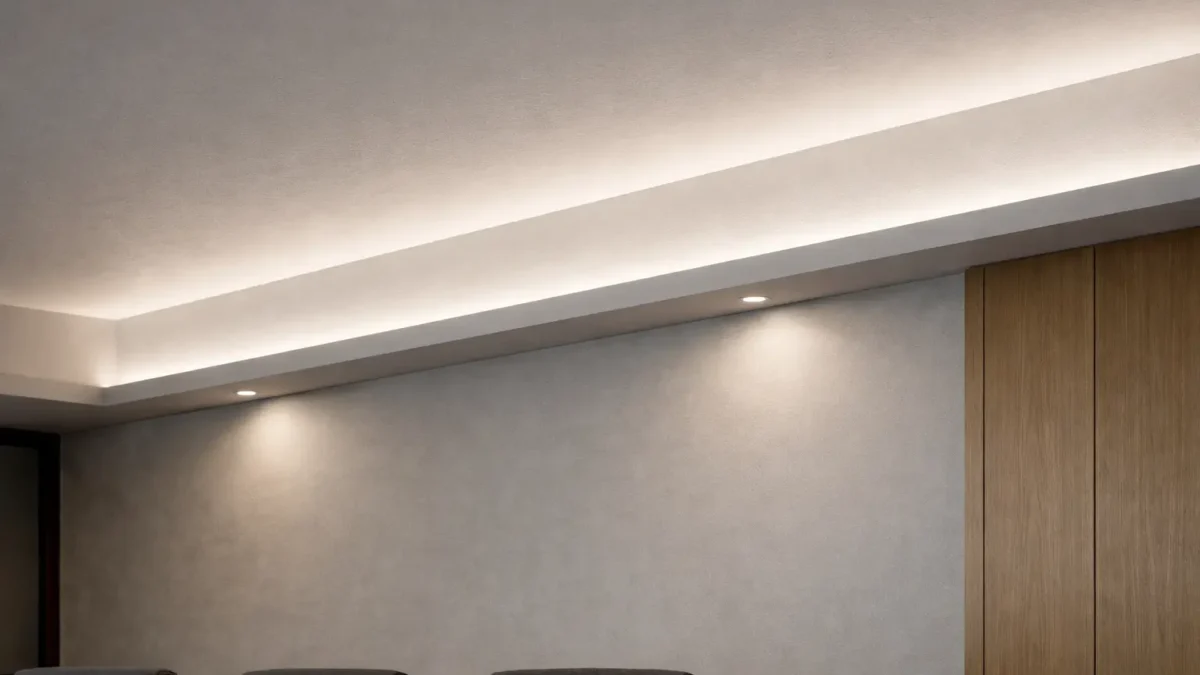
 English
  Spanish
  French
  Arabic