Before choosing between LED strips and LED bulbs, start with the light’s purpose. Some spaces need a wide room glow. Other spaces need a thin line of light under a cabinet, shelf, or display.
What are LED strips?
LED strips are flexible boards with many small LEDs. They can bend, cut at marked points, and fit into narrow areas. As a result, they are useful for accent lighting, under-cabinet lighting, display lighting, and task lighting.
What are LED bulbs?
LED bulbs are standard bulb-shaped lights. They replace older incandescent or CFL bulbs in existing fixtures. Also, they are easy to use in lamps, ceiling fixtures, wall lights, and common home lighting setups.
Quick answer
LED strips give more design freedom. Meanwhile, LED bulbs give easier installation. Therefore, choose LED strips for detail and choose LED bulbs for simple general light.
Technical Differences Between LED Strips and LED Bulbs
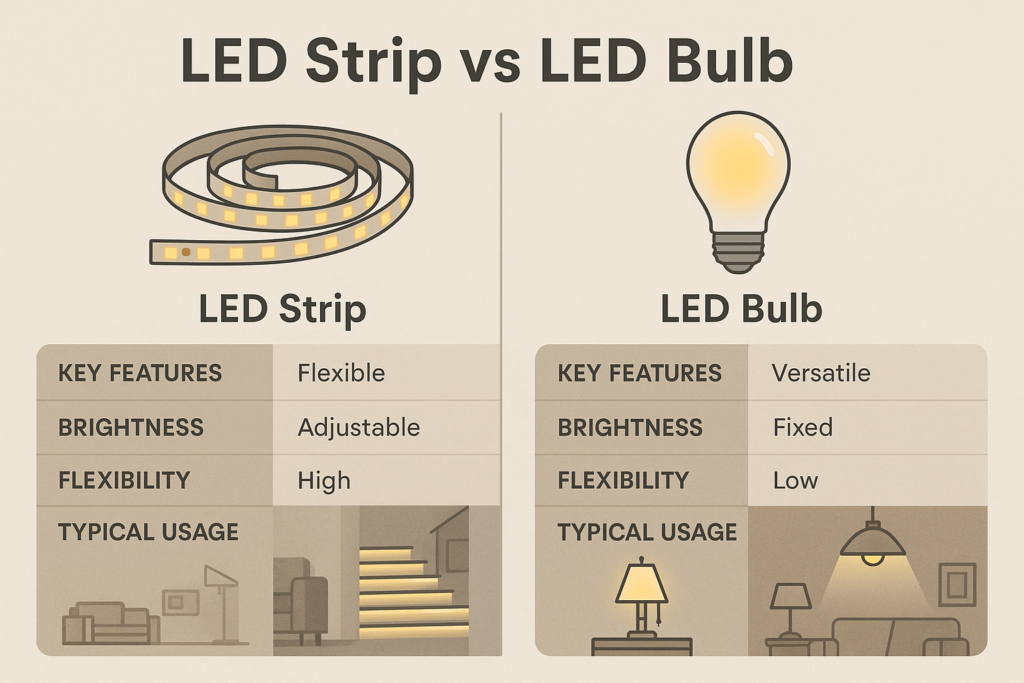
The main differences are shape, light spread, install method, control options, and use case. In addition, LED strips often need a power supply and wiring plan, while LED bulbs usually fit into existing sockets.
Brightness and light quality
LED strips: provide focused or hidden light. Also, they can be dimmed or color-controlled with the right parts.
LED bulbs: provide broad room light. As a result, they work well for daily lighting in common fixtures.
Energy use
LED strips: can be efficient when used only where light is needed.
LED bulbs: are also efficient and are easy replacements for older bulbs.
Installation and flexibility
LED strips: need surface prep, mounting, wiring, and sometimes a controller.
LED bulbs: are easier because they usually screw or lock into a fixture.
Comparison table
Feature
أضواء شريطية LED
لمبات LED
Brightness style
Custom, focused, and adjustable
General and room-wide
Energy use
Efficient when planned by zone
Efficient for daily fixture use
التركيب
Needs more planning
Simple in existing sockets
المرونة
عالية
Limited
Best use
Accent, task, decorative, display
General home and fixture lighting
Simple takeaway
Choose LED strips when placement and shape matter. Choose LED bulbs when speed and fixture fit matter more.
Advantages and Disadvantages of LED Strip Lights
LED strips are strong when a project needs a custom light path. However, they need more planning than a simple bulb replacement.
Advantages of LED strip lights
Custom layout: strips can fit shelves, cabinets, coves, signs, and curved spaces.
Flexible control: many strips support dimming, RGB, RGBW, or CCT control.
Task lighting: strips work well under cabinets and near work surfaces.
Efficient zones: strips can light only the exact area that needs light.
Disadvantages of LED strip lights
More setup work: strips may need power supplies, wiring, profiles, and controls.
Higher system cost: profiles, drivers, and controllers can add cost.
Heat planning: bright strips may need aluminum channels.
Mounting limits: weak adhesive or poor prep can cause peeling.
Best fit summary
LED strips fit projects that need detail, mood, or task light. Therefore, they are useful for kitchens, shelves, displays, signage, and custom interiors.
Advantages and Disadvantages of LED Bulbs
LED bulbs are practical when you want quick, reliable light from an existing fixture. As a result, they are common in homes, offices, shops, and rental spaces.
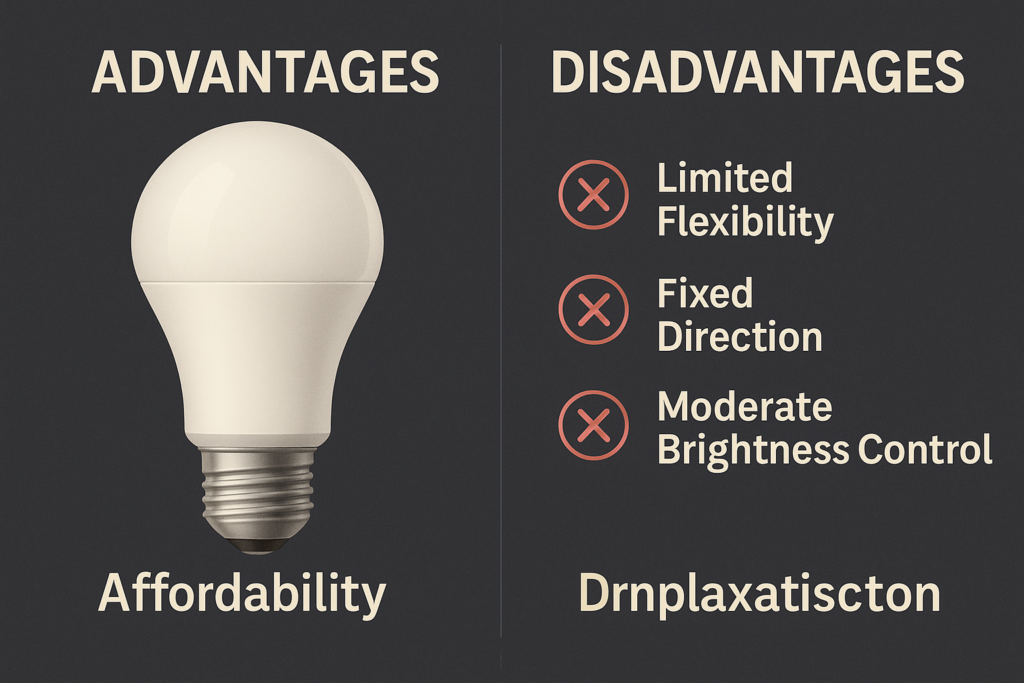
Advantages of LED bulbs
Easy install: most bulbs fit standard sockets.
Lower starting cost: many bulbs are budget-friendly.
Wide fixture fit: bulbs work in lamps, ceiling lights, and wall fixtures.
Stable daily use: bulbs are simple for general lighting.
Disadvantages of LED bulbs
Less design freedom: bulbs cannot follow curves or thin lines.
Fixed shape: the fixture controls where the light goes.
Fewer custom effects: bulbs offer less control than LED strip systems.
Best fit summary
LED bulbs are best for general light. Therefore, they fit bedrooms, hallways, kitchens, offices, and basic commercial spaces.
Best Applications for LED Strips and LED Bulbs
Use the project goal first. Then, match the light type to the room, fixture, and effect you need.
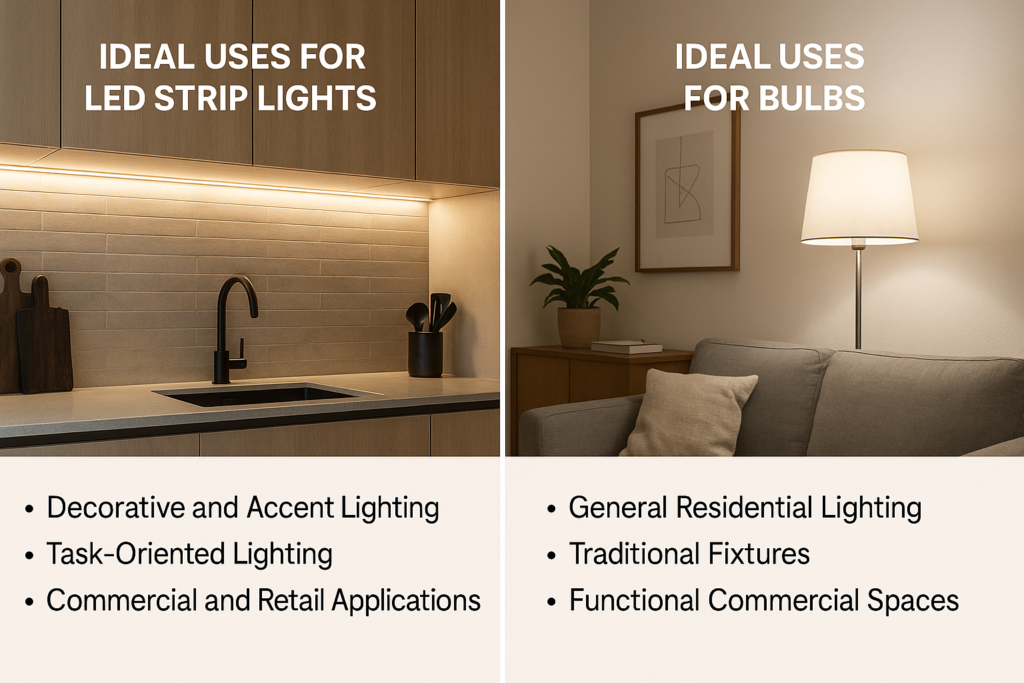
Ideal uses for LED strips
Decorative and accent lighting: use strips for shelves, coves, furniture, and signs.
Task lighting: use strips under cabinets, above counters, or near work surfaces.
Commercial displays: use strips for retail cases, product highlights, and custom shapes.
Ideal uses for LED bulbs
General home lighting: use bulbs in bedrooms, hallways, lamps, and ceiling fixtures.
Traditional fixtures: replace incandescent or CFL bulbs with LED bulbs.
Commercial spaces: use bulbs for offices, shops, and basic room light.
Home example
In a kitchen, LED strips work well under cabinets. Meanwhile, LED bulbs work well in ceiling fixtures. In many rooms, using both gives the best result.
How to Choose Between LED Strips and LED Bulbs
To choose well, compare the lighting purpose, install effort, budget, and control needs. Also, think about whether the light should be hidden or visible.
Key decision factors
Lighting purpose: choose strips for detail and bulbs for general light.
Brightness needs: choose strips for target zones and bulbs for broad coverage.
Install effort: choose bulbs for fast replacement and strips for planned layouts.
Budget: compare the full setup, not only the light source.
Common mistakes
Do not choose bulbs when you need a hidden light line.
Also, do not choose strips for simple general light if a bulb fits the fixture.
Finally, do not ignore power supplies, heat control, and mounting needs.
Practical advice
If the light comes from a normal fixture, LED bulbs are usually easier. However, if the light must follow a shape or edge, LED strips are usually better.
Good installation improves safety, light quality, and product life. Therefore, check power, mounting, and fixture fit before final setup.
LED strip installation
Plan the run: measure the area before cutting.
Prepare the surface: clean and dry the mounting area.
Connect power: use the correct power supply and controller.
Test first: check brightness before final mounting.
LED bulb installation
Check fixture fit: confirm the socket and bulb type.
Turn off power: install the bulb safely.
Test the light: check brightness and color temperature.
Maintenance tips
Inspect strips for loose sections and heat spots.
Also, clean bulbs and strips with a dry soft cloth.
Then, check drivers, controllers, and fixtures if flicker appears.
Troubleshooting quick checks
No light: check power, wiring, socket, and polarity.
Flicker: check dimmer fit, loose joints, and driver size.
Strip peeling: clean the surface and add clips or channels.
FAQs About LED Strips and LED Bulbs
Are LED strips better than bulbs?
It depends on the project. LED strips are better for custom shapes, accents, and task areas. However, LED bulbs are better for simple general light.
Do LED strips use more electricity than bulbs?
Power use depends on length, wattage, and brightness. Therefore, a short strip may use little power, while a long high-output strip may use more.
Can LED strips replace traditional bulbs?
Sometimes, yes. LED strips can replace bulbs for accent or task lighting. However, bulbs are still better for many standard fixtures.
Which is better for a bedroom?
Use LED bulbs for general room light. Then, add LED strips for mood light, shelves, headboards, or coves.
Conclusion and Next Steps
LED strips and LED bulbs both have useful roles. LED strips offer custom layout, task light, and design effects. In contrast, LED bulbs offer simple, reliable room light.
Start with the lighting goal. Next, compare install needs, budget, and brightness. Then, choose the product that fits the space best.





 English
  Spanish
  French
  Arabic