You can run as many LED strip lights as you like from one power supply as long as the total strip power stays within a safe fraction of the power supply rating and the voltage matches. The simplest way to check this is to calculate the total watts of all your strips and keep that total below about 80–90% of the power supply’s rated wattage.
Before you worry about “how many strips”, it helps to understand a few basic power terms used on LED strip datasheets and power supplies.
For a single LED strip:
strip_watts = watts_per_metre × strip_length
For multiple strips:
– Many datasheets give both W/m and total watts for standard lengths (e.g. a 5 m reel).
The power supply’s job is to provide stable DC voltage at the required level with enough power capacity. As long as:
you can supply one or many strips from a single power supply.
A good way to think about sizing is: calculate what the strip needs, then add a margin so the power supply is not working at 100% all the time.
For a single strip:
– Example: a 12V strip rated at 9.6 W/m and you plan to use 5 m.
– strip_watts = 9.6 W/m × 5 m = 48 W
– With a 25% margin: – recommended_psu_min = 48 W × 1.25 ≈ 60 W
In this example, we would choose a 12V power supply rated at 60 W or higher, such as a 12V 75 W model. The key points:
In general:
Once you know how to size a PSU for one strip, you can extend the logic to multiple strips or runs.
At a high level:
> You can run as many LED strips as you like from one power supply as long as the sum of all strip wattages stays below a safe fraction (typically 80–90%) of the power supply’s rated wattage and the voltage matches.
Let’s define:
Then:
And the key rule:
From this you can find:
max_strips ≈ safe_watts ÷ strip_power_single
max_length ≈ safe_watts ÷ (W/m)
Example table (single strip type)
In Example 3:
14.4 W/m × 5 m = 72 W.5 × 72 W = 360 W.You can adjust the margin factor depending on how conservative you want to be and how critical the application is.
| Example | Strip rating | Planned length | Strip watts (W) | PSU rating (W) | Safe watts @80% | Max safe length or count |
|---|---|---|---|---|---|---|
| 1 | 12V, 4.8 W/m | 10 m | 48 W | 60 W | 48 W | 10 m is at the 80% limit; a 60 W PSU is just enough |
| 2 | 12V, 9.6 W/m | 10 m | 96 W | 150 W | 120 W | 10 m uses 96 W; you could go up to ~12.5 m safely |
| 3 | 24V, 14.4 W/m | 5 × 5 m runs | 360 W total | 480 W | 384 W | Five 5 m runs (25 m total) use 360 W; still under 80% of 480 W |
Real projects often mix strip types (e.g. one run of RGBW, one run of single-colour). The good news is that the method does not change:
Total_strip_watts.Example:
If you use a 12V 150 W PSU:
If you plan to expand later, you may want a larger PSU or a second supply for future runs.
Multiple LED strips can share one power supply, but how you wire them is just as important as the arithmetic.
It is safe to connect multiple LED strips to one power supply if:
If any of these are wrong—especially voltage mismatch or overloading the power supply—you risk overheating, premature failure or tripping protections. When in doubt, choose a slightly larger PSU or split the load.
For low-voltage LED strips, “series” wiring is often used loosely to mean daisy-chaining strips end-to-end. That approach quickly leads to problems:
By contrast, parallel wiring means:
Typical pattern with parallel wiring:

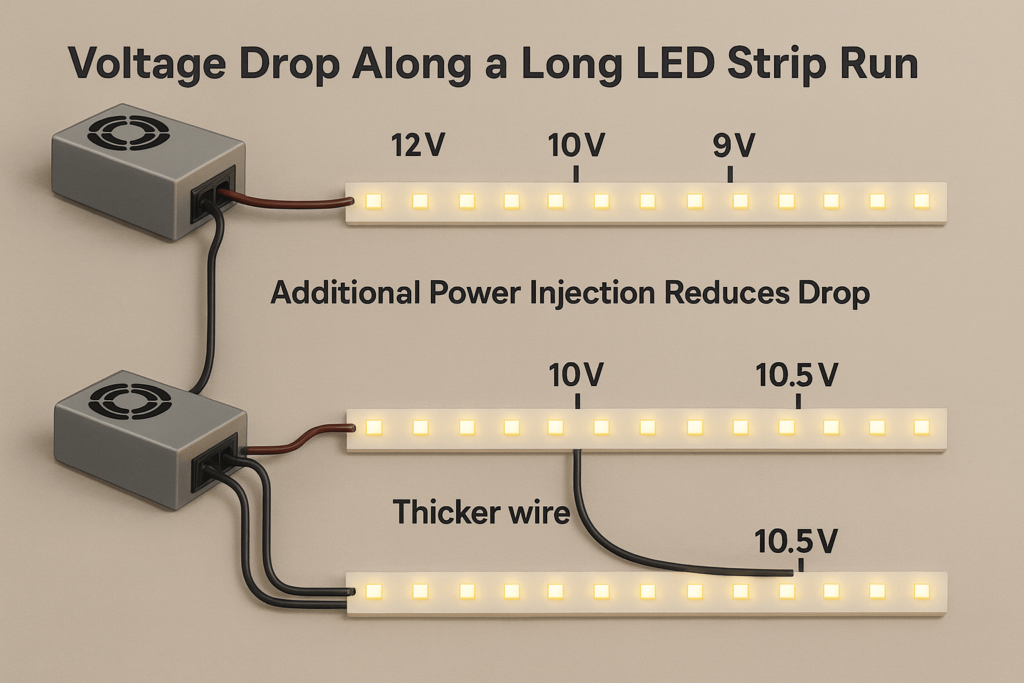
Even if your power supply is sized correctly, voltage drop و wire gauge can ruin performance on long runs or heavily loaded cables.
Power injection means bringing power into the strip at more than one point so that voltage stays high along its length.
Typical cases where injection helps:
Common strategies:
Key reminders:
Wire gauge (thickness) and distance both affect:
High-level guidance (not a substitute for local code tables):
– Shorter runs per branch, – Higher strip voltage (e.g. 24V instead of 12V for long runs), – Extra power injection points, and – Thicker main feed cables from the PSU.
A voltage-drop calculator or tables from your cable supplier can help for critical and long-distance projects.
Using a single large power supply for everything is not always the best idea. In many projects, using several smaller supplies is safer and easier to install.
Situations where multiple PSUs make sense:
– If one PSU would need to run near its maximum rating, consider splitting strips across two or more supplies to keep each one comfortably within its safe range.
– If strips are located far apart (e.g. different rooms, long corridors, multiple shelves), a single PSU might require long cable runs with significant voltage drop. – Local supplies reduce cable lengths and simplify troubleshooting.
– In commercial or architectural installs, losing one big PSU can darken a large area. – Multiple smaller supplies limit the impact of a single failure and are easier to replace.
– Multiple PSUs can be spread across separate AC circuits or plugs if needed, helping keep within AC-side limits and simplifying wiring.
A useful rule of thumb:
> If your total DC load is approaching the upper end of a single supply’s rating or the physical layout forces long, messy cable runs, it’s worth considering two or more smaller power supplies instead of one large one.
On the AC side, the power supply appears as a load on the outlet or circuit. The circuit doesn’t “see” LED strips directly; it sees the sum of power supply input wattages.
High-level guidelines:
For small LED projects, a single supply or a few modest supplies usually sit well below circuit limits. For larger installations:
Important: this article focuses mainly on the low-voltage DC side. AC-side design must follow local standards; when in doubt, treat the limits in this guide as conservative rules-of-thumb, not a replacement for local regulations.

How many LED strip lights can I run on one power supply? As many as you want, as long as the sum of their wattages stays below about 80–90% of the power supply’s rated wattage و voltage matches. Calculate total strip watts from W/m and length (or per-strip wattage), and compare it to the safe portion of your PSU rating.
How do I calculate how many LED strips a power supply can handle? First, find the PSU’s safe watts (for example, safe_watts = PSU_watts × 0.8). Then calculate each strip’s power and sum them: total_strip_watts = Σ strip_watts. As long as total_strip_watts ≤ safe_watts, the supply can handle that number of strips.
Can I mix LED strips with different wattages on the same power supply? Yes, provided all strips are designed for the same voltage as the power supply and the sum of their wattages stays within the safe load limit. Just add up each strip’s watts (W/m × length or total W per run) and treat the total the same way you would for identical strips.
Can I run RGB/RGBW strips and amplifiers from one power supply? Yes. Each RGB/RGBW strip and amplifier has its own wattage requirement; you simply add them to the total load like any other strip. Make sure the power supply and wiring are sized for the combined power, and keep within your safe wattage margin.
How far can I run LED strips from the power supply? It depends on voltage, current and cable gauge. Higher voltages (e.g. 24V), thicker wires و power injection points allow longer runs. If you see dimming at the far end, consider shorter runs, higher voltage strips or more feed points.
When should I use more than one power supply? Use multiple supplies when your total load is high, when strips are spread over distant zones, or when you want redundancy and easier maintenance. Splitting loads can reduce voltage drop, simplify wiring and reduce the impact of a single supply failure.
Designing a multi-strip system around one power supply is mostly about math and good wiring practice. Once you understand how to calculate load and apply simple safety rules, the decisions become straightforward.
Key takeaways:
If you need help choosing specific strip models and power supplies for a larger project, we can help you turn these principles into a complete system design.
You can explore our LED strip light range and our LED power supply range. For complex or multi-zone projects, you can also refer to our guide on how to connect multiple LED strips to one power source or contact us via our contact page to discuss the best setup for your application.


 English
  Spanish
  French
  Arabic