هل تحتاج إلى شيء تالي في وقت قصير؟ لدينا خطة لك.
الاسم
البريد الإلكتروني الهاتف حاجة المنتج
رسالتك
If you’re evaluating a 230V COB LED strip for a project, the main question is not “which product is cheapest,” but “which system architecture reduces risk for this installation.” 230V strips can simplify long runs, but they also raise the importance of termination quality, dimming compatibility, and ingress protection at connectors and ends.
This guide is written for B2B buyers and specifiers (OEM/ODM brands, distributors, contractors, and project teams) who want a procurement-ready way to choose between 230V and 24V COB, avoid dimming surprises, and specify installation details that prevent rework.
A 230V COB LED strip is a mains-voltage “dotless” linear light format designed to run directly from 220–240V markets, often with simplified power wiring compared to low-voltage systems. It can be a strong fit for long continuous lines, but only when dimming, terminations, and IP execution are confirmed for the specific model/series.
Quick “confirm before you order” checklist (model/series specific):
A 230V COB LED strip combines:
What it is:
What it is not:
Use this checklist to prevent ordering the wrong format when listings use inconsistent naming:
Many 230V products are marketed as “no transformer.” In practice, it usually means you may not need a separate external low-voltage power supply like a 24V system does. It does not mean:
Risk-control reminder:
You should choose between 230V and 24V COB based on project constraints (controls, safety posture, environment, and maintenance access), not on a single marketing promise.
Boundary condition:
Choose 230V when:
Choose 24V when:
A 230V COB strip can be dimmable, but dimming performance is primarily a compatibility question: the dimmer type and waveform control must match the strip/system design. Compatibility issues (not simple “quality”) are a common cause of poor dimming outcomes. A technical report from Pacific Northwest National Laboratory (PNNL) highlights that performance depends on LED source and dimmer compatibility rather than the capability of either alone. (https://www.pnnl.gov/main/publications/external/technical_reports/pnnl-22945.pdf)
Before you specify “dimmable 230V COB strip,” confirm these points for the exact model/series:
For 230V systems, the highest-risk failures commonly originate at ends, joints, and terminations. The safest approach is a workflow that is explicit, model-scoped, and verified before concealment.
Important boundary:
Common mistakes to prevent:
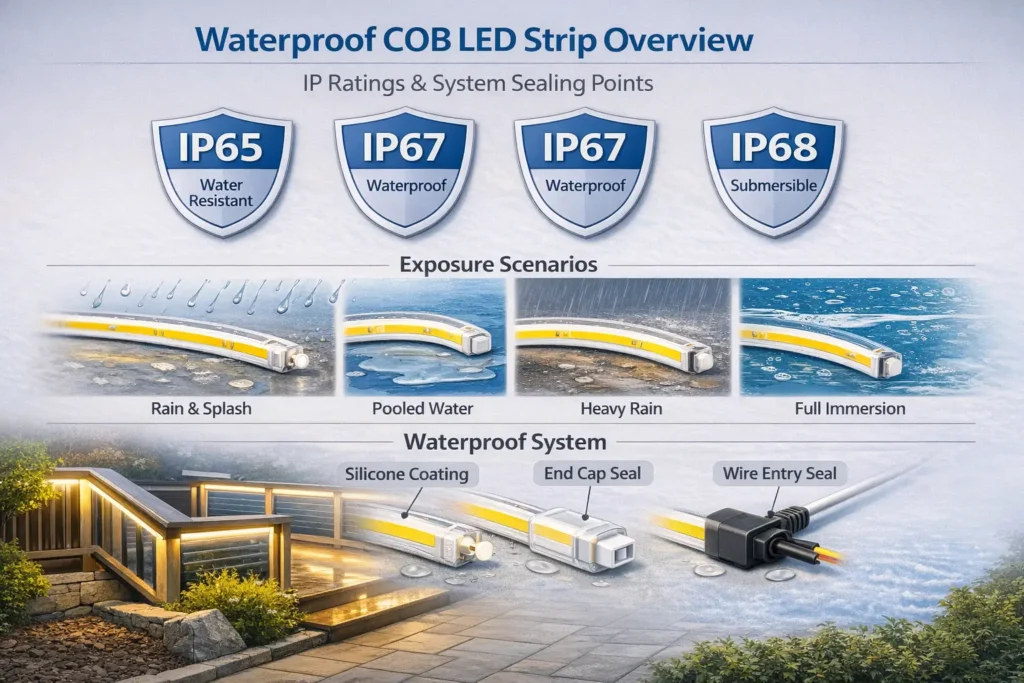
IP ratings describe degrees of protection against dust and water ingress for enclosures. IEC explains IP ratings as a classification developed under IEC 60529. (https://www.iec.ch/ip-ratings)
For linear strip systems, the practical failure point outdoors is often not the strip body, but the ends and connector interfaces. Your purchase spec should describe not just “IP65,” but how IP integrity is achieved at terminations and joints.
Boundary conditions:
Waterproofing checklist (ends/connectors focus):
A 230V COB strip is typically in the scope of EU electrical safety expectations for equipment within the Low Voltage Directive voltage range. The European Commission’s LVD overview explains the directive aims to ensure a high level of protection for electrical equipment within certain voltage limits. (https://single-market-economy.ec.europa.eu/sectors/electrical-and-electronic-engineering-industries-eei/low-voltage-directive-lvd_en)
This guide is not a legal checklist, but your project specification should clearly state safety boundaries and verification expectations:
Safety boundary statement:
Risk-control checklist (project language, non-jurisdictional):
This section is about reducing early failures and maintenance headaches. For many projects, survivability is driven by mechanical and serviceability decisions more than by the headline features of the strip.
Aluminum profiles/channels can reduce risk because they:
“Depends on” conditions to call out in your spec:
Even if 230V systems are marketed for long runs, planning still matters:
Planning steps (project-ready):
The fastest way to reduce project risk is to treat 230V COB strips as a documented system, not as a generic commodity item. Your purchase process should demand model-scoped documentation and a verification plan.
Request these items before placing a PO:
Confirm these items (in writing, by model/series):
Optional procurement table (useful for internal approvals):
If you want a faster approval loop, prepare a one-page “project input sheet” and share it with the supplier: application (indoor/outdoor), total run lengths, mounting method (profile vs direct), dimming/control plan, and target IP. Ask for a model-scoped confirmation pack (datasheet + wiring + installation guide + accessory set) before ordering.
This section is a diagnostic shortcut for project teams. It is not a substitute for qualified mains-voltage practice. If a safety hazard is suspected, stop and follow local procedures.
If you take only three actions from this guide:
Project-ready next steps checklist:
For projects with outdoor exposure, dimming-critical requirements, or long concealed runs, it’s worth doing a quick pre-order spec review: share environment, run lengths, mounting method, and control plan, then request a model-scoped confirmation pack and sample-test guidance before committing to volume.
Back to top
لن يتم نشر عنوان بريدك الإلكتروني. الحقول الإلزامية مشار إليها بـ *
التعليق *
الاسم *
البريد الإلكتروني *
الموقع الإلكتروني



 English
  Spanish
  French
  Arabic