Usually, LED strip lights do not make an electric bill high by themselves. The real cost depends on the strip’s watts per meter, total length, daily runtime, brightness setting, and your local electricity rate. A short strip used a few hours per day may add only a small amount, while long commercial runs used for many hours can become more noticeable. The best way to estimate the cost is simple: Total watts → daily kWh → monthly cost
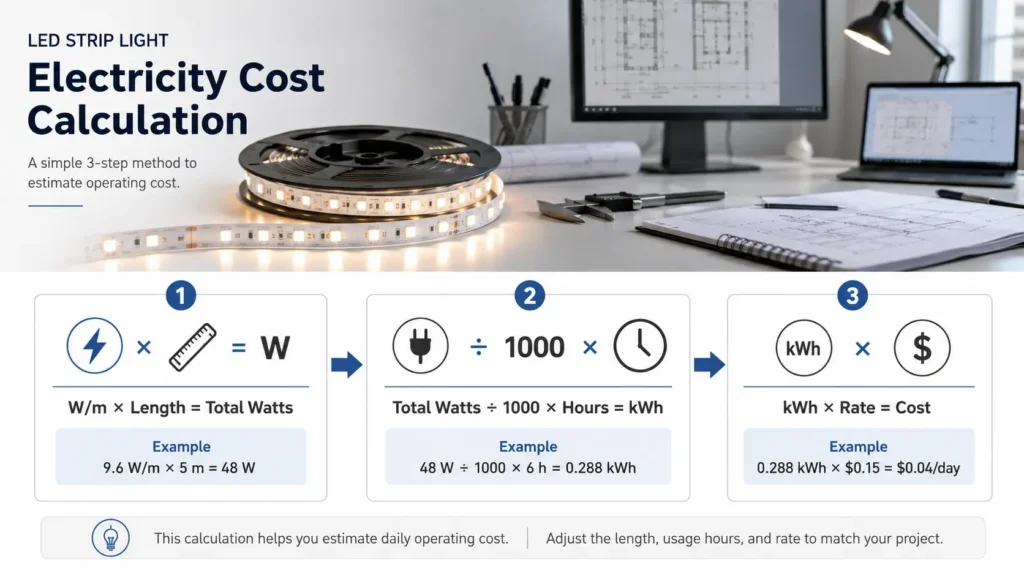
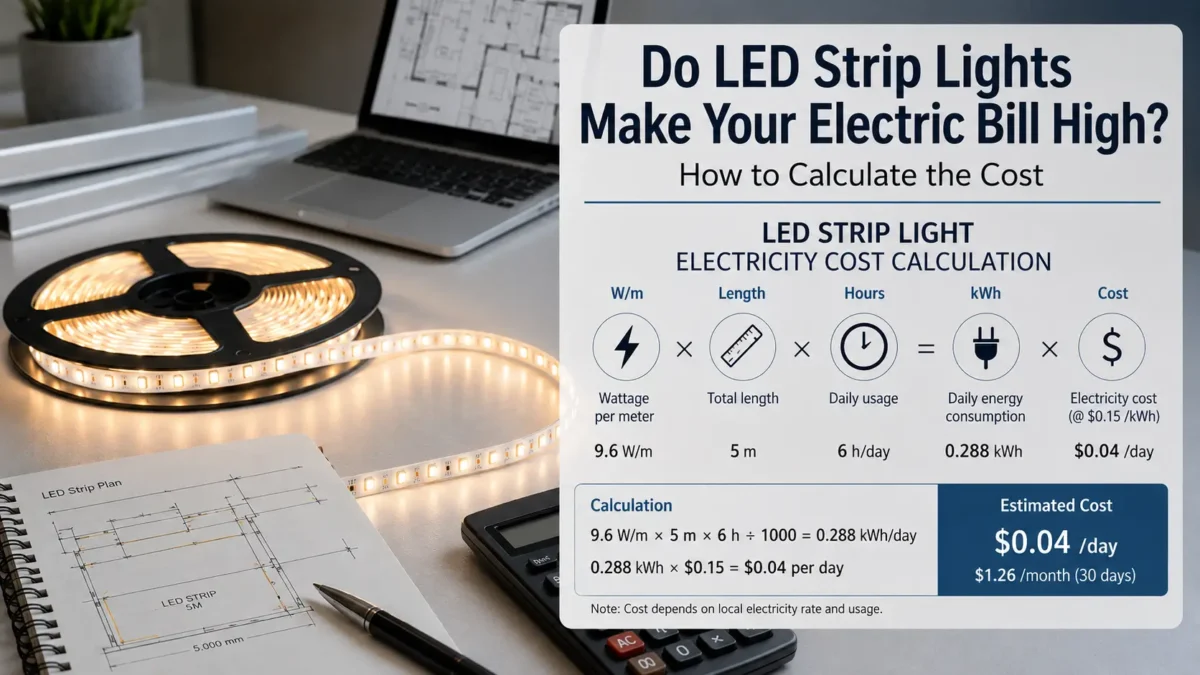
To estimate LED strip light cost, start with the power rating of the strip. Many LED strip lights list power as watts per meter, often written as W/m. Once you know the W/m and total length, you can estimate the load.
Watts per meter × total strip length = total wattsExample:
10 W/m × 5 m = 50 WThat means the strip uses about 50 watts when running at the assumed power level.
Electricity bills are usually based on kilowatt-hours, or kWh. The U.S. Department of Energy uses the formula wattage × hours used per day ÷ 1000 = daily kWh for estimating daily energy use.
Total watts ÷ 1000 × hours used per day = daily kWhExample:
50 W ÷ 1000 × 4 hours = 0.2 kWh per dayDaily kWh × days per month × electricity rate = monthly costExample using the EIA February 2026 U.S. total residential average of 17.65 cents/kWh as a calculation sample. Replace this with the rate on your own electricity bill:
0.2 kWh × 30 days × $0.1765 = $1.06 per monthThis is only an example. Electricity prices vary by state, utility, and customer type, so use your own rate for the most accurate estimate.
The cost of a 5m LED strip depends on the strip’s wattage. A 5m strip rated at 4.8 W/m will use much less electricity than a 5m strip rated at 14.4 W/m. The table below uses the EIA February 2026 U.S. total residential average of 17.65 cents/kWh as a calculation sample. It is for calculation practice only; actual rates vary by location, utility, and customer type. These are not Elstar product specifications.
| Example Strip Setup | Total Watts | Runtime | Monthly kWh | Estimated Monthly Cost |
|---|---|---|---|---|
| 5m strip at 4.8 W/m | 24 W | 4 hours/day | 2.88 kWh | $0.51 |
| 5m strip at 10 W/m | 50 W | 4 hours/day | 6.00 kWh | $1.06 |
| 5m strip at 14.4 W/m | 72 W | 4 hours/day | 8.64 kWh | $1.52 |
| 5m strip at 10 W/m | 50 W | 12 hours/day | 18.00 kWh | $3.18 |
| 5m strip at 10 W/m | 50 W | 24 hours/day | 36.00 kWh | $6.35 |
The pattern is clear: runtime matters a lot. The same strip used for 4 hours per day costs much less than one left on all day.
LED strip lights do not all use the same amount of power. Before judging whether they will affect your bill, check these factors.
| العامل | Why It Matters |
|---|---|
| واط لكل متر | A higher W/m strip uses more power for the same length. |
| Total length | Longer runs multiply the total wattage. |
| Runtime | A low-watt strip can still use noticeable energy if it runs all day. |
| Brightness setting | Dimming can reduce power use, depending on the controller and setup. |
| LED density and strip type | Dense, bright, RGBW, or high-output strips may draw more power than basic decorative strips. |
| Power supply and control setup | Poor planning can affect system performance, especially with long runs. |
| Electricity rate | The same kWh use costs more in areas with higher electricity prices. |
For most users, the biggest mistake is looking only at the strip length. A 10m strip can be low or high power depending on W/m. Always check both.
LED strip lights are often low-cost for short decorative use, but cost can become more noticeable in larger or long-hour installations. Use this table as a planning example. It uses the same EIA February 2026 residential average of 17.65 cents/kWh and does not represent a guaranteed bill amount.
| Scenario | Example Setup | Runtime | Estimated Monthly Cost | Cost Risk |
|---|---|---|---|---|
| Bedroom accent lighting | 5m × 4.8 W/m | 3 hours/day | $0.38 | Low |
| Kitchen or shelf lighting | 5m × 10 W/m | 4 hours/day | $1.06 | Low |
| Retail shelf lighting | 20m × 10 W/m | 10 hours/day | $10.59 | Moderate |
| Long commercial display | 30m × 14.4 W/m | 12 hours/day | $27.45 | أعلى |
| Long-hour signage-style use | 50m × 14.4 W/m | 12 hours/day | $45.75 | أعلى |
The main takeaway: LED strips do not usually become expensive because they are LED strips. They become more expensive when the installation is long, bright, and used for many hours. For commercial projects, the monthly cost is only one part of the planning. You also need to check total load, voltage, power supply capacity, controller compatibility, and possible voltage drop.
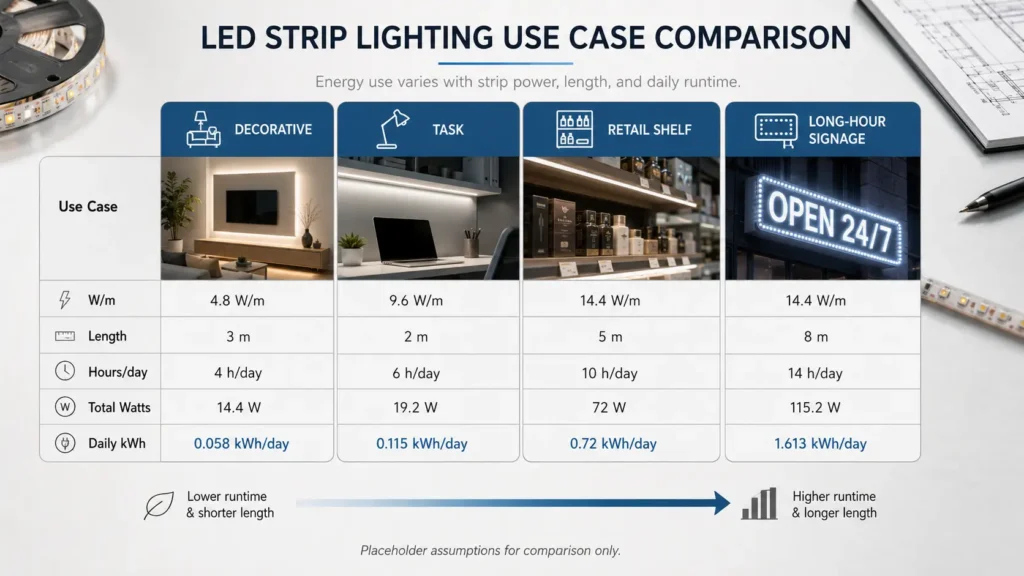
LED lighting is generally more energy-efficient than incandescent lighting. ENERGY STAR says LED lighting products produce light up to 90% more efficiently than incandescent light bulbs. That does not mean every LED strip installation automatically saves a fixed percentage on the electric bill. The result depends on what the strip replaces, how bright it is, how long it runs, and how the system is controlled. A safer way to think about it:
So the right question is not only, “Are LED strips efficient?” It is also, “How many watts will this project use, and how many hours will it run?”
If you are buying LED strips for a home, retail display, cabinet project, signage feature, hospitality space, or OEM product, collect the basic project details before choosing a strip.
| Spec to Check | Why It Matters |
|---|---|
| Total strip length | Determines total wattage and possible voltage-drop risk. |
| واط لكل متر | The core number for energy and power supply calculation. |
| الفولتية | The strip and power supply must match voltage. |
| Runtime per day | Affects monthly electricity cost. |
| Brightness target | Higher brightness usually requires higher output. |
| Color type | Single-color, CCT, RGB, RGBW, and digital strips can have different power behavior. |
| Dimming/control needs | Controls affect how the system is operated day to day. |
| Installation environment | Indoor, outdoor, enclosed, and heat-sensitive spaces need different planning. |
| Quantity and layout | Multi-zone or long-run layouts need better load planning. |
For a small decorative installation, a quick calculation may be enough. For a long commercial project, send the length, W/m target, voltage, runtime, and layout before ordering so the system can be planned properly.
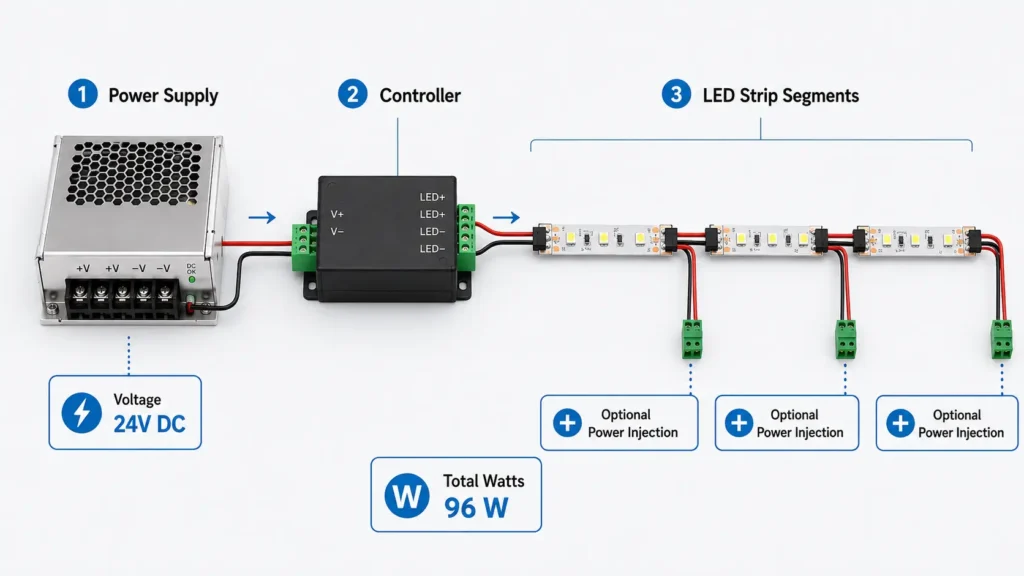
Electricity cost and power supply planning are connected. Once you know the total watts, you can estimate running cost and select a suitable power system. Elstar’s LED strip category page explains that LED strip wattage may be shown as watts per meter, watts per foot, or watts per LED, and that total power draw can be calculated by multiplying wattage per meter by total strip length. Elstar’s power-supply guide also uses W/m × length to calculate strip power and links power planning to voltage and power supply capacity.
| Planning Item | What to Check |
|---|---|
| Strip voltage | Confirm whether the strip is 5V, 12V, 24V, or another rated voltage. |
| Total watts | Multiply W/m by total length. |
| Power supply capacity | Use a supply sized for the load with appropriate headroom. |
| Controller rating | Make sure the controller can handle the load and channel type. |
| Long-run layout | Long runs may need parallel feeds or power injection. |
| Voltage drop | Longer distances can cause dimming at the far end if not planned. |
| Wire distance and gauge | Longer cable runs need careful planning to reduce voltage loss. |
Avoid choosing a power supply based only on strip length. Two 5m strips can require very different power supplies if their W/m ratings are different.
Usually, not by themselves. A short LED strip used a few hours per day often adds only a small amount to the bill. The cost rises when the strip is longer, higher wattage, brighter, or used for many hours each day.
Check the strip’s watts per meter. Multiply that number by the total length to estimate total watts. For example, a 5m strip rated at 10 W/m uses about 50 W under the stated assumption.
Use this formula: watts per meter × length = total watts; total watts ÷ 1000 × hours used = kWh; kWh × electricity rate = cost. Use your actual utility rate for the most accurate result.
It depends on the W/m rating and runtime. As a simple example, a 5m strip rated at 10 W/m uses 50 W. If it runs 4 hours per day at $0.1765/kWh, it would cost about $1.06 per month. This is a sample calculation, not a fixed product cost.
It can be more expensive than short use because runtime multiplies energy consumption. A strip used 12 hours per night will use three times as much energy as the same strip used 4 hours per day. For overnight use, calculate the monthly kWh before deciding.
It depends on the product design, brightness level, controller setting, and which channels are active. Do not assume all RGB strips use the same power. Check the product’s rated wattage and calculate from that number.
The biggest factors are watts per meter, total length, daily runtime, brightness setting, and electricity rate. In larger projects, voltage, driver capacity, controller rating, and long-run layout also matter.
Check total length, W/m, voltage, runtime, brightness target, color type, dimming/control needs, installation environment, and power supply requirements. For commercial or custom layouts, prepare these details before asking for a recommendation or quote.
For a small project, you can estimate running cost with the formula above. For longer runs, commercial lighting, shelf lighting, signage-style layouts, or multi-zone projects, prepare the project details before choosing a strip. Send these details for review:
With those details, Elstar can help review the load, strip selection, and power planning direction without relying on guesswork.


 English
  Spanish
  French
  Arabic