If you are sourcing LED strips for wholesale, OEM, private-label, or project use, the first decision is not only which strip to buy. You also need to know whether the supplier can understand your application, review the right specifications, clarify documents, and discuss commercial terms before quotation.
This guide helps you prepare that supplier conversation before you request pricing, samples, or bulk-order details.
Choose an LED strip manufacturer by matching your application with the supplier’s product range, specification support, customization review, document readiness, and RFQ communication. Prepare the installation environment, voltage, run length, color requirements, IP needs, control method, quantity, destination, packaging, and required documents before asking for a quote.
A useful shortlist should not be based on price alone. It should show whether the manufacturer can understand your use case, recommend the right strip type, clarify technical risks, and explain what must be confirmed before sampling or bulk production.
Review ELSTARLED’s LED strip manufacturer context before preparing your RFQ.
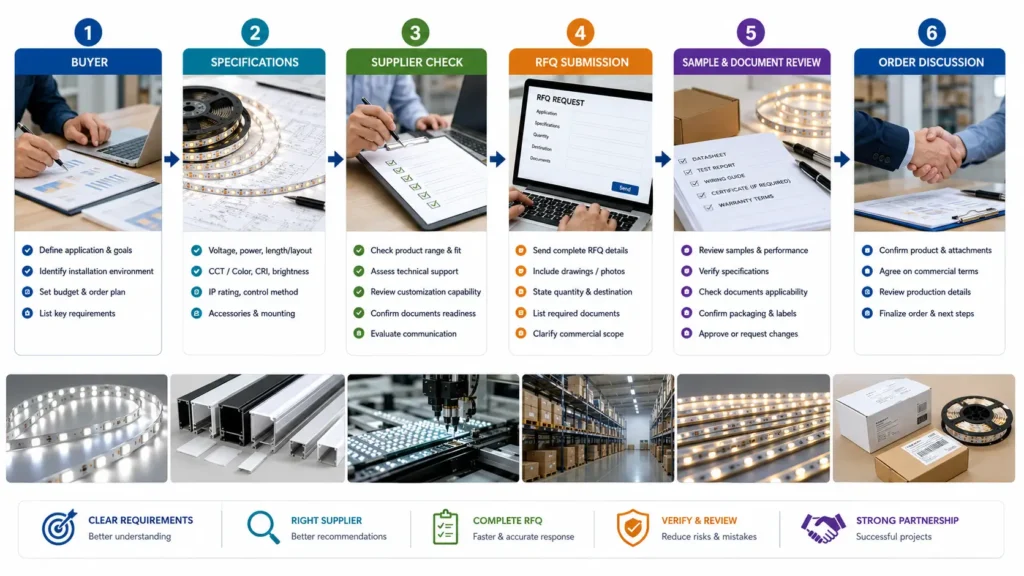
A low price can become expensive if the LED strip does not fit the application. Before comparing suppliers, define the lighting task and the operating conditions. A cove lighting project, display shelf, signage project, wet-area installation, architectural line, OEM kit, and private-label order may all need different specifications.
| Requirement | What to Clarify Before RFQ |
|---|---|
| التطبيق | Is the strip for accent lighting, task lighting, signage, cabinet lighting, architectural lines, retail display, or OEM integration? |
| Installation environment | Indoor dry, damp, outdoor, enclosed channel, exposed surface, high-touch area, or heat-sensitive location? |
| Run length | How long is each continuous run, and where can power be injected? |
| Mounting method | Adhesive backing, aluminum profile, clip, channel, or custom housing? |
| Lighting effect | Dot-free line, high brightness, soft ambient light, color-changing effect, or tunable white? |
| Control method | Single-color dimming, RGB/RGBW control, addressable control, sensor, or smart-control integration? |
| Quantity and repeat order | Prototype, project batch, wholesale stock, or repeat OEM program? |
| Documentation | Datasheets, wiring guidance, test data, applicable certificates, labels, packaging details, or warranty terms? |
Specification alone does not guarantee the right result. The same strip can behave differently depending on layout, power supply selection, mounting surface, heat conditions, controller compatibility, and installation quality. For general LED context, ENERGY STAR explains LED heat and lumen depreciation, which is why thermal conditions and lifetime wording should be reviewed carefully.
A manufacturer conversation becomes more productive when you know which product family is likely to fit the project. You do not need to finalize every specification before contacting the supplier, but you should know the application goal well enough to avoid vague RFQs such as “send your best LED strip price.”
ELSTARLED’s public product navigation lists LED strip categories such as 3528, 5050, 2835, 5730, 3014, 2216, RGB/RGBW, addressable, and COB LED strips. Treat this product range as a starting point for discussion, not a guarantee that every option applies to every order condition. View the LED strip lights category.
| Buyer Need | Product Direction to Discuss | Specs to Confirm | Common Risk If Unclear |
|---|---|---|---|
| Smooth linear light | COB strip or neon-style strip may be considered | Dot-free appearance, CCT, brightness, profile/channel, voltage, run length | Visible LED dots, uneven brightness, wrong diffuser/profile match |
| High-output task or display lighting | Higher-density or higher-output strip may be considered | Wattage per meter, lumen target, heat dissipation, mounting surface | Heat buildup, glare, wrong power supply |
| Color-changing commercial display | RGB, RGBW, or addressable strip may be considered | Control system, pixel/control requirement, voltage, wiring plan | Controller mismatch, color inconsistency, installation complexity |
| Outdoor or damp-area use | Waterproof or sealed strip may be considered | IP requirement, sealing method, end treatment, mounting environment | Moisture ingress, poor adhesion, difficult maintenance |
| OEM/private-label kit | Custom strip or assembly path may be needed | PCB size, cut length, connector, label, packaging, accessory kit | Rework after sample, unclear packaging, wrong connector/accessory |
| Long-run project | Voltage, power injection, and layout need early review | Run length, voltage, power supply location, dimming/control method | Voltage drop, uneven brightness, overloaded system |
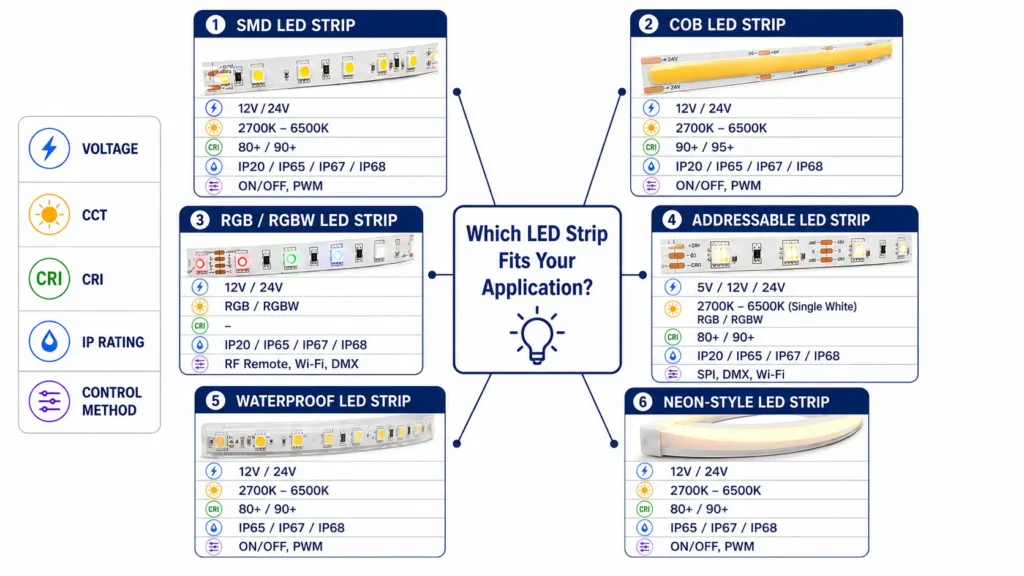
Ask the manufacturer to help confirm input voltage, wattage per meter, lumen target, CCT or color requirement, CRI requirement, IP rating, LED density, cut interval, PCB width, run length, power injection plan, dimming or control method, accessory requirements, and installation environment.
For brightness discussions, use lumens or a clear visual target rather than only watts. The U.S. Department of Energy explains lumens as a measure of light output. For lifetime discussions, use careful wording because LED lifetime is often tied to lumen depreciation, thermal management, and system conditions rather than a simple “burnout” event.
A product page can show what a supplier sells. A manufacturer evaluation should show whether the supplier can help you make the right decision for your project, order model, and market requirements.
Use the matrix below to compare manufacturers before requesting samples or bulk pricing. You can also review LED strip manufacturer options as commercial context.
| Evaluation Area | What to Compare | What to Ask | Evidence or Response to Request |
|---|---|---|---|
| Product range | Does the supplier offer product families close to your application? | Which strip type would you recommend for this application and why? | Product page, datasheet, sample option, specification sheet |
| Specification support | Can the supplier discuss voltage, output, CCT, CRI, IP rating, control, and run length clearly? | What specs should be confirmed before quoting? | Spec recommendation, wiring guidance, installation notes |
| Custom/OEM support | Can the supplier review custom length, PCB, connector, packaging, or label requirements? | Which requirements can be customized and which need tooling or validation? | Custom requirement checklist, sample process, drawing/spec review |
| Quality questions | Can the supplier explain process checks without vague promises? | What inspections or tests apply to this product type? | Process overview, testing notes, inspection points |
| Documentation | Can the supplier identify applicable documents for your target market? | Which datasheets, certificates, reports, or warranty terms are available for this exact item? | Applicable documents only; do not assume all documents apply |
| Commercial fit | Can the supplier clarify quotation scope and order conditions? | What affects price, MOQ, sample discussion, lead time, packaging, and shipping terms? | Written quote scope and commercial terms |
| Communication | Does the supplier ask useful questions before quoting? | What information do you need from us before recommendation? | Clear follow-up questions, project-specific response |
Do not treat broad claims as proof. Ask for documents, specifications, samples, or written confirmation that match the exact product and order conditions.
Custom LED strip projects need more than a product name. They usually require a discussion of application, electrical design, mechanical fit, packaging, labeling, accessory matching, and validation before bulk production.
ELSTARLED’s public product pages mention customization topics such as strip size, brightness, CRI, CCT, IP rating, and related accessories. Use those topics as prompts for project discussion rather than assuming every option applies to every product or order. Discuss a custom LED strip project.
| Step | Buyer Action | Manufacturer Discussion |
|---|---|---|
| 1. Requirement review | Share application, drawing, installation condition, and expected lighting effect | Confirm whether a standard product, modified product, or custom path is suitable |
| 2. Specification check | Define voltage, length, width, brightness, color, IP rating, control, and accessory needs | Check technical feasibility and required adjustments |
| 3. Sample or prototype discussion | Ask what can be sampled and what must be confirmed first | Clarify sample scope, limitations, and approval criteria |
| 4. Document review | Request datasheets, wiring notes, labels, and applicable documents | Confirm what documents apply to the exact product and market |
| 5. Bulk-order discussion | Provide quantity, destination, packaging, schedule expectations, and commercial terms | Confirm quote scope, production discussion, shipment terms, and next steps |
For private-label or distributor programs, also prepare packaging expectations, label requirements, SKU logic, accessory kits, and target-market document needs.
A strong RFQ helps the supplier understand the project quickly. It also reduces back-and-forth caused by missing details.
Do not send only a product name and quantity. Send the application, technical details, commercial context, and document requirements together. When ready, send your LED strip RFQ.
| RFQ Field | What to Send |
|---|---|
| التطبيق | Where and how the strip will be used |
| Installation environment | Indoor, outdoor, damp, enclosed, exposed, high-temperature area, or other condition |
| Strip type | SMD, COB, neon-style, RGB/RGBW, addressable, waterproof, rigid, or unsure |
| الفولتية | Preferred voltage or system requirement |
| Length and layout | Total length, run length, cut points, installation drawing if available |
| Brightness target | Lumen target, wattage preference, or reference sample |
| CCT/color | Warm white, neutral white, cool white, RGB, RGBW, tunable white, or custom color need |
| CRI target | Color-rendering requirement if important for the project |
| IP rating | Required protection level or installation condition |
| Control method | Dimmer, controller, sensor, DMX, SPI, app control, or other system |
| الإكسسوارات | Power supply, connector, controller, aluminum profile, diffuser, cable, mounting parts |
| التخصيص | PCB width, cut length, connector, label, logo, packaging, color, IP treatment |
| Quantity | Sample quantity, trial order, project quantity, or repeat-order forecast |
| Destination | Country/region, shipping destination, and delivery constraints if any |
| Packaging | Bulk pack, retail pack, private-label packaging, barcode, label, manual |
| Documents | Datasheet, wiring guide, test data, applicable certificates, warranty terms, label requirements |
| Timeline expectation | Desired schedule for discussion, sample, or order planning, without assuming it is guaranteed |
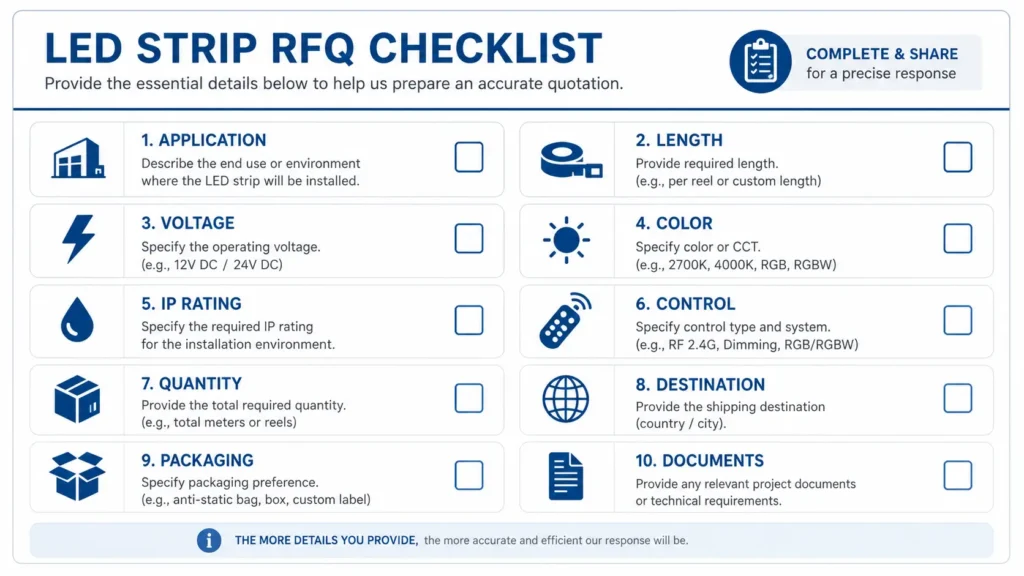
If you do not know every technical value, state the goal. For example:
A manufacturer can usually respond better when they understand the installation and approval process, not only the strip model.
| Commercial Item | What to Confirm |
|---|---|
| Quantity | Sample, trial order, batch order, or repeat order |
| Destination | Delivery country/region |
| Packaging | Bulk, project, distributor, or private-label packaging |
| Documents | Documents required before sample, order, or import |
| Quote scope | Product only, accessories included, packaging included, or full kit |
| Incoterms | Ask what terms can be quoted |
| Payment terms | Confirm directly with supplier |
| Sample process | Ask what sample options apply |
| Lead time | Confirm based on product, quantity, customization, and schedule |
| Warranty terms | Request written terms for the exact product and order |
Do not assume commercial terms. MOQ, sample availability, lead time, shipping method, and warranty terms can depend on product type, customization, quantity, destination, and documentation requirements.
Documentation is part of supplier evaluation. It is especially important for importers, distributors, contractors, OEM buyers, and projects with approval requirements.
Ask for documents that apply to the exact product, market, and order. Do not assume every certificate, report, or warranty term applies to every LED strip.
| Document or Information | Why It Matters | Safe Question to Ask |
|---|---|---|
| Product datasheet | Confirms electrical and optical specs | Can you provide the datasheet for this exact strip? |
| Installation or wiring guide | Helps avoid layout and connection mistakes | What wiring or installation notes should our installer follow? |
| Power supply recommendation | Helps match strip load and system design | What power supply capacity and layout should be reviewed? |
| Control compatibility | Prevents dimmer/controller mismatch | Which controller or dimming method is compatible? |
| IP rating information | Helps match product to environment | Which IP option applies to this installation condition? |
| Test data, if applicable | Supports internal approval | What test data is available for this product? |
| Certificates, if required | Supports market or project compliance review | Which certificates apply to this exact product and destination market? |
| Warranty terms | Clarifies commercial responsibility | What written warranty terms apply to this product/order? |
| Packaging and label details | Supports distributor/import needs | What packaging, label, or barcode options can be discussed? |
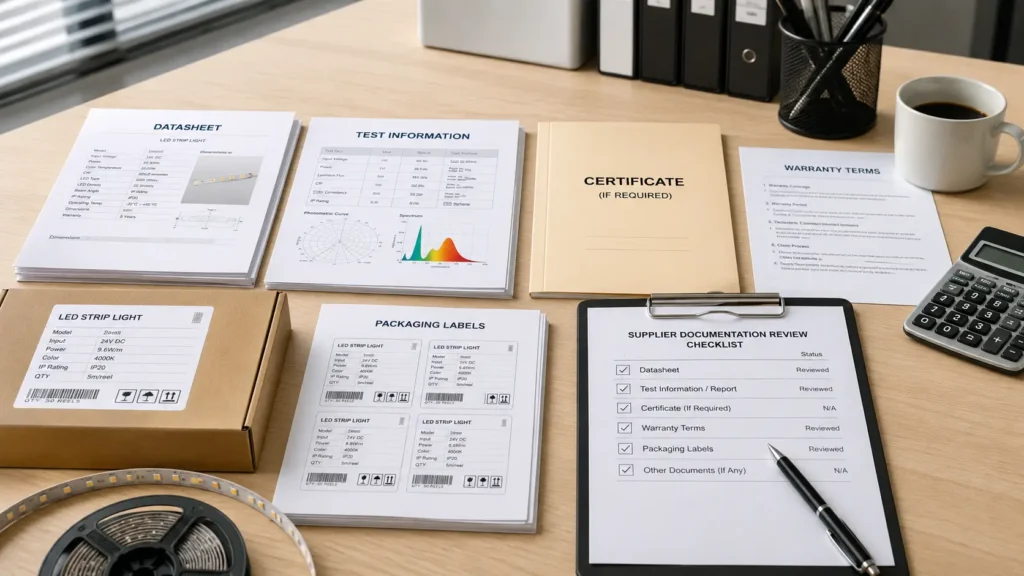
ELSTARLED’s public production page describes production and inspection topics that buyers can use as a starting point for questions. This is not a replacement for project-specific proof or written approval documents. Review the production and testing process.
If your project has strict approval requirements, request written documents before final order discussion.
Before sample approval or bulk production, confirm the commercial terms in writing. This prevents misunderstandings about what is included in the quote.
| Term | What to Confirm |
|---|---|
| Product scope | Exact strip model, specs, accessory list, and customization requirements |
| Quantity | Sample quantity, trial order quantity, bulk quantity, and repeat-order plan |
| MOQ | Whether an MOQ applies to the selected product or customization |
| Sample | Sample availability, sample scope, and what is included |
| Lead time | Estimated schedule based on product, quantity, and customization |
| Packaging | Standard packaging, bulk packaging, or private-label requirements |
| Documents | Datasheets, applicable certificates, test information, labels, warranty terms |
| Shipping terms | Destination, Incoterms, freight method, and quote scope |
| Payment terms | Terms to be confirmed directly with supplier |
| Approval process | Who approves samples, documents, packaging, and final order details |
A clear RFQ does not guarantee a specific price or schedule, but it helps both sides identify what must be reviewed before a formal quotation.
Contact ELSTARLED when you have enough project information for a useful supplier discussion. You do not need a finished engineering package, but you should provide the application, installation environment, strip type or lighting effect, voltage, run layout, CCT/color, CRI target, IP requirement, control method, quantity, destination, packaging needs, and any required documents.
Share drawings, photos, packaging requirements, or reference samples if available so the product and quotation scope can be reviewed more clearly.
Choose an LED strip manufacturer by comparing product range, specification support, application understanding, customization review, document readiness, sample discussion, and communication quality. Avoid choosing on price alone unless the product scope, required documents, and commercial terms are clear.
Include the application, installation environment, strip type, voltage, run length, color requirement, brightness target, CRI target, IP rating, control method, quantity, destination, packaging needs, and required documents. Add drawings or photos when possible.
Confirm voltage, wattage per meter, lumen or brightness target, CCT, CRI, IP rating, cut interval, LED density, run length, dimming or control method, and installation environment. If you are not sure, describe the application and ask the manufacturer what must be checked.
Ask for documents that apply to the exact product and destination market. These may include datasheets, wiring or installation information, applicable certificates, test information, warranty terms, packaging labels, and other approval documents required by your buyer or project.
Choose based on the lighting effect and installation condition. COB or neon-style options may be discussed for smoother linear light. RGB/RGBW or addressable strips may be discussed for color-changing effects. Waterproof options may be needed for damp or outdoor conditions. Confirm the final product type with the manufacturer before quotation.
Longer runs and layout choices can affect brightness consistency and system design. Ask the manufacturer to review voltage, run length, power injection, power supply location, and control method before finalizing the strip.
Custom discussions may involve strip length, PCB width, connector, label, packaging, color, brightness, IP treatment, and accessory matching. Ask which custom options apply to your product, quantity, and approval process before assuming availability.
Ask what specifications the sample represents, what documents are available, what tests or inspections apply, how packaging will be handled, what commercial terms apply, and what must be approved before bulk production.

 English
  Spanish
  French
  Arabic